

Inspection Errors Are Costly: How AR for Inspection Eliminates Them
Visual inspection errors are the main source of losses in manufacturing. Even an experienced inspector can miss a defect due to fatigue, rush, or ambiguous instructions.
The cost of such a mistake quickly grows: defective products move further down the chain, forcing rework, line stoppages, and sometimes — answering to a client for a substandard shipment.
Quality control is often built on personal experience and the "eye" of a specific person. When standards exist only in the head of the most experienced master, every new employee starts from scratch, and inspection results depend on mood and attentiveness. A missed defect is discovered too late — when fixing it costs many times more than a timely check.
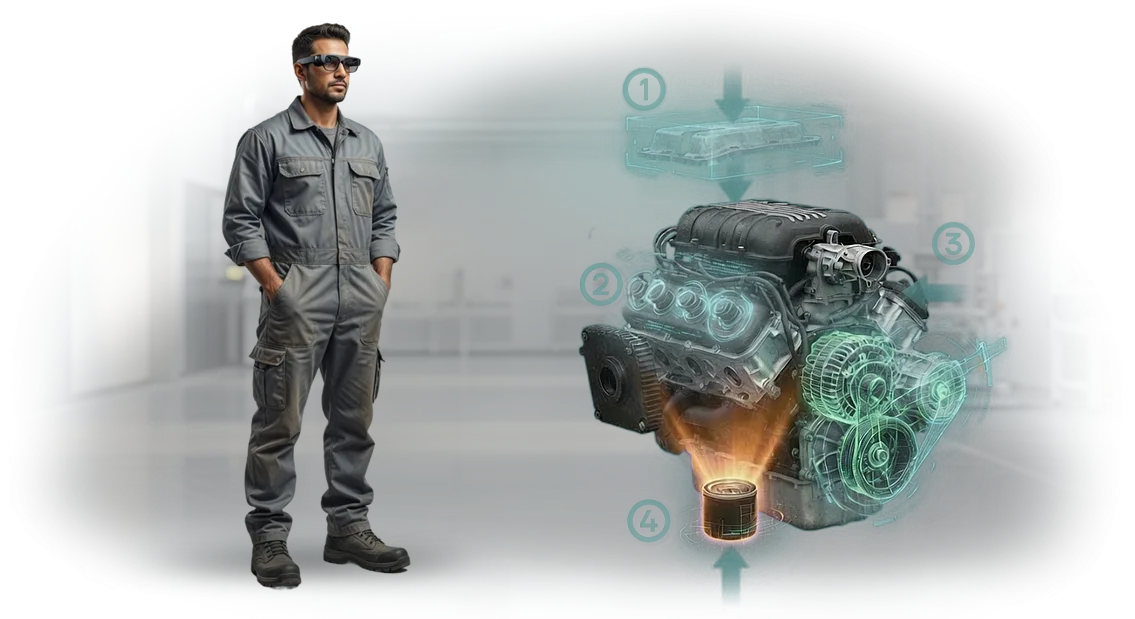
AR for inspection removes this uncertainty. The system shows directly on the real object which zones need to be inspected, which deviations are acceptable, and which require a stop.
The employee sees control points and a step-by-step scenario without being distracted by paper checklists or relying on memory. The result is recorded automatically — every inspection is performed the same way, regardless of shift or specialist experience.
This is exactly the kind of quality inspection we design for industrial equipment: we overlay digital control scenarios onto physical objects, integrate them with your processes, and ensure inspection errors are eliminated at the examination stage itself.
You get predictable inspection quality, fewer losses, and confidence that a defect won't reach the client.
What You Get from Implementing Interactive Inspection
Implementing interactive inspection directly reduces losses from defects. Instead of eliminating defects after the fact, you gain the ability to detect a deviation at an early stage — when correction costs a fraction of what late-stage rework would.
Inspection accuracy increases because the employee sees not an abstract drawing but a step-by-step prompt directly on the equipment, making it nearly impossible to miss a nonconformity.
Inspection speed increases many times over: the specialist doesn't waste time searching for the right documentation section or deciphering complex schematics. Everything needed appears before their eyes exactly when required.
As a result, more inspections are completed per shift, downtime shrinks, and the production rhythm stays steady. For a manager, this means higher output volume without hiring additional staff or increasing the load on the existing team.
Improved inspection accuracy also delivers a long-term effect: fewer customer complaints, fewer quality disputes, and a more stable supplier reputation.
Interactive inspection standardizes the actions of all employees — an experienced engineer and a newcomer follow the same logic with equally high results. This simplifies training and makes quality less dependent on the human factor.
We implement such solutions for the specific needs of your production. You get not just a tool but a manageable control process where every step is recorded and the result is easy to verify.
Savings on defects and rework costs quickly offset the investment, and further operations proceed with lower risks and a more predictable cost structure.
AR Formats for Inspection to Match Your Needs
Equipment inspection typically involves paper regulations, the engineer's personal experience, and time spent finding the right instruction item. A mistake during such an inspection is expensive: an undetected defect later turns into a line stoppage or unscheduled repair.
AR inspection changes the process: the employee sees prompts directly on the equipment and follows the inspection step by step without getting distracted by documents.
We offer two AR formats for inspection so you can choose based on your timeline, budget, and scale. The table shows who each option suits and what results it delivers.
AR Implementation Options for Inspection
| Format | Who it's for | What it gives the client |
|---|---|---|
| Quick start — standard AR scenarios | Companies that want to test the technology on one area or line before scaling | Visible effect in 2–4 weeks, minimal initial investment, clear ROI assessment before deployment to other workshops |
| Custom development — AR for your equipment | Production facilities with non-standard machinery, special safety regulations, or specific customer requirements | Instructions precisely mirror your processes, integrate with existing documentation, and are easily replicated across all sites |
In both cases, we work on professional equipment and proven tools — the result is stable, and employees quickly get used to the prompts. Tell us about your task in a short brief, and we'll propose an AR inspection format that addresses it with minimal risk.
How We'll Build Your Project: Step by Step
Before moving to the contract, here's how the project work unfolds. You always know what stage we're at, what you get as an output, and in how many weeks the instruction will be working on your site.
- Brief and technical specification — we dive into your task: what operations employees perform, where they most often make mistakes, what equipment needs to be covered. We set targets for error reduction and timelines.
- Equipment and process audit — our engineers visit the site or work with drawings and photos. We put together a plan of the components that will be reflected in the AR instruction.
- Instruction prototype creation — we build an interactive step sequence on a selected component. The prototype shows what the inspection will look like and allows adjusting the logic before full production.
- Full version development and content filling — we add all operations, components, and acceptable deviations. The instruction is adapted for the tablets and headsets already available at the facility, or we select a suitable device.
- Testing on real equipment — together with your specialists, we check the inspection scenarios on the shop floor and make corrections. At this stage, the actual minutes per inspection item become clear.
- Employee training and launch — we hand over the instructions to the operations department, run short training sessions, and provide a usage reference card. After launch, we stay in touch: we fix feedback, add new components, and help with updates.
These steps make it possible to launch the project without missed deadlines and with a predictable result: you get a clear inspection tool, not "technology for technology's sake."
Delivery Scope: What's Included in the Project
The delivery scope includes a ready-made solution that works in production immediately — not separate files. You get a complete package: from the AR instruction itself to documents for regulatory checks and staff training.
- Ready-made AR instruction — an interactive step-by-step sequence for operations from scheduled maintenance to control inspection. The employee sees prompts directly on the equipment and doesn't waste time on paper regulations.
- Adaptation for tablets, smartphones, and rugged devices already available at the site. No need to purchase new equipment.
- Library of source materials and 3D models of components — useful for future instructions and training without new development.
- Documentation package: user manual, operation descriptions, content update procedure. Everything for internal control and work with supervisory authorities.
- Employee training: sessions for operators and administrators so the instruction is adopted from day one.
- Technical support after launch: we answer questions and help with updates during the agreed period.
- Project development plan: recommendations on which operations to digitize next and how to expand the library to other sites.
Each item in the package addresses a specific task: reducing onboarding time, lowering operator errors, and speeding up inspections. You get a documented, maintainable product that can be replicated across other workshops.
Example: How Our Client Reduced Defects by 40%
A large machine-building holding company supplying components into the Siemens chain faced growing defect rates at the finished-component inspection stage.
Inspectors checked every part against paper drawings, taking up to 45 minutes per item, and during shift changes and urgent orders, some deviations were simply missed. The plant was losing money on rework and reputation due to shipment delays.
We proposed replacing the paper checklist with AR inspection: an engineer points the tablet camera at the component, and the system highlights the zones to check in real time, shows the standard, and records the result.
The employee doesn't need to keep dozens of tolerances in mind — the solution itself prompts where to look for a deviation and automatically generates the inspection report.
What Changed After Launch
Three months after going live, the plant reduced its share of defective products by 40%.
Inspection time per component dropped from 45 to 12 minutes, and missed defects practically disappeared: even a new employee with minimal training delivers results at the level of an experienced inspector.
Production stopped halting due to rework, and the quality department gained transparent statistics for every equipment unit.
Why It Worked
The key factor was not AR itself but the embedded inspection scenario. We didn't just display a model over the part — we built the instruction logic into it: the order of checking components, acceptable deviation limits, and automatic status recording.
This removed the main source of defects — human attention, which fades at the end of a shift and during urgent orders.
The implementation paid for itself within six months through reduced rework losses.
We're now applying the same approach to the client's other lines and to projects in adjacent industries — where the price of an error is measured not in percentages but in the downtime of an entire workshop.
How to Choose the Right Format for Your Equipment?
Choosing an AR instruction format depends not on trends but on your task: what employees actually do with the equipment — inspect, maintain, repair, or train on it.
There is no universal solution, but there is a proven principle: the more accurately the format mirrors the real work step, the greater the benefit.
That's why we start not with technology but with an analysis of your process — what slows down work, where errors most often occur, and what information a specialist needs right on the spot.
Simply "putting on glasses and seeing a 3D model" isn't always what you need. For regular inspection, speed and accuracy matter more: the worker sees control points directly on the equipment housing without being distracted by drawings.
For training new employees, step-by-step scenarios with prompts and action verification work better. For complex repairs — animation of the internal structure with the problem component highlighted.
We match the format to the scenario, so the solution ends up simple for people and effective for your production.
Our selection is based on a short study: we break down a typical shift, talk to the people who work with their hands, and identify where time is lost.
Then we propose an option — for example, a checklist overlay for daily inspection or an interactive instruction for non-standard situations. We always test with your employees: it's important that a specialist without special training immediately understands what to do. After the test, we refine the details and only then scale to the entire equipment fleet.
You'll feel the result quickly: new employees reach full working mode in days rather than weeks, inspection errors drop, and experienced staff stop being the sole holders of knowledge. The instructions work on devices already available in the workshop — a tablet or smartphone. This doesn't require equipment replacement and fits into the normal work rhythm.
If you're unsure which format suits you best, we suggest starting with a pilot area: in a couple of weeks you'll see how the speed and quality of operations change, and then decide on scaling. This way, the choice becomes the result of measurement, not guesswork.
Common Concerns: Will It Really Not Break Down?
Any new technology raises questions: "how will it behave on a real shop floor, who will maintain it, what if it lets us down in the middle of a shift?" These are normal concerns. Below are answers to the most common ones, so you understand what we take on ourselves.
What if the equipment operates in a dusty workshop or in freezing temperatures?
We use rugged devices proven in real operating conditions. If a device does fail, a replacement is provided within the working day, and instruction data is stored in a protected environment.
What happens if an AR instruction contains an error or becomes outdated?
Instructions are created based on current technical documentation and approved with your engineers before launch. If a regulation changes, we update the content remotely — old versions won't interfere with operations.
Will an employee be able to use AR without training?
The interface is built as step-by-step on-screen prompts displayed over the equipment. Typically, a short introductory briefing is enough — a person works the same way as with a paper instruction, but faster and without errors.
Who is responsible for support after implementation?
We stay on as support: we monitor stability, update content, and visit the site when needed. The contract specifies our response time to requests — you're never left alone with a problem.
How long will the launch take?
We start with a pilot area to show first results and metrics within a few weeks. Based on the pilot, we scale the solution to the remaining lines — so you see the value before full implementation.
Ready to Improve Inspection Accuracy? Leave a Request
Leave a request — and we'll prepare a preliminary solution for your task: show how AR instructions will integrate into your existing control process and estimate the effect for your site. The consultation is non-binding — you'll get concrete specifics, not general words.
After your inquiry, you'll receive:
- Express audit of the inspection process — we'll identify exactly where AR will save time and reduce errors, with priorities by area.
- Savings calculation — we'll show what each hour of downtime or rework due to an incorrect inspection costs and how AR will pay off in your numbers.
- Examples for your industry — we'll select cases similar to your equipment so you can see how it works in comparable conditions.
- Implementation roadmap — stages, timelines, and responsible parties: from pilot to full deployment without stopping production.
- Fixed cost estimate — we'll name the price before work starts, with no hidden extras or "surprises" along the way.
- Support guarantee — after launch, we stay in touch: update instructions, help with training, and accompany the first weeks of operation.
Fill out the form — we'll call you back within one business day, answer your questions, and prepare an individual proposal. Inspection accuracy is a measurable result, and we'll show you how to achieve it.