

AR inspection services: how to reduce downtime and defect losses
Losses from defects and downtime are not just the cost of rework. A production line stoppage drags down adjacent processes, delays shipment deadlines, and undermines customer trust.
Most often, a defect is noticed too late, after the part has already passed several stages, and fixing it costs many times more.
Quality control often works on a schedule or after the fact, and a person physically cannot keep attention on every assembly point under high load. A minor deviation quietly grows into expensive scrap, and the time to eliminate it is measured in hours of equipment downtime.
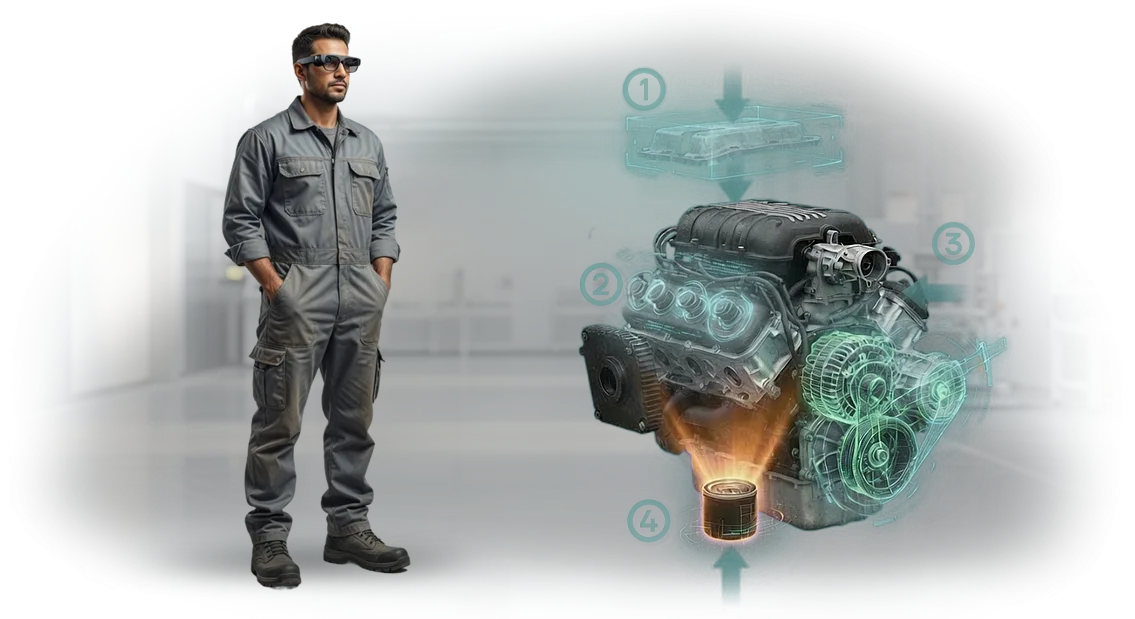
This is exactly where AR inspection services give a manager what traditional checks lack: a clear control scheme projected directly onto the equipment.
The operator sees in real time where the norm is and where the deviation is, and can stop the process at an early stage without waiting for the quality control department's acceptance.
The result is reduced downtime and defect rates, quality control without stopping the line, and no need to expand staff. Every saved hour of equipment operation means a completed order, lower costs, and preserved reputation with your customers.
We develop such services for the specific tasks of an enterprise, from a single section to a whole workshop. Our engineers configure the inspection logic to your production process so you get predictable quality without lengthy experiments or implementation downtime.
What augmented reality inspection delivers: 5 benefits
AR inspection speeds up equipment checks many times over. Instead of flipping through paper regulations and searching for the right item, an employee sees prompts directly on machine components: what to check, what parameters are acceptable, where the critical zones are.
This cuts inspection time from hours to minutes and allows equipment to be restarted faster after repairs or scheduled maintenance.
Inspection accuracy does not suffer — on the contrary, it improves. The system suggests the sequence of actions and records results, eliminating the human factor: whether a point was missed, whether the operator forgot to take a temperature measurement. Every check follows the same standard, so the risk of missing a defect decreases.
Staff training also becomes simpler and cheaper. A newcomer does not need weeks to study instructions and memorize hundreds of positions — AR prompts guide them step by step.
An experienced employee spends less time on mentoring, and the likelihood of errors at the start drops sharply. This is especially important when staff turnover is high.
Maintenance costs decrease. Fewer mistakes mean fewer unplanned stoppages and expensive repairs.
Plus, preparing for inspection itself takes minimal time: no need to print checklists, gather documents, or deal with reports — everything is recorded automatically and sent to the system.
Finally, payback. Implementing AR inspection usually pays for itself through reduced downtime and fewer failures. Savings on each assembly point add up to a tangible amount — customers see the effect after the first months of use. And because the solution scales to other workshops and lines, the benefit grows every year.
Inspection formats: from a one-time audit to continuous control
Every enterprise approaches inspection differently: some need a one-time check, some are ready for a pilot on one section, and some need continuous control. We offer four inspection formats, from a one-time audit to full integration into production processes.
| Format | For whom | What it provides |
|---|---|---|
| One-time audit | Quickly assess line condition | An objective picture in 1–2 days without major investment |
| Pilot project | Test the technology on one section | Real numbers on time and errors for scaling |
| Continuous operation | Regular checks to a single standard | Less human factor, full traceability |
| Turnkey integration | Embed AR into an existing system | A ready-made “employee — AR — report” scheme from day one |
Whichever format you choose, we start with an audit of current processes to select the best option. A local task — a pilot project will take a few weeks and deliver a measurable result.
If you are ready to change the process entirely, we design integration without stopping production: employees get clear instructions, managers get transparent statistics.
The format can be changed as you grow: many start with a one-time audit, then run a pilot, and then move to a permanent basis. Each stage becomes the foundation for the next without data loss or extra costs.
How an inspection solution is implemented in 6 steps
Implementation is structured so that you see results at early stages and can influence them without unnecessary costs. Each step ends with a clear outcome: a scenario, a prototype, a working template. Below is how we have built the process.
-
Brief and equipment audit — we record tasks, typical errors, and regulations. We study the machinery your employees will work with so the instructions fit the real workflow.
-
Scenario and prompt structure — we break the operation into steps, define control points and attention zones. The output is a document that is easy to approve with technologists.
-
Prototype on a real object — we build a short version of the instruction and test it on your equipment. This allows us to see bottlenecks early and clarify details.
-
Pilot on a section — we launch the solution among several operators and collect feedback. Based on the results, we adjust the scenario, interface, and prompt speed.
-
Full deployment and training — we connect the entire range of operations, integrate with your regulations, and train the team. Employees start using the instruction without interrupting their work.
-
Support and scaling — we stay in touch after launch: update scenarios, add new operations, and roll the solution out to other sites.
What is included in the inspection kit delivery
The delivery kit is a ready-made solution for launching inspection, not just an “app”. We have thought through everything so your team can start working within the first days, from installation to daily support. Below is what you receive.
- Inspection application — a working program installed on your tablets and smartphones. The operator sees step-by-step instructions on the screen, marks inspection results, and the system automatically stores the check history.
- Configuration for your equipment — we adapt inspection scenarios to the specific components and regulations of your production. This is not a “boxed” solution but a tool that takes your processes and safety requirements into account.
- Clear documentation — concise guides for operators and administrators: how to conduct an inspection, what to do in abnormal situations, how to manage accounts. No complex technical literature or unnecessary information.
- Employee training — we conduct practical sessions for your team. After training, operators use the application independently, and administrators configure processes and work with reports.
- Maintenance and support — for the entire service life you receive technical support, updates, and consultations. If questions arise, we are available — so inspection never stops.
- Reporting system — automatic summaries of check results: which components were inspected, where deviations were found, which require attention. A manager sees the overall picture without manually collecting data.
Thanks to this kit, your team starts working from day one instead of spending weeks figuring out the tool. All components cover the full cycle: installation → training → operation → control.
Case: how augmented reality cut inspection time by 40%
For the machine-building plant ПромТех, we developed an AR instruction for scheduled inspection of hydraulic units. Previously, a technologist spent about 35 minutes on one position: opening paper regulations, checking drawings, and calling an engineer when in doubt. Mistakes due to inattention led to line stoppages and repeated service calls.
We converted the checklist into a step-by-step AR mode. The operator points the tablet at the unit — and sees the required control point, the standard, and a risk warning directly over the equipment. We also added one-touch recording of results and automatic generation of the inspection report.
What changed over the two-week test loop
Each inspection now takes 20 minutes instead of 35. Time was cut by 40%, while the number of missed defects did not increase — on the contrary, according to the chief engineer, defects on that section fell by a quarter. The report is now ready immediately, rather than an hour after the walkthrough.
The economic effect was estimated using the formula: less engineer time + less downtime. For the plant’s three lines, this translates into significant annual savings. No equipment replacement was required — we used the standard industrial tablets already available on the site.
After the test loop, the plant ordered a rollout to five more sections. Six months later, they achieved a 35–40% reduction in total inspection time across the entire site. We continue to support the system: update scenarios for new equipment and train shift personnel.
How to choose an inspection format for your task?
Choosing an AR inspection format always starts not with technology but with a specific production task. Inspecting one complex welding operation is one thing; walking dozens of equipment units daily is another.
So the right answer is this: there is no universal format, but there is a set of criteria we use together with you to select a solution for your specifics.
The main criteria are the complexity of the operation, how often it is performed, the employee’s skill level, and the cost of an error. For a short oil-level check, simple prompts over the real object are enough.
For repairing a multi-unit machine where the sequence of actions is critical, you need step-by-step instruction overlay and control of key stages.
And if the process spans several shifts, safety prompts and recording of completed steps are added — so nothing is lost during shift handover.
In our practice, a combined approach often works. For example, a “quick mode” with an AR checklist suits regular equipment inspections, while complex diagnostics use an extended instruction with part and hidden-component labeling.
What matters is that the format does not overload the employee: the simpler the interaction, the higher the speed and the fewer the errors. That is why we customize the interface for a specific operation rather than offering a one-size-fits-all template.
If you are unsure which format to choose, we recommend starting with a pilot: you select one operation where errors cost the most, and we show results within a short period — metrics on time, errors, and learning speed.
Based on this data, you decide on scaling without risking production. This approach has already helped many enterprises reduce inspection time and lower defect rates.
We will walk the whole path together: analyze your processes, propose specific formats for each task, test them on your equipment, and implement them with employee training.
The main thing is that you get a solution measured not by “technical wow” but by real benefit: fewer stoppages, higher safety, and peace of mind for a manager who knows that execution control is now under reliable supervision.
Frequently asked questions about implementing inspection
We understand: before implementing AR inspection, the same questions come up — how long it will take, how much it will cost, whether it will work with our equipment, and whether employees can use the new system. We answer the most important ones, without technical details.
How long does implementation take?
Usually from two weeks to two months — depending on the number of workshops and equipment complexity. We build a phased plan so you start with one section and see results quickly.
How much does it cost?
The cost depends on the volume of instructions, the number of equipment units, and the degree of integration. After the brief, we give you an exact quotation, with no hidden fees. The project often pays for itself through reduced downtime and errors.
Will it work with our equipment?
We work with most types of industrial installations, from machine tools to conveyor lines. To verify compatibility, we run a short pilot on one section: within a few days you will see that the solution works in your conditions.
Will employees be able to use it?
The interface is designed so that a single short instruction is enough — on a smartphone or tablet. Workers see prompts directly on the equipment without turning to manuals. We train key employees and provide support during launch.
If you still have questions about timelines, pricing, or compatibility — ask us directly: we will reply within one business day and prepare a preliminary estimate for your situation.Leave a request for an inspection consultation
Calculating the cost of the service is the moment when a future project either gets the green light or gets stuck in negotiations. We have made it so that you receive a transparent estimate and implementation plan within a few working days, not after a month of approvals.
Leave a request for a consultation — and here is what you get immediately after contacting us:
- A direct conversation with the engineer who will lead your project, not with a sales manager.
- A preliminary assessment based on your drawings or photos of the site — already at the first meeting.
- A cost calculation in two variants: a minimum kit for testing and full implementation across all lines.
- A pilot launch plan with timelines and responsibilities for your team.
- Examples of similar projects for your manufacturing industry.
- Recommendations on the format: augmented reality on tablets or stationary terminals.
Then we follow a simple scenario. First, a short brief by phone — 15 minutes to understand the task. Then our engineers study your site and prepare a technical proposal with a fixed price, calculated after audit.
After approval, we assemble the pilot module, test it on your equipment, and only then scale to the remaining workshops.
The request is not binding. You will receive a cost estimate and an expert view on inspection automation — even if you decide to postpone implementation. Write to us, and by tomorrow you will understand what it costs to relieve your inspectors and reduce the defect rate.
Translate the above into English. Preserve structure exactly.