

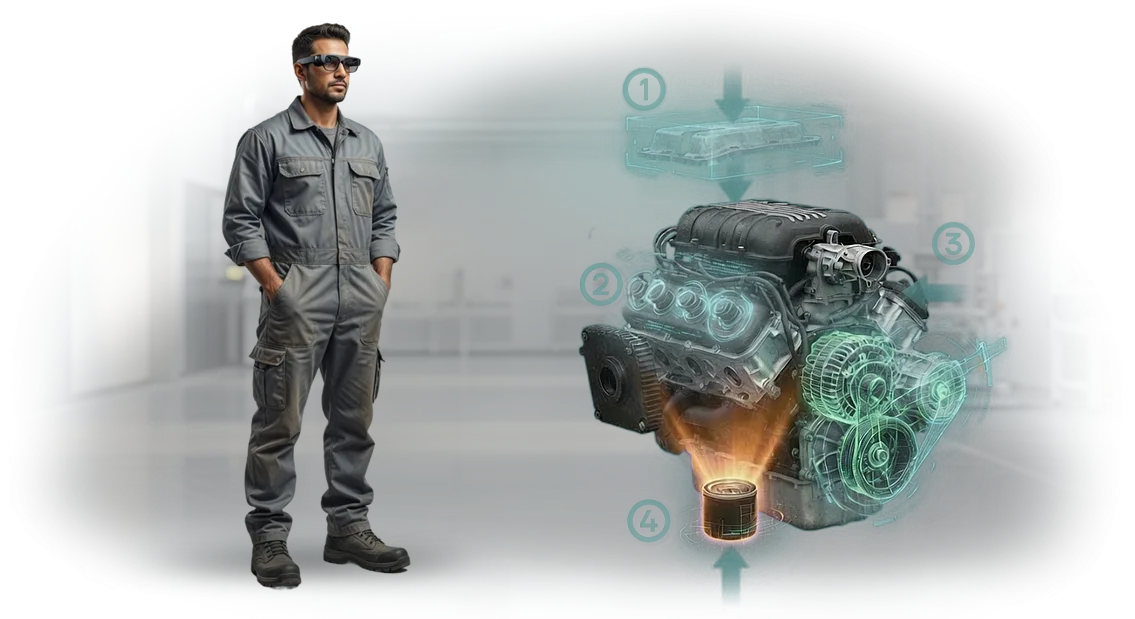
Breakdowns and lengthy repairs: AR-remote assistance reduces losses
Every minute of equipment downtime means unproduced output, missed deadlines, and dissatisfied customers.
When a machine or production line stops and there is no qualified specialist nearby, repairs stretch out for hours or even days: first the waiting, then the travel, then lengthy on-site diagnostics. As a result, the enterprise loses revenue and the production plan goes into the red.
AR-remote assistance changes this logic: you can connect a remote expert right from the failure site without waiting for them to arrive physically.
Through augmented reality, the engineer sees the equipment through the employee's eyes, points to the problem area, provides step-by-step instructions, and monitors execution.
This turns a lengthy repair into a short, manageable process, and production downtime is reduced several times over.
For a manager, this means predictability: fewer stops, faster restart, lower losses from breakdowns. And there is no need to expand the staff of field specialists — it is enough to establish a remote support channel.
This is exactly the kind of system we help implement: we select tools, set up the process, and train employees so that AR-remote assistance works for your profit.
Implementation results: repair speed and growth in output
Implementing AR instructions directly affects key production metrics. Employees find faults faster, make fewer mistakes, and return equipment to operation in minutes rather than hours. This delivers a measurable result: growth in output with the same resources.
Repair speed is the first effect customers notice. Instead of waiting for a rare specialist or long searches through paper manuals, the technician gets step-by-step guidance right on the screen. Equipment downtime is cut by 30–40%, and those hours go back into production output.
Staff efficiency also grows: new employees get up to speed without lengthy training, and experienced masters are no longer the only link without whom repairs stop. Errors during operations decrease, which means fewer repeat site visits and less rework.
Service quality reaches a new level. Every step is documented, the specialist follows a proven algorithm, and the customer sees a transparent process. This reduces the number of complaints and increases trust in your service.
Taken together, this saves time and increases output, which is easy to calculate in financial terms. Our clients see implementation results within the first month: faster repairs, less downtime, higher team efficiency. Contact us to discuss how AR-remote assistance will work at your enterprise.
AR-remote assistance formats for your tasks
There is no one-size-fits-all approach to remote support: an urgent incident and planned training require different tools. That is why we have developed several AR-remote assistance formats — from a short session with an expert to a permanent application for field service. Compare the options and choose the one that addresses your task with the right speed and budget.
| Format | Who it is for | What it gives the client |
|---|---|---|
| Remote expert | Urgent incidents, non-standard breakdowns | The expert sees the equipment through the employee's eyes and guides actions online — downtime is eliminated without a specialist's site visit |
| Interactive AR instructions | Standard operations, training new hires | Step-by-step prompts overlay the real equipment — staff do not search for paper regulations and get up to speed faster |
| Field service application | Mobile field engineers | Knowledge base on a tablet or phone, works offline, records completed steps and the next step |
| Integration into an existing system | Companies with their own tracking platform | We add an AR layer without replacing the current software — employees stay in their familiar processes |
| Hybrid model | Productions with strict downtime requirements | The first line handles most requests, complex cases automatically escalate to an expert |
The formats differ in launch speed and investment volume: the remote expert is deployed in a couple of days, the application takes a bit longer, and integration is discussed individually. We will help you choose the option that fits your task and budget. Tell us how your employees work — we will propose an AR-remote assistance scheme for your process.
How a remote support implementation project goes
Remote support is implemented not as "boxed software" but as a working process embedded in production. We configure the solution in stages so that every step is aligned and clear to your team.
This is a proven route we have followed with dozens of industrial clients — it eliminates missed deadlines and misunderstandings.
Implementation stages
- Brief and audit. We discuss tasks, equipment types, and common breakdowns. We identify areas where remote assistance will have the maximum effect.
- Solution and estimate agreement. We fix the scope, timeline, and budget. We select the format: one-off remote sessions or a system with an instruction library.
- Preparation and configuration. We adapt the service to your infrastructure, write scenarios for standard operations, and set up access.
- Pilot launch. We test it on one or two sites, collect feedback from engineers, and adjust scenarios and the interface.
- Team training. We conduct a workshop: how to call for help, what to show the expert, how to work with AR prompts. The session lasts one to two hours.
- Launch and support. We deploy the system across all sites and support it through the first weeks, bringing the process to stable operation.
After launch, we stay in touch: we help expand scenarios, add instructions, and connect new specialists. Thanks to the phased approach, you see the effect right after the pilot and can confidently scale support to new workshops.
What is included in the work package for remote support
When it comes to remote equipment support, it is important to understand what you get in the delivery. We prepare not just individual AR scenarios but a working package: instructions, documentation, staff training, and post-implementation support.
This allows you to launch the remote assistance system in a few days and get results immediately. Here is what is included in the work package:
- AR instructions for standard operations — replacing components, scheduled maintenance, resolving common faults. The operator sees prompts on the screen and completes steps without unnecessary movements.
- Documentation adapted for command centers: short regulations, checklists, safe work diagrams. Everything for quickly solving the task on site.
- Remote assistance module: the engineer connects to the employee's camera, sees the equipment in real time, and makes annotations in the frame. This speeds up task resolution and reduces the risk of errors.
- Staff training. We conduct briefings for operators and administrators and record training videos for inclusion in the new employee onboarding program.
- Post-support: warranty on our work, scenario updates when regulations change, consultations on non-standard situations.
- Usage analytics: reports on the number of remote sessions, average resolution time, and downtime dynamics. The data helps plan maintenance and adjust processes.
This package addresses several tasks at once: fast fault resolution, training new employees, and monitoring the service department's work. You get a ready-made system, not a set of files.
Case study: how remote support reduced downtime at a factory
At one machine-building plant, downtime of the main equipment was costing a substantial amount per hour (cost calculated after audit).
Engineers took 4–6 hours to fix a typical breakdown: they waited for a field specialist, sent each other photos, and clarified over the phone what exactly had broken.
We connected AR-remote assistance — remote support where an expert sees the production floor through the employee's eyes and manages the repair process in real time.
Implementation took three weeks. The operator points a tablet or smartphone at the equipment, and the engineer in the office sees the exact picture and overlays prompts on it: part contours, arrows, step-by-step actions. Sessions are recorded and protected.
We used the TeamViewer platform for communication — this provided a stable channel with minimal latency and the ability to save each breakdown analysis for training new employees.
Already in the second month, average repair time decreased by 1.7 times — from 4.5 to 2.5 hours. Over the quarter, downtime in the main workshop fell by 30%, and the savings from uninterrupted operation were substantial (cost calculated after audit).
An additional bonus: travel expenses were halved because field specialists were only needed for complex cases.
Since then, we have used AR-remote assistance as the standard for plants with distributed sites. This client's experience showed: the payback period is one quarter, and all you need to launch is a regular tablet and the plant's network. The key is to properly structure the process, not to buy expensive equipment.
Answers to typical questions before launching a project
Before a project launch, clients ask the same questions: how will the instruction fit into current processes, will it interfere with equipment operation, and what happens if something goes wrong. We answer the main ones — briefly and to the point.
Is it safe for equipment and employees?
Yes. The solution operates at the level of a regular tablet or smartphone — it does not connect to the machine's control system and does not interfere with its operation. The employee sees prompts overlaid on the real image, and all data stays within your network.
Is it difficult to integrate with your accounting system?
Integration goes through standard data exchange interfaces and does not require halting production. Our engineers configure the exchange with your accounting system and test it in a test environment before launch. This usually takes from a few days to a couple of weeks.
What happens if the connection is lost or the system fails?
Instructions are saved directly on the device, so if the network drops, the employee continues working without delays. We design the solution with downtime in mind: content is verified on a test bench, and backup scenarios are provided. If something goes wrong, we quickly connect and restore access.
Who will update the instructions after equipment changes?
You or your engineers — through an intuitive interface without programming. We train the team and hand over the documentation. If you wish, we can take over maintenance and make edits at your request.
Take the first step: request a support implementation
Leave a request — and within one business day we will call you back to discuss how AR-remote assistance will reduce downtime and speed up the maintenance of your equipment.
In 10–15 minutes of conversation, you will understand whether the technology fits your tasks and what results are realistically achievable.
The consultation is non-binding. We do not offer one-size-fits-all solutions — first we study your process, then we propose a format: a pilot project on one unit or a full implementation with integration into the existing system.
After your request, you will get:
- Expert assessment of your scenario: where AR instructions will have the maximum effect and where they are not needed.
- A consultation from an implementation engineer with industrial experience — in plain language, without technical details.
- A prototype of the work area: you see how an employee receives prompts on the screen and make your decision.
- A pilot project with a measurable result: operation completion time, number of errors, training speed.
- A full implementation plan with stages, timelines, areas of responsibility, and a fixed cost.
- Post-launch support: instruction updates, employee training, ongoing support.
Take the first step — send a request through the form. From there, we will propose the optimal next steps ourselves: from pilot to scaling across all lines. The sooner you start, the faster you will gain savings on downtime and reduce the load on your experts.
How to choose a remote support format for your plant?
Choosing a remote support format depends not on fashionable technology but on the specific needs of your production. If it is a typical consultation on adjusting a simple component, a regular video call is enough.
But when an employee is at the machine and the commissioning engineer is in another city, each hour of downtime is extremely expensive, and an error can put equipment out of service for several days — you need a format that gives the specialist a complete picture of what is happening.
The key selection criteria are the complexity of operations, the skill level of on-site personnel, and the speed at which operations need to be restored.
The more complex the equipment and the more unpredictable the fault, the more useful AR-remote assistance becomes: the remote expert sees not a static image but exactly the same object the employee does and can overlay prompts, arrows, and contours in real time — without the risk of misinterpreting words.
This is especially important in production where every part looks the same and you can only tell the right valve from the neighboring one by referring to the manual.
At the same time, full AR immersion is not always required. Sometimes photo capture of the defect and a short chat are enough.
That is why we take an individual approach to selection: we analyze typical scenarios at your plant — which operations are performed, which mistakes occur most often, what skill level the personnel have, and how quickly you need to respond.
Based on this data, we propose a format that does not overload the process with unnecessary technology but solves exactly your problem.
The main thing is not to rely on abstract "best practices" from the market. Experience shows there is no universal solution. Some clients only need a video call with image zoom; others need full AR instructions with step-by-step execution control.
The right choice saves up to 30–40% of repair and commissioning time, reduces the number of errors, and cuts travel expenses for specialists.
To decide on a format for your plant, you do not need to study technical details for long. Come to a consultation — we will look at your equipment, listen to what tasks you are setting, and propose the optimal option with a clear cost calculation and expected effect.
Book a conversation — it will take no more than 30 minutes, and the result will save months of work.