

AR for Field Service: Why Paper Instructions Slow Down Repairs
When a machine is down, every minute costs money. A field engineer on site searches for the right diagram in a paper manual — flipping through dozens of pages, checking labels, going back to the beginning.
The client watches and understands: the repair is dragging on, and equipment downtime keeps growing. This is a familiar situation for any field service operation.
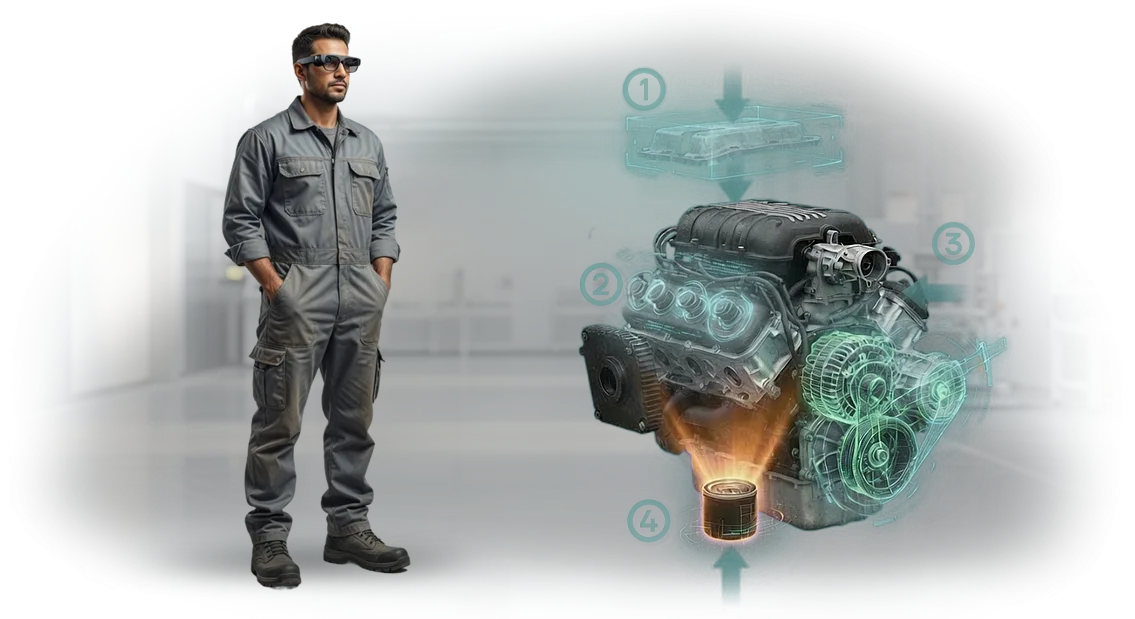
AR for field service flips the process: instead of searching through documentation, the engineer sees step-by-step AR instructions directly on the equipment.
Arrows, highlighted components, checklists — everything is right in front of them, hands are free, mistakes are eliminated. Repairs take a fraction of the time, and the client gets a predictable timeframe for restoring machine operation.
We specialize in developing AR instructions for industrial equipment. Our solutions integrate into existing field service workflows and require no retraining of specialists.
Implementing AR instructions reduces repair time, improves service quality, and maintains client loyalty — they see that the service operates professionally and quickly.
What Changes After Implementing AR Instructions: 5 Benefits
Today, service teams spend up to 40% of their time searching for the right diagram: paper manuals become outdated, experienced engineers leave, and new hires take months to learn.
Every hour of equipment downtime is direct production losses and the risk of missing contractual deadlines.
AR instructions change the work logic: the technician sees step-by-step prompts directly on the equipment, like a navigation system — no paper, no phone, no searching through a knowledge base.
This is not an "instruction manual on a phone" but a working tool that guides the specialist and controls every step.
| Parameter | How it is now | How it becomes with AR instructions |
|---|---|---|
| Repair speed | 2-4 hours for a standard operation | 1-1.5 hours; the technician does not look away from the equipment |
| Number of errors | Every 7th operation is performed with an error | Step-by-step prompts eliminate skipped steps and incorrect sequences |
| Staff training | 2 weeks for onboarding | 2-3 days: a beginner sees prompts and works like an experienced engineer |
| Equipment downtime | 3% of working time | Less than 1% — due to speed and fewer repeat visits |
| Client satisfaction | The customer waits, worries, doubts | Repair on the first visit; the client sees a transparent process and comes back |
Business result: downtime reduced by 30-50% and service costs reduced per year per production facility. AR instructions integrate easily with your ticketing system — for example, SAP PM or 1C — and require no equipment replacement. Only the way information is accessed changes, and capital investment is minimal.
Five key benefits of implementation:
- Reduced downtime — money stays in production instead of becoming losses.
- Fewer errors — fewer repeat visits and warranty claims.
- Fast onboarding of new employees — no need to wait for an experienced mentor.
- Higher repair quality — customer trust and reputation grow.
- More repeat orders — a satisfied client pays and recommends you.
AR for Field Service Formats for Your Task
Different field service tasks require different tools: sometimes a step-by-step prompt on a screen is enough, and sometimes an experienced engineer needs to see through the mechanic's eyes and guide them in real time.
We match the format to the specific operation so you don't pay for excessive complexity and get results after the first pilot.
Below are three standard formats we use in industrial equipment projects. They differ in implementation depth and scope, but each one reduces downtime and simplifies the team's work.
| Format | Who it is for | What it gives the client |
|---|---|---|
| Step-by-step AR instructions | Technical specialists on site | Fewer errors and faster standard operations through clear prompts directly on the equipment |
| Interactive guides with animation | Training departments and learning centers | Fast preparation of new employees without expensive simulators or pulling experienced mentors away from work |
| Remote assistance with augmented reality | Field teams and remote experts | Solving complex breakdowns without a repeat visit: the expert sees the technician's camera view and guides actions "on the spot" |
Once you choose the right format, you receive a complete package from our team: developed scenarios, adaptation to your equipment, and deployment on technicians' tablets or smartphones.
Next, we'll explain how we build the project — so you understand timelines and stages before starting.
How the Project Works: 6 Steps from Brief to Launch
We structured the project so you understand what happens at every stage. No "black box": you see what you pay for and can influence the outcome without risking missed deadlines.
-
Brief and task audit — we discuss which operations the AR instructions should cover, which specialists will use them, and on which equipment. The result is a clear understanding of scope and timeline.
-
Work plan and cost estimate — we define stages, roles, and cost. You receive a transparent document with no hidden items or "extras along the way."
-
Scenario and mockup approval — we show how AR prompts will appear on the screen: texts, arrows, highlighting of the relevant parts. All edits are made before development begins, so the final version comes as no surprise.
-
AR instruction development — our engineers create step-by-step scenarios for your equipment. You don't need to dig into technical details — you get a ready-to-use format that easily fits into the daily work of service teams.
-
Pilot project — we launch the instructions with a limited group of specialists or on one equipment type. We collect feedback and adjust details before rolling out the solution across the entire fleet.
-
Launch and support — we deploy the AR instructions to all required departments, train the team, and support you after implementation. You can add new instructions and update existing ones without lengthy development or extra approvals.
In the end, you get not just an application but a working tool that reduces training time and service errors. The process takes from two weeks to two months depending on equipment complexity, and at every stage you understand what is happening and what result you will get.
What Is Included in the AR Service Solution Delivery
We deliver a "turnkey" solution — not just an application but a working system that service engineers use from day one.
The package includes all stages: preparation, configuration, training, and support, so you don't need to hire contractors or understand technical details.
- Ready-to-use AR application for smartphones and tablets that works on site even without internet. The engineer points the camera at the equipment and sees step-by-step prompts directly on the parts — no need to flip through paper manuals.
- Instruction library for your models. We convert existing manuals into an interactive format and break them into short operations: diagnostics, component replacement, setup. Each step is accompanied by a visual prompt.
- Integration with your accounting system. Work orders, service history, and reports automatically go into your database — engineers don't have to enter data manually, and you see the status of each job in real time.
- Employee training. We conduct onsite or remote sessions, prepare reference materials, and short video tutorials. Service engineers master AR in a couple of days and immediately apply it on site visits.
- Access rights and update configuration. Your administrator manages access, edits instructions, and tracks versions. We connect technical support and regularly update content to reflect equipment changes.
- Support during launch and after. We answer engineers' questions, help with setup, and quickly resolve any issues in the first months of operation.
This package shortens implementation time to a few weeks and ensures that every technical specialist gets the help they need exactly when they need it. You get a transparent system that reduces repeat visits and equipment downtime.
Case Study: We Reduced Downtime by 40% with AR Instructions
Our client is a machine-building enterprise, VolgoTechMash, producing equipment serviced by field engineers across the country.
Before the project, specialists spent up to 60% of their time searching for information: paper manuals, calls to senior colleagues, trips back to the warehouse for tools.
Each such visit meant equipment downtime for the client — and an hour of production downtime costs many times more than the service itself.
We developed AR instructions for standard operations: component diagnostics, consumable replacement, post-installation setup.
The engineer points a tablet at the machine and sees prompts directly over the mechanism: which component to remove, in what order to proceed, which parameters to check. No paper, no "let me ask the master."
What the project showed in the first six months
- Equipment downtime at client sites was reduced by 40%: the average visit became 3-3.5 hours instead of 5-6.
- Errors during initial setup almost halved — fewer repeat visits and complaints.
- Onboarding time for a new service engineer dropped from a month and a half to two weeks.
- The client extended the contract for the next year and added two more equipment types to the instructions.
The enterprise's technical director summed it up: "Previously, preparing a new employee took months. Now they handle a standard site visit within their first week, under a mentor's supervision. For us, that means both speed and significant savings on service engineers."
This case shows that AR for field service is not a "trendy gimmick" but a working cost management tool. Reduced downtime directly increases the number of completed work orders per month without expanding the team.
We continue to support the project: we update the instructions when regulations and equipment design change, so the effect does not fade over time.
How to Choose the Right AR Instruction Format for Your Equipment?
Choosing an AR instruction format starts not with technology but with analyzing the operations you need to speed up. For standard tasks — replacing consumables, daily maintenance — lightweight prompts appearing directly on the equipment are enough.
For complex diagnostics or repairs, interactive 3D diagrams are needed: they show hidden components and the disassembly sequence so the mechanic never has to guess.
The second starting point is the specifics of your equipment. Large machines and compact workstations require different scales and viewing angles. It also matters where staff work: in a noisy workshop, outdoors, or in a confined space.
That determines the control method — tablet, voice, or on-screen buttons. These are not technical decorations but factors that decide whether staff accept the instruction or abandon it after the first try.
The answer to "how to choose AR" is — start with a pilot format on one operation that most often causes downtime or errors. We help you do this without unnecessary expense: we conduct a short audit, select the instruction type, and implement it on one section.
Within a few weeks you have the numbers — speed, error rate, master feedback — to scale the solution to the rest of the equipment.
So there is no universally correct format. There is a format that suits your employees, your equipment, and your tasks. It pays off within the first months: faster repair response, fewer errors, shorter training for new specialists.
And mechanics do not reject AR — on the contrary, they ask to extend the instructions to new components.
Frequently Asked Questions about Implementing AR Instructions
Before implementing AR instructions, managers ask about risks: what if the device breaks down, who will update the instructions, and how long until the first result. We answer briefly — based on field service experience.
What happens if the device or AR tablet fails?
The instructions remain accessible on any device — smartphone, laptop, or a backup tablet. We do not tie you to a single manufacturer, so the engineer can always open the needed step. Data syncs automatically, and work will not stop.
Who will update the instructions after design changes?
Updating is our task as part of support. You send the new version of the regulation or a photo of the component, and we adapt the AR scenario and publish it to all devices. You need neither internal developers nor an additional budget.
How long does it take to launch AR instructions?
We launch the first pilot scenario in 2-3 weeks. A full package for standard tasks takes 1-2 months. You see a working result at the first stage and decide how to scale it.
If you still have questions — write to us, and we'll show examples for your industry.Order Turnkey AR Instructions and Get Results in a Month
Field service loses money on every downtime: a technician waits for instructions, makes mistakes, redoes work. AR instructions solve this — but ordering development feels risky: it's unclear what it costs, what the timeline is, and whether the result will come.
We remove that uncertainty: we take the project turnkey, take responsibility for implementation, and show the result before final payment.
First, we immerse ourselves in your specifics: we study the equipment, regulations, and typical breakdowns.
In the end, you get not just an AR application but a working training and support system for employees — with intuitive interfaces and adaptation for the tablets and smart glasses your technicians already use.
What you get after submitting a request
- Implementation plan — a step-by-step route that accounts for your equipment fleet and service team schedule.
- Cost calculation — a precise estimate with cost calculated after audit, broken down by stage, with no hidden payments.
- Demo on your equipment — an example instruction for one real component so you can evaluate usability before the full project starts.
- Scope of work and timeline — a list of tasks, communication guidelines, and milestones.
- Instruction formats — we choose based on your scenario: for tablets, smartphones, or AR glasses — so it's convenient for your technicians.
- Support model — how we maintain the system after launch and update content.
This is what the checklist looks like based on our experience with industrial clients, for example, when working with Fanuc machines. Usually, after the demo, the client immediately sees savings on site visits — up to 30% time per operation.
Submit a request — within 3 business days we will prepare an implementation plan, a cost calculation, and show a demo on your component. You get a ready turnkey solution, not an abstract promise. We will start with a short brief — we will handle the rest.