

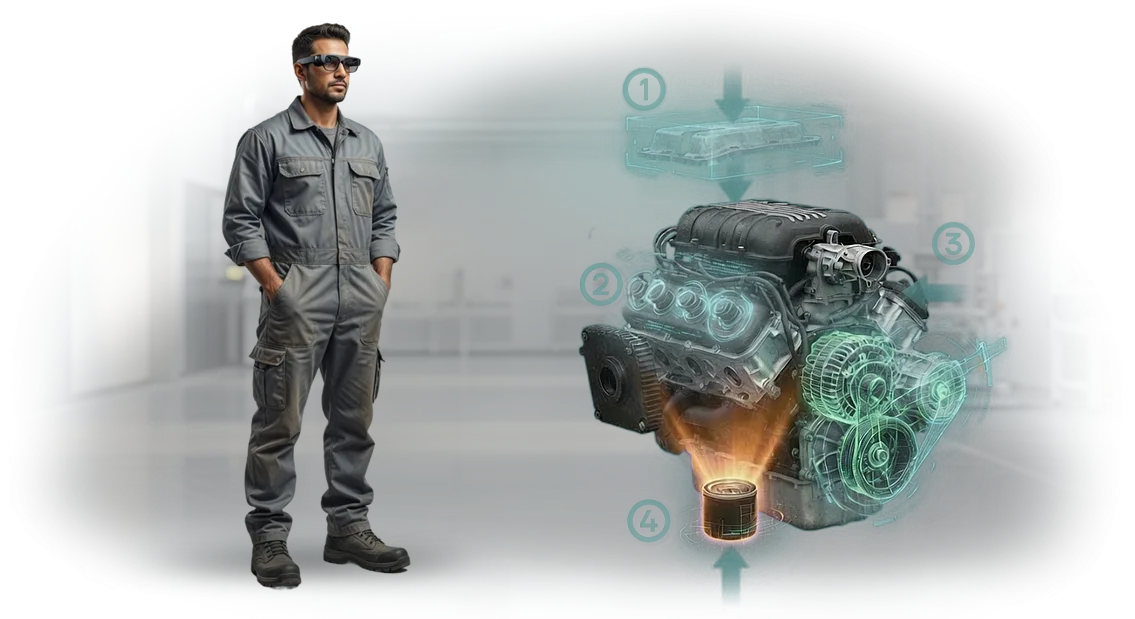
AR Smart Glasses for Factories: How to Eliminate Repair Errors
When the line stops again because of an improperly tightened valve, I understand the cost of every minute of downtime. The plant loses money, shipments are delayed, repair technicians blame each other, and I go looking for someone at fault.
The cause is almost always the same — repair errors that occur when the instruction doesn't match the actual assembly or a mechanic can't remember every step.
Experienced specialists are worth their weight in gold, while newcomers need constant supervision. Paper manuals and videos don't help: it's noisy on the shop floor, hands are covered in oil, and the machine doesn't tolerate guesswork.
Every hour of equipment downtime turns into unfulfilled orders, and a repeated error means replacing expensive components.
AR smart glasses solve this pain. They display clear instructions in augmented reality directly on industrial equipment parts: arrows, part numbers, checkpoints.
The mechanic sees the sequence without looking at a tablet, and the system automatically verifies that the component is tightened correctly. That eliminates the most expensive factor — human inattention.
We have already helped factories reduce typical repair errors severalfold. Our team develops AR instructions for your specific equipment models, trains employees, and supports the rollout.
All that remains is to put on the glasses, look at the assembly, and do everything right the first time.
How AR Instructions Accelerate Repairs and Staff Training
Repair speed and staff training are the two main sources of losses on the production floor. While an employee looks for the right instruction step or waits for a specialist to arrive, equipment sits idle: deadlines slip, costs grow, errors pile up.
AR instructions remove this dependency: prompts appear directly in the smart glasses over the real equipment, at the moment of task execution.
According to PTC, companies that implemented augmented reality in maintenance reduce repair time by 30-50% and cut the number of errors almost in half.
Repairs Twice as Fast
Smart glasses work like a navigation system for maintenance: arrows, highlighting of the needed component, step-by-step animations. The operator gets it right on the first attempt, and downtime shrinks from hours to minutes.
Often the repair is done by someone already at the machine — no need to call in an external specialist.
Employee Training in Days Instead of Weeks
A newcomer performs operations together with a virtual mentor that is always there and shows each step. This format takes days instead of weeks: the trainee immediately works at real pace, and production doesn't stop for training.
Fewer Errors and Predictable Quality
Each step is visually confirmed, and any discrepancy is visible immediately. Production sees less scrap, fewer repeat repairs and spare part overruns, while the manager gets stable quality and predictable deadlines.
Deployment Formats for Augmented Reality Instructions
AR instructions on smart glasses cover the moments when an operator needs an instant hint: before startup, when changing tooling, or in an emergency. The deployment format depends on the task — from a short step-by-step check to full process guidance. Below are typical scenarios and specialized solutions.
Typical Scenarios
| Format | For whom | What it gives the client |
|---|---|---|
| Step-by-step smart glasses instructions | Machine operators, assemblers | Reduced training time and fewer errors when performing operations |
| Interactive assembly diagram with animation | Maintenance services, adjusters | Quick fault finding without disassembling equipment |
| Pre-startup checklist | Shift supervisors | Consistency: every operator follows the procedure and records the check |
| Remote video hint from an expert | New employees | Employee doesn't stop and wait but continues working with support |
Specialized Formats
For specific tasks, we use narrower formats: safety pictograms at the workstation, part recognition for the warehouse, and overlay of virtual markers during quality control. These solutions integrate into the existing process and don't require equipment replacement.
The key point: the format is chosen based on the task, not the technology. We select a scenario for your production process, build a prototype, and measure the effect before a full-scale launch.
How the Work Flows: From Request to Support
We structure our work as a clear step-by-step process — no "black box" and no surprises. All we need from you is 2-3 hours for a brief and approvals: we will then organize everything needed to launch AR instructions on your production floor.
- Request and brief — you tell us which equipment needs instructions, what operations employees perform, and what currently prevents faster work.
- Process audit — we look at real conditions: how equipment is laid out and where exactly smart glasses will make a difference.
- Plan and technical specification — we record the sequence of steps, instruction content, deadlines, and budget. You receive a document that clearly outlines what will be done.
- Approval — before full-scale development, we show a scenario example for one operation. Edits at this stage don't require rework and don't affect the schedule.
- Development — we create step-by-step prompts, animations, and voice explanations, then test them on your equipment or its model.
- Testing and launch — we configure the smart glasses, train master mechanics and operators, provide support during the first days, and make adjustments.
- Support and updates — if procedures change, we update the instructions, answer employees' questions, and help scale the solution to other areas.
Who Is Involved
On our side — a project manager, an engineer, and a content specialist. From the customer, a technologist or site manager is enough: this person knows how the operation is actually performed and confirms the correctness of each step.
Timeline
A pilot instruction set takes 2-3 weeks on a turnkey basis; a comprehensive project with multiple scenarios takes 1-2 months. Exact deadlines are set in the technical specification before work begins, so the launch date is known upfront.
What Is Included in the Project Deliverables
For an industrial enterprise, it's important to receive not just a set of files but a ready-made solution that can be immediately implemented. We package the project so your specialists can start using AR instructions from day one, without needing to finish anything themselves. This eliminates downtime and accelerates reaching planned productivity.
Main Package
- Ready-made AR instructions based on your procedures — scan the marker, and the step-by-step sequence of operations appears on the smart glasses screen.
- An administrative web portal for content management: you edit instructions yourself, add new operations, and assign access rights to employees.
- A training kit for staff: short scenarios on how to use the glasses and what to do in an emergency.
- Documentation: administrator's guide, operator's manual, and content update procedure — all in Russian.
- Marker labels in the required quantity for applying to equipment and workstations.
- Test operation on your site: several shifts working with the glasses, feedback collection, and final tuning.
Warranty and Support
We don't disappear after launch. A technical support contract covers ongoing maintenance: engineers are available during business hours and can visit the site if needed.
Staff training and instruction updates are included in the plan — you focus on production, we take care of the technical side. Support doesn't end after a month; it stays with you for the entire lifecycle of the solution.
Implementation Example: Factory Reduced Repair Time by 30%
At a metalworking machine plant, AR instructions were implemented for the maintenance service. Before the start, the average time to fix a typical fault was 55 minutes; one month after launch — 38. That's 30% less time with the same crew and without purchasing additional equipment.
"Previously, mechanics spent up to 15 minutes just finding the needed diagram in a paper catalog," recalls the chief engineer of the TechnoLine enterprise. "Now the smart glasses show the steps right on the component, and hands are free. Errors have become rarer, and line downtime has decreased by almost a third."
Why It Worked
The key factor is not merely replacing paper with a screen but restructuring the process. The AR instruction automatically links to a specific machine, guides the mechanic through the steps, and verifies that each stage is completed correctly. If a part is assembled incorrectly, the system immediately reports it — no need to redo the work.
The second effect is lowering the entry barrier for new employees. A young specialist performs the work at the level of an experienced mentor because all that expertise is already built into the scenario. This reduces training time and lowers dependence on a few key employees.
Return on Investment for the Enterprise
Investment in AR smart glasses and instruction development pays back in 4-6 months: lower downtime directly increases production output, and fewer emergency repairs reduce spare parts costs.
Within a pilot project, we always calculate the economic effect before launch — based on your downtime data and the average cost of an hour of production stoppage.
How to Choose the Right Format of Instructions for Production?
There is no universal instruction for all production: the format must match the specifics of your operations and working conditions.
If employees need to keep their hands free and simultaneously check equipment components, AR smart glasses with step-by-step prompts right in the field of view work best.
If the process is rare and requires detailed study, a tablet or an on-screen interactive guide is enough — selection criteria are always determined by the specific task.
When choosing a format, it's important to consider three things: complexity and frequency of operations, working environment (noise, dust, need for protection), and how quickly procedures change.
In an area where you can't take your eyes off the task, glasses win; where instructions are updated monthly, ease of editing is critical. It's better to assess these specific requirements before launch, not after you've already invested in the wrong tool.
We don't sell a one-size-fits-all solution — we tailor a solution to your processes. Our engineers analyze your employees' tasks, conduct a short audit, and propose a format: from simple text checklists to full AR scenarios.
You get a clear explanation of why this option was chosen, what the implementation timeline is, and what effect to expect.
If you're not sure which format suits you, start with a consultation. It's non-binding: we'll review your situation, show you options, and explain how each one affects training speed, error rates, and staff convenience.
Submit a request — our specialists will contact you within one business day and help you choose the optimal solution.
We Answer Questions About Implementation
Before implementing AR instructions, the same questions come up: timelines, compatibility with the existing equipment fleet, documentation updates, and unexpected breakdowns. We answer them directly because we understand that a digital tool must not stop production.
How long does implementation take?
First results appear in 2-3 weeks: we take one equipment unit, build an instruction, and you test it during a real shift. Full workshop coverage takes 1 to 2 months, depending on the number of operations.
Will this work with our equipment and old instructions?
We don't need a perfect factory model. We work with the technical documentation you already use: drawings, procedures, videos. We adapt it for RealWear AR smart glasses and other industrial models — they withstand dust, moisture, and impacts.
How are instructions updated after equipment changes?
We make edits in a single file, and the changes immediately appear for all employees. No need to reprint paper procedures or wait for new versions to reach the shop floor.
What happens if equipment or glasses break?
Instructions are tied to the device fleet, not to a single unit. If the glasses fail, the employee opens the same steps on a tablet or smartphone. We also operate under an SLA: technical support for the entire usage period, with response within one business day.
Order Development of AR Instructions for Your Production
Equipment doesn't generate profit when employees spend hours searching for instructions and analyzing errors. AR instructions solve this: all the necessary information appears right before the master's eyes at the moment of the operation.
But before changing the process, you want to know how much it costs and how quickly it will pay off.
Leave a request for AR instruction development — we'll do a short audit of your tasks and prepare a specific proposal, without technical details or fluff.
You don't need to understand glasses and software — our engineers will select the right solution for your equipment fleet and workshop specifics.
What you get immediately after ordering:
- Cost estimate for development for your equipment fleet — no hidden fees or imposed options.
- Consultation with our engineer: whether AR suits your operations and what is needed for launch.
- A sample implementation plan for one unit — you'll see how the instruction works at your production.
- Savings estimate: how many minutes per operation and how much scrap we eliminate at a specific site.
- Project launch: we assign a team and align the pilot phase within a few business days.
- A personal manager — one contact for all matters, from task setting to equipment delivery.
Fill out the form on the website or message us in a messenger — we'll respond within one business day. On the first call, we'll show you how AR instructions pay off for clients in your industry, and take the first step toward their implementation at your production.