

Costly mistakes: how AR glasses for manufacturing reduce losses
Every operator error when working with industrial equipment is not just a human factor but direct losses: defects, damaged components, line downtime, and missed order deadlines.
Over the course of a year, such incidents add up to tens of thousands in lost profit, and the time spent on fixing the aftermath could have been used for production output.
The root of the problem is often in staff training: new employees study complex regulations for weeks, but in a stressful situation they act from memory and make mistakes. Experienced operators leave, taking knowledge that is not documented anywhere. The company pays twice: for training and for downtime due to inexperience.
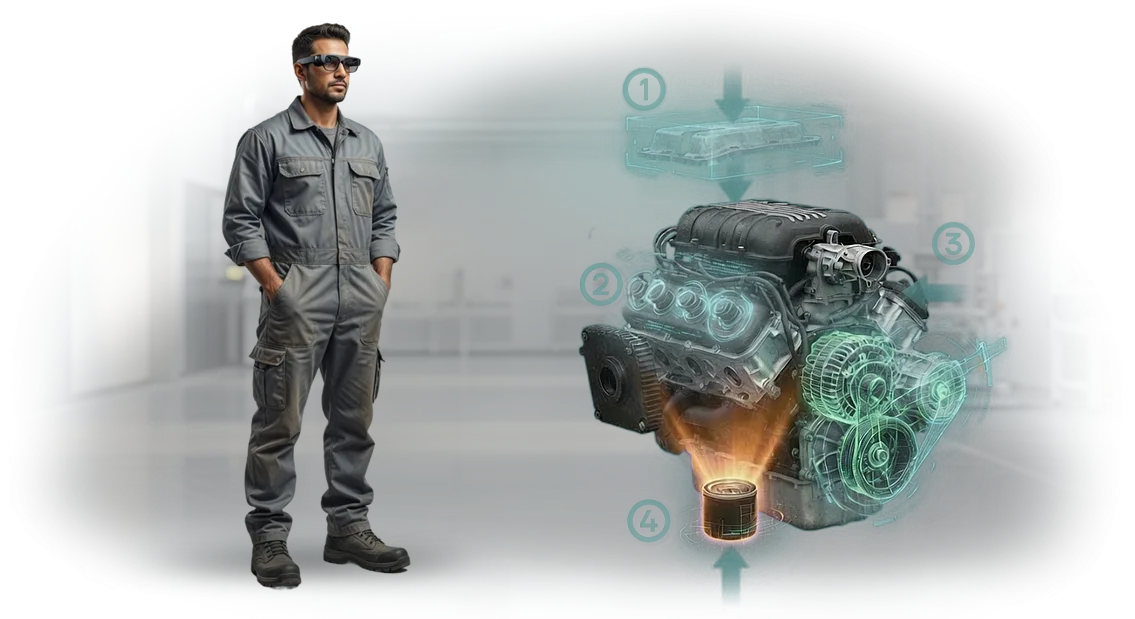
AR glasses for manufacturing change this logic. Instead of thick manuals and searching for the right section, the operator sees step-by-step prompts right on the equipment: where to press, which component to tighten, in what sequence to perform the operation.
This reduces the number of errors by 30–40% and cuts the onboarding time for new hires roughly in half — they start working independently in a couple of days, not weeks.
Equipment downtime is also becoming a thing of the past: if setup takes minutes instead of hours, the line runs more stably, and scheduled maintenance is done without involving rare specialists.
The manager gets a predictable process where the human factor is no longer the main source of risk. We help implement such AR instructions — from process audit to deployment at your production site.
What you get from implementing digital instructions
For a manufacturer, every minute of downtime and every operator error is a direct loss. Paper instructions distract attention, and training stretches over weeks.
Digital instructions in AR glasses solve this: the worker sees prompts directly on the equipment and acts without mistakes.
According to Deloitte, augmented reality in manufacturing significantly reduces operation time and the number of defects. Here is what your enterprise specifically gets:
- Fewer errors — step-by-step prompts eliminate omissions and rework. Defects fall by 30–50% from the first months.
- Fast onboarding — a newcomer masters the equipment in days, not months. The supervisor does not have to constantly step in.
- Improved safety — the system warns about dangerous areas and incorrect actions before an injury or breakdown.
- Faster work — no need to flip through paper or find a specialist: data is in front of your eyes, hands are free.
- Unified quality standard — everyone follows one proven method regardless of experience or shift.
- Control and analytics — you can see where employees hesitate, and instructions are easy to improve.
Unlike training videos, AR instructions work right at the workplace and adapt to the specific equipment model. This is a proven solution, not an experiment: we implement such systems in production — from assembly to machine repair.
Formats of digital instructions for manufacturing
Paper regulations and PDF instructions do not answer the operator's main question: what to do right now. On complex equipment, every extra minute spent searching for the right component is machine downtime and lost output.
That is why manufacturers are moving to digital instructions that show steps directly in the employee's field of view. According to a Deloitte study, such formats reduce task completion time by up to 30% — and this is not about technology, but about money.
We do not supply a one-size-fits-all template. For each task we choose the right option: step-by-step assembly, maintenance scenario, or training simulator. The content stays the same — the logic of presentation, depth of detail, and way of checking the result change.
So you get a system that meets the needs of both experienced engineers and newcomers without duplicating development work.
| Format | For whom | What it gives the client |
|---|---|---|
| Step-by-step AR assembly | Operators and fitters | Fewer assembly errors, quick ramp-up to pace without a supervisor |
| AR maintenance and diagnostics | Service engineers | Fast fault finding, component replacement prompts, less downtime |
| AR training simulator | New employees and training centers | Training without the risk of breaking equipment, visual scenarios, and skill checks |
Formats can be easily interchanged: what works today as a reference guide can become a testing scenario for certification tomorrow. This allows you not to buy a new solution for every task, but to develop one system and expand it as production grows.
Choose one format or combine several — for example, a simulator for beginners and step-by-step assembly for experienced operators. At a meeting, we will review your tasks and show which option will deliver quick results and pay off sooner.
How implementation goes: from brief to support
Deploying AR instructions is a structured project with clear stages. We accompany you from brief to support, so you always know what is happening and what you will get at each step. Project stages:
- Development brief: we discuss tasks, equipment, and employee skill levels. You receive a plan with estimated timeline and cost.
- Process audit: we review existing instructions and real operations, identifying points where AR prompts will have the greatest effect.
- Layout approval: we show how the instruction looks in the glasses and how an employee works with it. You see the result in advance and can make edits before development starts.
- Scenario development: we create step-by-step prompts, error control, and component checks. The focus is on speed of learning and reducing errors.
- On-site testing: we test instructions at your workplaces and with your employees, taking into account lighting and operational specifics.
- Instruction launch: we deploy the system, train personnel, and hand over administration. Employees work with new scenarios from day one.
- Technical support: we stay in touch, update content when regulations change, and add new components and processes.
This approach removes uncertainty: you see results after the first stages, and make the final decision based on a prototype. In the end, you get a tool integrated into your production and support after launch.
What you get as a result of the project
As a result of the project, you receive a complete kit for training and staff work — from scenarios to step-by-step instructions.
All materials are adapted to real operations on your equipment, so the employee sees exactly the components they work with and is not distracted by abstract diagrams.
- Instruction scenarios for key operations — disassembly, maintenance, setup, fault finding. Each step is broken down into clear actions with highlighting of the required part.
- Graphic materials — 3D models of components and parts with labels that can be viewed from any angle. This replaces dozens of pages of paper manuals.
- Training video inserts — short clips right in the interface showing the correct sequence of actions. Suitable for quickly bringing newcomers up to speed.
- User guide — a simple document for operators and administrators: how to turn on, select a scenario, and customize for your workplace.
- Administrative panel — you change instructions and add new scenarios yourself without programmers.
- Technical support and warranty — after launch we stay in touch: we update materials when equipment changes and answer employee questions.
The entire kit is delivered in a convenient form and remains your property. You can scale it to other workshops and plants, and add new operations as production grows.
Case study: how we helped a plant cut downtime by 30%
A large agricultural machinery plant, AgroMash, faced equipment downtime becoming its main source of losses.
Operators spent up to half an hour searching for the right page in a paper manual, and unique knowledge about complex components lived in the heads of two or three experienced setup technicians. When they went on the lunch shift or on vacation — the line stopped.
We conducted an audit and converted the regulations into AR glasses: the worker sees step-by-step 3D prompts right on the equipment. No need to flip through paper, open a tablet, or call a mentor — hands are free, and the eyes stay on the part.
Results a quarter after launch
- Downtime decreased by 30% — about 12 additional hours of line operation every week.
- Newcomer onboarding time was cut in half: new operators reach the planned standard from the second week.
- Assembly and setup errors fell by half, and the number of warranty repairs — by a quarter.
The production manager commented: “We finally saw how technology delivers measurable economic impact, not just a nice image.” The project paid for itself in four months, and the client is now rolling the solution out to three neighboring workshops.
Same staff and same machine fleet — but output grew. This is the kind of result possible when the task is solved not “for the sake of technology” but for specific production metrics.
What if we have specific requirements?
Specific requirements are not a limitation but the starting conditions of the task. There is no one-size-fits-all solution for industry: each manufacturer has its own regulations, equipment types, and staff skill levels.
That is why we do not fit a project into a ready-made template; we design the format around your process — from the first brief to an instruction at the workplace.
When you describe a non-standard situation — a special component, a rare operation, harsh site conditions — we turn it into a clear technical specification for our engineers.
At this stage, an individual format emerges: sometimes a step-by-step mode with video is more convenient, sometimes an interactive 3D overlay on the real object. We determine this together, based on your scenario, not on an “industry average.”
Individual conditions apply not only to content but also to the way of working: deadlines, number of iterations, checkpoints, training for your employees. For large implementations, we prepare a roadmap; for one-off tasks, a compact scope with a fixed cost. You always understand where the project stands and what you will get as a result.
We also plan for evolution: over time, regulations change, new components are added, and equipment is upgraded. So we make the format modular — so instructions can be supplemented and adapted without a full rework and extra costs.
If you are not sure which format is right for you, that is normal. Tell us about your task, show us the regulation, or give us a short tour of the process. We will propose a solution that fits your workflow, not one that forces you to adapt to technology.
Frequently asked questions about digital instructions
Before launching instructions, managers tend to have the same questions: will deadlines slip, will the budget balloon, will employees handle the new format. We answer the main ones.
If your question is not here, ask us directly.
What guarantees do you provide?
We fix the cost, timeline, and scope of work in the contract. The project is divided into stages — you see results every 1-2 weeks and pay only for the accepted part. After launch, we support the instructions: we update content and adapt it to new equipment.
How long does development take?
The first pilot project typically takes 4-8 weeks. We create 2-3 instructions, test them at your site, and measure the effect. Scaling then goes faster: standard operations are converted to digital format in a few days.
How much does it cost?
The cost depends on the number of instructions and the complexity of operations. The pilot project cost is calculated after an audit: this lets you test the hypothesis without a large upfront investment.
Full deployment pays off through reduced downtime, fewer errors, and shorter employee training time. We will show you the payback calculation before starting.
Do we need to buy AR glasses right away?
No. At the start, tablets and smartphones already available at your production site are enough. When you are ready for glasses — we will deploy instructions on them as well. We select equipment based on the task and budget, rather than pushing “the newest” on you.
Start your project with a consultation
Every project begins with understanding the task. During a consultation, we analyze your production process, find points where AR instructions will deliver quick results, and honestly tell you where they are not needed.
This takes about an hour and does not obligate you to order anything. No marketing promises here — only specifics about your production.
You get a preliminary plan: what can be automated, which operations can be moved to AR, how much time it will save your employees, and when to expect results. No technical fluff — only practical solutions for your task.
What the consultation includes:
- Analysis of your process and the goals you want to achieve.
- Assessment of AR instructions applicability to your equipment.
- Preliminary implementation plan with stages and timelines.
- Indicative project cost and options for optimizing it.
- Answers to questions: integration with existing systems, staff training, support.
Important: we do not offer “boxed” solutions. Each plan is prepared for your equipment fleet, staff skill levels, and real production objectives.
Leave a request for a consultation — we will contact you within one business day, agree on a convenient time, and prepare materials. After the consultation, you will receive an action plan — even if you decide not to work with us, it stays yours.