

AR for Maintenance: How to Reduce Downtime and Staff Errors
In manufacturing, time is money. When a machine goes down due to a breakdown, every minute of downtime is extremely expensive, and repairs can drag on for hours because of outdated paper instructions and scarce specialists.
The technician is forced to flip through manuals, call the author of the diagram, and search for drawings in the archive. The result is errors, repeat repairs, delivery delays, and dissatisfied customers.
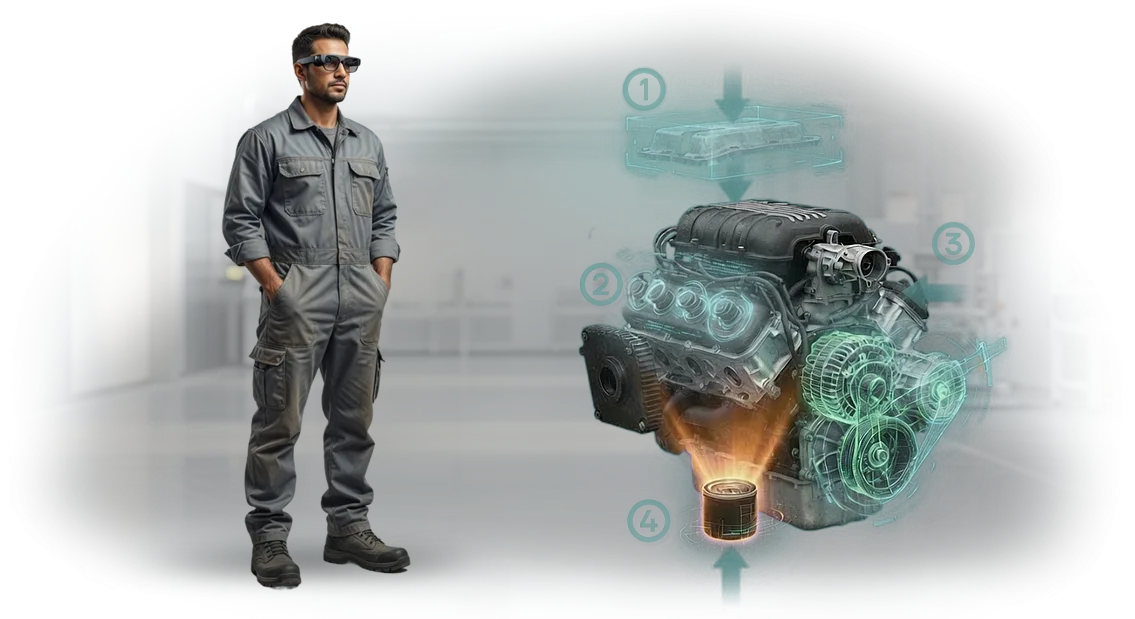
That is why more and more enterprises are adopting AR for maintenance — an augmented reality technology that overlays step-by-step diagrams and prompts directly onto the equipment view.
The worker sees which part to unscrew, which wrench to use, and in what sequence — without the risk of mistakes or long searches for information. This cuts repair time by 2–3 times and reduces staff errors by 30–40%.
In essence, AR instructions turn the experience of a seasoned engineer into a digital format available to every employee.
New specialists get up to speed faster, and abnormal situations stop being a catastrophe — even a rare component can be serviced with a clear animated instruction. Production instructions no longer gather dust in a cabinet: they are always in sight and updated instantly.
As a result, you get predictable equipment maintenance times, fewer downtimes, and more output. Below we discuss how to properly implement AR for maintenance and what results to expect.
What AR Instruction Implementation Delivers: 5 Measurable Benefits
AR instructions turn paper regulations into digital prompts right in the operator's field of view. This reduces the time spent searching for information and lowers the risk of errors, which in turn reduces downtime and repair costs. Here are 5 measurable benefits:
- Time savings. The prompt appears directly on the part — no need to flip through manuals or wait for an engineer. Repair operation time is reduced by 30–40%, which is especially noticeable with frequent repetitive tasks.
- Repair accuracy. The sequence of actions and warnings about critical components reduce errors and repeat repairs by up to 25%. Equipment wears less and its service life increases.
- Personnel training. A new employee works with digital support from day one, without waiting for a mentor. Training costs are halved, and reaching full productivity is accelerated by 30%.
- Quality control. The system records every step, detects deviations, and generates a report. The supervisor sees where errors occur and adjusts the process in time — service quality reaches 95%.
- Work safety. Reminders about protective measures and blocking of dangerous actions reduce the number of injury-prone situations, and therefore compensation and penalty costs.
Integration with existing management systems takes minimal time — for example, with Siemens controllers. We adapt content to your specific equipment and process, so you get a working tool rather than a demo stand.
AR Instruction Formats for Maintenance Tasks
Each maintenance task has its own format. Quick on-site diagnostics does not require expensive equipment: a tablet with mobile AR is enough.
But for complex machine repairs where hands are occupied with tools, an AR helmet is more convenient — the instruction is always in front of your eyes and the device does not interfere with work.
It also matters who uses the instruction. A beginner needs a detailed step-by-step scenario; an experienced adjuster needs quick access to the desired component without flipping through paper regulations.
We select the format based on the type of equipment and staff skill level so that maintenance does not slow down production.
Possible AR Formats
| Format | For whom | What it gives the client |
|---|---|---|
| Mobile AR — tablet or smartphone | Field engineers, on-site equipment repairs | No need to purchase special equipment; instruction overlays the real machine, fault search takes less time |
| AR helmets | Complex repairs, maintenance of machines with limited access | Hands are free, step-by-step prompts are in front of your eyes; fewer errors, repeat calls, and downtimes |
| Stationary AR stand | Training new employees in production | Beginners learn operations without risk to equipment and without stopping the production line |
| AR markers on equipment components | Operators and duty personnel | Instant call-up of instructions for a specific component — no need to search for regulations in paper or wait for a senior technician |
Whichever format you choose, the result is the same: faster diagnostics, less downtime, predictable service.
Our engineers will test the scenario on your equipment and advise where mobile AR is sufficient and where a helmet will pay off — without overpaying for unnecessary options.
How AR Instructions Are Developed: 6 Steps
AR instruction development is a clear six-step process that we manage from the first conversation to daily use in production.
You are not left alone with the technology: each stage has transparent results and checkpoints, and the final solution is delivered with training and support.
- Brief and equipment audit — we immerse ourselves in your specifics: we study typical operations, regulations, and points where errors most often occur. We collect documentation and even record processes on video. The result is a clear understanding of the scope of work and success criteria.
- Technical specification and cost estimate — we record all agreements in a document: scenarios, number of instructions, timeline, and budget. You see the full picture before development starts and can make changes without extra costs.
- AR instruction development — we create 3D models of components, disassembly and assembly animations, and text prompts. We create content based on your documentation and interviews with technicians, so it is understandable even to new employees.
- Pilot project — we test instructions directly at your site, for example on Fanuc machines or any other equipment. We collect feedback from mechanics and adjusters, refine the interface and scenarios. The pilot takes 1–2 weeks and provides measurable results.
- Launch and staff training — we deploy the solution on employees' tablets or smartphones, conduct short training sessions, and hand over instructions. Launch takes a couple of days and does not stop production.
- Support and development — we stay in touch: update content for new models, add instructions, expand the knowledge base. We also provide usage analytics so you can see which scenarios are in demand.
What the AR Instruction Delivery Includes: The Full Package
We deliver not just files and "pictures," but a ready-made working solution that integrates into maintenance processes from day one.
The package includes everything needed for the operations department to quickly adopt the tool, and for you to control and develop it without dependence on us.
- Ready-made AR scenarios for key operations — planned maintenance, fault finding, component repair. Scenarios are based on your regulations and tested on real equipment.
- Turnkey staff training — a short program for operators and repair technicians: how to use the instructions, what to do in case of a failure, how to achieve the required execution speed. No "learn by doing" on your machines.
- Integration with your systems — we connect instructions to your existing document flow, accounting system, or work order logs. When an employee finishes a job, the data automatically goes into your reporting — nothing manual.
- Complete Russian-language documentation — description of scenarios, change management procedures, areas of responsibility, access rights. Everything so that your engineer or technologist can update instructions without our team.
- Ownership of all materials — scenarios, objects, texts, and source data remain with you. This is your asset that you can modify, transfer to contractors, or use at new sites.
- Post-launch support — consultations during the first month, quick readjustment to changes in regulations, and assistance with expanding the equipment fleet.
As a result, you get an independent, transparent system: employees work faster and make fewer mistakes, and you have a management tool rather than a one-time campaign. We handle the entire delivery — from scenario to documentation — and then the work continues by your rules.
Case Study: How We Cut Repair Time by 30%
For a client in the energy sector — EnergoService — maintenance of transformer substations was a bottleneck: every mistake by a crew led to hours of downtime and risk for the entire grid.
Experienced specialists were leaving, and new ones trained for months because paper instructions did not reflect the actual state of the equipment.
We developed AR repair instructions: through a tablet, the technician sees a step-by-step scenario directly on the unit's components — what to unscrew, in what order to check, what to pay attention to.
It is a working tool embedded into the familiar process: the engineer opens it, follows the steps, and records the result. And it didn't require changing either the equipment itself or the existing regulations — the app runs on the crew's standard tablets.
Implementation Results
Over three months of the pilot, repair time was cut by a third, and the number of errors halved. Equipment downtime decreased — this directly affected the client's output volume.
Crews stopped waiting for senior colleagues to confirm every action: the instruction itself suggests the next step.
After the pilot, the company expanded the project to all regions where it operates. Now these AR instructions are a mandatory part of training new employees and a way to pass experience between generations of engineers without losing accumulated expertise.
This result is achieved not by magic, but by first analyzing typical failures and work algorithms, and then packaging them into clear prompts. That is why the effect is visible in the first week, not after lengthy setup.
Common Concerns: We Answer Before the Project Starts
Implementation of AR instructions on industrial equipment is held back not by technology, but by justified concerns. Will augmented reality work well with an old fleet of machines? How quickly will employees accept the new format? And when will the project pay off?
We answer these questions before the start — so that the decision is based on facts rather than fears.
Is AR compatible with old equipment?
Yes. AR instructions work on top of existing processes and do not require replacing machines or expensive industrial software. An employee only needs a tablet or smartphone that is already available in the workshop. All information is displayed directly on the screen over the real component.
Isn't implementation too complex?
Implementation is carried out in stages: we study regulations, create scenarios, test on one site, and only then scale to other lines. Production is not stopped in the process. Staff learn in a couple of short sessions — people work as usual but get prompts at the right moment.
When will the project pay off?
Payback comes from three components: a new employee reaches working mode many times faster, errors during maintenance are reduced, and dependence on narrow specialists decreases.
In most projects, the effect is visible within the first months, and investments are recovered through less equipment downtime.
Will employees trust the prompts?
Employees get used to AR faster than it seems. Arrows, component highlighting, and step-by-step checks feel natural for a person holding a tablet. Over time, fatigue decreases and there are fewer arguable situations when you need to recall the instruction from memory.
What guarantees do we provide?
We are responsible for the result and set deadlines in the contract. After launch, we support the project, update instructions when regulations change, and adjust scenarios at no extra cost within the warranty period. This reduces risks for your team and simplifies internal approval.
Next Steps: How to Start and What You Get
We understand that implementing AR instructions is a responsible step for manufacturing. That is why we have structured the path so that you see the value early on and make decisions without unnecessary risks. From there, everything follows a clear scenario:
- Request. You submit a request — we contact you within one business day and identify where AR instructions will deliver a quick effect.
- Consultation. We discuss your process: staff training, repair and maintenance, quality control. We show examples of solutions for similar tasks.
- Pilot project. We create a working sample instruction at one site. Your employees test it — without stopping production or additional costs.
- Commercial proposal. Based on the pilot results, we set the scope, timeline, and cost. You know exactly what you get and how much it costs.
- Result guarantee. We set target metrics in the contract: training time, operation execution speed, number of errors. If there is no effect, we refine it for free.
Special conditions apply for the first clients: priority scheduling and a fixed price for the entire project. This means you receive AR instructions within the agreed timeframe and without unexpected surcharges. Submit a request — we will show you how it works on your equipment.
How to Choose the Right AR Instruction Format for Your Equipment
The choice of AR instruction format depends not on fashion but on the working conditions of your employees and the tasks you need to solve.
Mobile AR on a tablet or smartphone is suitable when repair crews move between workshops and sites: the instruction is always at hand, does not require stationary equipment, and updates quickly.
Augmented reality helmets or glasses are convenient for complex operations when both hands are occupied with tools and a technologist needs to see a diagram directly on the component — this reduces time spent searching for information and lowers the risk of error.
Stationary AR stands work best at permanent workstations with repetitive operations: they can be used to train beginners without risk to expensive equipment and to practice algorithms until they become automatic.
The main criterion is the frequency and type of task: if the operation is rare and requires mobility, choose a phone or tablet; if it is complex and frequent, choose a helmet or stand.
There is no universal solution, so we select the format based on your equipment, staff qualifications, and the specifics of your production processes.
Also keep in mind that different workshops may need different formats for the same instruction: for example, on a line with high staff turnover, a stand is more effective, while for field service engineers, a mobile app is better.
We help conduct an audit, identify bottlenecks, and propose a combination of formats that delivers quick results without unnecessary costs.
Properly chosen AR training is not technology for technology's sake, but a reduction of downtime, fewer repair errors, and fast onboarding of new employees into full-fledged work. As a result, you get exactly the tool that pays off in your production from the very first weeks.