

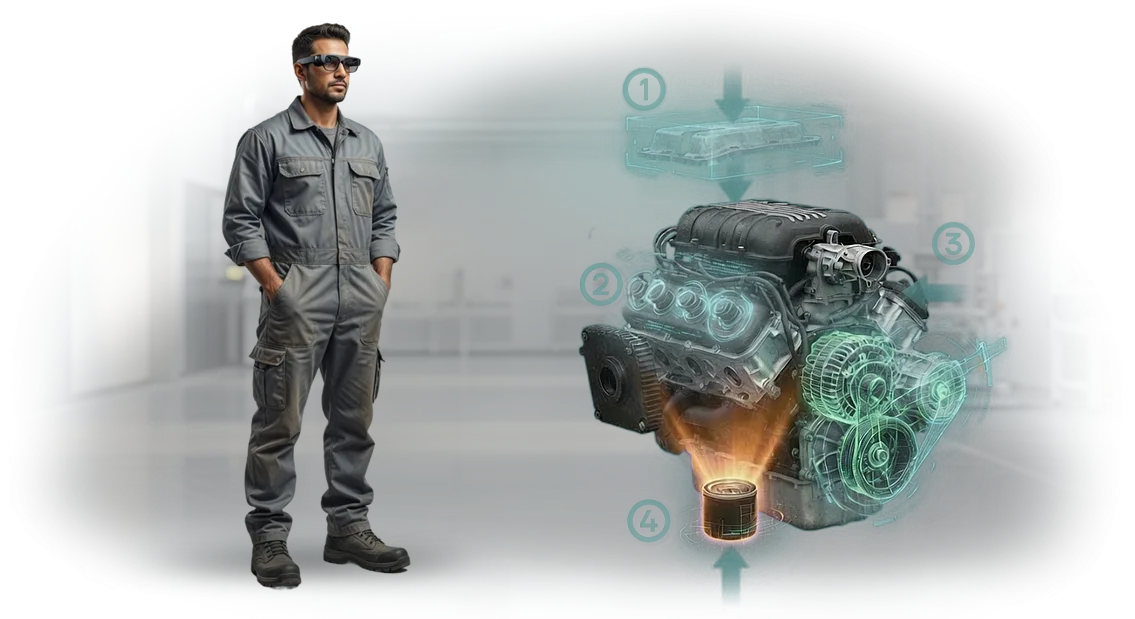
Why AR-guided maintenance is essential for your equipment?
Unscheduled production stoppages are one of the most expensive problems in any workshop. Every hour of downtime means lost output, missed deadlines, and extra repair costs. And most often the cause isn't even the equipment itself — it's staff errors during technical maintenance.
Traditional paper or electronic instructions don't help when you need to quickly understand an equipment assembly. A worker spends time searching for the right section, interprets diagrams in their own way, and mixes up the sequence of operations.
This is especially critical for young specialists who don't yet have the years of experience of their senior colleagues.
This is where AR-guided maintenance — augmented reality maintenance — comes in. Our engineers develop step-by-step digital instructions that project directly onto the equipment.
The specialist sees arrows, prompts, required tools, and the sequence of actions right in front of them, instead of searching for them in a manual.
The result: fewer errors, faster maintenance and repair, and therefore a lower risk of unplanned downtime. For example, in one project for hydraulic systems manufacturer HydraTech, planned maintenance time dropped by a third, and assembly error rates fell by half. The equipment ran more reliably, and employees became more confident.
AR-guided maintenance solves the skilled labor shortage: the knowledge of experienced specialists is turned into digital instructions and stays with the company forever. This keeps equipment running without depending on any single employee.
What benefits AR instructions deliver on the production floor
Every hour of production line downtime represents a cost calculated after audit, and a staff error during maintenance can take equipment out of service for several shifts.
Even experienced specialists waste time searching for the right instruction, while newcomers spend weeks learning from paper procedures.
AR instructions solve this right at the workstation: the employee sees step-by-step prompts overlaid on the real equipment and carries out operations accurately and quickly.
AR instructions replace multi-page documents with an interactive guide that's always at hand — on a tablet or smartphone.
Fast maintenance without downtime
Average repair time drops by 30-40% because the specialist doesn't need to flip through instructions and hunt for the right component. The system itself shows which element to check or replace, and after each step it logs completion — this eliminates skipped steps and rework.
Fewer errors and greater safety
Step-by-step control prevents the employee from skipping a critical stage: torque tightening, pressure checks, or power disconnection. This reduces the risk of accidents, injuries, and damage to expensive equipment — which in turn lowers repair costs and insurance claims.
Staff training 2-3 times faster
A newcomer performs their first operation right away, without a mentor or long courses. Experienced staff spend less time on onboarding, and staff turnover stops being critical: the knowledge is built into the instruction itself, not locked in one master's head.
Transparent tracking and control
Every operation is logged: who did what and when. A manager sees staff workload and can confirm that procedures were followed for an audit or a client — this simplifies certification and builds trust in the processes.
We design AR instructions for the specific operations of your production line: from filter replacement to complex diagnostics. Our engineers visit your site, capture the actions of your best specialists, and turn them into clear step-by-step scenarios. You get a ready-to-use tool that pays for itself after the first few prevented downtime events.
AR-guided maintenance formats for different tasks
There's no single ideal presentation for equipment repair and maintenance: a line mechanic needs a quick answer to "what to turn," while a field engineer needs the full context of the assembly.
That's why we break AR instructions into formats and build a solution for the specific task, the employee's skill level, and the type of equipment.
All formats work on tablets, smartphones, and smart glasses — through a familiar camera, without retraining staff or stopping production. The employee points the device at the machine and sees prompts right on top of the parts.
Format / Who it's for / What it delivers to the client
| Format | Who it's for | What it delivers to the client |
|---|---|---|
| Interactive assembly diagrams | Engineers, setup technicians, repair crews | Fast "inside" view of the unit: hidden parts, disassembly order, and control points are visible before work begins. |
| Step-by-step AR instructions | Line staff, new employees | The employee performs the operation step by step with verification of each action — fewer errors and defects during maintenance. |
| Remote support with AR marking | Field service engineers, external contractors | An expert in the office sees the same thing as the specialist on site and can "draw" directly on the screen to show what to unscrew and adjust. |
How we select the format
At the first briefing, we look at operation frequency and risk level. If a unit is rarely disassembled and an error is costly, we strengthen the instruction with an interactive diagram. If you need to train newcomers quickly, we build a step-by-step scenario with prompts. For unusual situations, we add remote support.
We package each format in a simple environment: the engineer or operator works in an app that requires no special training. And we stay in touch, refining the solution until it delivers stable results on your equipment.
How we build AR instructions: project stages
We work by a clear process — from the first briefing to launch and support. You always know where the project stands, what's being approved, and when the first results will appear. Below is the typical journey a client goes through.
- Briefing and audit. We analyze what equipment the team works with, which operations need instructions, and where errors most often occur. The output is an understanding of the project scope and a preliminary estimate.
- Scenario plan. We define the maintenance steps to be shown in augmented reality: from simple checks to complex unit replacements. We agree on the structure and logic of each instruction.
- Layout approval. We build a prototype on real equipment: what the step-by-step prompt looks like, what the operator sees, which labels and markers are used. You make corrections before full production begins.
- Implementation. We create all AR scenarios: animations, part highlighting, control points. We work with professional equipment and refined tools — so the result is stable across different device models.
- Pilot at your site. We test the instructions with real operators, collect feedback, and refine the wording and visuals. At this stage, changes are easy to make without impacting the schedule.
- Launch and training. We install the solution on work devices, secure access, and run a short training session for the team. By launch, your employees already know how to use the instructions.
- Support and growth. We update content when procedures change, add new operations, and help with technical questions. The project lives and grows along with your equipment.
This sequence eliminates surprises: you see the result at every stage and understand what you're paying for. And we get the ability to make changes promptly without redoing the entire work.
What's included in AR instruction delivery
The project's result isn't just a "nice app" — it's a working tool that employees use from day one. We hand over a complete turnkey package so your team is never left alone with the machinery.
- Ready-to-use maintenance scenarios — we analyze your equipment procedures and turn them into step-by-step AR algorithms. The employee sees what to do next without reading manuals or paper procedures.
- AR content for your equipment — interactive prompts, animations, and machine parts right in the operator's field of view. This cuts the time spent locating components and reduces repair errors.
- User guides — short reference notes to complement the AR scene: for troubleshooting, for new employees, or for working without a tablet.
- Training for your team — we demonstrate on real tasks and teach your engineers to modify instructions on their own, so they don't depend on us.
- Post-launch support — technical support, content updates for new models, and scenario refinements per your requests for an agreed period.
This package covers the entire cycle: employees master operations faster, make fewer mistakes, and don't waste time searching for information. The company saves on unplanned repairs and downtime, and you gain control over the process. All that's left is to agree on a pilot area and see how it works on your line.
Case study: how AR instructions cut maintenance time
At packaging line manufacturer PackLine, equipment maintenance took more than half of each mechanic's working day. When experienced specialists went on vacation, repairs turned into hunting for instructions in paper procedures, phone calls to headquarters, and on-site guesswork.
We proposed replacing all that with AR instructions: pointing a tablet at a component, the employee sees step-by-step prompts directly on the parts.
Over three months, we converted the ten most frequent operations to the new format: belt replacement, sensor calibration, and disassembly of feed units. We used an industrial AR tablet that works even in oil and under vibration. The result was measurable.
| Metric | Before | After |
|---|---|---|
| Average planned maintenance time | 4.5 hours | 3.4 hours (−25%) |
| Repair errors | 12% of operations | 4% of operations |
| Line downtime due to repairs | ~2 days per month | 1 day |
A 25% reduction isn't just the mechanic's time. Less downtime means more packaging produced, and fewer errors eliminate repeat visits and defect returns.
The client estimated the annual savings per line — the exact cost calculated after audit — and ordered an expansion to two more plants.
We achieve such results because we start with diagnostics: we measure the actual time of each operation, find the most frequent errors, and only then design the scenario. That's how AR instructions become a working tool, not a "pretty presentation."
How to choose the right AR instruction format?
There's no universal AR instruction format. The choice is determined by three criteria: equipment complexity, staff skill level, and use case. Simple operations only need lightweight prompts; multi-step repairs need step-by-step scenarios with verification of each action.
This approach is called AR-guided maintenance: the employee gets the instruction right at the workstation without being distracted by paper procedures.
Equipment dictates the depth of detail. If you have dozens of similar machines, a quick format with markers on components wins. If your units are complex and expensive, you need detailed 3D layers: disassembly, diagnostics, operation sequence. The higher the downtime cost, the more justified the detail.
Staff matters too. Experienced mechanics perceive AR as interference when the interface is overloaded, so we build an "expert" mode for them: only key control points.
Newcomers and workers in related trades, by contrast, need detailed scenarios with verification after each step. This also solves the language issue: the interface can be adapted to the employee without translating all the documentation.
Finally, the scenario matters: planned inspection, urgent repair, or training. Each has its own format. We start with an operations audit, measure time, run a pilot on one area, and then scale the solution.
This gives you a measurable result — fewer errors, faster maintenance, simpler training — without overpaying for unnecessary functionality.
Frequently asked questions about implementing AR instructions
Implementing AR instructions raises three main questions for managers: will it interfere with work, will it work with the equipment already installed, and how long will training take. Here's how we address these risks at the discussion stage.
Is it safe to work with AR instructions on the production floor?
Yes. The instructions are designed so the employee sees prompts right in their field of view, without getting distracted by paper or a tablet. This reduces errors rather than creating new risks.
We design the interface with large prompts and short steps — the employee always stays in control of the process.
Will this system work with our equipment?
We don't tie ourselves to specific manufacturers or models. Our specialists visit your site, document the specifics of your equipment, and build step-by-step scenarios around them.
If equipment changes or new units are added, the instructions are refined without rebuilding the whole system.
How long does staff training take?
Usually a single short introductory session is enough: the interface is intuitive, and the employee sees most actions on the very first day. Our team supports the launch and stays in touch until the staff is comfortable. After that, everything runs as normal.
What about warranty and support after launch?
We guarantee the result: the instructions must be clear to your employees and reduce maintenance time. After launch, we stay in touch, take your feedback, and refine the scenarios until you see the desired effect.
If you still have questions — let's discuss them on a short call and show examples tailored to your task.Ready to get AR instructions for your equipment?
After you submit a request, you receive not just a commercial proposal but a concrete implementation plan for AR instructions tailored to your equipment line.
We work through all stages in sequence — from initial analysis to launch — so you can see the result at each step and control the budget.
What happens after you get in touch:
- Request and initial call — in 30-40 minutes we clarify the goals, equipment types, and the expected impact of AR instructions.
- Next step — technical documentation audit — we review maintenance procedures, diagrams, and the list of critical operations to be converted to augmented reality.
- Usage scenario analysis — we identify where AR will deliver the greatest effect: on the line, during repairs, or when training new employees.
- Prototype on one unit — within a short timeframe we show how the instruction looks on a tablet or smartphone: step-by-step highlighting, disassembly animation, operator dialog.
- Cost estimate and precise timeline — after the prototype is approved, we lock in the budget and work schedule for the entire equipment line.
- Development start and full support — we put together a team for the task, and you receive intermediate results and milestones.
We don't ask for "blind" payment: first you see how an AR instruction works on your real equipment, assess the experience for your employees, and only then decide on scaling. Leave your request — we'll advise on timelines and budget within one business day.