

Why AR for Oil and Gas Reduces Downtime and Risks
At oil and gas facilities, the cost of a mistake is measured not only in money but also in human safety. Paper-based regulatory instructions become outdated, and the expertise of key specialists leaves along with them.
A new employee repairing oil and gas facilities is forced to act blindly — this leads to equipment downtime, increased wear, and emergency situations.
Traditional staff training takes months and fails to keep up with changes in equipment design. When an abnormal situation occurs on site, a specialist spends hours searching for the right section of documentation.
Meanwhile, the plant or field loses profit due to process stoppages, and every delay increases risks to the environment and people.
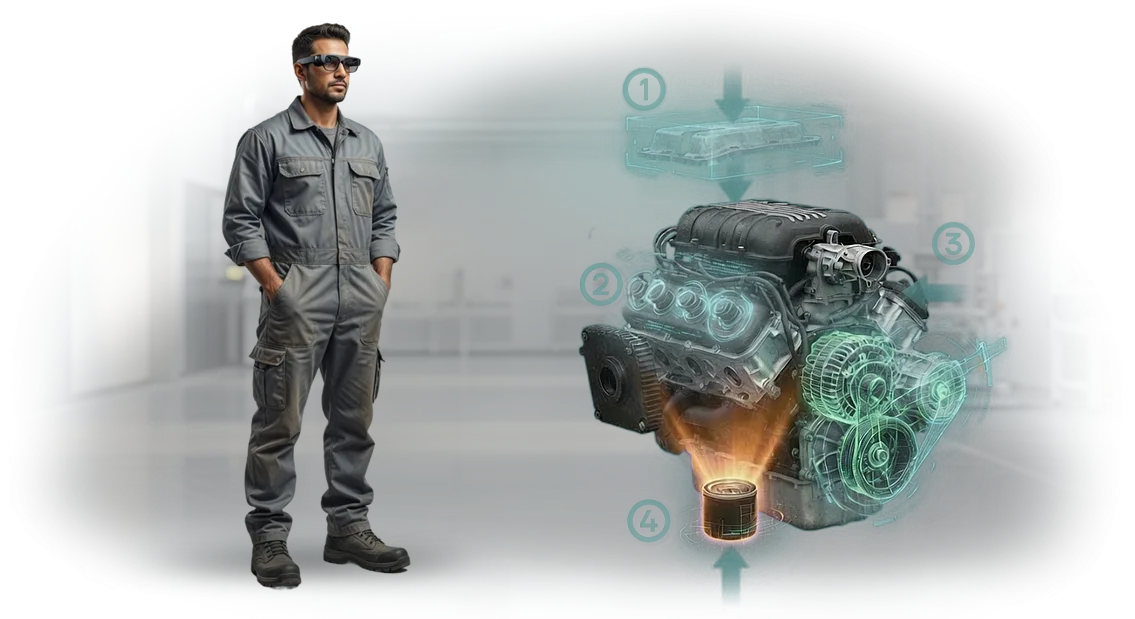
AR for oil and gas solves this problem in a radically different way. Instead of abstract drawings, the employee sees 3D prompts right on the equipment: how to disassemble a unit, in what order to tighten fasteners, where the critical sensor is located.
Repair steps are displayed in the field of view, and the system automatically verifies the correctness of actions. This format turns a complex regulation into a visual algorithm accessible even to a newcomer.
Implementing augmented reality reduces equipment downtime through fewer errors and faster diagnostics. The operator doesn't need to flip through paper instructions or wait for a specialized expert to arrive — the necessary information appears instantly. Moreover, every step is recorded, which simplifies quality control and incident analysis.
For the oil and gas sector, where every minute of downtime is expensive, AR becomes not a luxury but a daily work tool. It's protection for personnel, stability of production KPIs, and confidence that repairs are performed to current requirements.
What Implementing Augmented Reality in Production Delivers
Faster Staff Training
Staff master new equipment several times faster when they see step-by-step prompts right on the facility. Instead of reading instructions and memorizing the operation sequence, the employee receives a visual hint in their field of view. This shortens the adaptation period for newcomers and reduces the burden on mentors.
Fewer Work Errors
Augmented reality in production suggests the correct sequence of actions and warns about critical steps. If an operator misses a step or selects the wrong tool, the system immediately draws attention to it. The result is fewer defects, repeated operations, and emergency equipment shutdowns.
Quality Control at Every Stage
AR instructions make it possible to compare actual results against the reference: after each step, the employee sees whether the operation was performed correctly. This is especially important for multi-stage processes where an error at a late stage is costly.
Quality control becomes built into the work itself rather than a separate check at the end of the shift.
Remote Support Without Downtime
When a specialist encounters an abnormal situation, they can connect a remote expert who sees the same image and marks the necessary elements right in the frame. This speeds up problem resolution and reduces engineers' site visits.
Equipment experiences less downtime, and experts cover more production sites without business trips.
Formats for Implementing Augmented Reality in Industry
Augmented reality in the oil and gas industry solves various tasks: from quick access to instructions to remote support from an experienced specialist. There is no universal format — what is convenient for an operator on a drilling rig doesn't suit a repair crew in a workshop.
That's why we offer three implementation formats so you can choose the one that covers your task without overpaying.
We match the format to the use case, not the other way around. Below are typical options already working at industrial facilities: from mobile apps to industrial helmets.
| Format | For whom | What the client gets |
|---|---|---|
| Mobile app | Field personnel, operators | Instructions always at hand — employees spend less time searching for documentation and make fewer mistakes. |
| Tablet with AR overlay | Repair and service crews | Step-by-step diagram right on the equipment: faster diagnostics, less downtime. |
| Industrial helmet | Operator training, complex work | Hands are free, the expert sees what the employee sees — remote support without sending a specialist. |
How AR Instructions Are Developed
Developing AR instructions is not magic but a clear process with defined milestones. We don't disappear for months: you see the result at every stage, make edits, and control the budget.
Project approval is conducted in a convenient format, and technical documentation becomes the foundation for future updates.
Here's how we work:
- Brief and equipment audit — we meet with your engineers, review the regulations, and identify operations where employees most often make mistakes.
- Scenario design — we determine the sequence of steps to be shown in AR and record them in the technical specification.
- Layout approval — you receive a prototype of the future instruction and see the prompt logic before production begins.
- Content development — we create 3D models, animations, and text prompts that precisely mirror your equipment.
- On-site testing — together with your employees, we test the instruction on real equipment and incorporate their feedback.
- Instruction launch — we deploy the solution to tablets or industrial glasses, configure access, and train administrators.
- Support and updates — when equipment changes or regulations are updated, we promptly make edits to the AR content.
The result is a working system, not a "project on paper." Every stage is transparent, timelines are fixed, and the outcome matches your documentation and employee expectations.
What Is Included in the Delivery Package for Augmented Reality Projects
The client receives not just an augmented reality application but a ready-made tool that can be used immediately.
We assemble the package so that launch, training, and support don't fall on your employees, and the result is predictable: fewer errors, faster onboarding, and preservation of experienced specialists' knowledge.
- Augmented reality content — step-by-step instructions that overlay real equipment and guide the employee from step to step without reading paper regulations.
- Digital copies of equipment — 3D models of assemblies and parts that allow studying the design and repair procedures without stopping production.
- User guide — a clear manual for your engineers and operators: how to launch instructions, what to do in case of failures, how to update content.
- Staff training — we conduct training sessions for your employees before launch and during the pilot stage so they can confidently use the system from day one.
- Warranty and support — we fix a warranty period for the content and application, and after launch we stay in touch for refinements and consultations.
- Updates and refinement — if equipment or regulations change, we promptly make edits to the instructions so they always remain current.
| What's included | For whom | What the client gets |
|---|---|---|
| Ready-made AR instructions | Operators, repair crews | Clear steps right on the equipment, fewer errors |
| Digital copies of assemblies | Engineers, mentors | Training without the risk of breakage or line stoppage |
| User guide and training | Managers, internal trainers | Quick launch and knowledge transfer within the team |
| Warranty and support | Department head | Confidence that the system will work after handover |
All of this is packaged into one transparent project: you know what you get, what it costs, and when it will be ready. Our team handles the technical part so you can manage the process instead of digging into implementation details.
Case Study: Errors in Equipment Maintenance Reduced by 40%
For SeverEnergoProm — one of the largest operators in the oil and gas segment — we ran a pilot project to convert pump equipment maintenance regulations into augmented reality.
Engineers worked with paper instructions: some operations were performed from memory, and changes reached the workshops with a delay. The consequences were repair errors, increased accident risks, and equipment downtime.
How It Works
We developed AR instructions that show the sequence of operations step by step right on the equipment. The system monitors the sequence of actions and immediately records deviations, so every employee works to a single standard.
After two months of measurements, the number of errors during routine maintenance dropped by 40%. The average repair time fell by a quarter, and equipment downtime decreased twofold — neighboring processes stopped stalling due to prolonged work.
What the Client Got
- A single standard for all engineers: fewer disputes and rework.
- Newcomer training in 3–4 shifts instead of several weeks.
- Recording of all operations — it's clear where difficulties arise and what to improve.
After the pilot, the client rolled out the solution to three sites and ordered a second phase for the overhaul service.
Frequently Asked Questions About Implementing Augmented Reality
Implementing augmented reality in work with industrial equipment raises questions — especially about how it will affect current processes. We answer the main concerns most often voiced at meetings with technical department heads.
Is it difficult to integrate AR into existing systems?
Integration happens without stopping production: data is loaded from your regulations and schematics. Engineers connect remotely — you don't need to allocate a dedicated IT team.
How are instructions updated after equipment changes?
Content is changed through a simple web portal — no programmers needed. You edit texts and 3D schematics, and employees immediately see the current version on a tablet or smartphone.
What guarantees do we get?
We work under a contract: we fix the support schedule, response time, and free maintenance for the first year. In case of failures, we resolve them on a priority basis — you don't lose time to downtime.
How long does launch take?
A typical project takes 3–6 weeks: audit, content preparation, and a pilot area. For large facilities, we implement in stages — this reduces risks.
Didn't find the answer to your question? Write to us — we'll prepare a cost estimate for your facility.We'll Calculate the Project Cost for Your Task
Send us a description of your task — and within one business day you'll receive a cost estimate and a recommended AR instruction format. We work with oil and gas industry equipment: from pumps and compressors to valves and product treatment units.
For each facility, we select a solution that genuinely reduces training time and the number of staff errors.
Ordering AR is not just buying an application — it's the development of instructions that actually work: clear prompts for employees, fast onboarding, and less downtime. That's why we fix all stages in the estimate and stay in touch after launch.
What you'll get after submitting a request:
- Accurate development cost — the estimate is fixed before work begins, with no hidden payments.
- Format selection for your task: a single instruction, a series of modules, or a system with operator action control.
- Specific timelines and stages: from brief to production launch — you see the entire path.
- Examples of our AR developments for industry and feedback from industry colleagues.
- An engineer's consultation: we'll advise on how to integrate AR into current regulations and the training system.
- Post-implementation support and quick refinement for new equipment models.
Fill out the request form on the website or write to us in any convenient messenger — specify the equipment type and the recurring problem you need to solve. We'll calculate the cost and propose a solution that will pay off as soon as the first batch of trained employees.
How to Choose the Right Instruction Format for Your Production Specifics?
The choice of AR instruction format is determined not by the "trendiness" of the technology but by the specifics of your production: equipment type, staff working conditions, and error criticality.
For complex units with dozens of assemblies, step-by-step scenarios with part highlighting are effective — the employee sees the sequence of actions right on the housing without being distracted by paper.
For frequent routine tasks, short checklists that verify key points in a couple of minutes are sufficient.
The operating context also matters: in workshops with high noise levels or at sites where hands are occupied with tools, voice prompts and camera-based control without touching the screen work better.
If equipment is spread across the territory, AR instructions can include navigation to the required unit.
Explosion-hazard zones require standalone solutions without constant server connectivity — this also affects the format but not its value: personnel receive accurate information exactly when they need it.
The decisive factor remains the skill level of employees. Experienced specialists value quick access to reference data and the ability to disable detailed prompts. New employees, on the contrary, need a "training mode" with explanations for each step. The right format adapts to the user rather than forcing a person to adapt to the technology.
We select the AR instruction format for your production specifics as early as the analysis stage: we look at equipment types, maintenance scenarios, and crew qualifications.
As a result, you get a tool that is clear to your staff, reduces training time, lowers the risk of errors, and pays off through less downtime. If you're unsure which format suits you, send us a description of one typical task, and we'll show you how it will look in AR.