

AR for Oil and Gas: Instructions That Reduce Downtime
Every hour of downtime at an oil and gas enterprise is a direct loss: halted production, missed schedules, idle crews.
Complex equipment requires precise and timely maintenance, and a repair error can result not only in financial losses but also in risks to people and the environment.
At the same time, traditional instructions do not always help: a technician spends time searching for the right page, tries to match a drawing with the actual component, and acts at their own risk.
Industrial AR instructions solve this problem.
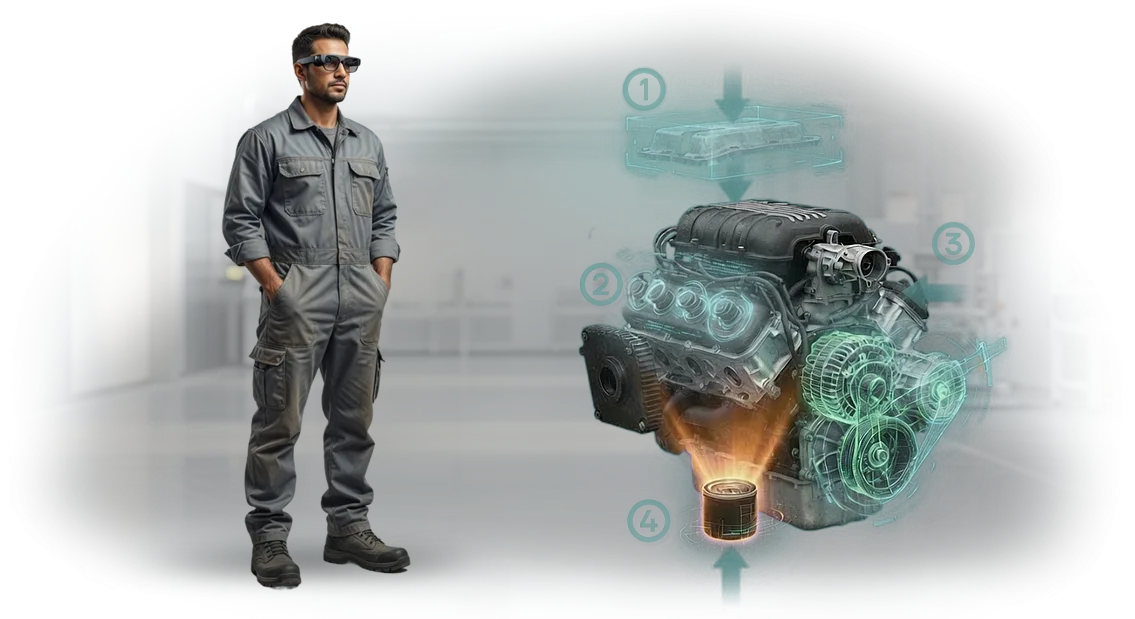
Instead of flipping through documentation, an employee sees digital hints right on the equipment: arrows indicate exactly what to unscrew, animation shows the disassembly sequence, and a checklist in their field of view prevents missing an important step.
This is especially valuable in the oil and gas industry, where equipment is often unique and the cost of error is high.
For a manager, this means predictability of repair and maintenance work. Equipment downtime is reduced by multiple times—operations that previously took hours and required rare specialists are performed by the regular team faster and without defects.
In addition, AR instructions pass on the experience of veterans to novices through visual repair scenarios, not through thick manuals.
AR for industry is no longer an experiment but a working tool that has proven effective in repairing pumps, shut-off valves, and compressor equipment.
We help oil and gas enterprises implement such instructions turnkey: we analyze typical repair scenarios, create digital guides, and train personnel.
As a result, you get less downtime, lower service costs, and confidence that any task at the site will be done correctly the first time.
What the AR Approach Gives Workers and Engineers
Workers and engineers at industrial sites daily face complex regulations, multi-page instructions, and high accuracy requirements. Any error during equipment repair or maintenance results in downtime, costs, and risks to people.
AR instructions solve this problem: instead of reading paper documents, a specialist sees step-by-step prompts directly on the equipment. This speeds up repair work by 30–40%—less time spent finding components, determining the sequence of operations, and checking the result. Less downtime means higher output and revenue.
Operation accuracy also reaches a new level. The system highlights the needed parts, shows the correct tool, and monitors each step. An engineer does not need to keep hundreds of details in mind—they simply follow visual guidance. This reduces the number of errors and rework, saving budget on spare parts and repairs.
Safety deserves special mention. AR warns about potentially dangerous areas, reminds about protective equipment, and blocks actions that could lead to an accident.
If the site needs a consultation from a narrow specialist, they connect remotely and see the same image as the worker—remote support becomes as effective as having an expert present on site.
In addition, AR instructions accelerate the training of new employees. A newcomer quickly learns processes by looking at prompts, while experienced specialists are freed from mentoring.
This is critical for the oil and gas industry: a shortage of personnel and high turnover require fast onboarding.
We implement AR solutions at industrial enterprises and work on professional equipment, including HoloLens. This delivers consistent results: our clients reduce downtime and improve work safety without capital expenditures for re-equipment.
AR for Oil and Gas: The Right Implementation Format
Every oil and gas enterprise faces the same pain point: the equipment is complex, the instructions are extensive, and an employee must perform an operation quickly and without errors.
Paper regulations do not help—they take a long time to find, are difficult to match against the actual component, and knowledge is lost when personnel change.
Augmented reality technology solves this problem, but it is important to understand: AR is not one product but several formats, each of which addresses its own task.
| Format | For whom | What it gives the client |
|---|---|---|
| Overlay AR instructions | Operators, repair crews, on-duty personnel | Step-by-step prompts directly on the equipment: an employee sees which component and in what order to turn. Fewer errors, faster startup and maintenance. |
| Industrial AR simulator | New employees, training centers, personnel development departments | Training on a virtual model of equipment without the risk of breakdown or production shutdown. Practicing algorithms before going to the real site reduces onboarding time by 30–50%. |
| Remote AR assistance | Service engineers, field crews, technical support | An expert in the office sees on their screen the same thing as the specialist on site and draws prompts directly in their field of view. Fewer site visits, faster resolution of abnormal situations. |
The choice of format depends on the specific point in the process: where you are losing speed, quality, or knowledge.
We help identify that point, choose the appropriate type of AR solution, and integrate it into your regulations—without restructuring the production system and with personnel training.
As a result, you get operational predictability and a measurable effect on every piece of equipment.
How the Project Proceeds: From Brief to Launch
We know that at an industrial site, every day of downtime or personnel error is expensive. Therefore, the AR implementation process is built transparently: you see the result at each stage and can make edits without delays.
Below are the typical stages of AR instruction development for oil and gas, from brief to launch and support.
- Brief and task audit — you tell us about your equipment, regulations, and complex operations. We identify which instructions will have a quick effect and offer a solution tailored to your processes.
- AR solution approval — we show a prototype at your site or workshop, discuss logic and safety. You approve the plan before development begins.
- AR instruction development — we create step-by-step scenarios for repair, maintenance, and personnel training. You receive intermediate versions for review at each stage.
- On-site testing — we test the instructions with your employees in real conditions, collect feedback, and make final edits.
- AR project launch — we deploy the solution on tablets or smartphones, train the team, and hand over documentation. Personnel start working with AR within a couple of days.
- Post-launch support — we stay in touch: update content, add new components, and help expand the project to other areas.
What Is Included in the AR Solution Delivery
We deliver the AR product as a working tool, not as a set of files. The customer receives an AR instructions kit that can be implemented immediately: ready-made scenarios, system access, personnel training, and documentation for the operations department. Everything needed for launch and support is in one package.
The delivery includes:
- Ready-made AR instructions for key operations—maintenance, diagnostics, repair. We build scenarios according to your regulations and tie them to specific equipment.
- Platform access — a secure account for engineers and administrators, with role-based permissions. New workstations can be connected as the company grows.
- Personnel AR training — practical sessions for operators and administrators: how to use the instructions, update content, and add new scenarios without contacting developers.
- AR documentation — operation, administration, and technical support guides in Russian. Everything your operations department needs to work independently.
- AR system maintenance — warranty support, scheduled content updates, and stability monitoring. If something changes in your processes, we help adapt the instructions.
Each item in the kit is customized to your tasks and production specifics. We are responsible for ensuring the AR solution is integrated into the workflow and delivers measurable results: fewer errors, faster onboarding, and lower downtime.
Case Study: How We Accelerated Pump Equipment Repair
Challenge
A major oil and gas operator faced a problem: pump equipment repair took up to six hours, and due to errors caused by human factors, the equipment repeatedly failed.
Crews spent time studying paper instructions and searching for the right components, increasing downtime and spare parts costs.
Solution
We developed AR instructions for Volganeft: on the screen of a regular tablet, a specialist sees step-by-step prompts overlaid directly on the real equipment.
Arrows, checkpoints, and the sequence of actions appear in their field of view—no need to be distracted by documentation or keep complex diagrams in mind.
Together with the customer's engineers, we transferred their experience, regulations, and typical faults into augmented reality scenarios. This preserved the company's expertise and made it accessible to every repair crew.
Result
The implementation of AR instructions reduced repair time by 30% and halved the number of errors. For the operator, this means less downtime, savings of more than a cost calculated after audit per year at a single site, and higher equipment utilization.
The pilot project paid for itself within several months, so the company's management scaled the solution to all pumping stations.
Now repair crews work faster and more confidently, and new employees reach the required skill level without lengthy mentoring. For the customer, this is not just savings but increased reliability of the entire production chain.
How to Choose the Right AR Format for Oil and Gas?
Choosing an AR solution for oil and gas usually comes down not to technology but to what problem you are solving: reducing personnel training time, lowering the risk of repair errors, or improving safety at the site.
That determines which AR you need—from simple step-by-step instructions to full support for complex operations in real time.
For the gas industry, operating conditions also matter: whether an employee works in a workshop, in an open area, or in a confined space, whether there is network access, and how critical each minute of downtime is.
All of this determines the format—for example, on a tablet or through augmented reality glasses, autonomously or with constant contact with an expert.
In practice, selecting an AR format should start with an audit of the specific area: which operations are performed most often, where errors occur, and how long training takes.
We help the customer go through this path without unnecessary costs: first we run a pilot on one process, measure the effect—speed, number of errors, time to independent work—and only then scale to other areas.
The main advice: do not look for a universal solution for all tasks at once. The problem of choosing an AR solution is solved gradually—start with a narrow but painful task where the result is visible in a couple of weeks. This way you get clear numbers for management and confidence that the next step is justified.
We are responsible for results, not for technology demonstrations. The choice of AR format is made based on your business metrics: reducing accident rates, repair speed, trainability of new employees.
If you need not just an experiment but a working tool for a production site or plant—let's start by reviewing your situation and we will offer an option that delivers value from the very first stage.
Frequently Asked Questions About Implementing AR Instructions
We understand that many questions arise when implementing AR instructions in oil and gas: is it safe, is it difficult to integrate, how long will it take, and what will it cost. We answer directly, without technical details.
We work on a professional AR platform (Unity), so we guarantee stability and data protection at all stages. Below are answers to the main concerns of customers.
What are AR instructions and why are they needed?
AR instructions are step-by-step prompts that appear directly on the equipment through a tablet or smart glasses. The operator sees where to press and what to check without being distracted from the work. This reduces the risk of errors and shortens training time.
Is it safe to use AR instructions on a production site?
Yes. AR instructions do not replace a person; they help them: the operator sees prompts directly on the equipment without being distracted by paper or a screen. The system works locally and does not transmit data to external networks, so the risk of leaks is excluded. We take industrial safety requirements into account and adapt the interface to specific conditions.
How difficult is it to integrate AR into existing processes?
Implementation proceeds without stopping production. We analyze your regulations, convert them into AR format, test them in one area, and only then scale. Usually there is no need to change equipment or software—tablets or smart glasses already available on site are sufficient.
What are the implementation timelines and project cost?
Timelines depend on the number of instructions and process complexity. A pilot project takes 4–6 weeks, and full deployment takes 2–3 months. The cost is calculated individually and pays off through reduced errors and faster training.
For an assessment, it is enough to audit your tasks—we will prepare an accurate estimate within a few days.
What do we get in the end?
Ready-made AR instructions integrated into your documentation system, personnel training, and technical support. After launch, our engineers support the project and update content when regulations change.
Get a Project Estimate in 2 Days
Leave a request and in 2 days you will receive a transparent cost calculation for AR instructions for your equipment.
You will know exactly how much the project costs, what stages are included, and when the interactive instruction will start reducing downtime and personnel errors.
What You Get After Contacting Us
- Estimate for your task — a preliminary cost calculation and timelines, with no hidden charges or fine print.
- Consultation with an AR specialist — we will help you understand which operations are worth converting to AR and where a regular instruction is sufficient.
- Examples of similar solutions — we will show how AR instructions work on similar equipment and what effect they produce.
- Implementation plan — a short document with stages, areas of responsibility, and a launch point.
- Collaboration format — a one-off project or long-term support, with the result captured in the contract.
- Protection of your data — we will discuss the terms for working with drawings and technical documentation even before the start.
After the estimate, you will be able to compare the cost of AR instructions with the losses from each error or minute of downtime—and make a decision without rushing. And if you want to discuss details personally, we will schedule an online meeting with an engineer from our team.
Fill out the form or write to us in any messenger—in the subject line, indicate "AR for Oil and Gas." We will respond within one business day.