

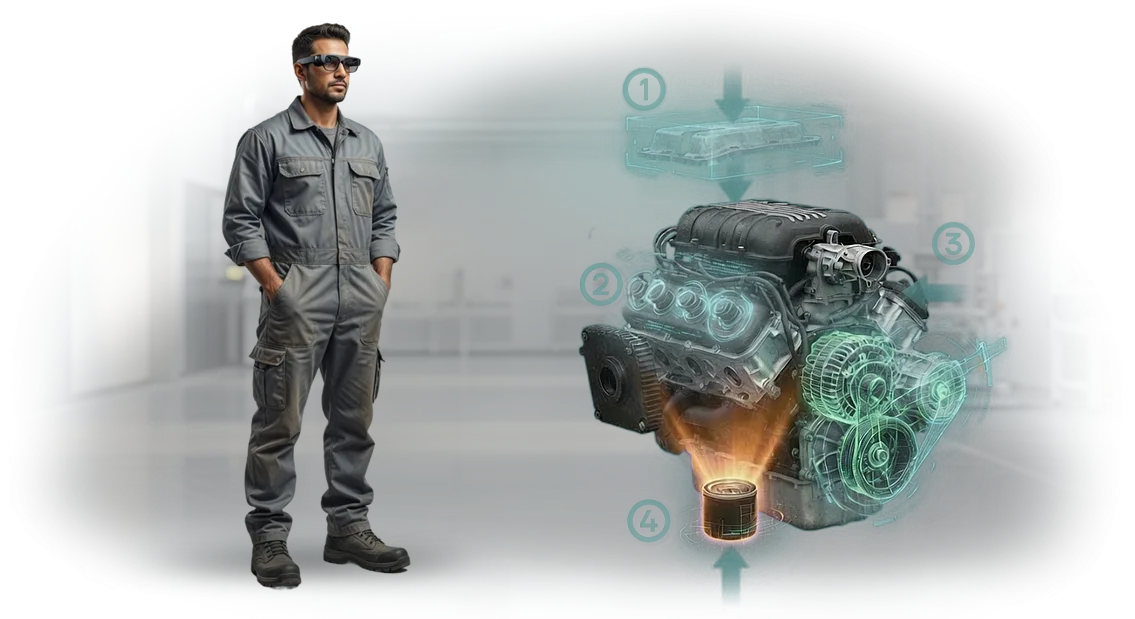
AR for Aerospace: Why Maintenance Errors Are Costly
The aerospace industry does not tolerate inaccuracies. An error in an instruction during maintenance of high-value equipment can result in days of production downtime and, in the worst case, accidents and risks to people.
When technical documentation is extensive and a specialist works under tight deadlines, the probability of a wrong step increases.
Every hour of downtime means lost contracts, delayed deliveries, and a hit to reputation. Meanwhile, quality control on the ground and in the air requires that every bolt is torqued to a specified value and every cable is connected according to the diagram.
Traditional paper manuals and PDF instructions force specialists to look away, search for the right section, and interpret drawings — and that is where errors are born.
AR for aerospace solves this problem: digital prompts are overlaid directly on the equipment, guiding the specialist step by step. The technician sees which part to pick up, where to install it, and what force to apply — without shifting attention to a screen or document.
This level of instruction accuracy shortens equipment commissioning time and minimizes defects. The company gets a predictable maintenance process, fewer downtimes, and confidence in operational safety. That is why aerospace manufacturers are increasingly adopting AR instructions as a standard.
Our team helps implement such solutions tailored to the tasks of a specific production facility — from a pilot area to scaling across all workshops.
What You Get from AR Instructions: Accuracy, Speed, Control
AR instructions for industrial equipment are a tool that transfers the experience of senior engineers into a digital environment and makes it available to everyone.
For a manager, this means three measurable outcomes: fewer errors, faster repairs, and significant training savings.
When a technician sees the sequence of operations directly on the actual component, there is no need to keep dozens of items from a paper procedure in mind.
Each part, each bolt displayed on the screen is overlaid on the real equipment, eliminating skipped steps and incorrect assembly. In aerospace, such precision is especially important because the cost of an error is not only downtime but also the safety of the entire aircraft.
With AR instructions, repairs no longer depend on the memory of an individual employee. Instead of searching for the right page in a manual, the specialist immediately receives prompts: what to unscrew, which tool to pick, and what torque value to apply.
Routine maintenance is completed 30–40% faster, and complex faults are resolved on the first attempt.
Training beginners stops being a separate, lengthy stage. With AR instructions, a new mechanic can perform tasks almost immediately, while a senior specialist simply supervises the result.
This shortens onboarding, reduces the workload on experienced employees, and lowers mentoring costs.
You get a complete picture of operations: which repairs have been performed, how long each stage took, and where deviations occur. This data enables continuous process improvement — updating instructions and adjusting procedures. In this way, AR becomes a management tool rather than just a digital layer.
AR Formats for Aerospace: How to Choose for Your Task
In the aerospace industry, downtime and errors are especially expensive: every hour of equipment downtime can mean missed contract deadlines.
Therefore, AR instructions should be selected not “in general,” but for a specific operation — planned maintenance, repair after a failure, or training new personnel. The right format reduces work time by a factor of 1.5–2 and lowers the number of errors.
We identify three working AR instruction formats. They differ in depth of detail, usage scenario, and the outcome a manager gets.
| Format | For whom | Client benefit |
|---|---|---|
| Maintenance | Engineers performing scheduled work | Fast checklist-based inspections, fewer missed components during checks, consistent quality |
| Repair | Repair crews and field specialists | Step-by-step disassembly of components with part highlighting, downtime reduced by up to 40% |
| Training | New employees and technical staff | Visual instructions without the risk of damaging equipment, faster readiness for shifts |
The choice of format depends on the frequency of the operation and the skill level of the employee.
For routine maintenance, a lightweight AR hint on a tablet is sufficient; for complex repairs, a detailed animation of the component; for training, an interactive simulator with action tracking.
We select the format according to your task and show, already at the brief stage, what result you will get at a specific site.
Stages of Developing AR Instructions for Your Production Facility
Developing AR instructions is a process in which your team participates at key points. We start with a brief and finish with deployment in the workshop, including employee training and post-implementation support.
For the aerospace industry, where the cost of an error is high, each stage is coordinated with those who will work with the instruction daily.
-
Brief and production immersion — we gather requirements, review current instructions and safety regulations, and identify areas where AR will deliver maximum impact: complex operations, infrequent maintenance, training beginners.
-
Prototype demonstration — we show the selected AR scenario at the actual workstation. You see the format before full development begins and can adjust your requirements.
-
Scenario alignment with your team — together with process engineers and engineers, we review each operator step: what appears on the screen, what prompts and warnings are needed. This ensures accuracy and safety.
-
Content creation and development — we prepare 3D models, animations, and prompts based on your technical documentation. In parallel, we test the instruction to ensure it works reliably in production.
-
Testing with operators — we involve the employees who will work with the instruction. They check usability and clarity, and we make corrections before deployment in the workshop.
-
Launch and training — we install the system at workstations, train personnel, and hand over materials for independent work to your team. We formalize the update procedure.
-
Support and evolution — we stay in touch after launch: update instructions when equipment changes, add new scenarios, and monitor stability. You pay only for the changes you need.
What Is Included in the AR Instruction Delivery: A Complete Package
You get not scattered instruction files but a ready-made AR prompt system embedded in your production. We cover the entire cycle — from scenario development to post-launch support — so you don’t need to hire contractors or deal with technical details.
- Ready-made AR scenarios for your operations — step-by-step instructions overlaid on equipment via a tablet or smartphone. The employee sees what to do and where directly on the machine’s components, which reduces errors and accelerates training for beginners.
- Customization for your equipment — scenarios are adapted to specific models of machines, instruments, and production lines, including rare and non-standard modifications.
- Operator and administrator training — we conduct training sessions: some employees learn to work with AR instructions, while others learn to edit and extend them independently without involving programmers.
- Content update environment — an intuitive editor where you update scenarios when processes change. No need to wait for developers or pay for every edit — everything is done by your team.
- Technical support after implementation — we remain available: advise on operational issues, help with configurations, and resolve emerging problems quickly.
- Documentation and procedures — we hand over a complete set: user manuals, administrator guides, update procedures, and version control. Everything is transparent and ready to use.
The entire delivery is structured as a single package — from the first scenario to daily support. You get a tool that increases work speed and reduces the burden on your specialists.
Case Study: How AR Instructions Reduced Repair Time by 30%
In the aviation industry, an hour of equipment downtime means lost money and the risk of flight disruptions. Repairing complex components requires high precision, while paper instructions do not show the actual position of parts. Engineers spend time reading schematics and asking senior colleagues instead of working.
We solved this problem at one of the plants of an aircraft maintenance holding company. The technical staff received tablets with step-by-step AR prompts: markers are overlaid directly on the equipment, showing the sequence of operations and control zones.
The specialist sees the entire instruction without looking away from the object and immediately notices deviations from the standard.
Implementation Figures
- Typical repair time decreased from 12 to 8.5 hours — a 30% reduction.
- The number of errors during reassembly fell by almost half.
- A new employee reaches the performance level of an experienced master three times faster.
The workshop manager received an interactive summary for each operation: where delays occur, which components require rework, and how team workloads change. This makes it possible to plan maintenance and prevent downtime rather than deal with its consequences.
The customer recouped the investment in four months and transferred two more repair lines to AR instructions.
We work with professional equipment and support implementation until a stable result is achieved, so what you get is not a “demo stand” but a working production tool.
How to Choose the Right AR Instruction Format for Your Task
Choosing the right AR instruction format is indeed like choosing a tool: there is no universal solution, but an optimal option exists for each specific task.
The answer depends on several factors: what exactly the employee does — assembles, diagnoses, or repairs a component; the working conditions; and the skill level of the staff.
If the operation is complex and multi-stage, step-by-step prompts that remain in the field of view and prevent distraction from the drawing are more suitable.
For quick equipment diagnostics, a mode that overlays a schematic onto the real object works better — it allows instant comparison of the component’s actual state with the reference.
For training new specialists, an interactive simulator is valuable because it allows them to safely gain hands-on experience before working with a real unit.
At the same time, we always start not with technology but with an audit of your production chain.
Our engineers visit the site or study the process in detail based on your materials to determine exactly where the AR usage scenario will provide the greatest gain in speed and quality.
This is why we ask for a consultation before development starts — it saves budget and ensures the format solves your problem rather than just looking modern.
Would you like an assessment for your specific case? Contact us — an engineer will analyze the scenario and recommend the format that will pay off fastest.
It is important to understand that we do not sell template solutions: every system is tested on a real site before implementation.
Answers to Frequently Asked Questions About Developing AR Instructions
Managers often postpone AR instruction implementation because of uncertainty: how it will affect the production cycle, how long it will take, and what will happen to existing equipment. We answer the main questions — briefly, without technical details, only what affects your decision.
How long does implementation take?
A typical project takes 4–6 weeks from the moment the instruction mockup is approved. The first pilot versions for one component are ready within a couple of weeks — you see the result and can make edits if needed before the main launch.
If you need to cover several workshops or complex units, the timeline extends to two months, but the work is carried out in stages without stopping production.
Is it difficult to integrate instructions into current processes?
No, there is no need to change equipment or retrain personnel. Employees use tablets and smartphones that are already available on the site, and training takes one working day.
The instructions do not replace existing procedures but complement them: the operator sees prompts directly on the screen and quickly learns the sequence of operations. Assembly and maintenance errors decrease within the first weeks.
Will the solution work with our equipment?
We create instructions for the specific models of machines and instruments used at your site. To start, we need technical documentation and a few photos of the components — after that, engineers anchor the animation and labels to the real parts.
Compatibility causes no conflicts with existing systems: the instructions work as a standalone application and do not interfere with equipment control or accounting software.
How much does development cost?
The cost depends on the number of instructions and the complexity of the components. The cost of a pilot project for a single site is calculated after an audit — this is enough to evaluate the effect before scaling to all workshops.
The investment is recouped through reduced defects and faster onboarding of new employees. For serial production, the savings from fewer errors often exceed the development cost in the first year.
What guarantees do you provide?
We fix deadlines, scope of work, and cost in the contract — before signing, you receive a detailed estimate with exact stages. After launch, we provide technical support: revisions and consultations are included in the price for the first year.
If something does not meet the declared quality, we fix it at our expense. Our goal is long-term cooperation, so the result is accepted only after you verify its convenience for your operators.
Order AR Instructions for Your Production Facility Today
Leave a request — and we will prepare a cost estimate for your production area. Within 2–3 days, we will show how an AR instruction will fit into existing processes and propose a pilot project for one component or operation.
The pilot allows you to assess the effect without major investments: you see how an employee works with overlaid prompts, how much time is saved during assembly or maintenance, and how quickly beginners master operations. After the pilot, you decide about scaling — we implement instructions at all critical points.
What you get by contacting us:
- Cost and timeline estimate tailored to your task — no hidden surcharges.
- Pilot on a real site: test AR on one component and pay only for that stage.
- Implementation without stopping production: training takes one day, and in parallel we work with your documentation.
- Support after launch: we update instructions when procedures change and respond within one business day.
- A dedicated project manager as your contact — available at all stages, from brief to acceptance.
We work remotely and have already implemented AR instructions for aerospace and engineering enterprises. Leave a request — we will come back within a day with concrete steps and figures for your production.