

Why AR VR in Oil and Gas Is Not a Fad but a Necessity
At oil and gas facilities, the cost of an error is measured in hours of downtime and risks to people. Outdated paper instructions do not reflect the real condition of equipment, and a newcomer needs months of training.
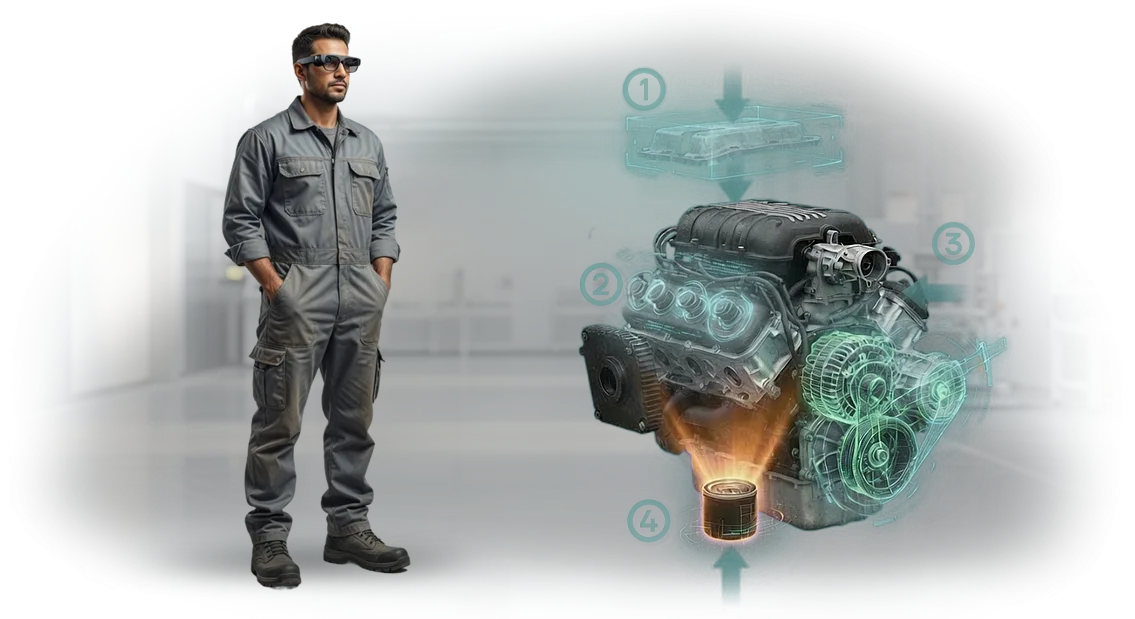
The introduction of AR in oil and gas changes this: step-by-step digital prompts are overlaid directly onto the object.
Human error is the main cause of emergency shutdowns and unplanned repairs. Every such incident means lost output and serious costs that are easy to measure. They hit revenue and reputation.
Industrial AR solutions reduce the number of errors in maintenance and repair. This directly cuts downtime, extends equipment service life and gives back the time of experienced specialists.
Personnel training in oil and gas is also becoming more practical. Instead of long theoretical courses — working with digital prompts right at the workplace. A new employee gets involved in the process faster, and an experienced specialist is distracted by routine less often.
AR VR oil and gas has already stopped being an experiment. Leading enterprises consider the deployment of AR a standard for briefings and repairs. Companies that postpone the decision are left with more expensive maintenance and less prepared teams. And this gap with competitors keeps growing.
What you will get from AR instructions for equipment
AR instructions for industrial equipment are a way to reduce losses from the human factor and accelerate bringing employees up to full working mode. We create such instructions on a proven AR platform adapted to industrial site conditions.
Instead of studying lengthy manuals, the operator receives prompts within their field of view, tied to a specific unit. As a result, the number of errors in following regulations decreases, and the time to master new processes is reduced many times over.
Operator training becomes systematic and does not depend on the mentor's experience. Every employee — both a newcomer and an experienced specialist — goes through the same visual scenario, which eliminates knowledge gaps.
AR instructions are convenient to use both for mass retraining and for rare operations, where previously external experts had to be invited.
Production safety reaches a new level. Prompts warn about hazardous zones, remind about protective equipment and the correct sequence of actions.
The operator is less distracted by paper documents and focused on the process itself, which means the risk of accidents and injuries is reduced.
The economic effect consists of several components: fewer defects and less downtime, faster onboarding of new employees, lower costs for business trips and training grounds.
AR instructions are easily replicated across all sites — content created once works at dozens of facilities without loss of quality. For the oil and gas industry with its remote fields and strict regulations, this is tangible savings in operation.
AR solution formats for your production tasks
The same AR guide can be displayed on a tablet, smartphone, or smart glasses — and each option solves its own task. We select the format for the scenario: where the employee works, what is in their hands, and how long the operation takes.
Here is what typical AR instruction formats look like in production:
| Format | For whom | What it gives the client |
|---|---|---|
| Tablets | Engineers, repair crews, commissioning | Large detail of components, diagrams and drawings directly on the equipment, convenient for scheduled inspections |
| Smart glasses | Operators, installers, employees in the workshop | Hands free: step-by-step prompts and access control in the field of view, fewer errors and higher safety |
| Mobile devices | Maintenance personnel, field specialists | Quick access to instructions from any device, no desktop computer or paper regulations needed |
Tablets provide maximum detail: you can show a component cross-section, an animated sequence of actions, or hidden elements. Smart glasses free up your hands — the employee sees prompts right in front of their eyes while performing the operation.
And the mobile format is convenient where speed matters: point the camera at the equipment and instantly get the needed section.
We help choose a format or a combination of them for your tasks and budget. If production is distributed, we will supplement the solution with a web version for access from any devices. If autonomy is needed, we will configure offline mode.
As a result, employees stop flipping through paper regulations, and training and repair time is reduced.
How an AR instruction creation project works
We have structured the process so that you understand the timelines, budget, and result in advance, rather than getting “surprises” in the middle of construction.
Each stage ends with a clear artifact: a document, a prototype, a pilot version — you see what you are paying for and can influence the course of the project.
- Brief and immersion in the task. We determine which operations need to be covered by instructions, who the user will be — an experienced mechanic or a new employee, and on which devices the AR will be opened. We define success criteria: reduced repair time, fewer errors, faster training.
- Audit of equipment and scenarios. We visit the site or work from your documentation, photos, and videos. Engineers identify the components that should be “highlighted” in AR and the difficult spots where the instruction will bring maximum benefit.
- Design and estimate. We prepare a detailed plan: a list of AR instructions, format (step-by-step hints, 3D diagram, checkpoints), timelines, and cost of each block. You approve priorities and can start with a pilot area.
- Content development. We create 3D models of components, disassembly-assembly animations, text hints, and voice comments. We verify the content on your real equipment samples so that the markings match what the operator sees.
- Approval and refinement. You receive interim versions and test them together with mechanics. We collect feedback, make edits — up to two iterations at no additional cost, so that the result satisfies both management and field personnel.
- Pilot testing on site. We launch AR instructions in a limited area: we check operational stability, interface usability, and the actual speed of performing operations. Based on the pilot results, we provide a report with metrics and scaling recommendations.
- Launch and support. We deploy the system in all required areas, train administrators, and hand over documentation. Then we provide ongoing support: we update instructions when regulations change, add new components, and monitor performance.
This order provides predictability: at each step you understand what you get and how much it costs. And a pilot project allows you to verify the effect on one operation before scaling AR across the entire equipment fleet.
What is included in the AR solution delivery for your facility
For an industrial facility, an AR instruction is valuable only when it works on the shop floor, not on a demo stand. We deliver not scattered prototypes, but a complete set of AR instructions: from scenarios to personnel training. This is turnkey AR implementation — you get a tool that immediately integrates into your workflow.
The AR solution delivery includes:
- Ready-made AR scenarios tailored to your regulations: step-by-step instructions for repair, maintenance, and diagnostics with hints overlaid on real equipment components.
- Integration with existing documentation: we convert process charts, regulations, and checklists into AR format so the operator sees the required step without referring to paper.
- Equipment configuration for your site: we select workstations, tablets, or headsets for the shop floor conditions — dust levels, temperature, explosion-proof requirements.
- Personnel training: we conduct sessions for engineers, operators, and repair crews so they can confidently use the instruction from day one.
- Content rights: all created AR content belongs entirely to you. You can update the instructions with your own team or order enhancements from us.
As a result, you get a controlled process: new employees reach the target performance faster, maintenance errors decrease, and knowledge does not depend on a specific specialist.
Case study: how we reduced equipment downtime by 30%
Our client is an oil and gas field operator. A shutdown of a pumping station or compressor costs hundreds of thousands of dollars per hour of downtime, so every failure requires an instant response.
The problem was that repairing complex equipment involves dozens of pages of instructions, components that cannot be seen by the naked eye, and a high risk of error during reassembly.
Engineers wasted time searching for the right diagram, and new mechanics took months to gain experience.
How we solved the task
We implemented AR instructions for repair crews. A specialist puts on an AR headset HoloLens and sees step-by-step prompts directly on the real equipment: in what order to unscrew the fasteners, how to remove the component, where to connect the hose.
There is no need to flip through paper manuals or call an engineer — the necessary information appears right in the field of view. This accelerated diagnostics and reduced the number of reassembly errors.
Implementation results
- Equipment downtime decreased by 30%;
- The time required to train new mechanics was cut in half;
- The share of repairs completed on the first attempt increased to 90%;
- The team began involving on-site specialists less often — savings on business trips.
The client appreciated the effect so much that they ordered scaling of the AR system to all key facilities of the field. For us, this is the main indicator: AR instructions have become a working practice rather than a demo project. We continue to support the system and adapt scenarios for new equipment.
How to choose an AR format for industrial equipment?
A common question is how to determine which AR format will suit your equipment, processes, and budget. The answer starts not with technology, but with analyzing the task: what you want to achieve — reduced downtime, faster training, quality control, safety.
This determines the choice: simple holographic hints, step-by-step 3D instructions, or full overlay of a digital model onto a real object.
The first criterion is the complexity and type of equipment. For a standard machine, a marker-based AR instruction is sufficient: an employee points a tablet camera, sees hints, and follows the steps.
For complex assemblies with many components, spatial alignment to the object's geometry is needed to accurately show attachment points, service areas, and the sequence of operations. The higher the risk of error, the more detailed the visualization must be.
The second criterion is working conditions. If personnel service equipment in a clean area, tablets and smartphones are convenient. In field conditions, in freezing cold, in dirt, or with limited access, voice-controlled glasses that free up the hands work better. We select the device and format for the environment, not the other way around.
The third criterion is budget and timelines. A small instruction for one machine type is launched within a few weeks and pays for itself through reduced errors and faster onboarding.
A large system integrated with your server architecture and covering dozens of sites requires more resources, but delivers economies of scale: a single instruction database, execution control, and analytics.
We suggest starting with a pilot area: demonstrate the result on real equipment, measure the benefit, and only then scale.
Choosing a format is always a compromise between implementation speed, accuracy, and cost. We help find that balance for your task and will suggest the optimal option within just a few meetings.
Answers to frequently asked questions about AR implementation
Before implementing AR, most managers have the same questions: how will it affect current processes, will equipment need to be replaced, and when will the investment pay off. We address the main concerns so you can see the result before the project starts.
Is it difficult to integrate AR into existing processes?
No. AR instructions overlay on top of the current way of working: an employee points a camera at equipment and receives prompts right on the screen. You do not need to change procedures or stop production — deployment takes a few weeks, and our engineers support every stage.
Will existing equipment need to be replaced? No. The instructions work on tablets and smartphones that staff already have. For harsh conditions — for example, explosion-proof design — we can offer suitable rugged devices, but this is not a mandatory requirement.
How much does implementation cost and when does it pay off? The cost depends on the number of instructions and the complexity of the scenarios, but the economics are clear in advance: reduced time to train new employees, fewer maintenance errors, and less downtime. In typical projects, we record payback 8-12 months after launch.
Can staff handle it without special training? The interface is designed specifically for industrial roles: large prompts, clear icons, voice guidance. Training takes a few hours, not days — and we conduct it together with your instructors.
Submit a request and get an AR implementation plan
Submit a request for AR — within two to three days you will receive not a generic presentation, but a specific AR implementation plan for your equipment.
We will start with an audit: we will look at where time is lost, at which operations errors occur, and which areas will pay back the technology fastest.
We work with industrial customers in oil and gas and energy, so we do not propose “AR for AR’s sake.” We evaluate each scenario through economics: reduced downtime, faster personnel training, lower repair costs. Once the effect is clear, we capture it in target figures.
After submitting a request, you will receive:
- AR audit — an assessment of your equipment, regulations, and typical errors to choose the implementation point with maximum return.
- AR format selection — assembly instructions, remote support, or a training simulator: optimal for your task, not “everything at once.”
- AR cost calculation — a transparent estimate by stages: development, equipment, integration, support. No hidden payments or unnecessary items.
- AR implementation plan — a roadmap with dates, stages, and responsible parties, understandable for your manager and procurement department.
- Pilot project — a limited area where you can test the technology on your site within a few weeks and see figures before scaling.
We take on not only development but also pilot launch: we will set up the equipment, train operators, and help measure the result. You will receive metrics — for example, reduced repair time or an increase in the number of successful checks on the first try.
Submit a request to launch an AR implementation plan starting with an audit — then all that remains is to make a decision based on the figures.