

AR for Repairs: Why Enterprises Lose Time and Money
Every hour of production line downtime is a direct loss. According to industry estimates, unplanned repairs of industrial equipment cost an enterprise a significant amount per hour: shipments are disrupted, employees stand idle, and product costs rise.
However, most delays are not caused by the breakdown itself, but by searching for information: where the component is located, what tool is needed, and in what order operations should be performed.
Traditional instructions — paper manuals, PDF files, video recordings — do not answer these questions quickly. A mechanic spends hours studying diagrams, corresponding with a specialist, or waiting for a service engineer to arrive.
The situation is aggravated by staff turnover: new employees without experience or a mentor make mistakes that cause parts to fail prematurely. Training personnel on the production floor turns into a long and expensive process.
In the end, the enterprise pays twice: first for downtime, then for repeat repairs or equipment replacement. Constant firefighting exhausts personnel and creates safety risks.
A manager sees profitability fall but does not always realize the root cause lies in how repair instructions and knowledge transfer are organized.
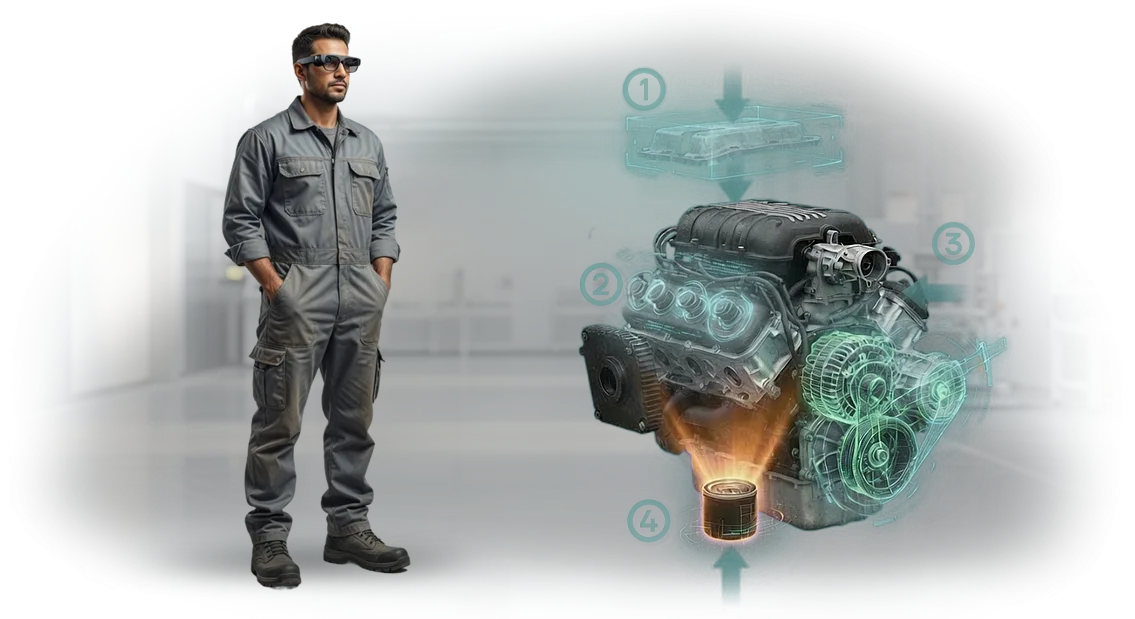
AR repair instructions change this scenario. Instead of searching for information in documents, the mechanic sees step-by-step prompts right on the equipment through a tablet or augmented reality glasses.
Operation time is reduced several times over, the number of errors drops, and training of new employees accelerates. We implement such solutions at production sites and help reduce downtime losses — from first repair to regular maintenance.
What Benefits Does Production Get from Augmented Reality
Equipment downtime costs production a considerable amount per hour, and every repairer mistake leads to rework and risks. Augmented reality changes this: digital prompts appear right on the mechanism, and the specialist sees the sequence of operations without paper instructions.
Large enterprises already use the technology — for example, aviation giant Boeing uses AR in assembling and servicing complex assemblies.
Speed: Less Downtime
Employees no longer waste time searching for the right diagram or calling a mentor. They get step-by-step navigation with precise indication of the work location.
In typical operations, repair time is reduced by 30–40%, and the machine returns to service faster to meet the production plan.
Quality: Fewer Errors
Standardized AR instructions eliminate the human factor: the repairer cannot miss an important step or mix up the order of actions. This is especially valuable when working with imported equipment where documentation is unavailable or only partially translated. The result is fewer defects and repeat repairs.
Safety: Employee Protection
The instructions warn in advance about hazardous zones, correct tool positioning, and permissible parameters. This is fundamentally important for beginners with limited practice.
Fewer injuries means less downtime due to sick leave and fewer inspections from regulatory authorities.
Savings: Fast Return on Investment
Creating an AR instruction pays for itself from the first repairs: each prevented emergency failure saves more than the cost of development.
Moreover, the accumulated knowledge base stays with the enterprise even after an experienced specialist leaves — it can be used to train newcomers.
Augmented Reality Formats for Maintenance: How to Choose
Augmented reality removes the main pain point of repair — equipment downtime caused by lengthy instruction searches or waiting for an expert. The employee sees prompts directly on the assembly: where to unscrew, what to remove, what torque to apply.
According to PwC, this approach reduces repair time by 30–50% and cuts the number of errors among beginners by almost half.
But the same AR technology is not suitable for all tasks. Training dozens of mechanics requires one format, emergency repair at height requires another, and customer support across the country requires a third.
We help you select an option compatible with your equipment and working conditions, rather than pushing the most expensive one.
| Format | For whom | What it gives the client |
|---|---|---|
| Stationary AR zone | Beginners and trainees | Fast training without pulling experienced mentors away from their work |
| AR glasses and tablets | Repair teams | Step-by-step instructions on the equipment — less downtime and fewer errors |
| Mobile app | Field service engineers | Expert sees the object through the employee's eyes and helps remotely |
| Web AR via link | Clients and contractors | Assembly and repair without installing apps — just a smartphone camera is enough |
The right solution depends on where the employee works and how critical downtime is. If a machine stops for an hour, an AR tablet with quick startup is more cost-effective. If you need to train an entire shift, a stationary zone pays off by reducing the load on instructors. For remote sites, we set up mobile support with video communication and on-screen annotations.
We select the format based on your budget and equipment fleet, run a pilot on one assembly, and show the savings in numbers. You get a working scenario, not "technology for the sake of technology."
How We Work: Full Project Cycle from Brief to Support
We manage the project from the first call to launch and support, so you don't need to coordinate multiple contractors. All work is divided into stages with clear results — you always know what's happening and what stage the project is in. We lock in timelines and costs before work begins.
- Brief and audit. We listen to how repairs are organized at your production site, where errors and delays occur most often. We prepare a work plan and cost estimate before we start — no "surprises."
- Scenario approval. We lock in the list of operations that will become AR instructions and the timeline for each. You approve the result at every stage.
- Prototype on your equipment. We show a working sample on a real assembly so you can see the instruction before full development. This removes the main risks.
- Full version development. We prepare content for all approved operations: steps, check sequence, and common mistakes. We demonstrate intermediate results.
- Launch and training. We deploy the instructions on site, train employees and engineers. During the first days, we accompany repairs and quickly adjust materials.
- Support and development. We update instructions when regulations change and add new assemblies upon request. Support is already included in the project.
What's Included in the Delivery: Implementation Kit
You get not just an application, but a complete implementation kit for bringing AR instructions into repair processes.
Everything is packaged so that within 2–3 weeks after launch, mechanics and engineers use it in daily work — without restructuring production or running a lengthy pilot.
The standard delivery includes:
- AR repair application: step-by-step instructions with visual prompts overlaid on equipment in real time. The employee sees what to turn and where, even if working with the assembly for the first time.
- Instruction library: from 10 to 50 scanned and digitized operations — process charts, diagrams, video breakdowns. Choose the volume to fit your tasks.
- Admin panel: your engineers can independently update instructions, change the order of steps, and add new operations without contacting developers.
- Technical documentation: installation, operation, and administration manuals for the system, as well as protocol descriptions for integration with your ERP or MES system.
- Employee training: 2–3 live online sessions for key specialists, review of real cases on your equipment, and recorded materials for internal use.
- Launch support: for the first two weeks after implementation, our engineers are on call to help set up the process and answer supervisors' questions.
Each item addresses a specific task: the app delivers speed and accuracy of repair, the library builds knowledge accumulation, the panel provides independence from the contractor, and training enables a quick start.
You are not buying "raw software" — you get a ready-made tool that delivers results immediately.
Case Study: How Augmented Reality Accelerated Equipment Maintenance
The case that best demonstrates the impact of AR is the implementation at the machine-building plant Preciz.
There, maintenance of packaging lines traditionally took 4–5 hours: you had to find the right instruction page, call in an experienced engineer, and spend a long time checking parts against the paper regulation.
Every hour of downtime carried a heavy price, and the lead specialist was a single point of failure.
We converted the repair and replacement regulations for assemblies into step-by-step AR prompts. On a tablet, the employee sees hints directly on the equipment: which compartment to open, which screw to unscrew, and how to verify the result.
There is no need to learn a new assembly — the system walks the user through the process, so errors and unnecessary actions disappeared.
AR Implementation Results
Average repair time dropped from 4 to 1.5 hours — a 60% reduction. Line downtime became shorter, and quarterly productivity grew by 18%.
Employees with up to one year of experience now handle tasks that previously were assigned only to engineers with more than ten years of experience.
"We stopped depending on a single specialist. The team now resolves most malfunctions on its own, and average downtime has fallen by a factor of 2.5," says the head of the maintenance department.
For us, this is a demonstrative AR efficiency case: the system paid for itself within the first months, and the customer expanded it to three shops. Augmented reality in industry is not a toy for presentations but a working tool that directly affects revenue and service speed.
How to Choose AR for Repair for Your Tasks?
Choosing AR for repair starts not with the technology, but with identifying where the maintenance process loses time and money.
For some enterprises it is the lengthy search for information in paper instructions, for others it is waiting for an expert to arrive, for others it is the mistakes of beginners on expensive equipment.
The criteria for choosing AR are the type of equipment, staff qualifications, and working conditions at the site.
If the weak point is slow onboarding, step-by-step instructions that show the sequence of operations directly on the equipment are suitable. If non-standard breakdowns are frequent, remote support is effective: the expert sees what the employee sees and guides them to the result.
When it is important to eliminate the human factor, verification with each step is used. In practice, formats are combined.
| Format | For whom | What it gives the client |
|---|---|---|
| Step-by-step AR instructions | New employees, rare operations | Fast information access, fewer errors |
| Remote expert support | Complex breakdowns, remote sites | Resolution without a visit, less downtime |
| Augmented reality training | Inexperienced staff, high turnover | Faster time to competence |
| Operation correctness control | Critical assemblies, seasonal work | Guarantee of no skipped steps |
We help you choose an AR solution for your task: we analyze business processes, calculate the economics, and select a format that will deliver fast results.
It can be launched on tablets and smartphones already available at the enterprise — our engineers handle setup and integration. Send us a description of your situation — we will suggest an option and calculate the benefit.
Frequently Asked Questions About Implementing Augmented Reality
Many managers worry that augmented reality is difficult to learn, will not fit their equipment, and takes a long time to pay off. We hear these questions every day — and answer them with examples from a decade of implementation experience.
How hard is it for employees to get used to AR?
Training takes one day. Prompts appear right on the screen over the equipment, so nothing needs to be memorized. We run a short training session and leave video materials.
Will AR work with our equipment?
All you need is a tablet or smartphone — there is no need to change machinery. We adapt instructions to your equipment model and, if necessary, connect to your service request system.
Is it safe for employees?
Yes. The interface is designed to keep hands free, and prompts do not interfere with monitoring hazardous zones. Fewer errors reduces the risk of injuries.
How much does it cost and when will it pay off?
The cost is comparable to the salary of one or two technical specialists for a couple of months. Payback comes through reduced downtime and faster training. Typically, the investment is recovered within six months.
What guarantees do you provide?
The first year of support is included. We help update instructions and refine the interface for new equipment. Terms are fixed in the contract.
Discuss Your Project and Get a Cost Estimate
Every hour of industrial equipment downtime is expensive. AR instructions help repair teams find faults faster and act without errors, but the effect depends on the specifics of your equipment fleet and tasks.
Submit a request for an AR project — we will assess where implementation will bring maximum benefit.
After your request, you will receive:
- an AR consultation: we will identify which repair operations to optimize first;
- a preliminary cost estimate for the AR project based on your scale and number of instructions;
- a timeline assessment — from prototype to commissioning;
- an implementation plan with stages and clear results for each step;
- examples of completed industrial projects and their business results;
- device recommendations — which devices your specialists will find most convenient;
- clarity on budget and expected payback.
The AR cost estimate is non-binding. You will get precise figures and an action plan to make an informed decision — start the project now or adjust your objectives.
Contact us through the form or by phone — already during the first consultation we will outline steps that will lead to real savings on repairs. Start your project with confidence in the result.