

AR Glasses for Maintenance: How to Reduce Equipment Downtime?
Every hour of equipment downtime means lost revenue, missed deadlines, and frustrated customers. When a machine or line stops, you have to call a rare specialist, wait for them, and hope for their expertise.
Service costs keep rising, and finding an engineer familiar with a specific model becomes ever harder.
Paper instructions and videos don’t help: it’s easy to get lost in them, they don’t show exactly where a component is, and they don’t adapt to the specific situation.
As a result, the technician wastes time searching for the right section, risks skipping an important step, or damaging the equipment. This leads to repeated breakdowns and even longer downtime.
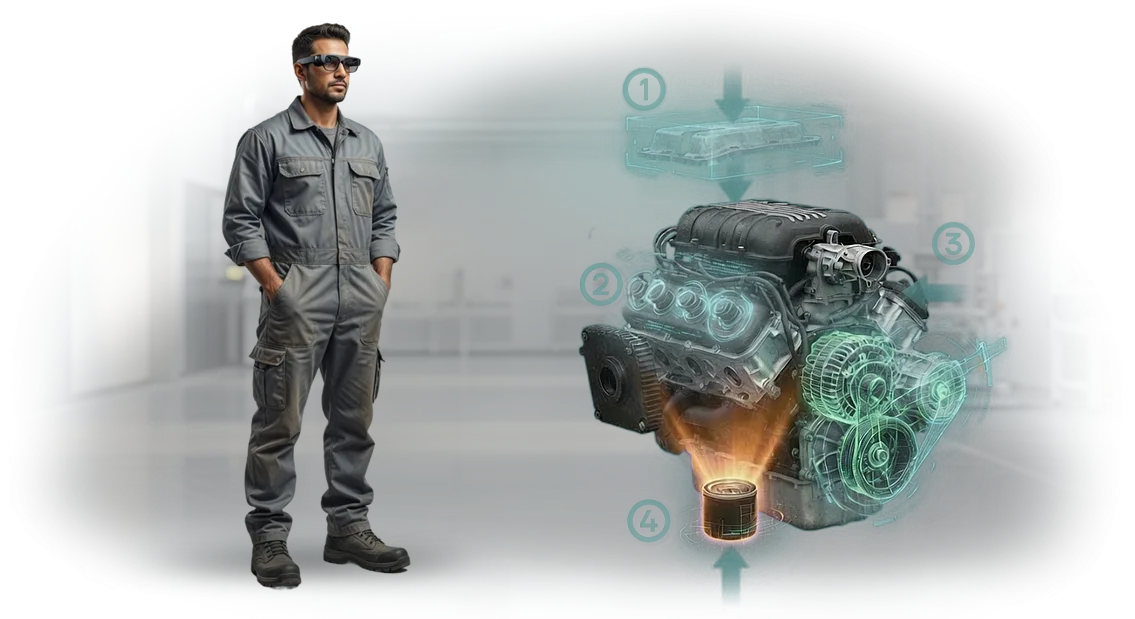
AR repair instructions change the approach: augmented reality shows directly on the equipment what to do and in what order. The technician sees arrows, hints, diagrams, and checkpoints — no need to read a manual or recall someone else’s experience.
Industrial equipment maintenance becomes faster, safer, and more predictable, and the probability of error drops dramatically.
For management, this means less downtime, lower service costs, and the ability to have in-house staff perform work that previously required external contractors. AR glasses pay for themselves after just one stoppage resolved in hours rather than days.
That’s why more and more manufacturers are rolling out such solutions into regular operations — and we help them do it.
Maintenance Without Errors: Augmented Reality for Service
Implementing AR instructions removes the main cause of long downtime — searching for the right section in a paper manual or waiting for a senior specialist. The operator sees a step-by-step diagram right on the equipment: where to open, what to unscrew, how to check.
We work on industrial AR glasses, including HoloLens, so that results are stable on the shop floor, not just in a presentation.
Reducing Downtime
Every minute of line stoppage is lost revenue. With an AR instruction, repairs are completed on average 30–40% faster: no need to flip through documentation, check drawings, or wait for a remote consultant.
The employee gets hints at the right moment and immediately sees whether the step was done correctly. This shortens equipment recovery time and reduces the number of assembly errors.
Training Without Interrupting Production
A new employee needs just a couple of days to start working with an AR instruction, while conventional training takes weeks. The system itself guides them through the process, highlights areas of attention, and warns about incorrect actions.
This solves the staff turnover problem: even an inexperienced specialist handles complex repairs without a mentor’s help.
In addition, AR instructions preserve the experience of shop-floor veterans. Previously, when a key employee left, their knowledge left with them — now it is captured in digital form.
Our approach has been proven in dozens of projects for clients in mechanical engineering and energy: after deployment, maintenance time decreases, and scheduled repairs go without surprises.
AR Instruction Formats for Production Maintenance
Production maintenance is a race against time: every minute of downtime costs money, and a repair error can take a line out of service for days. An employee must quickly understand what exactly is broken, in what order to disassemble a unit, and what effort is normal.
Paper instructions and videos lose — they describe an “average” situation, not the real machine in front of their eyes.
AR instructions solve this task differently: hints appear directly on the equipment, in the master’s field of view. We help select the right format for a specific area — from simple routine maintenance to complex repairs and training beginners.
| AR Instruction Format | For Whom | What It Gives the Client |
|---|---|---|
| Step-by-step repair | Service engineers | Less time per unit, no assembly errors |
| 3D instruction | Operators and setup technicians | Clear visualization of parts on the real object — no need to search for a drawing |
| Interactive reference | Maintenance supervisors | Quick answers on tolerances and kinematics in non-standard situations |
| Training scenario | Beginners and trainees | Training on real equipment without the risk of breakdown |
Whichever format you choose, we develop the scenario around your staff’s actual operations and test it at the site. In other words, you get not a “fashionable app” but a working tool used every day.
How We Create AR Instructions: 6 Steps from Brief to Launch
We have structured our work so that at each stage it is clear what you are paying for and what you receive. We have dozens of AR instruction implementation projects, so launching an AR project takes days, not months. Below are the six steps our team follows.
-
Development brief. We analyze which operations most often cause errors, where downtime costs the most, and what skill levels your staff have. We set goals, timelines, and the list of components to be converted to AR.
-
Scenario and prototype. We map out the step-by-step logic of the instruction and align it with your technologists. We show an interactive prototype on real equipment so you can see the result before full development starts.
-
Content and application development. We prepare 3D models of components, animations, and an interface for AR glasses. Our engineers use professional tools — everything works reliably in the workshop, not just in a presentation.
-
Testing at your site. We validate scenarios with real operators and machines: usability, execution speed, hint readability. Corrections are made before the project goes live.
-
Launch and training. We install the application, configure access rights, and train your employees. Operators work in AR from the first days, without lengthy retraining.
-
Support and evolution. We maintain stability, update instructions to new regulations, and add operations as the library grows.
The result is a predictable schedule, transparent cost, and AR instructions that reduce training time and the number of errors. We fix the deployment stages at the start, so you always know what is happening and when the result will appear.
What Is Included in AR Instruction Delivery: A Kit for Service and Training
“Paper instructions are a source of errors: you can’t find the right page, it’s easy to mix up the sequence of actions, and updates don’t reach technicians for months.
When a service team works with AR glasses for maintenance, they see hints directly on the equipment, not in memory or on a printout. We prepare a complete kit so the technology can be implemented in a week, not a quarter.”
What’s Included in the Delivery
- AR scenarios for your components and assemblies — step-by-step instructions with highlighting of the required parts and sequence control. The technician doesn’t guess; they do the job exactly according to the procedure.
- Digital content for AR — 3D models, animations, text hints, and warnings tied to your engineering documentation. Clear for a beginner and convenient for an experienced specialist.
- Instruction management system — a pool of updates: change a regulation, release a new version, and it immediately becomes available on all glasses in the team. No more paper copy distribution or mismatches between departments.
- Service and staff training — short practical sessions after which mechanics launch instructions themselves, use voice control, and don’t get distracted by the interface.
- AR technical support — assistance with device setup, instruction loading, and the first days of operation. We stay in touch until the team gets used to the new format.
- Guide for managers — how to track which instructions were used, how long an operation took, and where technicians most often stop. This is ready-made data for improving service processes.
This kit covers both the task of quickly bringing new employees up to speed and the task of reducing downtime: no need to wait until a senior supervisor is free and walks through the units. The instruction is always at hand — in the AR glasses.
After launch, you get not a one-off file but a working tool for training and quality control. We handle content updates, user support, and scenario refinement for new equipment models as part of clear support services. You pay for results: shorter repair times, fewer errors, and documented service team experience.
Case Study: Plant Reduced Downtime by 40% with AR Instructions
Implementation at a Production Site
Volzhsky Machine-Building Plant is an enterprise with thousands of machines and a strict repair schedule.
Previously, when a breakdown occurred, an operator waited for an engineer who had to search for a paper instruction and work through the diagram — this took on average 45 minutes.
With AR instructions, the employee sees the steps directly on the machine parts and performs the component replacement themselves, without waiting for a specialist.
Over four months, equipment downtime on the line fell by 40%, and typical repair time almost halved. New employees reached independent work in two weeks instead of two months: animated hints are clearer than thick manuals. For the plant, this means fewer losses from stoppages and faster ramp-up after staff changes.
Results and Development
The effect was visible in the first month: average response time to a fault dropped from 45 to 15 minutes. Training costs decreased, and defects during first repairs declined.
Six months later, the plant ordered a system extension for three new workshops and asked to include scheduled maintenance instructions.
In terms of payback, the project turned positive in four months: the savings from reduced downtime amounted to the cost calculated after audit for the period, while development cost was many times lower.
Now AR instructions are the standard for all critical operations: the plant depends less on the human factor and adapts newcomers faster.
FAQ: Safety, Compatibility, and Cost of AR Instructions
Managers usually worry about three things: whether production will stop during implementation, whether AR glasses will work with existing equipment, and how much it costs.
These are normal concerns — there are too many examples of technologies deployed for show while the result stays on paper.
We build AR instructions so that they integrate into the current process, not break it. Below are short answers to the main questions — no technical details, just the essence.
Is it safe to work with AR instructions in production?
Yes. The employee sees hints overlaid on the real object, not in a separate window — the field of view and peripheral vision are not blocked. Instructions undergo mandatory testing on your equipment under your conditions.
If needed, we configure time limits, access zones, and permission levels. Safety regulations remain just as strict; AR simply reduces errors when performing operations.
Are AR glasses compatible with our equipment?
We check compatibility before the project starts — during an audit we record specific equipment models, operation types, and usage scenarios. We develop the instruction around your installations, not the other way around.
This means you won’t have to change equipment or restructure processes: the AR scenario is overlaid on what the employee already sees and guides them step by step.
How much does development cost, and what quality guarantees do you offer?
The cost depends on scope: the number of operations, component complexity, number of languages, and device formats. After an audit, we give an exact figure and fix it in the contract — no hidden surcharges.
The work is accompanied by testing at your site, and after launch we support the instructions: we update content when regulations or equipment change. The warranty covers the correct operation of scenarios on the agreed equipment.
Below we break down the answers in more detail — with examples from projects and specific cooperation terms.Order AR Instructions for Your Production — Let’s Discuss Your Task Today
Employees spend hours on paper regulations, and equipment maintenance errors result in downtime and expensive repairs. AR instructions solve this problem: staff see the required component and the sequence of actions right in their field of view.
All that remains is to order turnkey AR instructions — and get a working solution, not an experiment.
Our team designs and implements AR instructions for your production tasks. We take on the entire path: from AR consultation to launch at workstations. That’s why you quickly get measurable results — faster training, fewer errors, higher service speed.
What you get when ordering:
- AR consultation — we’ll identify where instructions will deliver the greatest effect.
- AR project cost estimate in two variants: basic and expanded.
- Turnkey development of AR instructions adapted to your equipment and regulations.
- Integration with your existing training and maintenance systems without stopping production.
- Training for your specialists in working with AR instructions and support at all stages.
- Savings forecast: reduced downtime and repair costs — up to the cost calculated after audit per year per enterprise.
Let’s discuss your task today: send us a description of a component or process operation — our engineer will show how it could look in AR and provide timelines. This is non-binding, but you’ll understand how much the project costs and what results it will deliver.