

Personnel Errors and Downtime: How AR via Smart Glasses Reduces Risks
An employee error on a production line is not just a human factor. It means equipment stoppage, a disrupted shipping schedule, and sometimes expensive repairs.
For a manager, every such incident translates into tangible losses: unfulfilled orders, overtime, and a damaged reputation in the eyes of clients.
The cause is usually not people’s inattentiveness but how training and access to information are organized.
Paper instructions become outdated, a newcomer struggles to quickly find the right section, and an experienced employee does not always remember every nuance of working with a specific unit. As a result, errors repeat and downtime drags on.
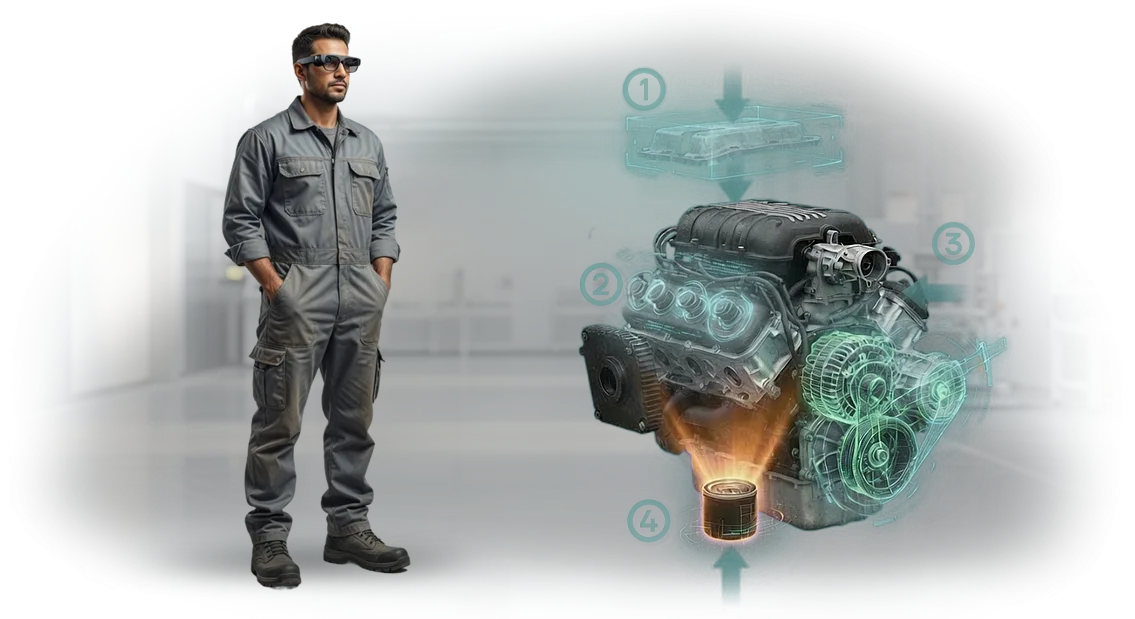
The solution is AR via smart glasses. Right before the operator’s eyes, step-by-step prompts, diagrams, and control points appear overlaid on real equipment. No need to flip through a manual or find a mentor — the system itself shows what to do and in what sequence. This changes the approach to staff training and reduces the dependence of results on human memory.
Industry, where the cost of an hour of downtime is enormous, has already appreciated this format. Employees master new operations faster, make fewer mistakes, and equipment stops less often due to incorrect actions.
AR instructions become a working tool that pays off from the very first days, cutting training costs and reducing production risks.
We implement AR via smart glasses, adapting scenarios to your tasks and current procedures. Our engineers help you configure the process so that you see the effect already at a pilot site.
What AR Instructions Implementation Gives Your Employees and Production
When equipment stops, every hour of downtime is extremely costly. An employee spends time searching for instructions, recalling procedures, and calling for a mentor.
AR instructions via smart glasses remove this chaos: step-by-step prompts are projected directly onto the mechanism, and the operator sees what to do next without breaking focus.
This directly increases the speed of repairs and maintenance, reduces downtime, and helps bring machinery back online faster.
Fewer errors — higher quality. Markups directly on parts and sequence control eliminate skipped important steps. Equipment is assembled and configured correctly the first time, reducing the number of defects, repeat calls, and unscheduled repairs. The result is consistent service quality and predictable production output.
Safety is an additional benefit. AR instructions remind about lockouts, warn about hazardous zones, and prevent operations outside the procedure. This protects employees from injuries and the enterprise from accidents and fines.
Training savings. A new specialist no longer needs to spend months in a room with manuals — they immediately see the action algorithm on a real object. Experienced workers also stop being “walking documentation.” Onboarding time and mentoring costs are significantly reduced.
AR instructions pay off through increased efficiency, reduced costs, and less downtime. We develop such scenarios for your equipment, procedures, and employee skill levels, help launch them on professional hardware, and support you after implementation. You get a working system, not just technology.
AR Deployment Formats via Smart Glasses for Enterprise Tasks
Working with industrial equipment requires precision: a mistake during repair or diagnostics results in downtime and extra costs.
AR via smart glasses closes the gap between instructions and the real machine — the employee sees prompts directly on the parts without being distracted by a tablet or paper.
But the key point is that the deployment format must match the specific task: one thing is training a newcomer, another is supporting complex repairs at a remote site.
We offer several AR instruction formats and choose together with you the one that delivers a quick effect. Below are typical scenarios that cover most production tasks.
| Format | Purpose | Benefit for the enterprise |
|---|---|---|
| Step-by-step instructions | Training new employees, onboarding | Reduced training time, fewer errors in the first weeks |
| Interactive checklists | Diagnostics, scheduled maintenance | Procedure compliance, reduced downtime |
| Overlaying diagrams on equipment | Repair of complex units | Fast fault location, fewer manual operations |
| Remote expert support | Non-standard breakdowns, rare equipment | Savings on specialist trips, solution “here and now” |
| Quality control | Work acceptance, assembly, inspection | Reduced defects, stable processes |
For each task, we select not only the format but also the interaction scenario: smart glasses guide, verify, and record the result.
Our engineers adapt the interface to your procedures and integrate AR with your accounting system so that data on completed operations goes into reports automatically.
In the end, you get a tool that works on your side: it reduces dependence on “golden hands,” accelerates training, and makes processes transparent. Just define the priority task — then we will show how AR solves exactly that.
Stages of AR Instruction Implementation at Your Enterprise
We work according to a transparent scheme: you know in advance what stages there will be, what timelines, and what you get at each step. No “magic” — only coordinated interaction, where you control the process and we are responsible for the result.
- Briefing and task audit. We meet, analyze which equipment and operations need to be described. We record frequent errors, training difficulties, and points where employees lose time. We define success criteria: speed to standard performance, error reduction, and decreased downtime.
- Prototype on one scenario. We prepare a working sample of an AR instruction on a real unit of your equipment. You see how the interface looks, how an employee interacts with the smart glasses, and you can make changes before full development starts. This removes risks and unnecessary expenses.
- Scenario and plan approval. We finalize the full list of instructions, step sequences, access levels, and editing rights. You approve the work plan and timelines — then we work according to that document without “surprises.”
- AR instruction development. Our engineers create step-by-step scenarios: visual prompts, execution correctness checks, and hints when an error occurs. Content is prepared based on your procedures and process charts — employees work according to familiar logic.
- Testing with your employees. We involve 2–3 operators or setup technicians, and they go through the instructions in real conditions. We collect feedback and refine the interface and logic where something is inconvenient. You get a solution accepted by your team, not imposed from outside.
- Launch and commissioning. We install software on the smart glasses and connect to your internal system (if statistics need to be transferred). We train administrators: how to update instructions, add new operations, and manage access.
- Support and development. After launch, we stay in touch: technical support, updates for equipment changes, and consultations on expanding to new sites. You can scale the system to other workshops or areas without diving into details again.
The average implementation time for a pilot site is 3–4 weeks from the briefing. Then you decide how quickly to roll the solution out across the entire equipment line.
What Is Included in the Delivery of AR Instructions for Industry
When purchasing AR instructions, it is easy to expect “just ready-made content.” In practice, the result consists of six components — and we deliver the full package so that you have no hidden surprises or additional payments “for the unaccounted.”
- Ready AR content for your operations. We create step-by-step instructions for equipment repair, setup, and maintenance. The employee sees prompts right at the workplace — no need to flip through paper manuals or call senior specialists.
- Integration with existing systems. We connect AR to your documentation, reference materials, and accounting data so that nothing has to be entered manually. Content always matches the current versions of your procedures.
- Staff training. We conduct training at your site or remotely. The technology does not require retraining: employees master the interface in a couple of hours and start working.
- Complete documentation. We provide an operator guide, administration procedures, and content update rules. You understand how the solution works and can develop it without our constant involvement.
- Technical support and updates. We support you after launch: update instructions when equipment changes, add new operations, and answer employee questions.
- Rights and source materials. You receive the rights to the created content and access to the source files. The solution is not tied to us and remains fully yours.
As a result, you get not a demo project but a working tool with predictable implementation timelines and a clear total cost of ownership.
Implementation Result: An Industrial Client Case
Implementation Result: An Industrial Client Case
For the engineering holding StalTek, we implemented AR instructions via smart glasses at the most problematic area — hydraulic press repair.
Previously, technicians had to page through paper procedures and technical support letters: one diagnostic took an average of 4 hours, and every assembly error meant line downtime and significant extra costs.
What changed in one quarter
We digitalized 25 typical operations and turned them into step-by-step AR prompts directly in the technician’s field of view.
Hands are free, all instructions and drawings appear before the eyes, and the system records every completed step — skipping or mixing up a unit became impossible.
Press repair time dropped from 4 to 1.5 hours. Repair team productivity grew by 35%, and the number of errors, repeat disassemblies, and engineer callouts decreased almost by half.
For the client, the main result was not time savings as such, but revenue: equipment downtime was reduced by 7 hours per week, which over the year gave the plant additional revenue calculated after audit.
Why it worked
The secret is not in “magic glasses” but in the approach: we studied real operations and wrote instructions in the language of the technicians, not process engineers.
We validated every step with people right on the shop floor, so implementation met no resistance — workers perceived the glasses as a helper, not a “spy.”
Today, the same client is expanding the project to three workshops. For us, this is the best indicator: the client does not need to be persuaded — they see the numbers and consider our format a mandatory standard for all new employees.
How to Choose an AR Instruction Format for Specific Equipment?
Choosing an AR instruction format starts not with technology but with the specifics of your equipment and the daily tasks of your employees. There is no universal solution that works equally well for a simple control panel and a complex machine with dozens of operations.
That is why we always suggest starting with a short audit: we analyze who works with the equipment and how, which errors happen most often, and where time is lost.
The equipment type sets the baseline format. For complex equipment with a multi-step procedure, step-by-step AR instructions via smart glasses work best, when the employee sees prompts directly on the machine components.
For quick operations — for example, setup or tooling replacement — short checklists overlaid on the real object are enough. And for rare repair work, a format with video fragments and control questions at each stage is convenient.
We help match these formats to your scenarios without overloading employees with unnecessary details.
The enterprise specifics are no less important: the level of digitalization, existing documentation, staff turnover, and how quickly you onboard a newcomer. An AR instruction must fit into current processes, not require rebuilding the entire training system.
Our engineers adapt content to your procedures — from operating instructions to videos from the workplace — so that information is understandable to the person actually standing at the machine.
After the analysis, we select and test an AR solution on one site so that you see the result with your own eyes: fewer errors, faster onboarding, and saved mentor time. That way you get a format that actually solves your task, not just a fashionable technology addition.
Book a consultation — in 30 minutes we will figure out which AR instruction format suits your equipment and prepare a pilot launch plan.
Answers to Frequently Asked Questions About AR Instruction Implementation
AR instruction implementation usually comes down to four questions: how quickly employees will master the glasses, when the result will appear, whether it will interfere with safety, and how compatible the technology is with current processes.
Below are short answers that address the main objections. If doubts remain, our engineers will carry out a demonstration on your equipment — without prepayment or obligations.
Will employees find it difficult to work in the glasses?
Training takes one or two days; the interface is built around visual prompts — the employee simply repeats actions in front of them. No complex menus or multi-page instructions. Based on project experience, operators master the glasses faster than a new computer program.
How much time is needed for implementation?
The first prototype appears 2–4 weeks after the start — you see how the instruction looks in the glasses and make adjustments. A full launch for one site takes 1–2 months and runs in parallel with current work. Production does not stop.
Are such instructions safe?
The glasses do not block the view: prompts appear at the side and do not interfere with process control.
At the same time, instructions reduce the number of errors and can remind about safety at every step — this is an additional layer of protection, not a replacement for existing rules.
Will this work with our equipment and documentation?
We build instructions based on your process charts, procedures, and 3D models. There is no need to buy new machines or change accounting systems — it is enough to load the instructions into the glasses. If necessary, we integrate the prompts with your electronic document management system.
Order AR Instruction Development for Your Production
Order AR instruction development — and your employees will receive step-by-step prompts directly in their field of view without being distracted from work.
We run the project end-to-end: we analyze your operation, design the scenario, create content, and adapt it to the smart glasses you already use or plan to purchase.
You do not need to dive into technical details — we take that on and deliver a finished solution, not a raw prototype.
What you get after placing an order:
- A ready-made AR instruction for a specific operation, procedure, or piece of equipment — it works in your process and for your tasks.
- Setup for your smart glasses and integration with your current technical documentation — no scattered paper manuals.
- Training for your employees and internal technical support: they will be able to use and maintain the solution themselves.
- Source materials, clear documentation, and project access — you do not become dependent on a contractor after launch.
- A performance guarantee: we refine it free of charge if something does not meet expectations or comes up during use.
- Support during launch and follow-up assistance after — we are in touch when you need us, without long waits.
We do not just create a “pretty picture” — we make sure the instruction actually reduces training time and lowers the number of errors. Before starting, we will define goals and efficiency criteria so that you see the result in numbers.
Leave a request for AR instruction development. We will discuss your task, suggest the optimal format, and propose concrete next steps. It takes no more than 15 minutes.