

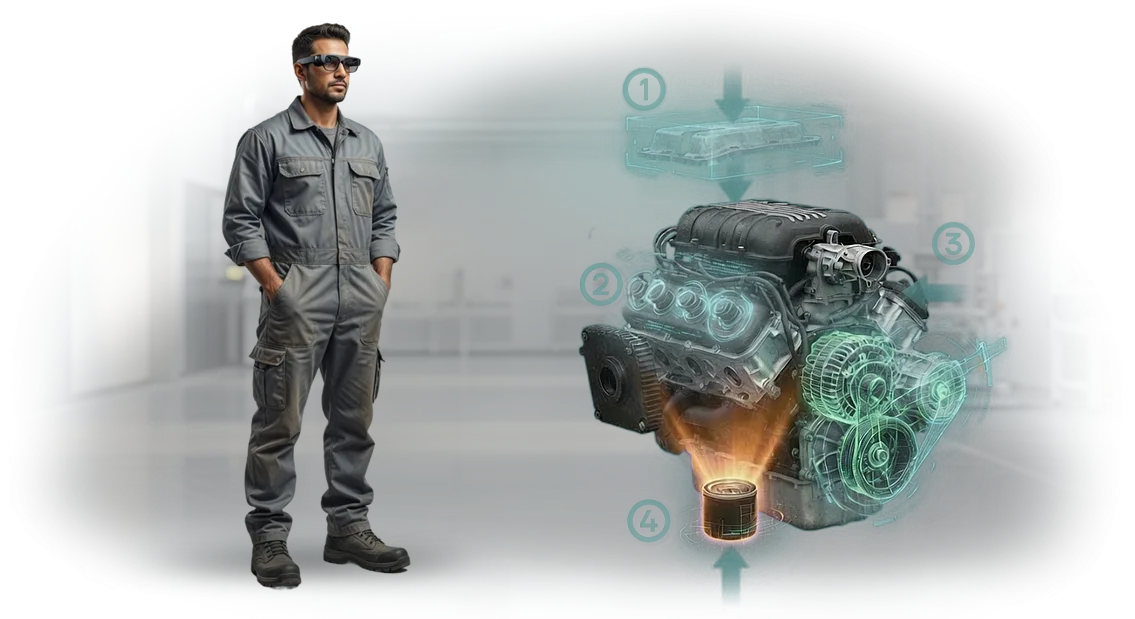
AR Inspection Tool: How to Reduce Defect Rates and Speed Up Quality Control
Quality control in manufacturing often runs into the human factor: even an experienced inspector can miss a discrepancy during a quick look, and finding the right page of a manual or drawing takes precious minutes.
As a result, the time to inspect one product unit grows, and the likelihood of missing a defect remains high — especially when the equipment is complex and requires sequential checks of dozens of components.
Every missed defective part is not just direct losses and rework, but also shipment delays, the risk of missing contract deadlines, and losing customer trust.
Paper checklists and static diagrams no longer suffice: they quickly become outdated, do not show the actual condition of the equipment, and do not help an inexperienced employee perform an inspection without errors.
An AR inspection tool solves this problem differently. The employee sees step-by-step prompts, checkpoints, and acceptable values directly on the equipment — no need to look away at manuals or keep the sequence of operations in mind.
The system itself guides the employee through the entire process, records which components have already been checked, and highlights deviations.
This speeds up quality control several times over and significantly reduces the defect rate: the employee does not skip important steps and immediately sees where metrics go out of range.
A manager gets transparent data on the results of each inspection — allowing problem areas to be identified and staff to be trained in a targeted way, rather than “all at once.”
We develop such AR tools for the specific needs of a particular production facility — from checking a single machine to regular inspection of an entire workshop. Our engineers design the interface around real operations, integrate it into existing processes, and train employees.
Implementation happens without stopping production, and the effect is visible from the first product batches: less scrap, faster control, higher quality confidence.
What an AR Inspection Tool Brings to Your Production
Manual inspection of industrial equipment is always a trade-off between speed and quality. An experienced specialist notices faults, but checking each component takes hours, while a novice can miss critical signs.
An AR inspection tool removes this contradiction: it tells the worker where and what to look at, right at the moment of inspection, and does not depend on the human factor.
The system shows the employee the required components and acceptable parameter values directly on the equipment. The specialist sees exactly what to inspect and what to compare against, so missed defects become fewer. The number of unscheduled stops and defective items decreases.
Inspection speeds up: no need to flip through paper manuals, recall the sequence of operations, or search for a drawing. All steps are displayed right before your eyes, and the result is recorded automatically.
Instead of a two-hour walk around the workshop, a check takes 30–40 minutes — with the same level of completeness.
An AR tool works as a mentor for new employees. Instead of spending months studying manuals, a trainee gets step-by-step prompts right in their field of view.
Errors during the training phase decrease, a novice reaches independent inspections faster, and experienced specialists do not waste time recalling procedures.
Each check is automatically logged: who inspected what, when, and what deviations were found. The manager sees the full picture and can analyze which components wear out more often, helping to plan repairs and prevent downtime.
AR Inspection Formats: For Your Equipment Type and Task
Every enterprise faces different tasks: one needs to train new specialists, another needs to speed up scheduled walkthroughs, and another needs to carry out urgent diagnostics without calling in an expensive expert.
There is no universal solution for all cases — so we select the AR inspection format based on your equipment type, regulations, and staff skill level.
Below are the typical scenarios our team covers. These are not abstract “features” but ready-made options already in use at production sites.
| AR Inspection Format | For Whom | What It Gives the Client |
|---|---|---|
| Step-by-step instructions in the field of view | Equipment operators and setters | Fast onboarding without reading manuals, fewer errors and less downtime |
| Checklists for regular maintenance | Service engineers and the chief mechanic’s department | Transparent walkdown procedure, each item checked and recorded |
| Remote support with video annotations | Repair teams for complex breakdowns | The expert sees the same as the on-site specialist and resolves the issue in one session |
| Trainer for studying component design | Training department and new employees | Practice without risk of damaging equipment, quick path to independent work |
We do not deliver a “boxed product” and do not force your team to restructure processes. First we study your regulations, standards, and equipment type, then we propose the appropriate format — from simple prompts to a full inspection support system.
Once a scenario is proven, we deploy it at your production site and hand it over to your employees along with training.
How We Develop an AR Inspection Tool: Project Stages
We have refined the process of developing AR inspection tools across dozens of projects for various industries — from mechanical engineering to energy.
So you get not an abstract “development project” but a clear roadmap with checkpoints, deadlines, and a person responsible for the result.
- Brief and audit. We break down your inspection process: where time is lost, where employees make mistakes, and which components are hard to check. The output is a list of tasks the AR tool will address with measurable impact.
- Prototype on your equipment. We show a working inspection scenario on one of your components. You see how an employee will interact with the system and can make adjustments before full development begins.
- AR tool development. Our engineers build the system using proven augmented reality tools. In parallel, we prepare an interface tailored to your procedures and staff skill levels.
- Workshop testing. We test the tool in real conditions: lighting, noise, protective clothing, and equipment specifics. We eliminate anything that prevents an employee from working quickly and without errors.
- Deployment and training. We roll out the system on your devices or purchase suitable ones, and train inspectors and supervisors. We hand over manuals and support access — the team starts working independently right away.
- Support and evolution. We monitor stability, update content when procedures change, and add new components and scenarios. You get not a one-off tool but a continuously evolving solution.
At each stage, you get short reports and result demos, not “we’re working, just wait.” You see where the budget goes and how it brings you closer to the goal: less downtime, faster acceptance, lower risk of missing a defect.
What Is Included in an AR Inspection Solution Delivery
When you order an AR inspection tool, you get not a “raw” prototype but a complete turnkey solution. We deliver a package that lets production start working immediately after launch — without hidden stages, extra purchases, or lengthy setup.
- AR inspection application, adapted to your procedures and equipment. Employees work through an intuitive interface on a tablet or phone — without rewriting existing processes.
- Digital instructions and checklists for typical operations: from visual inspection to complex diagnostics. Each item is accompanied by augmented reality prompts.
- Training for employees and technical specialists. We conduct training in a convenient format so the team confidently uses the tool from day one.
- Technical documentation: process descriptions, setup, and operating procedures. The customer gets clear materials for an internal standard and for passing knowledge to new employees.
- Integration with your information system — equipment records, inspection history, and results in one place. The manager sees data without manual reporting.
- Post-launch support and scheduled updates. The solution evolves with your tasks, and our engineers are available for quick fixes and enhancements.
Ultimately, you get a transparent delivery package where each element addresses a specific task — from employee training to daily on-site work. No unnecessary extras, only what affects inspection quality and speed of decisions.
Case Study: How an AR Inspection Tool Improved Inspection Accuracy at a Factory
A factory of one of the world’s hydraulic leaders, Bosch Rexroth, faced a typical pain point: quality control took up to 40 minutes per unit.
Engineers checked dozens of parameters by hand while flipping through paper manuals — some deviations slipped through, and training new employees stretched over weeks.
We developed an AR inspection tool: the operator points a tablet at a component, and the system overlays checkpoints and prompts onto the real equipment.
Any deviation from the norm is highlighted right in the field of view — the specialist does not need to switch between the part and the drawing, so hands and eyes are focused only on the task.
The implementation results were measurable. Inspection time per unit dropped from 40 to 12 minutes, and the rate of missed defects fell by nearly three times.
In the first six months, inspection accuracy rose from 91% to 98.5%, customer complaints decreased by 27%, and the solution paid for itself in five months.
Training also stood out: a new engineer reached working pace twice as fast because the system itself highlighted what and where to check.
This case confirmed that an AR inspection tool works not in a demo stand but in a real workshop with vibration, noise, and tight deadlines.
After the pilot, the customer extended the scenario to three production lines and ordered a year of support — in their words, it was the easiest project to see the impact of in recent years.
What If the Equipment Is Outdated or Non-Standard?
The most common concerns sound like this: “Our machines are more than 10 years old, some are completely unique, built specifically for our workshop.” And that is fine — we work not with abstract ideal equipment from a catalog but with what is actually on your production floor.
Our team takes standard documentation, photos, and videos from the site, then adapts the AR instruction to the actual buttons, indicators, and component layout.
For an AR inspection tool, the machine’s year of manufacture does not matter — what matters is that it is digitized correctly.
We ensure compatibility not through costly production restructuring or integration into your systems. Workers open the instruction on a tablet or special glasses, point the camera at the equipment, and see prompts superimposed on the real object.
If a machine has an unusual shape or layout, we simply take advantage of the fact that AR sees the object as it is, and does not require replacement or modification.
This allows us to address control and training tasks even where classic automated solutions could not gain a foothold.
To remove any remaining doubts, we always run a test on one real section. Our engineers meet with your technologists, clarify non-standard details, and adjust the scenario until it becomes convenient for the specific employees. Only then do we deploy the tool across all shifts.
As a result, you get not a “perfect demo” but a working AR inspection that genuinely reduces errors and speeds up personnel even on the oldest equipment.
Frequently Asked Questions About AR Inspection Tool Implementation
We answer the questions most often asked before launching an AR inspection tool: cost, timelines, safety, and return on investment.
How much does AR inspection tool development cost?
The cost depends on the number of instructions and equipment types. After a short audit, we provide a precise estimate broken down by stage. Typically, investments start from a cost calculated after audit — we fix the amount in the contract.
What are the implementation timelines?
A typical project takes 6–10 weeks — from process analysis to launch and employee training. If you need it fast, we build a pilot module in 3–4 weeks so you can evaluate the result.
How safe is this in production?
Prompts appear exactly when needed: hands are free, and the view is not blocked. Before launch, we test the scenario on your equipment — employees do not waste time on unnecessary actions.
When will the tool pay for itself?
We calculate the economics in advance: we see how much time is lost searching for information and correcting errors. Usually, payback occurs within 3–6 months. If an engineer saves an hour or an hour and a half per shift, that translates into significant annual savings.
What about support after launch?
We train your specialists and support the project in the first months. After that, you can update instructions yourself, and we remain available for enhancements and consultations.
Order Development of an AR Inspection Tool for Your Task
Submit a request, and we will break down your inspection task in clear terms: what is currently slowing the process, where time is lost, and which mistakes cost the most.
Right after the first discussion, you will see how an AR instruction will fit into your specialists’ work and what it will deliver in numbers: faster inspection, fewer missed defects, and easier training for new employees.
After your request, you will receive:
- An analysis of your situation and a proposal for the AR tool format — from simple prompts to full interactive component checks.
- A budget and timeline estimate for your scale — no hidden conditions or “later you will find out you need to pay extra.”
- A demonstration on similar tasks so you can see the result before work starts.
- A clear implementation plan: what we do, in what order, and what is needed from your specialists.
- Transparent support at every stage — you always know where the project stands and when it will be ready.
- A guarantee that the tool will solve your problem, not just become a “nice-looking technology” on paper.
We work with industrial enterprises and understand that an inspection tool must be reliable, clear, and convenient in the field. Our engineers select professional equipment and proven tools for your task so the result works reliably. No laboratory experiments — only a practical solution your employees will start using from day one.
Leave your contacts — we will call back at a convenient time, answer your questions, and prepare initial proposals for your task. We will start with a short analysis, and then you decide whether to move forward.
The request is non-binding, but it gives you clarity: how much AR inspection tool development costs and what impact it will bring specifically to your production.