

Defect losses eat into profits: how AR inspection changes the game
Every day, production defects quietly eat into profits: rework, missed shipments, lost orders. Traditional quality control requires the time of experienced specialists, and the human factor remains the main source of errors.
A missed defect reaches the customer — and then it is no longer about small expenses, but about reputation and future contracts.
The problem is that as production volumes grow, inspection costs rise faster than revenue. Employees get tired, lose attention, and checking complex assemblies takes minutes even for experts.
At the same time, every error at an early stage costs far less than fixing it after assembly or shipment.
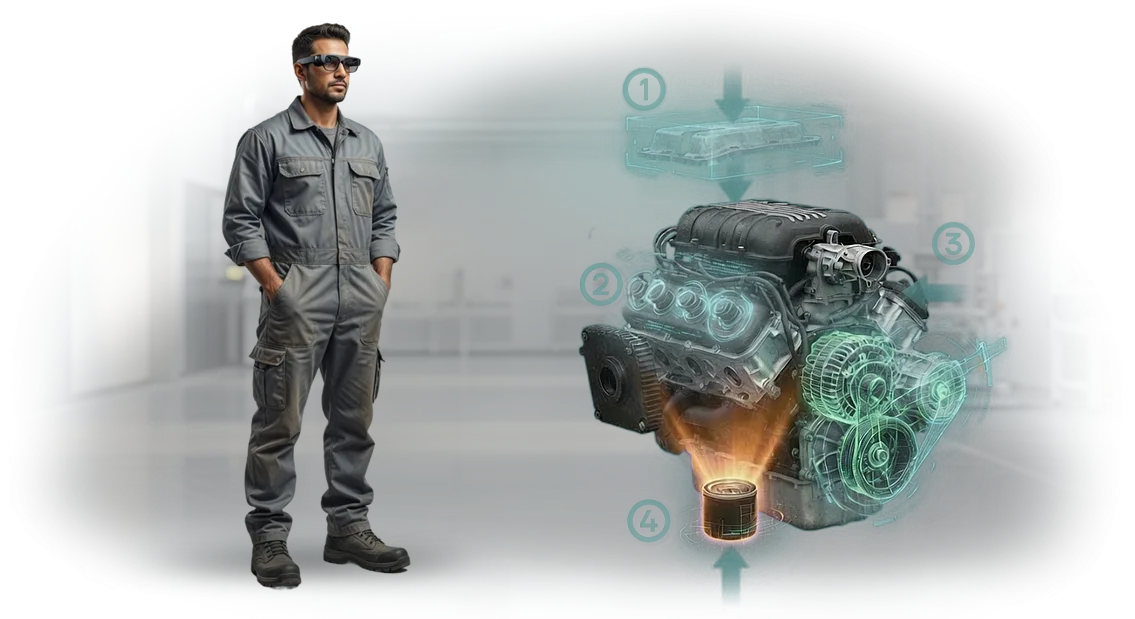
AR inspection changes the very principle of work: the operator or technologist puts on augmented reality glasses and sees directly on the equipment what and how to check.
The system highlights control points, shows acceptable deviations, and records the result — this takes seconds, not minutes. A specialist of any skill level works according to a single standard, so subjective assessment stops being a cause of defects.
Implementing AR inspection reduces the defect rate several times over and speeds up the inspection of each product unit by 30–50%. This directly lowers defect losses and the cost of quality control.
Our team handles the entire journey: analyzing your process, configuring scenarios for your assemblies, and training employees. You get a working system, not an experiment — with a measurable effect on output.
What AR inspection delivers: less scrap and greater efficiency
Inspection speed — without losing quality
With AR inspection, the operator no longer needs to flip through paper instructions and search for the right section. Prompts appear right in the field of view: what to check, what to pay attention to, which deviation is critical.
An inspection that used to take an hour is now completed in 15–20 minutes. The line idles less, and employees can focus on quality instead of searching for information.
Reduced defects and costs
Control accuracy increases because the system highlights every mandatory check point and does not allow a defect to be missed. The operator sees tolerance boundaries in real time and immediately understands when a product falls outside the norm.
Fewer defects mean less rework, fewer returns, and less material loss. Costs for correcting defects and handling customer claims go down — and each batch of products brings more profit.
Fast staff onboarding
Training newcomers is no longer a long process. Instead of memorizing complex diagrams and tables, the employee receives visual prompts right at the workstation. Adaptation shrinks from several weeks to a couple of days, and experienced masters spend less time mentoring.
The company becomes less dependent on individual specialists — digitized instructions keep knowledge inside the production operation.
Higher production efficiency
When control takes less time and produces fewer errors, the workshop’s throughput grows. Managers see objective inspection data: where deviations most often occur, at which stage time is lost. This makes it easier to find bottlenecks and make decisions to improve processes. This approach pays off within the first months and continues to deliver value every working day.
Implementation formats: choose the right option
Any AR instruction deployment starts with the question: “Where do we begin and what results will we get at the first stage?” We offer three formats — a pilot project, deployment at one site, and full coverage.
You choose the scope based on your current tasks and budget, and we tailor the process to your inspection equipment.
A pilot project is for testing the technology on real equipment without major investment. Deployment at one site is suitable when you already see the effect and are ready to cover an entire shift.
Full coverage is implemented when AR inspection must work across all locations and become part of the quality standard.
| Format | For whom | What the client gets |
|---|---|---|
| Pilot project | For a first AR test on one operation or assembly | Quick results in 2–4 weeks, clear metrics on operation time and number of errors |
| Deployment at one site | For a workshop or line with typical equipment | Coverage of workstations, process refinement, and effect measurement before scaling |
| Full coverage | For an enterprise with multiple locations | A unified AR inspection standard, reduced downtime, and lower training costs across the entire equipment fleet |
In any format, you get a measurable result: operation speed, defect frequency, and the time it takes a new employee to reach full productivity. After a pilot project, you keep a working solution and data for deciding on scaling — not just a test report.
How the project works: from brief to launch
We do not sell a “box”: every project starts with your task and goes through the stages from brief to launch, and then to support. At every stage, you see intermediate results and can make changes, so the system is built specifically for your requirements.
We work according to the Deming cycle: every step is tested in practice and corrected before it becomes expensive.
-
Brief and audit. We collect requirements from technologists, trainers, and line staff. We study existing instructions, regulations, and working conditions at the site. You receive a plan that shows which operations will benefit most from AR first.
-
Plan and approval. We set the scope of work, timeline, cost, and result metrics: reduced operation time, number of errors, new-hire training time. We agree on the plan and only then start production.
-
Prototype on a real assembly. We choose one operation and create a working AR instruction sample. You evaluate how convenient it is for your employees, and we make changes before scaling to the entire equipment fleet.
-
Development and regular demos. We create 3D models, animations, and texts in line with your design standard. Every 1–2 weeks we show intermediate versions, so you are never left guessing the final result.
-
Testing in your workshop. We test the system on real equipment together with your specialists. We account for conditions: lighting, safety glasses, noise, and time constraints on the operation.
-
Launch and training. We deploy the system on tablets or glasses, set up user accounts, and train personnel. Employees start using the instructions from day one.
-
Support and development. After launch, we collect analytics: which instructions are used most often, where difficulties arise. We update content, add new operations, and provide ongoing system support.
What is included in the delivery: a package for your team
We have prepared a delivery package that covers all stages, from the first days of use to planned updates when equipment changes. You will not have to dig into technical details — pass the materials to your team, and they will quickly start working with AR instructions.
- Ready-made AR instructions: step-by-step scenarios for typical operations — from maintenance to diagnostics. Employees see prompts directly on the equipment without turning to paper manuals, and they make fewer mistakes.
- Working interface: a simple application for tablets and smartphones. No special preparation is needed — open it and follow the steps; the system highlights the required elements itself.
- Personnel training: we run training sessions so your specialists can confidently use the tool and pass the skills to colleagues without involving developers.
- Documentation: clear user guides, installation and configuration instructions, and regulation descriptions. All information is organized — you can find an answer in a minute.
- Warranty and support: throughout the entire service period, we update instructions, monitor correctness, and make changes if you change your equipment composition.
This is not just a set of files, but a working system that employees use from day one. If questions arise, our team is always in touch.
Result for the manufacturer: 40% less scrap
In production, defect losses usually exceed expectations: rework, shipment delays, reputational risks. This is especially painful for complex equipment, where quality control requires attention to dozens of parameters and a single operator error can stop an entire line.
We solve this problem with AR inspection: the employee sees step-by-step prompts on a tablet directly on the assembly — what to check, which tolerances to maintain, how to record the result.
Control becomes equally accurate for a new hire and an experienced master, and errors are caught before shipment, not after.
One of our cases is hydraulic systems manufacturer HydraTech Industries. The company produced custom equipment, but the defect rate at final inspection reached double digits.
We audited the processes and implemented AR instructions for inspectors: instead of paper checklists, an interactive diagram that highlights control zones and automatically records deviations.
The result after six months: scrap decreased by 40%, and direct losses dropped by an amount verified after audit. The equipment paid for itself in four months, and inspectors train twice as fast and make fewer mistakes.
The production manager notes: the main thing is not the technology, but the systematic approach — AR instructions removed the “human factor” in areas that previously depended entirely on attentiveness.
This result is achievable not only in hydraulics: we adapt AR instructions for assembly, inspection, and repair of any industrial product. If scrap is a source of costs at your production site, start with one area and measure the effect using our methodology.
What if you have specific equipment requirements?
For any enterprise with non-standard equipment, this is familiar: ready-made solutions do not fit, and developing your own takes too long and costs too much. We have encountered this in dozens of projects.
So we answer directly: we adapt AR instructions to your specifics — equipment, regulations, and staff skill levels.
First, our engineers study production processes, equipment passports, and typical employee errors. Based on that, we create step-by-step scenarios that take into account your specific assemblies, characteristic faults, and safety rules.
As a result, the AR instruction works not on its own, but as part of your training and control system.
You get a solution that connects to existing equipment without stopping production. Employees point the camera at a part and see prompts tied to the specific model.
This reduces the time spent searching for information, lowers the risk of errors, and speeds up new-hire onboarding.
We handle all configuration, testing, and support. If your equipment changes over time, we update the content and scenarios. No “static instructions” and endless approvals: everything adapts to your real tasks.
So specific requirements are not a limitation, but a reason to create a solution that truly fits your production. Tell us about your equipment — we will prepare adaptation options for your processes.
Common concerns before ordering a solution
Before ordering augmented reality for equipment inspection, the same concerns come up: will the solution disrupt current processes, how long will launch take, who is responsible for the result. That is normal — something new is always tested in practice.
We address concerns in advance: we show how AR inspection integrates into your infrastructure and take on implementation, training, and support.
How does the solution integrate with our systems?
We do not replace existing systems; we complement them. The solution works on top of your regulations, databases, and documents, and launch does not require restructuring processes.
Engineers check compatibility at a pilot site, and all changes are recorded in a log — control remains with you.
Is it safe, and is it difficult to train employees?
The solution does not interfere with equipment control — it only displays instructions over the object. Before launch, we conduct a risk assessment together with your occupational safety department.
Training takes one day on your equipment. The employee sees familiar assemblies and learns the interface in a couple of hours; we also prepare an internal administrator who can update instructions independently.
What warranty and support do we get?
We provide a warranty on the proper functioning of the solution and document it in the contract. After launch, you get a direct channel to our engineers, with response times specified in the agreement. If regulations change, we adapt the content so the solution remains relevant.
Discuss your task — get a cost calculation
First, a short consultation on your task. Tell us what equipment you maintain and where you want to apply AR inspection: setup, control, training. We will analyze where the technology will deliver quick results and how to stay within budget.
Leave a request — get a cost calculation for AR tailored to your scenario. This is not a “market average price,” but figures tied to your equipment, the number of instructions, and the format of use.
In response, you will receive:
- consultation on applying AR instructions at your sites;
- a preliminary cost calculation: development, launch, support;
- a timeline estimate: from pilot to scaling;
- format recommendations — step-by-step instructions, completion checks, remote assistance;
- a clear project budget with a fixed scope of work and price;
- a pilot launch plan at one site to measure the effect before full implementation.
We work remotely and prepare a proposal within a few business days. Our engineers have already implemented AR instructions at industrial enterprises, so we understand which details really affect the cost and where savings are possible.
Describe your task in the form — we will prepare a solution for your project budget. If you do not have many details yet, just write a couple of lines: together we will clarify the details and send you a calculation.