

AR for Utilities: When Old Instructions Slow Down Repairs
Every utility service knows: paper instructions become outdated faster than the equipment on-site. A crew arrives for a repair and spends hours searching for the current diagram.
Every such hour turns into downtime and lost budget, while a mistake made from an old instruction leads to a return visit.
In emergency situations, it is even tougher. There are deadlines and a high cost of error, while all you have nearby is an old folder and the phone number of a busy specialist. While you wait for a hint or try to recall past experience, the company loses money on downtime.
Staff training is also built on hands-on transfer of experience. A newcomer remembers part of the actions and fills in the rest by guessing, so the first independent repairs end up being redone. When an experienced mentor leaves the crew, their knowledge leaves with them.
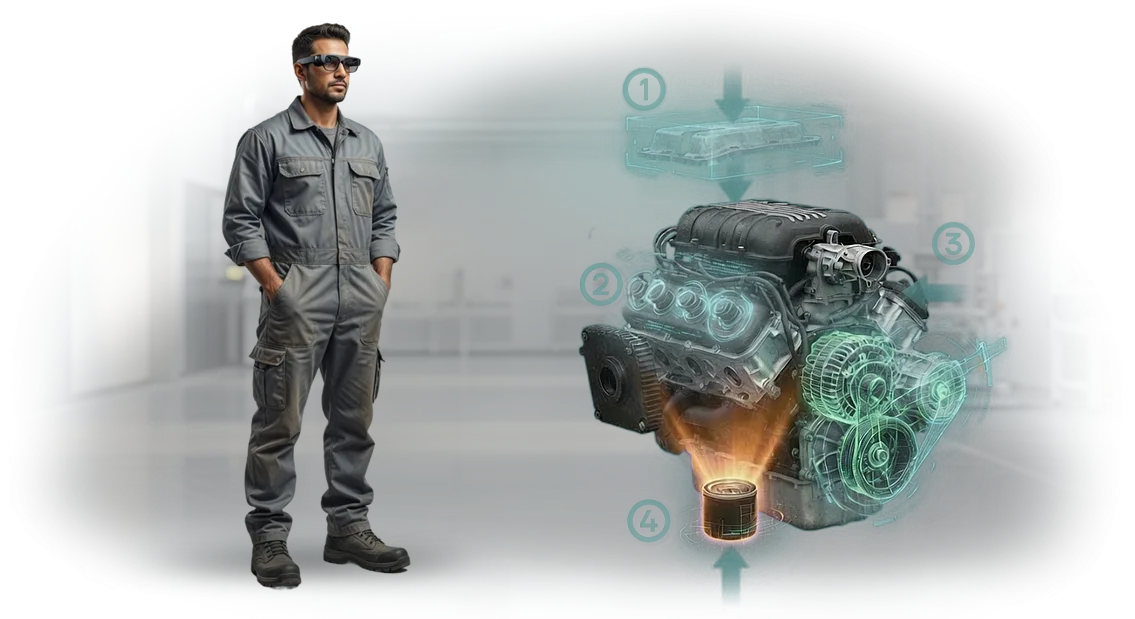
AR for utilities changes the picture: the up-to-date instruction appears right on the equipment, with no need to search through papers or guess.
The worker sees step-by-step prompts in the repair zone, a newcomer gets up to speed faster, and emergency tasks are handled more calmly and quickly.
We solve this pain point with AR instructions that are always present on-site and updated centrally. There is no need to reprint regulations or track versions — staff see the latest information at the right moment, and the company reduces downtime and rework.
What Augmented Reality Delivers in Facility Maintenance
Maintaining industrial facilities is a race between speed and quality. Long searches for a component, paper regulations, and the human factor all lead to downtime.
Augmented reality solves both problems: the technician sees prompts directly on the equipment and acts without delays.
According to Deloitte, AR instructions cut maintenance time by a third and reduce the number of errors by half. For a utility, this means faster emergency work and stable network operation.
Fast Response to Abnormal Situations
Every minute of downtime costs money and breeds resident dissatisfaction. AR displays the device diagram on screen, highlights the required component, and shows the sequence of actions. The technician does not flip through documents — repair time drops by 30–40%.
Fewer Staff Errors
Even an experienced employee can mix up the order of operations. AR does not allow deviation from the procedure: every step is confirmed, and an error triggers a warning. Work follows a single standard, and defects become noticeably fewer.
On-the-Job Training
Newcomers used to need weeks of theory and a mentor. With AR, a trainee puts on a headset or opens a tablet and gets prompts directly on the equipment. The path to independent work is 2–3 times faster.
Transparent Control and Savings
The AR system records every step and automatically creates a report. The manager sees who worked on-site and when, without paper summaries. This simplifies planning and reduces repeat visits — the total cost of maintenance goes down.
Augmented Reality Formats for Your Specific Task
Different tasks call for different AR formats. One client needs to bring new employees up to speed quickly, another needs to reduce expert visits to sites, and a third needs to practice emergency scenarios without putting staff at risk. We match the format to your task, not the other way around.
| Format | For whom | What it gives the client |
|---|---|---|
| Step-by-step AR instructions | Workshop staff and repair crews | Fewer maintenance errors: the worker sees prompts directly on the equipment and does not need to consult paper regulations |
| Remote AR support | Field engineers and dispatchers | An expert sees exactly what the on-site specialist sees and helps within minutes — no travel or downtime |
| Emergency scenario simulation | Training centers and safety departments | Staff practice abnormal scenarios in a safe environment without stopping production |
Implementation starts with a pilot site: we choose one process where the effect is visible fastest. When the pilot is complete, you receive measurements — time per operation, number of errors, speed of onboarding — and based on those figures we decide which formats to scale next. This usually takes weeks, not months.
How AR Instructions Are Implemented
Implementing AR instructions is not magic and not a long experiment — it is a well-structured process with clear stages and checkpoints.
We accompany the client from the first brief to daily operation, so that within a few weeks employees work with augmented reality rather than paper regulations.
- Brief and task audit. We gather requirements: which operations most often cause errors, where time is lost, which equipment needs clarification. We determine which devices employees will use — tablets, smartphones, or smart glasses.
- Scenario approval. Together with your technologists and engineers, we describe step-by-step scenarios: what the worker sees, what prompts appear, how the result is recorded. You approve the logic before development begins.
- AR content development. We model digital prompts, arrows, animations, and text instructions that overlay on real equipment. The content passes internal review for compliance with your regulations.
- Pilot launch on-site. We select 2–3 areas or pieces of equipment where the instructions are tested in real conditions. We collect feedback from employees and fine-tune details — prompt speed, wording, interface usability.
- Staff training. We run short sessions for workers and supervisors: how to open an instruction, what to do in case of a failure, how to return to a previous step. Our engineers stay in touch during the first days of operation.
- Full launch. We roll out the system across all planned sites and connect remote monitoring. Managers see usage statistics, and employees see a reduction in errors.
- Support and updates. We regularly update content when regulations change or equipment is modernized. If needed, we add new instructions without stopping operations.
This approach allows you to launch AR for utilities without missing deadlines and with minimal risk. You control every stage, and we are responsible for the result — working instructions that are actually used in the field.
What Is Included in the Augmented Reality Solution Package
When we talk about implementing augmented reality for utilities, it is important to understand: you get not just an application but a ready-to-use working tool.
The package includes everything staff need to start using it from day one, while you see the effect in fewer errors and faster repairs.
- A set of AR instructions for your equipment: step-by-step repair, maintenance, and component inspection scenarios in augmented reality.
- Staff training: hands-on sessions with your supervisors so they confidently work with AR without our assistance.
- Integration with existing systems: we connect the solution to the work-order database, reference guides, and regulations so data is pulled automatically.
- Documentation for your team: clear administrator and user guides, plus instruction update procedures.
- Technical support: our engineers are available — they help with setup, content updates, and on-site questions.
- Deployment on your devices: we install the software on the tablets and smartphones your employees already use.
Every item in the package addresses a specific goal: fast onboarding, reduced load on mentors, and a single standard for performing operations. You get a solution that works as part of your processes, not a standalone experiment. We also support the project after launch, so support is formalized in the contract.
Case Study: Repair Crew Cuts Emergency Resolution Time by 40%
An emergency crew is always racing against time. While a repair technician searches for the right section of an instruction or waits for a hint from a senior colleague over the radio, residents sit without power and the dispatch center is flooded with calls.
A similar situation affected the utility operator “City Networks”: the average emergency resolution took more than two hours, and for young employees almost four.
We took this area as a pilot. We studied typical scenarios — pipe rupture, power outage, component replacement — and built AR instructions for utilities on that basis.
Prompts appear step by step right on the equipment housing: where to open the panel, which valve to shut off, what values should be on the display. The fitter does not need to flip through paper memos or hold a phone — everything needed is right in front of them.
What Changed
After three months of operation, the average emergency resolution time dropped by 40% — from two hours to one hour and twelve minutes. For the first time, the crew handled a nighttime pipe burst within a single shift without calling in a reserve team.
Repeat visits due to errors fell by a third, and new employees are onboarded twice as fast: instead of an impatient mentor standing nearby, there is a tablet with AR prompts.
Why This Is Only the Beginning
The client expanded the project to three neighboring districts. Now AR instructions work not as a one-off experiment but as a standard tool for daily operations.
This is exactly the kind of result we build into every case: measurable figures, calm duty shifts, and fewer calls from residents.
Frequently Asked Questions About Augmented Reality in Industrial Operations
Managers of industrial and utility services ask us the same questions: will AR interfere with employees, how quickly will implementation pay off, and is the technology compatible with the existing equipment fleet. We answer the main ones to remove doubts before the project starts.
We have accumulated solid statistics on industrial AR solutions and are ready to share figures and real cases. If your question is not on the list — we will send a detailed estimate for your task.
Is it difficult to implement AR if employees have not worked with technology before?
We handle the setup, integration, and training. Implementation proceeds in stages without stopping production: first a pilot on one line, then scaling. A full launch takes 2–4 weeks, and employees start using the instructions on day one.
Is it safe to use AR in industrial environments?
We design interfaces so they do not block the field of view, do not distract from operations, and comply with occupational safety requirements. The devices are lightweight, do not restrict movement, and run for several hours continuously.
Across all of our projects, there has not been a single incident related to the use of AR equipment.
How much does implementation cost and when will it pay off?
The cost depends on the number of instructions and workstations. The minimum starting project cost is calculated after audit, but the effect is visible within the first year: reduced training time and fewer staff errors. According to Deloitte, industrial companies recover their AR solutions on average in 8–12 months.
Is AR compatible with our equipment if it includes different brands and years of manufacture?
We tie instructions not to a specific model but to operations and processes. This allows us to work with equipment of any level of automation — from simple manually operated machines to modern CNC lines.
Integration does not require replacing the equipment fleet and does not affect manufacturer warranties.
Let's Discuss Your Augmented Reality Project
For utilities, augmented reality is not theory but a working tool: it helps train staff faster, reduces errors during repairs, and cuts equipment downtime. To understand the effect at your facility, you do not need to roll out the system across your entire operation.
It is enough to start with a pilot project: we will demonstrate the result on a small site, and you will receive actual savings figures.
Submit a request for a consultation — we will analyze your task, suggest AR use cases, and provide a preliminary cost estimate. There is no obligation, but you will get concrete information for making a decision.
What you get after reaching out:
- A consultation — we discuss goals, growth areas, and constraints with no obligations.
- A cost estimate tailored to your request — a transparent quote with no hidden charges or fine print.
- Scenario recommendations: equipment repair, employee instruction, remote support for field crews.
- A pilot project proposal — a small site where we will implement AR and measure the results.
- Benefit assessment: faster work, fewer defects, reduced downtime and training time.
- An implementation plan with clear timelines and owners for each stage.
- A demonstration on your equipment — you will see how AR works in your environment.
Submit your request right now — it will only take a couple of minutes. We will get in touch, ask the right questions, and prepare a proposal that makes the decision easy for you.
Which Utilities Benefit Most from AR Implementation?
The services that benefit most are those where employees work with complex equipment under time pressure.
Power utilities and water utilities are natural candidates: crews travel to different sites, face non-standard situations, and the cost of error is measured in hours of downtime or service interruptions for residents.
AR helps show the sequence of operations right on the spot, highlight the required component, and warn about risks — this reduces repair time and lowers the error rate among newcomers.
The effect is especially visible where staff turnover is high or most specialists are approaching retirement age. Experience leaves with the people, and passing it on takes years.
AR instructions turn veteran knowledge into visual prompts: a young employee sees not an abstract diagram but an exact sequence of actions right on the equipment.
For gas services and heating networks, this is also a safety issue — the system indicates where work without protection is prohibited and in what order to shut down components.
To avoid spreading resources too thin, it is worth starting with a single process where errors cost the most. Look at your work-order statistics: which type of fault most often requires a repeat visit? Where does it take the longest to onboard new employees?
That is where the return will be greatest. This could be scheduled maintenance of pumping stations, repair of transformer substations, or emergency response on water supply networks — the key is to choose a narrow area with clear, measurable results.
AR does not replace engineers; it removes the routine of searching for information and recalling nuances. After the pilot project, you will see concrete results: work-order completion time, number of errors during commissioning, and speed of trainee adaptation.
If the metrics confirm the value, you scale to other areas. If not, you reconsider the process choice. Either way, you get a clear justification for developing the system, not an abstract “technology implementation.”