

Microsoft HoloLens for the Construction Industry: Accelerating Commissioning
When equipment stops on a site, every hour of downtime costs money. Commissioning a new machine or a complex line involves dozens of pages of paper instructions, searching for the right section, and the risk of mistakes from a misread diagram.
An employee spends time reading instead of working, and an engineer has to travel to the site to explain the obvious.
Errors during adjustment lead to repeated startups, crew downtime, and missed project deadlines.
Often the problem is not the specialist’s qualifications but that the instruction does not answer the question, “what exactly do I do right now with this component?” Paper becomes outdated, updates do not reach everyone, and complex equipment requires precise actions.
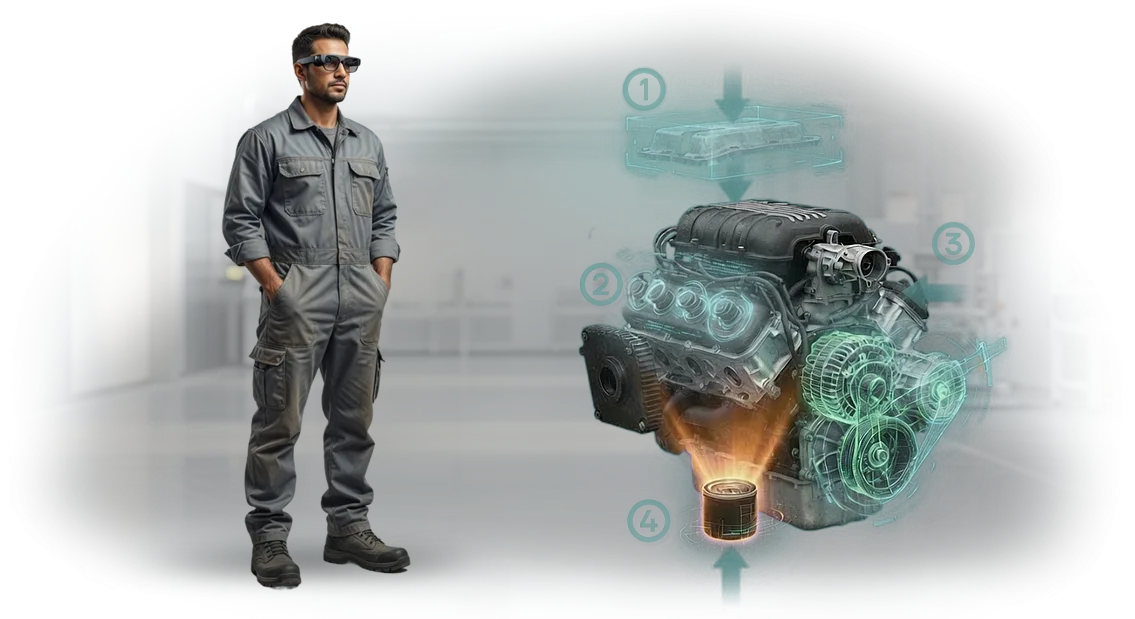
Augmented reality changes this. With Microsoft HoloLens for construction, a worker sees digital instructions directly on top of the equipment: arrows, highlighted components, and the sequence of operations.
AR instructions for equipment keep the employee’s attention in the right place and eliminate ambiguity — from drawing to live mechanism.
Commissioning becomes predictable: the specialist acts step by step without being distracted by searching for information, and the manager sees that the process follows the procedure.
Augmented reality shortens the time to bring equipment online, reduces the number of errors, and accelerates training for new employees — they immediately work with prompts rather than from memory.
We develop digital instructions for the specific tasks of your facility: from machine adjustment to servicing an entire line.
We analyze the equipment, create step-by-step scenarios, and configure HoloLens so that the result is clear to any employee — without retraining or complex settings.
What AR Instructions Deliver on a Construction Site
Work speed directly affects the cost estimate: the longer a crew stands over a component, the more expensive the project. AR instructions remove the main bottleneck — searching for the right drawing and checking it against the real object.
The worker sees a prompt directly on the equipment and performs the operation immediately, without the gap between “looked” and “did.”
Work Speed — No Stops for Documentation
Installation, commissioning, or scheduled inspections are completed 1.5–2 times faster because there is no need to flip through paper regulations or cross-check diagrams. All data appears in the field of view at the right moment. The crew finishes their shift earlier, and machine downtime is reduced.
Fewer Errors and Rework
Interactive instructions set the order of actions, warn about critical moments, and show acceptable tolerances. An employee makes fewer wrong moves, which reduces the defect rate and the cost of fixing issues. This is especially important when working with expensive equipment.
Process Control for Managers
A manager sees task status in real time: which operation is running, which is complete, and where a delay has occurred. Reports are generated automatically, so there is no need to interview supervisors or gather information piece by piece. You find bottlenecks faster and make decisions sooner.
Faster Training for New Employees
AR instructions allow a trainee to perform complex operations almost immediately, without memorizing multi-volume documents. Time to full competency is reduced by 30–50%, and a mentor can focus on unusual situations instead of repeating the basics. This reduces dependence on “rare” specialists and simplifies team scaling.
Digitalization of construction begins with solutions like these: less paper, higher accuracy, and a transparent process for the contractor and the customer.
AR instructions pay for themselves by reducing downtime and rework — the costs that usually surface only after the project is handed over.
AR Instruction Formats for Your Task
Each production task has its own augmented reality format. Some situations require a precise sequence of operations with component highlighting, while regular actions only need a brief prompt in the field of view.
We do not lock ourselves to specific headsets; instead, we choose a scenario for your specific needs so that the employee finishes work faster and makes fewer mistakes.
| Format | Who It’s For | What It Delivers |
|---|---|---|
| Step-by-step guide with a 3D model of the equipment | Repair services, adjusters, installers | The employee sees the internal structure of the component and the disassembly order, and repair errors are reduced many times over |
| Short prompts at the workstation | Operators, maintenance service, assembly-line workers | No need to flip through paper regulations — the next step appears right in front of the eyes |
| Interactive training scenarios | New employees, trainees, training supervisors | Practice on real equipment without the risk of an accident; onboarding takes days instead of weeks |
| Remote support with AR markup | Field service engineers, technical experts | The specialist sees the same thing as the operator and draws prompts in the operator’s field of view — the problem is solved in a single session |
When choosing an AR solution, we analyze exactly how operations are performed and where errors most often occur. This allows us to prepare an AR instruction format that employees use daily rather than store on a shelf.
Short training scenarios are easy to update — changes to regulations are made in minutes and immediately become available to all workers.
How We Create an AR Instruction
We have structured the process so that you always understand what stage the project is at and what you are getting. From brief to support, the AR instruction development stages cover the main risks: the wrong scenario, long approval cycles, and outdated content. After each stage, there is a clear result that you can approve or adjust.
-
Instruction brief. We analyze which equipment and which employees the AR instruction is for, where errors most often occur, and what should change after implementation. The output is a task description and success criteria.
-
Scenario design. We create a step-by-step scenario: what the employee sees, in what order they perform operations, and what prompts they receive. The scenario is approved before development — this saves time and money.
-
AR content development. We prepare 3D models, animations, and text prompts and link them to the real equipment. Internally, we use professional development tools, so the result works reliably on industrial sites.
-
Testing on real equipment. We test the instruction with your specialists: whether the prompts are comfortable to read, whether the component is recognized correctly, and whether false triggers occur. We make corrections before launch.
-
Implementation on site. We install the instruction on devices, train employees, and launch a pilot. At this stage, you see how AR helps newcomers and experienced workers.
-
Instruction support. If regulations, equipment, or the composition of operations change, we update the content. The instruction remains relevant instead of becoming a “dead document.”
This workflow is already familiar to customers in the construction industry: a clear brief, an approved scenario, and post-launch support allow you to use HoloLens for training and control without missing deadlines.
What Is Included in Delivery and Implementation
We deliver not just a demo but a ready-to-work package. Everything your team needs — from digital copies of existing instructions to employee training — is included in the project. You receive a system that can be implemented immediately after handover.
- Digital copies of all instructions used in production: they are available through AR glasses right at the machine, without paper folders or searching for the right page.
- Ready-made AR scenarios for typical operations — startup, changeover, repair. Each step is shown clearly, with prompts and completion control.
- A complete set of documentation for operating and maintaining the AR system — your engineers and technologists will quickly understand the procedures and set up the process.
- Employee training: we conduct training for operators and repair staff so they confidently work with the new tool from day one.
- A content update procedure: when instructions or procedures change, we update the data — without stopping production or making repeat purchases.
- Support during implementation: we help deploy the system across all workshops, configure it, and verify it on real equipment.
- A unified instruction base for the entire company: employees anywhere always see the latest version, and you control access and change history.
Case Study: AR Instructions Cut Repair Time by 40%
At a construction equipment service company, repairing a hydraulic station took up to four hours: a mechanic flipped through paper manuals, searched for the right component, and cross-checked diagrams. Mistakes were expensive — the unit had to be disassembled again.
We proposed AR instructions for engineers: step-by-step prompts directly on the equipment through Microsoft HoloLens.
Instead of keeping the sequence of operations in mind, the specialist sees arrows, part numbers, and risk warnings. Hands remain free, and key components are right before the eyes. The very first pilot week showed that repair time dropped by approximately 40%. The number of assembly errors also decreased: the system prevents mixing up the order of steps.
Implementation Results
- Repair speed increased by 40% — saving up to two hours on a single component.
- A new mechanic reaches independent work twice as fast: instructions replace a mentor in the early stages.
- Less equipment downtime — the company returns machines to rental or to the site faster.
The customer’s service department manager noted: “Previously, repairs depended on the experience of a specific person; now the process is standardized.
Even after a crew change, the result is the same.” We supported the implementation: trained the engineers, configured the interface for their technological operations, and handed over source materials for updating instructions.
This was the customer’s first AR experience, and after the project they ordered a second block of instructions — for scheduled maintenance.
How to Choose an AR Instruction Format for Your Facility?
Choosing an AR instruction format starts with a question: what exactly does an employee need on site — a one-time prompt before an operation or a permanent reference for an entire component?
If the task is narrow, such as “replace the valve” or “check the fastening,” a short step-by-step prompt that appears right before the eyes and disappears after completion is enough.
If it involves a complex unit or an entire line, it is better to create a complete digital map of the facility, where the technician selects the desired component and the system shows the sequence of actions, standards, and checkpoints.
The second criterion is the type of equipment and environment. For stationary machines in a workshop, detailed instructions with overlay on real parts are suitable: the worker sees exactly where to apply the tool, where the bolt is, and where the fragile element is.
For mobile equipment on a construction site, short “check-secure-report” scenarios are more important, as they do not distract from the surroundings.
The construction industry adds its own conditions: dust, bright sunlight, limited field of view, so the material delivery must also vary — from large diagrams to voice prompts.
The team’s skill level is equally important. A beginner benefits from a guided mode where each step shows what to do and the system records the result.
Such prompts get in the way of an experienced specialist — they need quick access to regulations, drawings, or component parameters without unnecessary animations.
A good approach is to adjust prompt density: each employee can have their own level of detail, and the device will adapt the presentation automatically.
The final algorithm is simple: identify 2–3 frequent operations, see where errors or delays occur, and choose a scenario — a targeted prompt, a full instruction for a component, or a control checklist.
For our part, we select the format for your facility, employees, and tasks so that the implementation of HoloLens for the construction industry delivers a measurable effect in speed and quality of work.
After a short pilot on a real operation, you will see which option is more convenient, and we will build the scale-up around it.
Common Doubts About AR Instructions
Managers often postpone AR instruction implementation due to concerns: equipment might break, regulations might become outdated, or deadlines might slip. Below are answers to the most common questions before signing a contract.
Warranty for AR operation and equipment breakdown — who is responsible?
We answer at every stage, from testing to operation. Devices based on Microsoft HoloLens carry the manufacturer’s official warranty; while repairs are being made, we provide replacement equipment — the site does not stop.
How are instructions updated?
Updates are uploaded remotely to a shared repository — all employees see the latest version simultaneously. No site visits or work stoppages are needed.
Implementation timeline — will we miss the project deadline?
We deploy a pilot section in two to three weeks while preparing the remaining instructions in parallel. For an existing facility, launch is possible over a weekend.
How much does development cost?
Cost is calculated based on the number of instructions and workstations. A typical project is cost calculated after audit for the first year. This is recovered through reduced errors and faster training.
What about accountability for results?
We set metrics during the pilot and take responsibility for them. After launch, we maintain and update the system.
If you have any remaining questions — we will send a calculation and show examples based on your procedures. Get in touch; it is not binding.Get an AR Instruction Plan for Your Task
Making the first step is easier than it seems: simply describe your task, and we will prepare an AR instruction plan for your site, machine, or process.
No abstract theory, only a concrete scenario: what we digitize, how long it will take, and what result you will get on the production floor.
We will calculate the cost and suggest the optimal format — from a small pilot project to full implementation across all sites. You will see how AR instructions reduce training time and lower error rates before you decide on scaling.
What You Get After Contacting Us
- A consultation: we analyze your task and choose a solution without unnecessary expenses.
- Cost and timeline estimate: a clear budget for your scale — from one machine to an entire workshop.
- Pilot project: we test the AR instruction on one section so you can evaluate the effect live.
- Instruction prototype: see what a step-by-step prompt looks like for an operator or repair technician.
- Implementation plan for HoloLens and other equipment: what to purchase, how to train employees, and how to integrate it into current processes.
- Support after launch: our engineers stay in touch and help scale and update the instructions.
Leave a request, and within two business days you will receive an AR instruction plan for your task. Everything else is up to you: start with a pilot or implement the solution across all sites right away.