

AR for assembly: How to eliminate assembly errors and reduce downtime
Every assembly error is not just a spoiled part — it's a stopped line, a missed shipment, and rework costs.
On complex operations where dozens of actions must be kept in mind, even experienced employees make omissions: a fastener tightened in the wrong place, a cable mixed up, an intermediate step forgotten.
In the end, the defect is discovered only at quality control or at the customer's site, and the cost of the mistake multiplies.
The culprit is the human factor, which neither paper instructions nor PDFs on a tablet can handle: it's easy to get lost in them, especially with high staff turnover and a shortage of experienced mentors.
Retraining staff is expensive, and downtime from defects hits the manufacturer's profit and reputation.
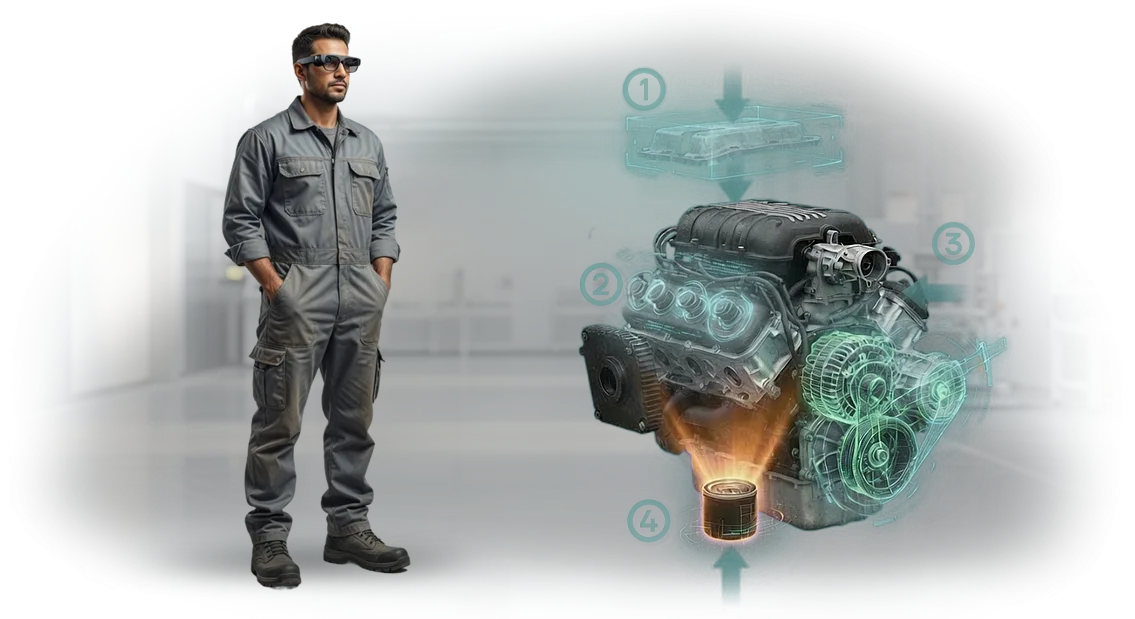
AR instructions solve this problem at a fundamental level: step-by-step prompts are projected directly onto the equipment in the employee's field of view.
The assembler sees where to mount the component and which tool to use, while the system highlights the correct sequence and won't let them move forward until the action is completed. This is not just a reference guide — it's real-time control of every step.
The result is a minimum number of defects and a faster ramp-up for new employees, who reach a normal pace within the first days.
We have worked with manufacturing companies for ten years and know how to adapt AR to your product line so the instructions are clear to any employee without special training.
Our engineers handle the entire cycle: from analyzing assembly operations to implementation and staff training.
What benefits do you get from AR instructions
AR instructions for assembly operations help production run steadily, without losses from rework and lengthy training. Instead of paper regulations and reliance on employees' memory, you get a visual system that prompts every next step right at the workstation.
The tool suits both serial assembly and one-off products, and it doesn't change your familiar technology. Implementation pays for itself from the very first batches by reducing defects and downtime.
Fewer errors is the main result, noticeable within the first week. The operator sees which part to take, how to orient it, and how to fasten it — and performs the operation correctly the first time. Defects and rework disappear, and with them the costs of materials and time.
Quality becomes stable even when a new employee handles the assembly. This is especially important on complex assemblies where the sequence of actions is critical.
Staff training is no longer long and expensive. Newcomers don't need to memorize dozens of process charts: they just put on the device and follow the prompts. An experienced mentor can support several people at once without spending time repeating the same thing.
Dependence on "unique" specialists decreases, and a talent pool is built through the rapid training of in-house employees.
Productivity grows because every operation is performed at a consistent pace and without errors. Downtime from waiting for a supervisor's consultation is eliminated, and changeover to a new product takes minutes instead of days. Processes speed up, and more finished products come off the line per shift with the same resources.
Quality control becomes transparent: every action is recorded in the system, and you always see at which stage deviations occur. This allows you to quickly adjust the process and confirm to the customer that the product is assembled exactly to standard.
In addition, the collected data helps identify risks in advance and plan preventive measures — without stopping the shop floor.
AR for assembly formats for different production tasks
One type of instruction cannot cover all needs on a single production site. Complex assembly requires step-by-step visualization, quality control requires comparison with a reference, and training newcomers requires a special approach.
We break AR instructions into formats and match them to the specific operation and employee skill level.
Here are some typical formats we use in projects:
| Format | For whom | What it gives the client |
|---|---|---|
| Step-by-step navigation | Assembly station operators | Fewer errors, faster assembly |
| Result verification | Quality control inspectors | Automatic comparison with the reference, fewer missed defects |
| Newcomer training | Mentors and training department | Fast onboarding, mentor stays focused on their work |
| Prompts overlaid on equipment | Maintenance and service teams | No need to search for instructions — everything is visible right on the assembly |
| Action data collection | Area supervisors | Clear visibility into where time is lost and who needs additional training |
Unlike paper regulations or videos, the AR format is tied to the real equipment and the actual place of work. The operator sees prompts right on the assembly without being distracted by searching for information.
This gives production three key effects: fewer assembly errors, faster ramp-up to a steady rhythm, and independence from experienced employees.
The formats are easy to combine: step-by-step navigation is complemented by result verification, and newcomer training by action data collection.
We tailor the instruction to your task and production type to deliver a measurable result: faster launch of new products, fewer defects, and easier knowledge transfer.
How the project works: from brief to support
When you choose us, you get a transparent process: every stage is agreed upon, and results are visible at checkpoints.
We work so that you understand what is happening at each step and can influence the project's direction — no "black box" and no surprises at the finish.
-
Brief and task immersion. We lock down the operation the instruction will cover: its complexity, the number of employees, and current losses from errors and training. The outcome is a clear understanding of the effect you'll get and the timeline.
-
Analysis and scenario preparation. We study the real process at your facility, break it down into steps, and define checkpoints. This makes the instruction logical and clear to the operator, not just a "nice picture."
-
AR instruction development. We create a digital overlay for the workflow: text prompts, component highlighting, action sequence, and correctness checks. You get a working prototype that can be tested on real equipment.
-
Approval and refinement. We present the result to process engineers and area supervisors, collect feedback, and make adjustments. You approve the final version before launch, so the instruction exactly matches your regulations.
-
Launch and employee training. We deploy the AR instruction at workstations, configure access, and conduct brief operator training. Implementation takes days, not months — your production keeps running at its normal pace.
-
Support and updates. After launch, we stay in touch: we update instructions when regulations change, add new operations, and answer employee questions. This guarantees the instruction won't become outdated along with the process.
As a result, you get not a one-off artifact but a manageable tool for improving assembly quality — with clear timelines, understandable stages, and post-implementation support.
What's included in the AR instruction delivery
Delivering AR instructions is not just handing files over to the shop floor. We prepare a complete package: from the instructions themselves, integrated into the workflow, to operator training and technical documentation.
Everything you need to launch AR in production arrives at once — no need to negotiate with contractors for each individual item.
- Ready-to-use AR instructions for your operations: from digital prompts right on the equipment to step-by-step assembly control. The operator sees what to fasten and where, without being distracted by paper diagrams or re-reading the instruction.
- Training for operators and supervisors: on-site or remote sessions so your team confidently uses AR from day one and can train newcomers without our involvement.
- Integration with your existing production environment: we connect the instructions to your regulations, databases, and quality control system. You won't have to change familiar processes — AR becomes part of everyday work.
- Documentation for your team: regulations for updating, configuring, and administering the system. Your specialists can edit instructions on their own without coming to us for minor issues.
- Support during launch: in the first weeks, our engineers are on hand to help operators and supervisors adapt. Any issue is resolved quickly without stopping the workflow.
- Ongoing support and development: scheduled updates to instructions when operations change, plus new scenarios. You are never left alone with the tool — we stay with you at every stage.
- Flexible content format: text, photos, video, or animation — selected to match the complexity of the operation and the employee's skill level. Employees learn faster, make fewer mistakes, and ask the supervisor less often.
Each deliverable addresses a specific goal: reduce assembly errors, accelerate newcomer ramp-up to working pace, and free supervisors from repeated explanations. In the end, you get not a one-off file but a working system your team uses every day.
Case study: how AR instructions improved assembly accuracy
Here's what AR instruction implementation looks like on a real production line.
At the station where hydraulic distributors are assembled, operators worked from paper cards: finding the component and checking it against the drawing took up to 10 minutes per operation, and a mixed-up assembly sequence meant the part had to be redone. The first-pass defect rate reached 12 percent — one in nine assemblies went to rework.
We converted 14 assembly positions to augmented reality. Now step-by-step 3D prompts appear right on the operator's workbench: they see which part to take, where to install it, and with what torque to tighten the fastener.
The system won't allow the next step until the current one is completed correctly — this eliminates skipped operations and reduces how much quality depends on operator fatigue.
Measurements were taken before and one month after launch on two line teams. The numbers speak for themselves:
| Metric | Before implementation | After implementation | Effect |
|---|---|---|---|
| Assembly time per unit | 45 minutes | 28 minutes | −38% |
| First-pass defect rate | 12% | 4.5% | 2.7x reduction |
| Consultations with the process engineer per shift | 6–7 times | 1–2 times | −75% |
A new employee used to reach normal speed in three weeks. With AR instructions — in three shifts, while the number of errors on the line dropped nearly threefold. This changed how setup technicians view digital tools. — Chief Production Engineer, Agregat-Pro
After implementation, the client got more than just "dry" metrics: the load on process engineers decreased, operators stopped fearing assembly shift changes, and the savings on rework and defect losses were substantial — the exact amount was calculated after audit.
The first project phase was completed in six weeks — and four months later, the client extended AR instructions to another 20 assembly positions.
Frequently asked questions about implementing AR instructions
Implementing AR instructions for assembly usually raises understandable questions: how will it affect current processes, will it require large investments, and when will the return appear. Below we answer the five most common objections we encounter when working with production teams.
Is it difficult to integrate AR instructions into our processes?
No, this is not a replacement for your production system. AR instructions layer on top of existing process charts and 3D models, so workers continue using the tools they know.
We set up the integration so data loads from your drawings or BIM models, and employees simply see prompts on a tablet screen or in smart glasses.
How much does development cost, and will it blow the budget?
The cost depends on the number of operations and the complexity of the assemblies, but in most cases it is comparable to developing a standard electronic instruction.
The main savings come from training new employees and reducing defects: no need to pull mentors away or pay for rework. That's why the project usually pays for itself within the first months after launch.
Will AR instructions work with our equipment if it hasn't been updated in a long time?
Yes, there are virtually no restrictions on the type of machines or assembly lines. To create an instruction, a 3D model, drawings, or even photo documentation of key operations is enough.
The AR layer "anchors" to the real object, so it works for both old lines and new automated areas.
Won't this distract employees and create safety risks?
On the contrary, AR instructions reduce the risk of errors because the worker sees the next step right in their field of view and doesn't get distracted by paper or a monitor. We design the interface so prompts appear only at the right moment and don't overload attention.
All occupational safety requirements remain in place — the system complements them rather than replaces them.
When will the real return on investment appear, and how do we measure it?
The effect is visible in three areas: the speed at which a newcomer reaches full capacity (training accelerates severalfold), the share of defects caused by incorrect assembly sequence (reduced by 30–50%), and reduced downtime when an operator waits for a mentor.
Together with you, we define checkpoints and metrics before launch so you see results in numbers rather than vague statements.
If you still have doubts — send us a description of one typical operation, and we'll show you what the instruction will look like and what it will do for your specific shop floor.Ready to launch AR instructions at your production facility?
Submit a request — and within a week, we'll show how AR instructions integrate into your assembly process without stopping production.
We'll start with an audit: we'll look at where operations take the most time, which areas produce the most errors, and where AR will deliver the greatest impact.
After the audit, you'll receive a cost estimate tailored to your area, not a "hospital average." If you're satisfied with the result, we'll launch a pilot project at one or more workstations so you can evaluate the difference in assembly speed and quality yourself.
- Production audit — we identify bottlenecks and growth points before you commit any budget.
- Cost estimate within 2–3 days — a transparent quote tailored to your scale and number of operations.
- Pilot project — we launch AR instructions on one area and show a measurable result.
- Training for your employees — setup technicians and process engineers work with the system after a short workshop.
- Technical support during launch — our engineers support the first weeks of the pilot.
- Ready-made template for scaling — after a successful pilot, we roll the solution out to the remaining lines.
Take the first step toward reducing assembly time and errors. Submit a request — we'll call you back within one business day, answer your questions, and reserve a time for auditing your production.
How to choose the right AR instruction format for your task?
There is no universal "best" AR format: the solution depends on three parameters — the scale of operations, their complexity, and the budget.
The answer to "what format do we need" starts not with technology but with defining the task: how many employees will use the instruction, how often, and what ultimately counts as success.
If you have a one-off operation — for example, commissioning a single machine — a compact tablet-based solution is enough.
For a production line where hundreds of assemblies are built daily, you need a format that embeds into the process: automatic instruction loading, step-execution control, and error statistics.
The difference in scale also determines the level of detail: for a one-off task, clarity matters most; for serial production, the ability to quickly reuse one instruction across different workstations matters most.
The type of operations also sets the criterion. There are short cycles of a few movements — here AR helps a newcomer get up to speed faster.
And there are long multi-step processes with quality control at every stage — for these, a format with step-correctness verification and deviation prompts is valuable.
It is precisely in assembling complex units that AR delivers the greatest effect: up to 30% of time is saved on searching for documentation, and the number of errors drops noticeably after the first month of use.
Budget affects the starting configuration more than the ultimate value. You can begin with a small pilot on one line and scale the solution after the first measurements. This approach lets you test the format with real operators and collect data to justify scaling.
We help you choose a format for the task, not for specific equipment: we calculate coverage, implementation timelines, and return on investment before development begins.