

AR Assisted Assembly: How to Speed Up Assembly and Reduce Defects
Every assembly error is not just a damaged part, but a line stoppage, rework, and lost hours. Defects in production hit the cost and break deadlines: according to various estimates, fixing defects takes up to 15–20% of working time. And it is not only about material losses — the customer loses trust in the supplier.
The problem gets worse when experienced employees leave and new ones take a long time to train.
Traditional paper instructions and mentors cannot keep up with the pace of production: a newcomer reads the drawing and still misses a step, confuses the part orientation, or tightens fasteners in the wrong order.
Every such deviation is a direct path to defects that are only detected during testing or at the customer's site.
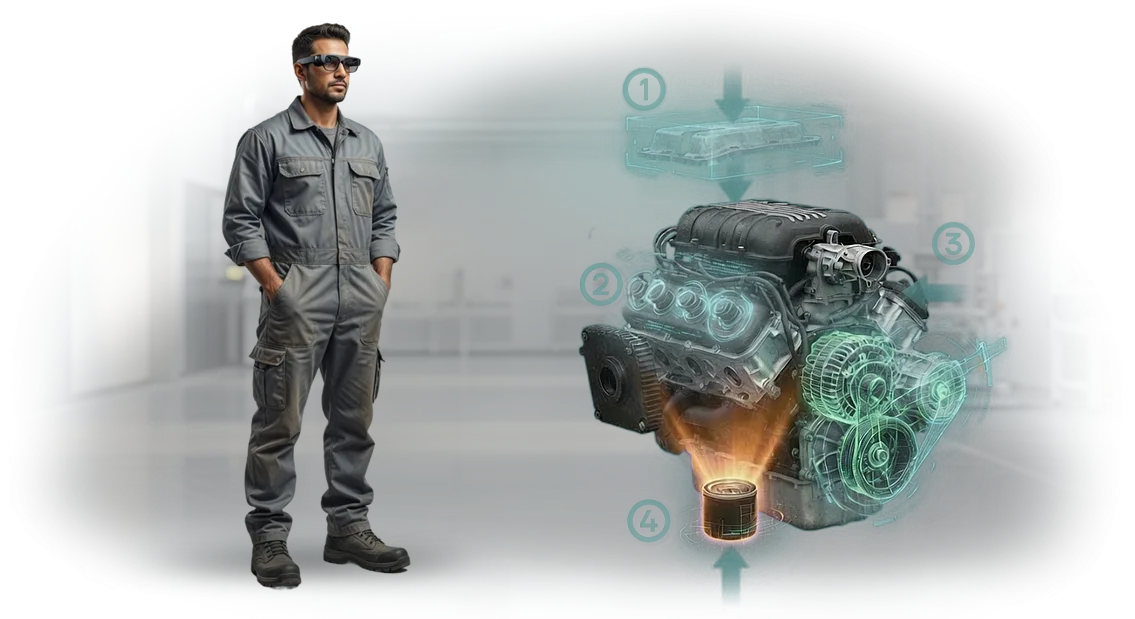
AR Assisted Assembly solves this problem: step-by-step prompts are projected directly onto the equipment, and the employee sees where and how to install the part without reading lengthy documents.
Assembly speed increases by 20–30%, the number of errors drops, and staff training takes days instead of months — just show the process once in augmented reality, and a newcomer works almost like an experienced mentor.
We help develop such AR instructions for your assembly unit or operation: from analyzing typical errors to implementation at workstations. Our engineers use professional equipment and proven tools, so the customer gets a stable result.
Such a tool quickly pays off by reducing defects, increasing assembly speed, and cutting training costs.
What a Digital Instruction Changes: 5 Key Benefits
A digital instruction is a practical application of AR Assisted Assembly. The operator sees prompts directly on the equipment and is not distracted by paper regulations. The assembly process becomes predictable and independent of the individual employee's experience.
The first benefit is reduced defects. The operator gets the precise order of steps, the required parts, and installation locations, so omissions and mixed-up assemblies practically disappear. Costly rework happens less often, and product quality remains stable from shift to shift.
The second is faster assembly. No need to flip through instructions, wait for a mentor, or double-check yourself: the next step appears at the right moment.
The operation cycle shortens, and in serial production this means additional hours of useful work without expanding the headcount.
The third is simple training for new employees. The digital prompt leads the newcomer by the hand, and they reach the planned speed faster. Experienced workers are not distracted from their tasks, and employee replacement stops being a problem that lasts for weeks.
The fourth is quality control. Each stage is recorded automatically, so the supervisor sees where deviations occur. This makes it possible to eliminate the causes of defects precisely rather than deal with the consequences after the fact.
The fifth is saving time and resources. Fewer defects, faster assembly, and simpler training create a combined effect that pays for the implementation within the first batches.
Formats of Interactive Instructions: From Diagrams to Scenarios
The same assembly process can be shown in different ways: from a simple diagram to an animated scenario overlaid on real equipment. The format affects not just the visuals but also the working speed, the number of errors, and the time needed to train operators. We select an option for each specific operation rather than using a template for all tasks.
Formats by Task
| Format | When we choose it | What it gives the customer |
|---|---|---|
| Step-by-step 3D instructions | For regulated operations and training newcomers | Clear sequence of actions, fewer errors, quick alignment of the worker to the rhythm |
| Animated assembly scenarios | For complex assemblies where order and correct torque matter | A clear visual example without words: the operator repeats each step exactly |
| AR overlay | For operations on real equipment | Prompts right in the field of view: no need to look at a screen, hands stay free |
| Combined format | For areas with frequent model and staff changes | A flexible instruction for different skill levels, fast adaptation to new models |
In practice, we combine formats: a basic 3D diagram provides the overall understanding, while the AR layer highlights critical points.
We convert the customer's source models, for example from SolidWorks, into interactive instructions without losing accuracy — the operator sees exactly the part they are working with.
The right format cuts training time severalfold and reduces the defect rate. That is why at the start we analyze your operations and propose the option that will pay off fastest.
How Development Works: 6 Steps from Brief to Launch
If a production operation changes while the instruction stays the same, the number of errors and the time needed to train newcomers grow.
AR prompts solve this problem, but customers often fear that development will take months and turn into a "black box" with an unpredictable result.
We have split the work into six clear steps — from brief to launch. At each stage you receive a concrete artifact: a plan, a mockup, a tested version, not abstract promises. This keeps you involved in the process and always aware of what is happening with the project.
- Briefing and production analysis — we visit the site or study the drawings and record how the operation is actually performed. You receive a technical specification and a step specification — the basis that you approve.
- Project plan and training methodology — we determine which actions become the steps of the instruction, how the operator interacts with the system, and what prompts a newcomer needs. You see the scope of work and the timeline before production starts, not after.
- Approval of mockups and scenarios — we show a mockup of the future instruction on your equipment: the list of steps, prompt texts, and voice guidance. You make edits before content creation — this saves time and money.
- Content and AR scene creation — we model the parts and assemblies, add animation and error control. The operator sees on the screen exactly the elements they work with, not an abstract diagram.
- Testing in production — we test the instruction with your employees in a real workshop, among them both newcomers and experienced workers. We collect data on operation time and error counts — and refine the scenario.
- Launch and support — after acceptance you receive the instruction, a maintenance plan, and content updates. If the technology changes six months later, we rebuild the scenario as part of standard support.
This process protects your budget and deadlines: you approve each stage and know exactly when you will receive the finished solution. The result is an AR instruction that is used in the workshop from day one, without separate training for the technical team.
What Is Included in the Delivery: A Complete Production Package
You receive a ready-to-use working package, not just an application. Everything needed to launch AR instructions in production is already included: from configured software to employee training.
No self-assembly or digging through documentation — you can launch a pilot area right away and evaluate the effect on real operations.
The delivery includes:
- AR application for assembly operations — runs on employees' tablets and smartphones and shows the step-by-step assembly process directly on the equipment.
- AR instruction library — step-by-step scenarios for your assemblies and operations, ready for operators to use.
- Employee guides — short cheat sheets and videos on how to use the instructions without stopping work.
- Staff training — we train supervisors and operators so they confidently work with AR from day one.
- Technical documentation — a complete package of documents for your operations and IT departments.
- Support and maintenance — we help update instructions, answer questions, and refine scenarios as production changes.
Each item addresses a specific task: clear steps for the operator, quality control for the supervisor, and productivity growth without downtime for the manager. If necessary, we add new scenarios to the package — you expand the product range, and we update the instructions.
Case Study: Assembly Instruction for Production
For the machine-building company Agromash-Engineering, we developed an AR instruction for assembling a hydraulic unit. Previously, new operators took two weeks to master the operation, and an error occurred on every tenth part.
After implementing augmented reality, the employee sees a step-by-step prompt directly on the equipment: where to fasten, which tool to use, and in what order.
The result was recorded after a month of work: average assembly time dropped by 30%, and the number of errors fell by half — from a 12% defect rate to 6%.
Now a newcomer can be trained in three days instead of two weeks: the mentor does not spend time repeating the instruction, and the operator no longer depends on memory.
This is especially important in areas with high staff turnover and seasonal employees, where new people must be brought up to speed quickly every week.
Another effect is the speed of technology updates. If the plant changes fasteners or the sequence of operations, an engineer updates the AR scenario, and the entire workshop immediately works with the new version.
No need to reprint posters or gather the team for a briefing — the edits reach the employee within minutes.
The economics are also noticeable: on a single conveyor, the reduction in defects and rework delivers significant annual savings — the exact figure is calculated after audit — while the shorter assembly time allows taking on more orders without expanding the headcount.
The customer is already scaling the solution to a neighboring workshop and plans similar instructions for other industrial equipment.
Frequently Asked Questions and Typical Objections
We understand: implementing AR instructions raises questions. Customers most often doubt the complexity of integration, compatibility with existing equipment, and whether the investment will pay off. Let us look at the typical objections — and show how they are resolved in practice.
Will production have to be stopped and the workshop rebuilt?
No. AR instructions work on top of existing processes. We do not replace equipment or interfere with control systems: the prompts are visible to the employee through a tablet or glasses, and operation control remains the same.
Implementation is carried out in stages — first a pilot area, then scaling, so production does not stop. Adaptation to your operations takes a few shifts, and workers quickly get used to the new format.
What equipment is the solution compatible with?
Practically any: from manual assembly to automated lines. The system does not depend on the machine manufacturer — it works with visual markers, drawings, or 3D models.
At the briefing stage, we check compatibility and provide a conclusion before the work starts, so you know in advance that the project is feasible.
How much does it cost and when will it pay off?
The cost depends on the number of operations and the complexity of integration, but we fix the estimate before the project starts. We calculate payback in hours: the reduction in assembly time and the training of new employees usually covers the investment in the first year.
For example, for a machine-building company we reduced defects by 30% and accelerated assembly by 20% — the project paid off in 8 months.
The main concern is that AR will turn out to be too complicated for workers and will not fit into current processes. That is why we structure the implementation as a gradual process: you see the result on a pilot area, train the team, and only then expand the solution. We stay in touch after launch as well — we update instructions when operations change and provide support.Order Development of Digital Instructions for Your Task
Production processes at every enterprise are unique: their own operations, equipment, and safety requirements. Off-the-shelf AR applications do not account for these peculiarities, so they often do not work in the workshop.
We develop digital instructions individually — from analyzing your assembly line to full support after launch.
When you order development, you get:
- An audit of assembly operations and identification of points where AR prompts will deliver the maximum effect.
- A prototype instruction on one real assembly — you will be able to evaluate the usability before scaling.
- A complete set of AR instructions for critical operations, taking into account your regulations and machines.
- A pilot launch with staff training and measurement of assembly speed before and after.
- Support and refinement after implementation, including updating instructions when processes change.
- Scaling of the solution to other areas and product types.
We work on the professional Unity platform, which guarantees the stability and performance of the instructions on any devices — from tablets to smart glasses. This is especially important in the workshop, where every second of downtime costs money.
Leave a request for development — we will contact you within a day, clarify your tasks, and propose a pilot project plan. You will see how AR instructions work on your operations before full implementation. We begin with a consultation on your tasks.
How to Choose the Right Instruction Format for Your Production?
To choose an instruction format, first determine where losses occur in your production: training time, assembly errors, dependence on experienced employees.
If operations rarely change and are performed by master craftsmen with many years of experience, paper or electronic documentation is enough.
But if newcomers join the line and the assembly unit is complex — static diagrams stop working: the employee gets distracted, confuses the sequence, and redoes things.
Criterion #1 — the complexity and responsibility of the operation. For simple actions, a picture is enough, but for multi-step assembly where every position and the moment of tightening matters, you need a format that guides through the steps in real time.
Criterion #2 — the skill level. An experienced employee only needs prompts in the form of exceptions; a newcomer needs step-by-step control and clear visualization to see what the result should look like at each stage.
The third criterion — how often the instructions are updated. If the product range changes every month, printing and re-approving documentation eats up time.
In this case, the digital format pays off faster: make the change once — and all operators are already working with the current version. The fourth — the cost of an error.
The more expensive the defect and the more responsible the operation, the more value comes from control that prevents a step from being missed.
The fifth criterion — the scale of production. For single-unit and small-batch production, rented assistants are sufficient; on a line with dozens of operators, AR instructions pay off by reducing onboarding time and the percentage of rework.
Start with one key area with a high risk of errors — calculate the difference in minutes and defect rates before and after. This gives you an objective assessment for rolling the solution out to other lines.