

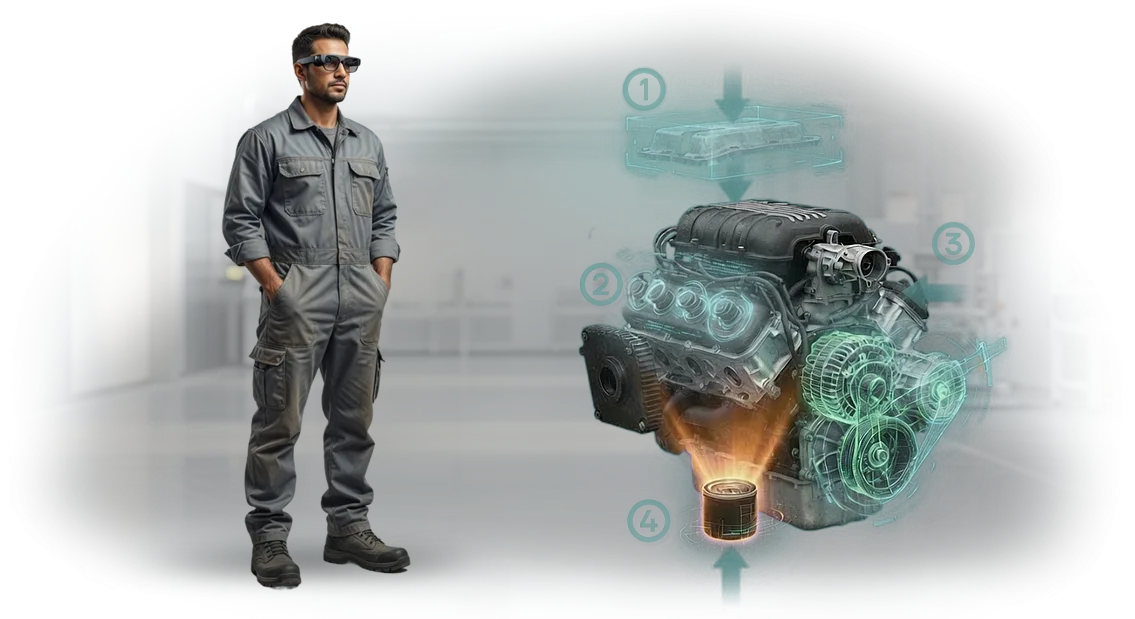
Employees make mistakes with equipment? AR for manufacturing solves the problem
Operator errors on the production floor don't just ruin a part — they cause equipment downtime, missed deadlines, and extra rework costs.
When an employee runs a multi-step machine using paper instructions or memory, the likelihood of an inaccurate action stays high even for experienced specialists. And every wrong press or skipped step quietly raises the unit cost of each product.
The root of the problem is usually in on-the-job training and access to up-to-date information. Classic procedures take time to find the right section, and new employees have to learn by trial and error.
Digitizing instructions solves this: step-by-step prompts appear directly on the equipment, showing what to do next, which parameters to check, and where the required component is.
Augmented reality turns a complex process into a visual scenario that cannot be skipped or confused.
AR for manufacturing is not the future — it's a working tool that already cuts setup time and reduces operator mistakes. Instead of thick manuals, voice and visual prompts; instead of memorizing sequences, control at every stage.
This approach speeds up onboarding for new employees while reducing the load on experienced mentors.
We help factories adopt this format: we develop AR instructions for specific operations, integrate them into the workflow, and support the launch. The result is less downtime, stable quality, and a team that works confidently even through staff turnover.
If employees make mistakes, they're missing the right instructions — and we create those instructions.
What you get from implementing interactive instructions
Implementing interactive instructions isn't about the technology — it's about measurable results on the production floor. Our clients use AR instructions to bring new employees up to full capacity faster and cut operational losses. Here's what you gain on each key metric.
- [ ] Faster training. Instead of spending weeks studying paper procedures, a new operator masters operations in a day or two. AR prompts each step right on the equipment, so the employee works from day one instead of watching from the sidelines.
- [ ] Fewer errors. Step-by-step execution control and visual prompts cut the number of incorrect actions by 2-3 times. That means less scrap, less rework, and fewer emergency stops.
- [ ] Workplace safety. Instructions flag hazardous zones and block the next step until safety requirements are met. Incidents drop, and the safety culture gains a clear, visual tool.
- [ ] Higher staff efficiency. Experienced specialists spend less time explaining and supervising, and simpler operations can be delegated to less experienced employees without losing quality.
- [ ] Less downtime. If equipment stops, an operator with an AR instruction finds and resolves a typical problem faster, without waiting for an engineer to be called in.
The experience of manufacturers such as Boeing shows that these solutions pay for themselves within a few months through shorter training times and reduced scrap.
Instruction formats for production tasks
Staff working at machines operate in different conditions: some need a prompt on a tablet, some can't take their eyes off the control panel, and some need information right on a transparent display.
There's no one-size-fits-all solution, so we match the format to the specific area and task. Sometimes a mobile instruction is enough; sometimes you need a stationary point with a guidance system.
The real value isn't "putting on a headset" — it's closing a specific gap: reducing training time, lowering the risk of errors, and accelerating changeovers.
Below we break down which format works in which scenario, and after the table we show how our engineers choose the right option for your processes.
AR formats: from tablet to integration
Mobile AR instructions — the fastest way to get started. Instead of thick paper manuals, an employee points a tablet camera at the machine and sees step-by-step prompts overlaid on the real equipment. This format is ideal for training newcomers and for rarely used operations.
Stationary AR complexes — a solution for repair and quality control zones where the employee works with both hands. A dedicated screen or headset is mounted at the workstation, and the system recognizes the part and highlights control points.
This reduces reliance on the human factor: the operator doesn't cross-check documentation but sees the exact sequence of actions.
Enterprise system integration — when AR tools are linked to your internal database.
These solutions work in tandem with CNC machines: when an order comes in, the system automatically loads the appropriate instruction adapted to the specific model — cutting changeover time by 20-30 seconds per operation.
| Format | For whom | What it gives the client |
|---|---|---|
| Mobile AR guides | Setup technicians, shop floor supervisors | Fast training, fewer changeover errors |
| Stationary AR complexes | Quality control department, repair services | Quality control without stopping the process |
| Enterprise system integration | Production leaders | Data transparency and faster processes |
This approach is already used by leading equipment manufacturers (such as Siemens and other vendors), but in our projects we adapt the format to the tasks that matter for your site.
If your goal is to reduce errors on complex operations or speed up onboarding for new employees, we'll prepare a turnkey solution — from format selection to on-site launch.
How a project for creating interactive guides proceeds
We structure the work so you never have to wonder what's happening at each stage. Below is a typical project path: from the first conversation to instructions your staff actually use on the floor. Timelines and details are adapted to your site, equipment types, and personnel skill levels.
Work stages
-
Brief and site audit. We identify which operations are critical, where mistakes happen most often, and which equipment needs instructions first. We lock in goals: reduce training time, lower scrap, or speed up commissioning.
-
Prototype and approval. We show on one real unit what the AR prompt will look like: text, animation, voice guidance. You see the result before full development and can make changes without extra cost.
-
Content creation. Our engineers break down each step of the operation, record it on real equipment, and turn it into clear visual prompts. Complex components are explained with 3D models and step-by-step animations — no need to read dozens of text pages.
-
Technical implementation. We build the solution on professional hardware and proven tools so it works reliably in shop conditions: dust, vibration, and uneven lighting. At this stage you get a working version, not a presentation.
-
Process integration. We configure access, link instructions to specific equipment units, and train administrators. Your team can update prompts independently, without our involvement.
-
Testing on the real site. We run the scenario together with your operators and setup technicians, remove friction points, and verify that the instruction actually reduces working time. Employees start learning at this stage.
-
Launch and support. We deploy the solution across all required areas, deliver final staff training, and support the project after launch. If equipment changes or new procedures appear, we help update instructions quickly.
The result is a working tool, not just an app. The first operators are already trained during the testing phase, so by the official launch the guides are delivering value: reducing downtime, cutting error rates, and accelerating onboarding.
What's included in the project delivery package
After the project is complete, you receive not just an application but a full set of materials you can work with on your own. We hand over all files, documents, and rights — nothing stays "in our studio."
Here's what's included:
- Ready AR solution — an app installed on your devices with configured employee accounts.
- Source materials — 3D models of the equipment, animations, instruction texts, and media files in their original formats. You can make edits without involving developers.
- Technical documentation — project structure description, administrator guide, and a quick operator manual.
- Employee training — we demonstrate on your equipment and provide video recordings and cheat sheets for fast onboarding of new specialists.
- Content rights — full rights to all materials created within the project. You can use and modify them freely.
- Warranty support — during the warranty period we fix errors, answer questions, and help adapt to changes on the production floor.
All materials are handed over in stages with acceptance certificates, so you always see what you're paying for. You're never locked in: want to develop the project further — use our documentation and sources; want to bring in another team — hand over the full package.
That means your investment in AR instructions remains your asset, not a "rental" of someone else's solution. You get control, transparency, and the ability to scale the system as production grows.
Case study: how we reduced equipment downtime at a factory
At the machine-building plant Priborostroy, a line stoppage meant a significant loss of revenue per shift. When a machine failed, the crew waited for an engineer to arrive from another city: diagnosis from paper diagrams took hours, and a small mistake caused another stoppage. Management was looking for a way to cut repair time using the local shift.
We proposed an AR instruction rollout: operators received step-by-step prompts right on a tablet screen, with highlighted components and video explanations. A specialist on a remote line could see the same image as the worker and guide them by voice and annotations. This removed the main pain point — dependence on an external expert arriving for repairs.
Project results
In the first 6 months, downtime fell by 40%. Average fault resolution time dropped from 3.5 hours to 1 hour 20 minutes, and scheduled diagnostics from half an hour to 15 minutes. New employees reach normal pace after 3-4 shifts instead of two weeks. The investment in developing the AR instructions paid for itself by the third stoppage.
To order, we prepared an instruction set for five equipment types: visual algorithms, checklists for scheduled maintenance, and records of typical failures. The plant continues to expand the library — maintenance no longer stops while waiting for rare specialists.
Bottom line: AR in a factory is not an experiment for its own sake — it's a tool for managing losses. Every hour of downtime is lost revenue, and that's exactly what a digital instruction reduces. We're ready to show a similar case for your equipment and calculate the effect based on your data.
Frequently asked questions before launch
Before launching AR instructions, managers tend to ask the same questions: will the technology work with existing equipment, will it burden employees, and how long will implementation take. We answer the main concerns — to the point, without technical detail.
Is AR compatible with our equipment?
Yes, almost always. We don't require replacing machines or lines: our engineers visit the site, study the specific components and operations, and create an AR scenario that works on top of the existing equipment.
If you have rare or outdated models — that's not a problem either: we adapt to each individual case.
Will employees need retraining?
No, quite the opposite — AR removes the need for lengthy training. The worker sees the prompt directly on the equipment: which tool to take, where to press, in what order to complete the steps.
On average, a new employee starts working without a mentor after the first shift, and errors and questions to supervisors drop noticeably.
How long does implementation take?
The first working prototype on a single site takes two to four weeks from task approval. That's enough to evaluate the effect on a small scale and decide on rollout.
Implementation across other shops is planned in parallel with the production cycle, so lines don't need to be stopped.
Will AR affect safety or technical processes?
Instructions don't interfere with equipment controls: they simply supplement the operator's field of view with information.
So risks to technical processes are eliminated, and occupational safety requirements are met automatically — recommendations are built into the scenario and prevent important steps from being missed.
If you still have questions about your equipment, write to us — we'll review the situation in detail and, if needed, prepare a demonstration at your production site.Order turnkey development
When you decide to order turnkey development, we start not with code but with an analysis of your production situation. We examine which operations take the most time, where errors occur, and what prevents new employees from finding their rhythm quickly.
This approach lets us design AR instructions that solve a real problem, not just impress with technology.
We work on transparent terms: we lock in the estimate before the start and don't change it along the way. AR pricing is based on the number of scenarios and integration complexity — you know the budget and timeline in advance.
How the work is structured
- Request — you describe your task, and we contact you within one business day to clarify details.
- Audit and design — we study your process, identify application areas, and prepare a scenario concept.
- Approval — we show the instruction logic, discuss changes, and finalize the estimate.
- Development — we build the AR instructions, test them on your equipment, and adjust based on feedback.
- Launch and training — we install the app and run a short training session for your team.
- Support — we stay in touch after launch and help with updates and refinements.
What you get
- A fixed estimate — no hidden fees or "surprise" surcharges.
- An approved delivery date for each stage.
- A complete set of source materials and documentation.
- AR instructions that work on your equipment and in your environment.
- Employee training and a quick administrator guide.
- A guarantee on the result: if the instruction doesn't solve the task, we refine it at no cost.
Order AR instruction development now — in a few weeks you'll have a tool that reduces training time and cuts the number of errors. Leave a request, and we'll prepare a cost estimate for your scenario within two business days.
How to choose a format for employee training?
Choosing an employee training format is always a trade-off between implementation speed, cost, and real results. Some prefer classic paper instruction, others prefer interactive simulators.
But when complex equipment is involved, a mistake is expensive: lost time, breakdowns, safety risks.
That's where AR for training comes to the forefront — a format that lets employees practice actions right at the workstation without stopping production and without waiting for a specialist to read dozens of pages of instructions.
The right format is determined by three questions: who your employees are, what equipment they need to master, and how often procedures change. If the team is young and used to mobile devices, augmented reality feels natural.
If experienced specialists with years on the job work on the floor, AR helps them quickly adapt to new machine modifications. The point isn't technology for its own sake — it's a measurable result: fewer errors, faster onboarding, less load on mentors.
Our engineers have spent years helping manufacturers compare formats and choose the one that pays off fastest.
We don't sell a "universal solution" — we analyze your process and offer options: from lightweight mobile scenarios to full AR instructions embedded in the working environment.
At this stage, you don't need to be a technology expert — just describe your task, and we'll handle the rest.
To understand which format suits your employees, start with a short consultation. We'll ask a few questions about your equipment, training process, and expected results — and in 30 minutes, we'll break down which options are worth comparing.
You'll get an honest assessment: where augmented reality will deliver impact and where a regular instruction is enough.
And then it's your call: either you implement AR and get hands-on training without stopping production, or you return to the previous process — but now with a clear understanding of the alternative. Either way, the consultation helps you decide.