

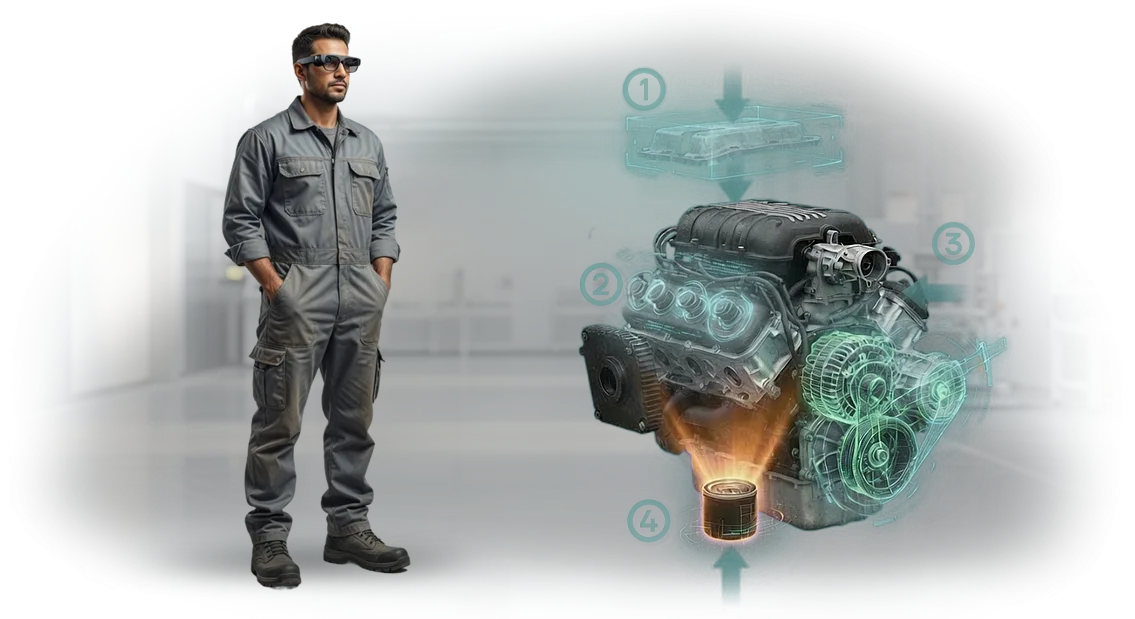
Equipment Downtime and Staff Shortages: Why AR in Manufacturing
Every hour of equipment downtime means delayed orders, additional costs, and pressure on the teams that have to keep up.
Often the problem is not the machinery itself, but the people who operate it: qualified staff are increasingly hard to find, and training a new operator takes a good few weeks.
Until then, someone experienced has to supervise every step, and any random mistake can stop the production line.
The shortage of qualified personnel is not solved with higher salaries alone. Even when you find people, they lack the practical knowledge of those who worked on that equipment for years. And when experienced operators retire or leave, their knowledge leaves with them.
All that remains is complicated documentation, thick manuals, and procedures that are hard to learn through trial and error. Operator errors become inevitable, and every error means lost time, rejected parts, and safety risks.
Augmented reality changes this equation. Instead of searching for answers in manuals or calling a more experienced colleague, the operator sees directly on the equipment the instructions they need: which button to press, in what order, where the next step is.
In practice, the machine becomes a visual guide that doesn't depend on the experience of the person using it. Staff training is shortened from weeks to a few days, and new employees become productive much faster, without putting pressure on senior colleagues.
For you, as a production manager, this means one thing: fewer unplanned stops, fewer mistakes, and a team that works with confidence.
The digital instructions we build capture the correct working methods of the best specialists and make them available to every operator, regardless of their skill level.
The result: production lines run more stably, and your resources are no longer spent on fixing errors, but on growing the business.
Digital Instructions Instead of Paper: Five Key Benefits
For a production manager, paper instructions are a constant source of losses: experienced employees waste time searching for the right page, and new hires are afraid of missing a step.
AR instructions solve this problem: prompts are displayed directly on the equipment, in the operator's field of view. We implement AR in manufacturing and see consistent results.
Five key benefits:
- Speed of onboarding. An employee reaches planned productivity in a few shifts, not weeks. No need to look for a mentor — a digital prompt accompanies every step.
- Fewer defects. The system checks every action and warns about an error in time. This reduces losses from low-quality output.
- Quality control of operations. The manager sees statistics for each operation: where delays occur, who works faster, where refinement is needed. This is the foundation for improvements.
- Knowledge transfer. The experience of the best machine setters is preserved as digital instructions and is available to any shift. You don't depend on a single expert.
- Training savings. Lower costs for mentors, fewer downtimes, faster ramp-up to full capacity. The pilot project pays for itself within a few months.
We work according to lean manufacturing methods, so the effect is visible in the area's metrics, not in "implementation for the sake of technology." We'll advise you on which area to start with and show you the savings calculation.
AR Formats in Manufacturing: Choose the Right One for Your Task
AR instruction formats differ not only visually, but also in the tasks they solve. Some are suitable for mass employee training, others for targeted remote assistance. To avoid overpaying and get quick results, it's important to define the usage scenario in advance.
| Format | For whom | What it gives the client |
|---|---|---|
| Mass training | New employees, line staff | Fast onboarding without stopping production, reduced burden on mentors |
| Remote support | Engineers, field teams, service departments | On-site problem solving, savings on travel and equipment downtime |
| Mentoring | Experienced specialists, knowledge transfer | Capturing expert knowledge, reducing dependence on specific people |
| Operations control | Quality control, process engineers | Fewer errors, a unified standard for performing work |
We integrate such instructions into existing processes: from training to maintenance. Our engineers create content in the professional Unity environment, so the instructions work equally reliably on smartphones, tablets, and AR glasses.
You don't need to buy expensive equipment — the devices already available at your facility are enough.
We'll help you choose the right format and prepare a pilot project at your production site. You'll see the effect on a specific unit before scaling the solution.
How Digital Instruction Implementation Works: From Brief to Support
We run the project transparently: you always see what stage the work is at and when you'll get the result. Below is a typical AR instruction implementation plan: from the first conversation to regular support.
- Brief and audit — we discuss the task, review existing instructions, and examine the equipment.
- Plan and prototype — we propose a structure and show a sample on one unit.
- Approval — you make edits, we finalize the scenario.
- Development — we create instructions for all operations, selecting visuals and texts.
- Testing in production — we check on real equipment and take feedback into account.
- Launch and training — we deploy the solution and conduct employee instruction.
- Support and updates — we adjust and supplement the instructions as needed.
| Stage | Typical timeline | What you get |
|---|---|---|
| Brief and audit | 2-3 days | Accurate scope of work and implementation plan |
| Plan and prototype | 5-7 days | A sample instruction before full development |
| Approval | 3-5 days | An approved scenario with no open questions |
| Development | 2-4 weeks | A ready-made set of instructions for your operations |
| Testing and launch | 5-7 days | A working system and trained employees |
| Support | On request | Up-to-date instructions after changes on the production floor |
What's Included in Delivery: Turnkey Package
When you order AR instruction development, you get not just content, but a ready-made tool that immediately embeds into production processes.
We've put the package together so you don't have to negotiate refinements yourself, hire additional specialists, or deal with technical details. Everything needed for launch and daily operation is included in the delivery.
Here's what's included in the package:
- Ready-made AR instructions for your operations — step-by-step prompts directly on the equipment; the employee sees the sequence of actions without referring to paper manuals.
- Content management system — you update instructions yourself when regulations or equipment specifications change, without involving developers.
- Access and roles for the team — we configure permissions for operators, engineers, and administrators so everyone sees only the information they need.
- Staff training — we conduct instruction sessions, show how to use AR solutions and administer the system, and reinforce skills through practice.
- Procedures and documentation — we describe the content update process, backup, and actions in case of failures; everything is ready for integration into your internal quality standards.
- Support at launch — we help implement the solution, answer employee questions, and fine-tune instructions for the specifics of particular areas if needed.
This package covers the key objectives: onboarding of new employees is faster, control over instructions stays with you, and production gets a unified work standard without downtime or paper documents. All that's left for you is to accept the result and use it at your facilities.
Case Study: Line Startup 40% Faster with Digital Instructions
Our team has already implemented digital instructions at a food industry production facility, where starting up a new line used to take up to two shifts.
Operators had to reread bulky paper regulations, distract process engineers, and work by trial and error — this dragged out commissioning and increased the number of errors.
We converted key operations into step-by-step AR scenarios that overlay directly onto the equipment. The employee sees the highlighted area, the next action, and the check point — without needing to flip through instructions or keep the sequence in mind.
As a result, line startup time dropped by 40%, and the number of errors during initial setup fell by nearly half.
The client recouped the development investment in four months: fewer downtimes, faster onboarding for new employees, and stable quality from the start. The results were so convincing that the company ordered the solution to be scaled to other production areas.
Efficiency metrics we record after implementation:
- line ramp-up speed to operating mode increased by 30-40%;
- the number of operator errors during startup fell by up to 70%;
- the cost of onboarding new employees was cut in half;
- average project payback period — from four to six months;
- 8 out of 10 clients place repeat orders for expansion.
These results are achieved because AR instructions work exactly where the problem arises: on real equipment, at the moment the task is performed. The operator doesn't search for information — they see it right in front of them.
This reduces the time for each step and removes the need to ask experienced colleagues for clarification.
How to Choose a Digital Instruction Format Without Overpaying?
The format of a digital instruction is not a matter of fashion, but of economics.
There's no universal solution: the same equipment can be described in different ways, and overpayment most often occurs where the format is chosen "by the pretty picture" rather than by the task.
To avoid overpaying, you need to understand what you want to get: fast onboarding of a new hire, fewer defects, or less downtime.
Four parameters influence the choice. The first is the number of employees who work with the instruction: the more people, the more expensive each hour of their training is, and the faster automation pays off.
The second is the frequency of operations: daily tasks require instant access to a prompt, while rare ones require detailed step-by-step guidance with result control.
The third is the complexity of the operation: the more steps, components, and check points, the higher the value of visual prompts. The fourth is the budget you're willing to allocate for development and support.
We also take into account what equipment is already available on site. If employees have smartphones or tablets, an AR instruction doesn't require additional investment in hardware — we embed prompts into the familiar workflow.
If there are no devices and the operation is simple, a browser-based format or a PDF with a checklist is enough. Pushing augmented reality where text is sufficient means building in extra costs without benefit to production.
The main selection criterion is the cost of an error. Compare the cost of implementing a format with the losses from defects, downtime, or injury. When the price of an error is high, AR pays off quickly; when the operation is simple and rare, overpaying makes no sense.
We help calculate this balance before development starts — and propose a format that solves your task, not the most expensive one possible.
In the end, the right format is not the one that uses the latest technology, but the one that delivers a measurable result: less training time, fewer errors, faster compliance with procedures.
These are exactly the criteria we use to select the format and calculate the economics before starting work — you get a solution tailored to your conditions, not a "kit" with imposed options.
FAQ: Cost, Timelines, and What You Need to Get Started
When deciding whether to implement AR instructions, managers ask the same questions: how much will development cost, how quickly will it pay off, will equipment have to be replaced, and what happens if the system fails. We answer honestly — so you can plan your budget and timeline before even reaching out.
How much do AR instructions cost for specific equipment?
The cost depends on the number of operations, component complexity, and format — from simple step-by-step prompts to a full 3D model with animation.
For a typical machine with 5-7 operations, the development cost is calculated after a short brief and includes filming, modeling, and system integration. We lock in the price before work begins.
How long does implementation take?
On average, a project takes 3-6 weeks: one to two weeks go to operation analysis and content preparation, two to three to development and testing, and a few more days to launch and employee training.
When you need to quickly test a hypothesis, we put together a lightweight version for a single operation in 10-14 days.
Will this work with our equipment?
We work with equipment from most manufacturers — from machine tool fleets to packaging lines. AR instructions don't require replacing machinery or stopping production: a tablet or smartphone with a camera and our marker, which can be easily applied to any machine, is enough.
What happens if the tablet or server fails?
The instructions will keep working without a network connection: if connectivity is lost, the materials remain available on the device. Backup scenarios are provided in case of failure — automatic switching to a PDF version or a paper card.
Technical support is available during business hours, and critical issues are resolved remotely or with an on-site visit.
If your situation differs from the typical one — send us a description of your task. We'll prepare a preliminary estimate and propose an option that fits your budget the day after you contact us.Request an Estimate and Demo
Start with an accurate assessment: whether an AR instruction is right for your production and what effect it will deliver.
It's hard to do this without a visual example, so as a first step we offer a short introduction phase — you describe the task, and we select a solution for your equipment and processes.
After contacting us, you'll receive not general promises, but a concrete set of materials for making a decision.
- Task audit — we analyze where AR instructions will genuinely reduce time and errors, and where spending budget isn't worth it.
- Demo on your scenario — we show how an employee will work with the instruction so you can assess the convenience before launch.
- Implementation plan — clear stages, timelines, and resources needed to move to regular operations.
- Cost estimate — a transparent estimate for your task without hidden payments or "extras" along the way.
- Commercial proposal — a ready document with terms and budget for approval by management.
- Payback assessment — we estimate how AR instructions will return the investment: faster training, fewer downtimes, lower risk of errors.
This is not binding in any way. You get numbers and arguments for an internal decision, and we get an accurate understanding of your task. The whole cycle usually takes a few business days, so no lengthy approvals are needed.
Leave a request — we'll get in touch within one business day, clarify the details, and prepare an estimate and demo tailored to your specifics. Start with a clear assessment before investing in a new direction.