

Equipment sits idle while staff train for months?
New equipment arrives on site, but there's no one to operate it: while engineers work through the documentation, the line stands still. Idle expensive machinery and missed commissioning deadlines hit revenue harder than the purchase itself.
And when the shift is finally staffed, newcomers make mistakes in the sequence of operations — and that means another stoppage, repair, and rework.
Classic workforce training in manufacturing is inflexible: the mentor gets pulled away from their own work, the group is scheduled around the calendar, and emergency scenarios can't be practiced on real equipment.
As a result, knowledge comes slowly, and the cost of an error grows along with the complexity of the machinery.
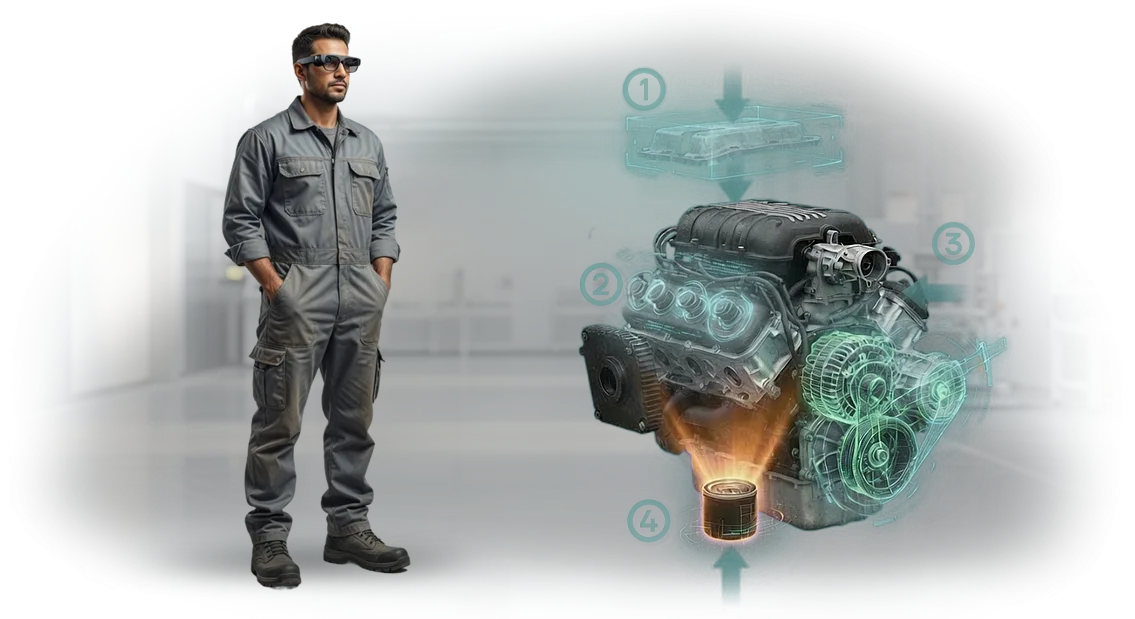
AR/VR for manufacturing removes this bottleneck. An employee puts on a headset or opens a tablet — and sees prompts right on the unit: what to unscrew, where to look, in what order to act.
The instruction proceeds step by step, responds to what the person has already done, and won't let a stage be skipped. Training moves to a simulator, where a mistake breaks nothing, and commissioning speeds up by practicing real scenarios before entering the shop floor.
For the department head, this is direct money: fewer hours of idle expensive machinery, faster time for new shifts to reach planned productivity, a lower rate of defects and emergency stoppages among inexperienced employees.
An instruction assembled once works for all subsequent newcomers — without repeatedly pulling mentors away from production.
We build such solutions for the customer's specific equipment and regulations: from training scenarios to ready-to-use prompts on the shop floor. Describe your task — we'll come back with an estimate and a plan.
What the customer gets: the effect on people and processes
Learning speed is the first thing managers notice.
A new employee becomes able to work independently not after weeks of shadowing a mentor, but noticeably faster: the instruction shows the relevant unit right on the equipment, in the right sequence, without flipping through regulations. The mentor, meanwhile, returns to their own tasks instead of standing by for half a shift.
Fewer errors is the second benefit, and it pays off immediately. When an action is confirmed visually on the machine itself, confusion between similar units and skipped steps disappear.
Less scrap, fewer downtime incidents due to incorrect operations, fewer unplanned line stoppages. For a manager, this is not abstract "digitalization" but the predictability of a shift.
Employee engagement grows through clarity. An employee sees what is expected of them and is not afraid of making a mistake — training stops being stressful.
This directly affects turnover: people are less likely to leave a shop floor where they are properly onboarded rather than thrown into a shift to "figure it out yourself."
Shift coverage is a separate effect. The instruction works the same for the morning, evening, and night shifts, for a new employee and for an experienced one who needs to refresh a rarely performed operation.
There is no need to gather everyone in a training room: access to knowledge is available at the workplace at any moment.
Finally, this works for the employer brand. When modern training tools are implemented in production, people talk about it in interviews and reviews — attracting staff becomes easier, and the reputation of a technology-driven site also helps in relationships with partners.
AR/VR formats for manufacturing tailored to your task
The format determines not the "beauty" of the solution, but how quickly your people will start working without errors. We start from the task: train a newcomer, reduce downtime on the line, or help an engineer on site. Below are three basic scenarios from which almost any project is assembled.
| Format | For whom | What it gives the client |
|---|---|---|
| Visual AR instruction | Operators, setup technicians, repair crews | Hints overlaid on real equipment: the employee follows the work step by step and doesn't flip through regulations |
| Interactive simulator | New employees, training centers, certification | Practicing actions on a virtual stand without risk to expensive equipment and without stopping production |
| Remote support | Field engineers, service departments | The expert sees the same thing as the person on site and advises in real time — fewer trips and less downtime |
How to choose a format
Look at the frequency of the task and the cost of an error. If an operation is performed daily and an error costs downtime — you need a visual instruction.
If there are many people and they need to be brought up to speed quickly — a simulator is more advantageous: it takes the load off mentors. If specialists are scattered across sites — remote support saves time and trips.
The formats combine well: first the employee goes through the simulator, then works using AR hints, and in a complex case calls an expert. We help choose the combination for your process — we'll discuss the task and come back with an estimate and a plan.
How a project unfolds: from task to working solution
A project doesn't start with a technical specification, but with a conversation about your task: what equipment employees service, where they most often make mistakes, how much time is lost on training and downtime.
We dig into the process, and then propose a format that genuinely removes the load — without unnecessary features you'd have to pay for.
From there, the work proceeds in transparent stages, and at each one you see a result, not a report about hours spent.
- Brief and task analysis. We discuss the equipment, employee roles, and bottlenecks: where newcomers take the longest to reach the norm, which operations most often lead to errors.
- Plan and estimate. We show what will be included in the solution, how long it will take in terms of timelines, and what materials are needed from you — usually this is access to the equipment and one or two specialists to verify the steps.
- Scenario approval. You approve how the instruction will guide the employee: the sequence of actions, prompts, control points. Revisions at this stage are essentially free — they cost less than redoing a finished product.
- Development. Our engineers build the interactive instruction and test it on real equipment, not in an office.
- Test at your site. Employees go through the instruction under supervision, we record where they stumble, and we refine it.
- Launch and staff training. We hand over the solution, show how to use it, and how to make revisions when equipment changes.
- Support. After launch, we stay in touch: we update steps, add new units, and answer your team's questions.
What you get along the way
You don't need to understand the technology — you approve a clear scenario and see how an employee goes through it step by step. We keep to deadlines and say in advance if something requires more time.
Why the stages matter for the result
The earlier you get involved in the approval, the more precisely the solution will fit real processes.
An instruction assembled without verification by those who work on the equipment remains beautiful but useless — that's why we consider the test at your site a mandatory stage, not a formality.
What is included in the delivery
When the project ends, you receive not a set of files, but a working tool that your shop floor or service department uses every day. Below is exactly what remains with you after handover: no "we'll finish it later" and no hidden extra work.
- Ready-made instruction scenarios — for each agreed unit or operation: assembly, setup, maintenance, repair. The scenarios are tested on real equipment by your own employees, not put together "from drawings".
- An app or web access for your devices — tablets, glasses, smartphones on the line. It works in a shop floor where it's noisy, hands are busy, and there's no time to look for a button.
- Clear documentation — how to add a new operation, update a model, replace a hint when the regulations change. Your engineer can handle it themselves, without contacting us.
- Team training — we hold sessions with foremen, mentors, and the operations service: how to use it, how to show it to newcomers, how to collect feedback from the line.
- Access and permissions — accounts, roles, segmentation by area. You can see who completed the instruction and when.
- Handover of source files and materials — models, texts, voiceover, diagrams. Everything remains with you; you are not tied to us as your only contractor.
- Warranty support — an agreed period during which we fix failures and answer questions about how the solution works.
What this gives in practice
A newcomer gets to the operation faster, the mentor stops repeating the same thing ten times, and assembly errors are caught before the part moves further down the line. The manager sees which employees have completed the briefing and which have not yet.
How we accept the work
We hand over according to a checklist: you verify each item above on your own equipment together with us. If a scenario is inconvenient in real work, we fix it before signing, not after.
Describe the task — we'll come back with an estimate, a plan, and the scope of delivery for your area.
Case study: how one factory cut downtime in half
The customer's challenge
A manufacturer of industrial equipment came to us with a classic pain point: experienced setup technicians knew the machinery "by hand," while newcomers stepped onto the line with paper instructions and folders of schematics.
Every assembly error meant a line stoppage, a re-run, and a missed shipping deadline. The department head wanted not "innovation for innovation's sake," but a tool that would cut downtime and take the load off the few experts.
What we did
We broke down exactly where time was being lost: during unit assembly and initial diagnostics.
Instead of rewriting the instructions, we built AR hints that overlay directly onto the equipment — the employee sees where to place the part and in what sequence, without flipping through documentation. We worked on professional equipment so the hints wouldn't "drift" on real parts.
Results in numbers
- Assembly downtime was cut in half — from 8 to 4 hours per batch.
- The time for a new employee to reach independent work dropped from 6 weeks to 3.
- The share of assembly errors fell by 70% over the first two months.
- Expert setup technicians freed up about a third of their time for complex tasks.
- The customer returned with an expansion to a second line and a repeat order.
Customer testimonial
"Previously we kept two mentors on every shift — now one is enough, and he does real engineering instead of retelling instructions. The guys figure things out on their own, and we see it in the downtime numbers," — production department head at an industrial holding.
We don't promise a "wow effect" — we show how it works on a specific line. Describe your task, and we'll come back with an estimate and a pilot plan.
What if the equipment breaks down or the staff can't figure it out?
This is the most common question we hear from managers before the start. The logic is simple: production cannot come to a halt because an instruction "didn't open" or an employee got confused.
That's why we build support, warranty, and training into the project from the start — rather than leaving the client alone with the system after launch.
If the equipment breaks down or changes. Instructions are tied to real components and work stages, not to an abstract diagram.
When you change a regulation, add a component, or update a machine model, we make edits to the scenario — the employee sees the current sequence of actions, not an outdated memo.
Updates are released on an agreed schedule so that changes on the production floor and in the instructions don't diverge.
If the staff can't figure it out. Training is part of the launch, not a separate "later" service. We show foremen and mentors how to work with the instruction, how to update it, and what to do in a non-standard situation.
A newcomer starts their shift with a prompt right in front of them, and an experienced employee spends less time explaining.
Warranty and support after launch. After handover, we stay in touch: we answer questions, help with edits, and make sure the system runs stably. If something goes wrong, we respond within pre-agreed timeframes, not "when we get around to it."
What happens if the equipment breaks down or gets replaced?
The instruction doesn't "detach" from production. We update the scenario for the new equipment or the changed regulation — employees continue working with the current sequence, without retraining from scratch.
If the staff can't figure it out, will they have to be retrained from scratch?
No. Staff training is included in the launch: we show mentors how to use the instruction and how to supplement it. After that, they pass the skill on to their shift themselves — without our team's constant involvement.
What does post-launch support include?
Answers to questions, scenario edits when production changes occur, updates, and monitoring of stable operation. We fix the terms and response timeframes in advance so that you have predictability, not hope for the best.
Let's discuss your task and come back with a plan
When you submit a request, we don't send a template proposal — first we dig into your situation. How many pieces of equipment, which operations cause the most errors, who comes on shift and how often. This determines which format of AR instructions will solve the task and which will be unnecessary.
After the analysis, you receive a project estimate and a work plan: stages, timelines, areas of responsibility. You see what you'll get and when, even before the start — and you can check it against your internal priorities.
What's included in the work
- Analysis of equipment and scenarios where instructions fail
- Project estimate with clear timelines and stages
- Work plan with roles distributed between your side and ours
- Development of AR instructions tailored to your processes and equipment fleet
- Testing on real shifts and refinement based on feedback
- Training employees to work with the instructions
- Post-launch support: edits, updates, maintenance
How to get in touch with us
Describe your task in any convenient format — a short email, a messenger, or a call. It's enough to tell us what equipment and what problem you want to solve: we'll clarify the rest ourselves.
We'll come back with an estimate and a plan, not with general words about the benefits of technology.
Ordering development is worth it if you want to reduce the number of errors on shift, onboard newcomers faster, and preserve the expertise of experienced employees within the company. Write to us — we'll discuss the task and propose a solution for your production process.