

Augmented Reality in Manufacturing: How to Reduce Errors
Every production manager knows the cost of an error: a wrongly performed operation turns into a defect, the defect stops the line, and downtime eats into profit.
Up to a third of defects arise from the human factor — an employee misunderstood the instruction, mixed up the sequence, or skipped an important step. Paper procedures and video instructions do not help: on the shop floor, the eyes are on the hands, not on a screen.
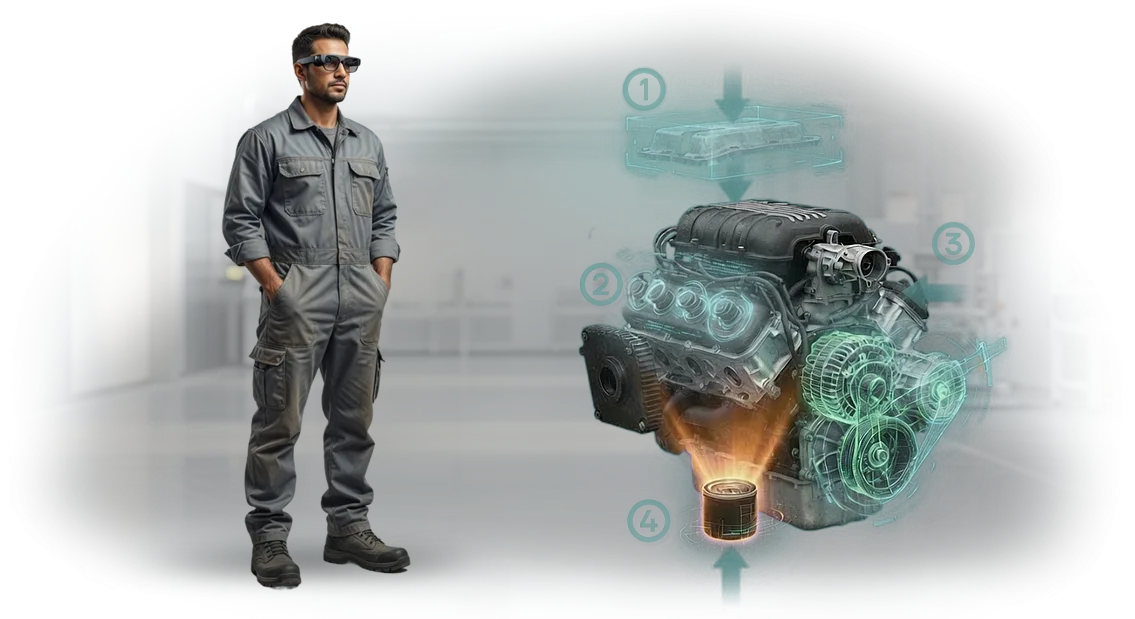
Augmented reality in manufacturing removes the gap between "written" and "done." The worker sees hints directly on the equipment: where the assembly is located, which part to take, where to apply lubricant, and with what torque to tighten the fastener.
There is no need to read and translate text onto reality — the system itself shows the next step over the object.
As a result, the number of errors, operation time, and retraining costs are reduced. A new employee gets up to speed in days, not weeks, and an experienced one stops relying on memory. For a manager, this means a lower defect rate, fewer stoppages, and more predictable output.
We tailor such instructions to your operations: we take real processes, annotate them, and turn them into step-by-step scenarios that a person sees through smart glasses or a tablet.
We work with professional equipment that withstands shop-floor conditions — our engineers themselves visit the site and adapt the solution to your machines and procedures.
If defects and downtime are your headache, augmented reality in manufacturing will become a tool that pays off immediately after launch. It is enough to start with one area to see the difference in numbers. We take on the entire cycle — from operations audit to implementation and staff training.
What Benefits You Get from Augmented Reality
Augmented reality in manufacturing is not an experiment for the sake of technology but a tool that measurably affects the key indicators of a shop floor.
Implementing AR instructions gives the business four main results: higher quality, less downtime, improved safety, and resource savings. Plus a fifth, often underestimated effect — personnel loyalty.
Quality. Overlaying digital hints directly on the equipment eliminates errors related to misreading drawings or forgetfulness. The operator sees the exact sequence of operations in the context of the real assembly — this reduces the defect rate and rework. The manager gets a consistent result even with high staff turnover.
Speed and reduced downtime. AR instructions make it possible to change over equipment faster and find faults.
Instead of long searches in documentation, the specialist receives step-by-step guidance right in their field of vision — downtime is reduced, and output grows without hiring additional staff.
Safety. By training an employee on real equipment with virtual warnings, you reduce the risk of injuries and accidents. The system points out hazardous zones, the lockout sequence, and mandatory checks.
This means fewer incidents, fewer fines, and a calmer working environment for the occupational safety service.
Savings. Errors and downtime cost money. By reducing defects, accelerating the onboarding of new employees, and shortening equipment maintenance time, the enterprise achieves tangible savings. AR investments pay off within a few months, and the effect only accumulates further.
Training and personnel loyalty. AR instructions turn the dull study of procedures into hands-on visual practice. New employees reach the required qualification faster and are less afraid of complex equipment.
Experienced workers perceive this support as care from the enterprise — it increases engagement and reduces staff turnover.
Each of these benefits is achieved without restructuring production processes. It is enough to develop AR instructions for key operations once — and the shop floor gets a lasting effect: higher quality, fewer stoppages, safer work, and lower costs.
Implementation Formats: From Pilot to Full Coverage
Implementing augmented reality in manufacturing does not have to start with a large-scale overhaul of all workshops. Most enterprises start with a pilot area, verify the effect on real operations, and only then expand the coverage.
We have prepared formats that cover both scenarios — from a local test to full digitalization of instructions.
Implementation Formats
| Format | Who it is for | What the client gets |
|---|---|---|
| Pilot on one area | For the first verification of the technology on a real line | Quick launch in 2–3 weeks, minimal investment, measurable result on one process |
| Scaling to several areas | For a shop with typical operations where quality needs to be standardized | Unified instructions for all shifts, fewer errors and less training time |
| Full plant coverage | For an enterprise ready to systematically change its training process and procedures | A unified instruction base, support for all workshops, fewer stoppages and incidents |
The formats work on regular tablets and mobile devices — no special infrastructure or expensive equipment is required. This allows you to start with a pilot and expand as confidence in the result grows.
Our engineers help you objectively assess which format will deliver the maximum effect within your budget. Then we adapt the instructions to specific operations, train the staff, and support the launch. You get a clear procedure and a guarantee that employees actually use the technology.
How an AR Instruction Implementation Project Proceeds
We follow a transparent process: you always know at what stage the project is and what you will get as a result.
No "black box" — after each step we show the intermediate result and agree it with you so that the AR instructions precisely solve the tasks of your production. The whole process is divided into stages with clear control points.
-
Brief and immersion into the task. We hold a meeting with your team, study the equipment, instructions, and typical operator errors. We define the goals: reduce training time, lower the number of errors, or speed up repairs.
-
Audit and implementation plan. We look at which areas will get the maximum effect from AR and prepare a plan with stages, timelines, and cost. You receive a clear document with priorities — we agree it before the work begins.
-
Prototype of one instruction. We create a working sample on real equipment so you can evaluate the scenario "through the operator's eyes": navigation, hints, and text volume. At this stage, details are easy to adjust before launching the full version.
-
Development of an AR instruction set. Our engineers build instructions according to your procedures, linking them to specific equipment assemblies. You get a user-friendly interface that does not require technical preparation from the operator.
-
Testing at your site. Operators and technologists check the instructions in real conditions. We collect feedback, make corrections, and record measurements: operation time before and after implementation.
-
Launch and training of your team. We deploy the system on tablets or smart glasses and connect your administrators. Basic skills are enough for an administrator — from then on, they manage instructions and employee access themselves.
-
Support and development. After the launch, we stay in touch: we update instructions when procedures change, add new scenarios, and help with technical questions. You are not left alone with the system.
At each stage, you see the intermediate result and make a decision — this eliminates surprises at the end of the project. The average launch time is three to eight weeks, depending on the number of instructions and the complexity of the equipment.
What Is Included in the Delivery of an AR Solution for a Plant
Ordering an AR solution for a plant, you receive not just individual instructions but a ready-to-use product. We think through the whole scenario: content preparation, interface, integration with your systems, and team training.
The package already includes all adaptation and launch work — nothing extra will need to be purchased. The delivery includes everything needed for the solution to start working from day one and bring measurable value.
Delivery checklist:
- An AR instruction set for your equipment: animated scenarios and hints at workstations.
- An interface for tablets and augmented reality smart glasses — an employee figures it out in a few minutes.
- Integration with your data: drawings, procedures, and maintenance logs in one AR window.
- Staff training: sessions for setters and repair technicians, a manual, and videos for newcomers.
- Administrator panel: instruction updates, access management, and usage statistics.
- Post-launch support: maintenance, updates, and scenario refinements when procedures change.
As a result, you get a working system, not "shelves with documentation." Employees master equipment faster and make fewer mistakes, and you do not need to hire a separate developer for support. Timelines and cost are fixed in the contract — you know in advance what you get and when.
Case Study: How a Plant Cut Downtime by 40% with AR
When a machine stops on a production line, every hour of downtime carries a heavy cost. The operator needs to find the instruction, understand the complex diagram, wait for the technologist — and only then start the repair. On one of our projects, this stretched to 3–4 hours. Augmented reality in manufacturing solves exactly this task.
We implemented a system at the TyazhMash plant in which the operator sees, through a tablet, a step-by-step augmented reality instruction overlaid directly on the equipment. Arrows show which assembly to unscrew, where the sensor is located, and which parameters to check.
A new employee does not need to search for paper procedures or call a mentor — everything is in front of their eyes. The reaction time to a breakdown drops from hours to minutes, and the number of repair errors noticeably decreases.
Implementation Results
- Downtime due to changeovers and minor breakdowns fell by 40% — the line is running again within 20 minutes instead of an hour.
- Onboarding of newcomers doubled in speed: the first independent repair is performed within a week instead of a month.
- Savings from the additional output: cost calculated after audit.
We measured the indicators using the stoppage log and the plant's accounting system before and after the launch. This case showed that augmented reality pays for itself in one quarter.
Three months later, the plant ordered the scaling of the system to all five workshops — now it works without our involvement.
Frequently Asked Questions About Implementing AR Instructions
Any changes in production raise questions: how difficult is it to implement augmented reality, will it break the process, how much does it cost. We answer what is most often asked before the start of a project. If you did not find your question — write to us, and we will tell you more about your case.
Will the production process have to be restructured?
No. AR instructions are overlaid on the existing equipment and procedures; we change nothing in the work of the shop floor. The employee sees hints over the real object, and the steps remain the same — only the way information is presented changes. Implementation happens in stages: first a trial run in one area, then scaling.
How much does development cost and what does the price depend on?
The cost depends on the number of instructions, the complexity of the operations, and the need to integrate them with your training system. After the brief, we fix the estimate and timelines — without hidden surcharges.
In most cases, the project pays for itself through reduced downtime and faster onboarding of new employees to independent work.
Will this work with our equipment?
We work with different types of industrial installations: from CNC machines to assembly lines. The main thing is to have a 3D model or drawings of the assembly. If there is no model, our engineers will create one based on your equipment.
The instruction will precisely align with the real object, regardless of the model and manufacturer.
Is it safe to use augmented reality in manufacturing?
Yes. The instructions do not connect to control systems and do not affect the operation of the equipment — it is a reference layer over reality.
We comply with your occupational safety requirements: the content is checked by technologists, and access to the instructions can be restricted by role. Augmented reality here is an assistant, not a replacement for the procedure.
What to Do If You Have Specific Equipment?
Specific equipment is not a "special case" but the normal reality of production. Non-standard assemblies, modifications, and machines whose actual condition differs from the passport — all of this breaks off-the-shelf solutions.
A ready-made AR program does not take into account the layout, raw material properties, and operator skill levels, so specialists return to paper procedures, and augmented reality turns into a demonstration mock-up.
We do not force equipment into a ready-made template; instead, we build scenarios for the specific model. Our engineers visit the site, study the design features, procedures, and typical maintenance errors, and then design the AR instruction as part of your production process.
Individual requirements are recorded at the audit stage: we find the critical operations where an error costs the most, and we focus augmented reality exactly on them.
The adaptation affects both logic and content: we translate the interface into the language used in your team, take into account the permit order, occupational safety requirements, and the complexity of individual operations.
We add checklists, control points, and hints so that assembly, setup, or repair reproduces as accurately as possible the actions that employees perform with their hands.
As a result, a newcomer reaches the target level faster, and an experienced technician misses a critical step less often.
This does not slow down the launch — we deliver the base version for a specific unit in 2–3 weeks and refine it without stopping production.
Given the annual downtime cost of a single unit (cost calculated after audit), the AR instruction pays for itself after the first months of operation. And when the procedure changes — we update the scenario without rewriting the project entirely.
If you have non-standard equipment, it is rather a plus: you get a solution that works only for your process and does not require the team to adapt to someone else's standards.
Write us a couple of phrases about your task and the unit's passport — we will offer a format and an estimate without reference to "ideal" equipment.
Ready to Reduce Errors and Downtime?
Leave a request — and the very next day we will hold a consultation where we assess your area and tell you where augmented reality will bring a quick effect. If the direction fits, we launch a pilot on one operation or assembly: you will see real numbers, not a presentation.
After the pilot, you will receive a savings calculation: how much time and how many defects were avoided, and how this affects equipment downtime and employee workload. Based on this data, a decision on scaling is made — without risk and extra costs.
What you get after your request:
- A consultation with an engineer and an assessment of your process;
- An implementation plan with specific control points;
- A pilot project in one area — with before-and-after measurements;
- A savings calculation: time, defects, downtime;
- A transparent estimate and timelines before the start of work;
- Support at all stages — from setup to employee training.
We have been working with manufacturing companies for over 10 years and know how to turn technology into a measurable result. Leave a request — and we will show how much you save in the first pilot.