

Custom AR Work Instructions: Why Standard Instructions Don't Reduce Error Rates
Personnel errors in manufacturing are costly: one wrong action can halt the line, increase defects, and delay shipments. Production losses accumulate quietly: first a small mistake, then rework, then equipment downtime—and at the end of the month you see a notable loss.
Most often, the cause is not lack of attention but that the instructions do not help people work correctly.
Standard paper manuals and static PDF diagrams do not answer questions at the moment of executing an operation.
Pages wear out, get lost, and are not updated after machine upgrades, and a static image does not show exactly how to turn a valve or in what order to tighten fasteners.
The employee has to look away from the equipment, flip through pages, interpret drawings—and that is when errors are born. Training new hires also takes longer: it takes weeks for a person to memorize the sequence of actions and stop asking the supervisor.
The time spent searching for the right page is time when the machine sits idle while the operator pretends to know what they are doing. In this way, hours of a work shift are lost for no reason, and the number of downtimes and unscheduled repairs increases.
Against this backdrop, the cost of a paper instruction is negligible, but it is precisely that paper instruction that leads to expensive incidents. Slow training is especially noticeable when equipment models or crew composition change.
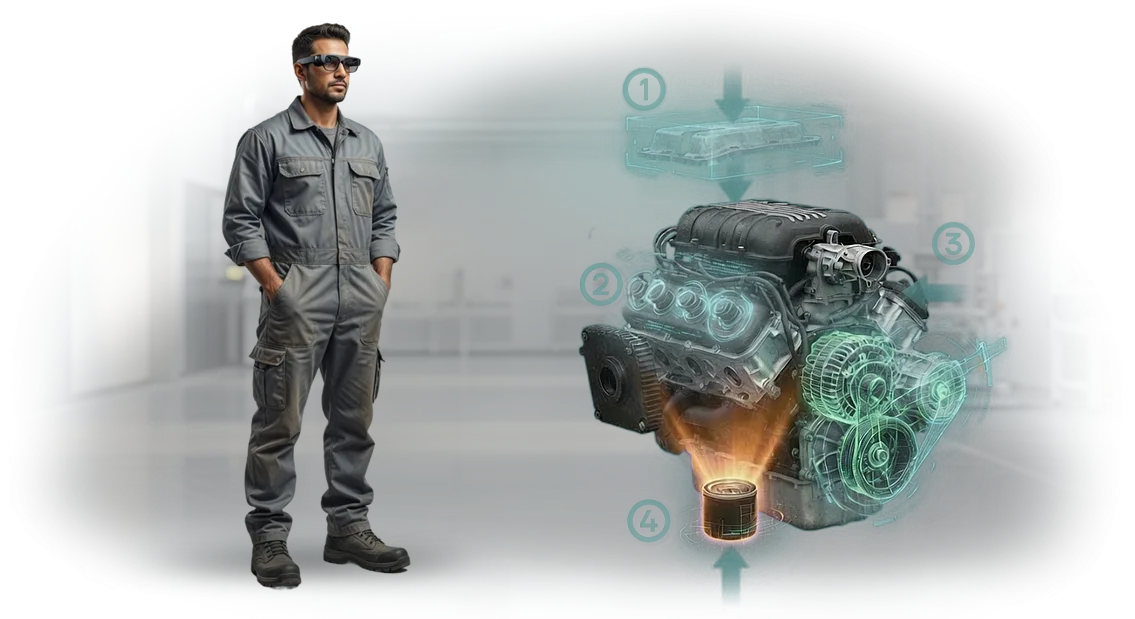
That is why it is time to replace standard materials with custom AR instructions. Custom AR work instructions are step-by-step prompts that are projected directly onto the equipment, taking into account its specific modification and the operator's skill level.
The worker sees exactly where to place the tool and the correct sequence of actions without being distracted from the task.
Such solutions reduce the number of errors per operation, accelerate new hires' path to full productivity, and minimize downtime. When implemented correctly, errors decrease several-fold and a new employee's adaptation period shrinks from weeks to days.
They are especially valuable on unique and modified machines where standard instructions do not exist at all. We develop individual AR guides for specific equipment and the client's business process—this is a key difference from universal solutions.
Development Approach: 5 Benefits for a Production Manager
Employees leave, newcomers need time to learn, and assembly errors result in defects and downtime. AR instructions overlay step-by-step prompts directly onto the equipment—the operator sees what to do instead of reading long documents. This is not a one-off demo but a systematic approach that embeds itself into your processes.
| Benefit | What the Production Manager Gets |
|---|---|
| Fast onboarding | A new employee reaches working pace in days, not weeks. Mentors are not pulled away from their tasks. |
| Operation accuracy | On-screen prompts reduce errors during assembly and setup—fewer reworks and defects. |
| Quality control | Each step follows an approved scenario; deviations are visible immediately, not at final inspection. |
| Repair cost savings | Scheduled maintenance with prompts reduces the number of breakdowns and costly downtime. |
| Production analytics | The action log reveals bottlenecks and common errors. You manage based on facts, not guesses. |
Implementing AR instructions pays off through reduced defects, less downtime, and faster ramp-up of new employees to working pace. For a manager, this means predictable results and operational control without micromanagement.
Development Instead of One-Off Solutions
We create instructions based on your technological processes and update them when regulations change. Employees always work with the latest version, and you get a unified standard for training and control—across all sites and every shift.
Augmented Reality Formats: From Stationary to Mobile
The same AR instruction can be delivered in different ways: a stationary setup near the conveyor, a tablet in a repair technician's hands, or augmented reality glasses on an operator's head.
Each format addresses its own task—accelerate assembly, reduce defects, train newcomers faster, and cut equipment downtime.
We select the device to fit your process, not the other way around. We look at where the employee works, what they need to see, and how mobile the access needs to be—and only then do we choose the format. All options integrate into current production without stopping lines or remodeling the shop floor.
| Format | For Whom | What It Gives the Client |
|---|---|---|
| Stationary AR solutions | Areas with repetitive operations: assembly, quality control, machine setup | Prompts are projected directly onto the equipment; hands stay free. Fewer errors and defects; new employees reach working pace in a couple of shifts. |
| Mobile AR instructions | Repair teams, field specialists, small production facilities | Point the camera at a component and get step-by-step guidance with diagrams. Fast implementation without re-equipment and low-cost scaling to other areas. |
| Production AR glasses | Operators who need to keep their hands free and move around the shop floor | The instruction is always in view; no need to flip through paper or look at a screen. Downtime and fatigue are reduced during complex multi-step operations. |
How Development and Launch Work: Step-by-Step Process
We structure the process so you see results at every stage. Development of custom AR instructions takes 4–6 weeks and does not require stopping production: we start with a scenario audit and gradually roll out the system on the needed work areas.
- Brief and scenario audit. We analyze which operations are the most complex and time-consuming: assembly, repair, commissioning. We select processes where AR will deliver quick results.
- Interactive scenario prototype. We create a working sample for one operation; you test it with your employees and provide feedback.
- Logic and interface alignment. We approve the steps, prompts, and control points. We make sure the instruction will be clear to a novice.
- Full set development. We create AR instructions for all selected operations with video, animation, and error checks.
- Production test. Operators work with the instructions on real equipment; we measure time and adjust details.
- Launch and training. We implement the system in the work areas and conduct short training sessions. Employees receive tablets or glasses and start working immediately.
- AR system support. We accompany the implementation: update scenarios when regulations change, monitor stability, and respond quickly to questions.
What Is Included in the Delivery: Production Package
We put together a package for your specific production area: your machinery, regulations, and staff skill levels. You do not need to understand technical details—everything is already configured and proven in practice. The delivery covers the full cycle: from an operator's first steps to scheduled maintenance.
The package includes:
- Ready-to-use AR equipment instructions — step-by-step scenarios for startup, setup, repair, and preventive maintenance. The operator sees prompts on a tablet or glasses screen: what to do, in what order, and what to pay attention to.
- Content editor — your technologists and engineers can edit texts, photos, and video prompts on their own, without programmers. Updated a regulation—changed the instruction in one day.
- Integration with the MRO system — instructions pull up current equipment data: work order number, maintenance history, scheduled jobs. All information in one window, no paper logs or scattered files.
- Operator and setup technician training — we conduct trainings right at your production site: we show how to use AR prompts and how to build them into the daily shift. Your employees start working immediately after launch.
- Technical support — we support the implementation, answer questions, and fine-tune scenarios. After the base period, you can extend support to fit your schedule.
Together, this is not just a set of files but a working tool that reduces new-hire training time and lowers the number of errors during maintenance.
Case Study: How We Reduced Repair Time by 40% with Augmented Reality
Industrial Robot Repair: From 5 Hours to 3
We were approached by a packaging factory. The line stopped 2–3 times a month: the robotic manipulator lost its calibration, and setup technicians spent an average of 5 hours searching for the cause—80-page paper instructions, PDF diagrams, calls to remote engineers.
Each hour of downtime was costly (the exact cost is calculated after audit). We proposed replacing the instructions with AR overlay: the technician sees precise calibration points on the equipment through a tablet.
Over 6 weeks, we built and tested 12 AR instructions for typical faults. The factory's engineers checked each one on real equipment, and we refined the scenarios.
Result after two months: repair time fell by 40% (from 5 to 3 hours), setup errors by a third, and new technicians were onboarded in 2 weeks instead of a month. The cost per downtime event dropped significantly—enough to deliver a clear project ROI within three months.
The secret behind the result is not the "magic" of augmented reality but the work on the professional engine Vuforia and a library of typical scenarios that we adapted to the specific machine.
The client got not just fancy glasses but a working tool: their employees add new AR instructions on their own, without involving programmers.
FAQ: What Happens if Equipment Breaks Down?
Every manager worries: what happens if equipment fails and a worker does not understand how to proceed? Our AR instructions save content on the device, so prompts are available even without the internet.
If a regulation changes, we update the instructions remotely—the whole team sees the latest version at once.
Below we answer the most common client questions. These are the concerns we address before the project starts—so you get a predictable result without downtime.
What happens if a tablet or phone breaks?
Instructions are not tied to a single device. An employee can log in from any gadget, and the system shows which step they stopped at.
In practice, this reduces recovery time from hours to minutes—the team does not wait for the hardware to be fixed but immediately continues working.
How often are instructions updated?
Whenever a regulation changes or after new equipment is introduced. We agree on a schedule in advance and upload updates without stopping production. An update usually takes one working day, and all employees instantly receive the latest version.
What if employees do not know how to use AR?
We train the staff in two to three hours—after that, they work independently. The interface is simple, and prompts appear right on the screen, so even beginners make fewer errors in the first week. There is no need to hire separate specialists or change hiring processes.
Who supports the system after launch?
Our team supports the project after handover: we answer questions, fix discrepancies, and add new instructions. Average response time is two hours, and even faster for urgent matters. The client does not face a problem alone, even if something goes wrong.
Equipment has broken down—will AR help?
Yes, and practice confirms this. For Vostok Industrial Holding, we developed press repair instructions. Over six months, the average troubleshooting time fell by 35%, and the factory avoided two long conveyor stoppages. The company ordered expansion to other lines—this is the best indicator of value.
Leave a Request for Development Tailored to Your Tasks
Want to order AR instructions that will work specifically on your equipment? Leave a request, and we will prepare a solution for your tasks. We will show how augmented reality will cut staff training time, reduce the risk of errors, and improve production safety.
We have already helped dozens of manufacturing companies convert instructions to digital format. We will take on your task too: we will design a solution that fits into current processes and delivers fast results.
By contacting us, you get a full cycle—from an AR consultation to implementation and support. Together with you, we will identify where augmented reality will have the greatest effect and propose a concrete action plan. Here is what you get after contacting us:
- AR consultation: we will discuss your task and advise where augmented reality will bring the greatest effect—in new employee training, repair, or scheduled maintenance.
- Audit of current instructions: we will analyze your documents and regulations and show which operations should be moved to AR and which should remain in paper form.
- AR project estimate: we will prepare a realistic cost estimate and timeline so you can approve the budget and plan within your company.
- Turnkey development: we will create scenarios, content, and an application for your equipment, taking into account the specifics of the shop floor and staff skill levels.
- Commercial proposal with a fixed price: we will lock in the scope of work and cost so you do not overpay for changes during the process.
- Guarantees and support: we will test the instructions on your equipment, train your employees, and stay in touch after launch.
Leave a request, and we will contact you within one business day, answer your questions, and suggest concrete steps. The consultation is non-binding, but it will help you see how AR instructions can improve your processes.
How to Choose the Right Augmented Reality Format for Your Task?
The right AR instruction format is determined not by fashion but by the specifics of your production.
For one company, a tablet with step-by-step overlay on a component is more effective; for another, voice-controlled glasses are better because the operator's hands are busy with tools.
Our engineers help you choose the option before development begins: we analyze employee tasks, equipment types, site conditions, and budget.
We never recommend "the most advanced" option if it will not pay off. Key decision points: how often the instruction is used, who will use it (a novice or an experienced setup technician), and how aggressive the environment is—dust, moisture, bright light.
If an employee needs to turn a valve and simultaneously see a prompt, we choose a wearable device. If it is a rare adjustment task, a tablet is enough—it is cheaper and easier to support.
Example from practice: for the equipment manufacturer HydroProm, we audited an assembly area. Employees worked with paper cards, and average setup time was 40 minutes. We proposed a smartphone-on-a-stand format—the operator performs steps and records checkpoints.
After a month, average setup time dropped to 15 minutes, and the number of errors among new employees fell threefold.
Choosing the format is not a one-time consultation. We test a prototype directly on your equipment, collect feedback, and finalize the decision together with you.
If new machines appear later or requirements change, the format can be easily adapted—because we build instructions on a modular basis.