

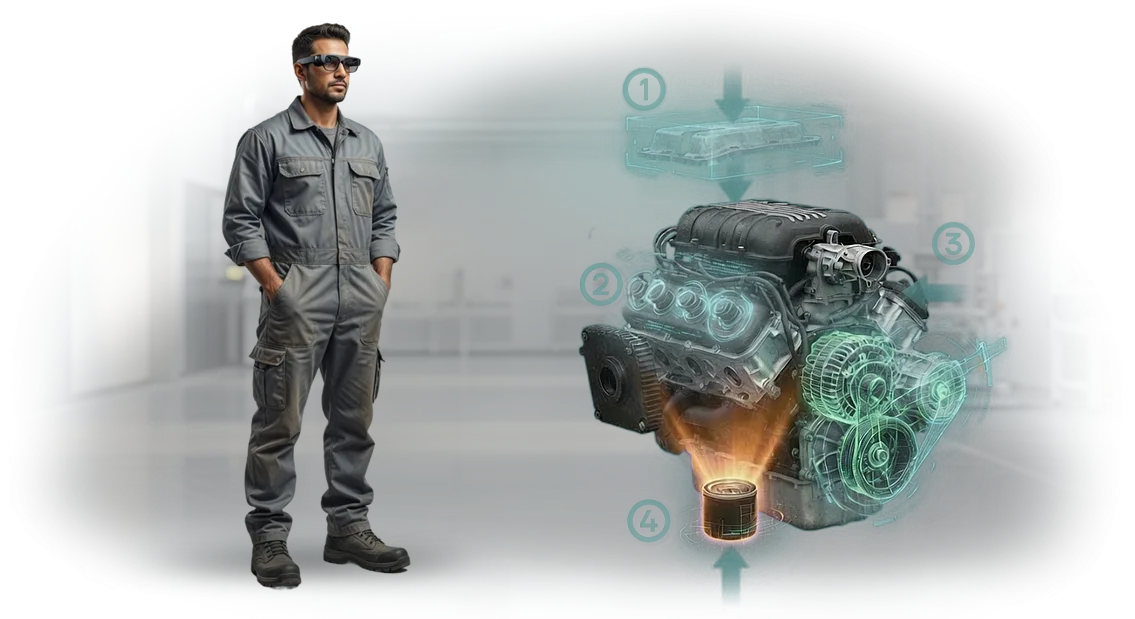
The real pain: realwear AR glasses instead of outdated instructions
On the factory floor, time is money. When equipment sits idle while an employee flips through a paper manual or hunts for the right section on a tablet, every minute becomes a loss.
This is especially acute when repairing complex machinery: every minute counts, and an assembly mistake can cause another downtime and extra costs. Paper instructions quickly become outdated, are hard to update, and in practice are often kept far away from the actual work area.
realwear AR glasses solve this differently: all the necessary information appears right before the specialist's eyes, “tied” to the specific piece of equipment.
No need to search, flip through pages, or hold anything in your hands — hands are free, and prompts show the sequence of actions step by step. This reduces operation time, lowers the risk of errors, and simplifies training for new employees.
At production sites where we implement such solutions, equipment downtime decreases by tens of percent within the first few months.
That is why we base our work on professional AR headsets RealWear: they work reliably on the shop floor, are compatible with protective hard hats, and do not restrict movement.
Our team of engineers handles the entire journey — from process audit to installation and staff training. You get not “technology for technology’s sake,” but a clear, practical tool that quickly pays for itself by reducing downtime and errors.
What implementing AR instructions delivers: speed, precision, safety
Industrial equipment is becoming more complex, and demands for speed and quality are rising.
Paper instructions and lengthy training no longer keep up with reality: an employee spends time searching for the right section and makes mistakes in the sequence of actions — the company gets downtime and defects.
AR instructions solve this problem: prompts appear right in the field of view, overlaid on the equipment.
Speed: less downtime, more completed orders
A new employee or a seasoned specialist facing an unusual breakdown no longer needs to flip through paper instructions — the step-by-step diagram appears before their eyes on the rugged RealWear headset. Operations are completed 30–40% faster, and onboarding time is reduced severalfold.
Precision: fewer errors and defects
AR prompts show control points: tightening torque, connection order, acceptable tolerances. The employee acts less by guesswork, which means fewer defects and rework.
For the business, this means material savings and a reputation as a reliable supplier that delivers quality work on the first attempt.
Safety: protecting people and equipment
During hazardous operations — working with electricity, chemicals, or at height — the headset displays warnings and stop-factors in real time without distracting the operator from the process.
This reduces the risk of injuries and accidents, along with insurance costs and unscheduled downtime.
Savings: implementation pays off within months
Instead of expensive in-person training and engineer site visits, instructions can be uploaded to headsets and updated centrally. New employee training accelerates, and experienced specialists spend less time mentoring. By our estimates, a company recoups the implementation within one or two quarters.
AR instruction formats for different manufacturing tasks
Different tasks on the shop floor require different instruction formats: what works well for routine maintenance of a stationary machine may not suit a mobile crew moving from site to site.
There is no one-size-fits-all solution — only a properly selected format for a specific task and working conditions.
Below is a summary of the main AR instruction formats. Use your situation as a guide: the type of equipment, the nature of the work, and how employees interact with the machinery.
| Format | For whom | What it gives the business |
|---|---|---|
| Step-by-step instructions on stationary equipment | Operators and maintenance staff working at a conveyor or machine | Reduces operation time by up to 30% — the worker sees the next step without looking away to paper or a tablet |
| Headset instructions for mobile crews | Service engineers traveling to sites, employees working across large areas | Frees up hands, all information is right before the eyes. Faster fault resolution, less equipment downtime |
| Interactive 3D diagrams for complex assemblies | Repair personnel handling unusual breakdowns | Clearly shows internal structure and disassembly sequence — reduces the risk of errors and damage |
| Verification checklists with completion control | Section supervisors and quality department | Automatic recording of each step, fewer skipped procedures — consistent work quality |
| Training scenarios for new employees | Mentors and newcomers on the shop floor | Fast onboarding without long courses: the newcomer works immediately with prompts, while the mentor sees their progress |
The choice of format depends on where the employee is and how much they move — fixed station or constant motion. A properly selected delivery format reduces training and repair costs and, most importantly, makes production processes more predictable.
We help you choose and implement the format for your tasks, not just “put on glasses” for the sake of technology.
How an AR instruction development project works: 7 steps
We run the project sequentially — from the first brief to launch and support — so that you see results at every stage and can influence the work. This approach reduces risks, keeps the budget under control, and leads to a solution that is actually used on the shop floor.
- Brief and immersion — we study your equipment, procedures, and typical situations. The output is a work plan, timeline, and a clear estimate.
- Scenario design — we determine which steps the employee should see and in what order. You approve the scenario before the main development begins.
- Content preparation — we turn your instructions and diagrams into clear prompts that are easy to perceive through the AR headset.
- Prototype on real equipment — we build a working sample that can be tested on site. You see the result and give feedback.
- Approval and refinement — we make edits based on your comments and fine-tune details so the instruction is accurate and understandable.
- Testing in working conditions — employees try the instruction on real tasks. We confirm that it reduces operation time and errors.
- Launch and support — we install the solution on all headsets, train your staff, and remain available for updates and improvements.
This process is built around your outcome: at every step you understand what you are getting and can adjust the task if needed. In the end, you get an AR instruction that works on your equipment and delivers value from day one.
What is included in the delivery: AR glasses and everything needed for launch
The customer receives not “bare hardware,” but a ready-to-work solution — from the device itself to staff training and technical support.
We design the package so you don’t need to buy anything extra, configure anything, or figure things out on your own — everything works immediately after delivery.
The full delivery package includes:
- AR glasses with preinstalled software — the devices already contain the necessary software, so you don’t need to find and install applications. The employee puts on the glasses and sees the instruction right before their eyes.
- Digital instructions loaded onto the device — all your production content is turned into step-by-step scenarios before launch. The worker no longer flips through paper manuals but performs the task with prompts in their field of view.
- Training for employees and administrators — our specialists conduct remote sessions for staff: they explain how to use the device, what to do in unusual situations, and how to update instructions. Administrators get access to content management without involving programmers.
- Support service and warranty maintenance — if you have questions or failures, you contact us directly. We respond during business hours, help with settings, and resolve issues so equipment downtime does not affect your production.
- Methodological materials for internal use — short reference guides and procedures that you can distribute among employees. This speeds up the adaptation of new workers and reduces the burden on mentors.
- Protective case for storage and transport — the glasses will not be damaged when moved between shops or sites. You receive a complete kit that is convenient to store and issue to staff.
The result is simple: the employee puts on the glasses and immediately starts working with the instruction — no stops and no searching for information. You get a turnkey solution that pays off by reducing errors and speeding up operations.
Case study: how AR instructions cut equipment downtime by 40%
For a plant with serial production of complex equipment, every minute of downtime is lost revenue. When a line is stopped because of waiting for a specialist or an adjustment error, losses quickly become significant.
We encountered this task at a company where technical documentation was scattered across paper manuals and forgotten files, and new employees spent hours searching for the right information.
We implemented AR instructions for technicians right at their workstations. Instead of thick manuals — step-by-step prompts that appear before their eyes on the AR headset.
The employee sees where to press, which parts to remove, and in what order to assemble the unit, without turning away from the equipment.
Case study result
Over three months of operation, equipment downtime in the area decreased by 40%. Time for a standard adjustment was cut in half, and the number of assembly errors fell threefold. For the enterprise, this means additional output without expanding staff or buying new machines.
The economic effect was greater than planned: downtime losses dropped by an amount comparable to the annual compensation of two line engineers.
Technicians no longer wait for a supervisor to confirm every step: the rules are built into the instruction, and the system records the completion of operations.
The plant management noted that after implementation, newcomer onboarding accelerated from two weeks to three days. Employees now reach independent work faster, and experienced specialists focus on truly complex tasks instead of repeating the same instruction.
We didn’t just put technical texts on a screen — we reworked processes so knowledge is available exactly when it is needed.
RealWear confirmed the reliability of the solution: the headsets have been working on the shop floor for over a year without failures, and the plant plans to scale the practice to other areas.
Want the same result? Tell us about your equipment, and we will calculate how much downtime can be reduced.
How to choose the right AR instruction format for your specific situation?
There is no single universal AR instruction format — and that is normal. At one plant, a short visual cue is enough for a unit; at another, step-by-step guidance with control of every action is required.
To choose the right option, it is important to determine what the instruction should actually solve: reduce training time, lower the number of errors, or provide access to data right during work — and only then select the format.
There are usually three key factors. The first is operation complexity: if it involves dozens of steps and requires a precise sequence, large visual prompts with automatic checking of key points work better.
The second is site conditions: a noisy workshop, poor lighting, or occupied hands dictate an interface that does not require reading long texts and responds to voice.
The third is the employee’s skill level: a newcomer needs the most detailed scenario possible; an experienced specialist needs quick access to data and emergency instructions.
It is important to consider how you will use the resulting data. Do you need statistics on task completion time and errors made? Then choose a format with action logging and analytics. Do the instructions need to interact with your accounting system or spare parts catalog? This determines how deep the integration will be and how data will be transmitted to specialists.
Our team does not sell a single “universal” template. We start with a short audit: we look at your procedures, typical errors, equipment features, and working conditions.
Then we propose 2–3 suitable formats, show them on your real operations, and let you test them on a pilot site — so the decision is made not from a presentation but from results on the shop floor.
In the end, the right format is the one that reduces the burden on employees, speeds up processes, and pays for itself in the first months.
If you are not sure where to start, send us a description of a couple of typical tasks, and we will recommend the best option for your specific situation.
Frequently asked questions about implementing AR instructions on the shop floor
Employees are used to paper instructions, so questions before AR implementation are normal. The main fears: will people refuse to work with a headset, will the technology get in the way, and what happens in case of a failure. We address these fears in advance.
We start with a pilot on one operation: train staff, check convenience, then roll out further without stopping production.
What if employees do not accept AR?
We conduct short training on real operations and make the interface as simple as possible. Usually, almost everyone gets the hang of it during the first shift.
Could AR cause errors or equipment damage?
The instructions only show steps overlaid on the real object; they do not interfere with control systems. Every scenario is approved with your technologists and tested on the equipment before launch.
What guarantees do you provide?
We fix the timeline, scope of work, training, and support. You accept the result against a checklist; if something does not work on your equipment, we refine it.
How long does implementation take?
A pilot for one operation takes 2–4 weeks: from process analysis to a working instruction on the RealWear headset. The remaining operations are connected in stages.
Discuss your project: get an AR solution estimate in 2 days
Implementing AR instructions is a decision that affects the speed of your staff and the safety of your processes. To help you make an informed decision, we will prepare a project estimate: we will guide you on budget, timeline, and scope of work before you even start.
An estimate is not just a cost sheet — it is a plan that helps you align the decision within your team and with management. In 2 days you will receive:
- A clear budget — fixed development cost with no hidden charges and no hourly billing.
- Realistic timeline — launch dates for the pilot area and full rollout across all lines.
- Usage scenario — a description of how AR instructions will fit into your processes: from onboarding new employees to repairing complex assemblies.
- Equipment composition — recommendations on headsets, including industrial RealWear models, for your working conditions.
- Effect assessment — what you will save on: reduced downtime, fewer errors, faster ramp-up to full operation.
- Pilot plan — how to test the solution in one area and quickly scale it if the results are positive.
No obligations: the estimate is a starting point for dialogue. Leave a request for a consultation, and our engineer will contact you within one business day, clarify the details, and prepare the estimate. You will get specifics, not general words.