

AR training app for workers: how to reduce downtime and defects
Every hour of shop floor downtime is not just a pause on the line — it is unproduced batches, missed shipments, and expensive equipment sitting idle.
Waiting for a mentor, searching for a paper instruction, or re-explaining the same operations costs an enterprise tens of thousands of dollars a month. At the same time, traditional worker training takes weeks, and errors still happen on the line, leading to defects and rework.
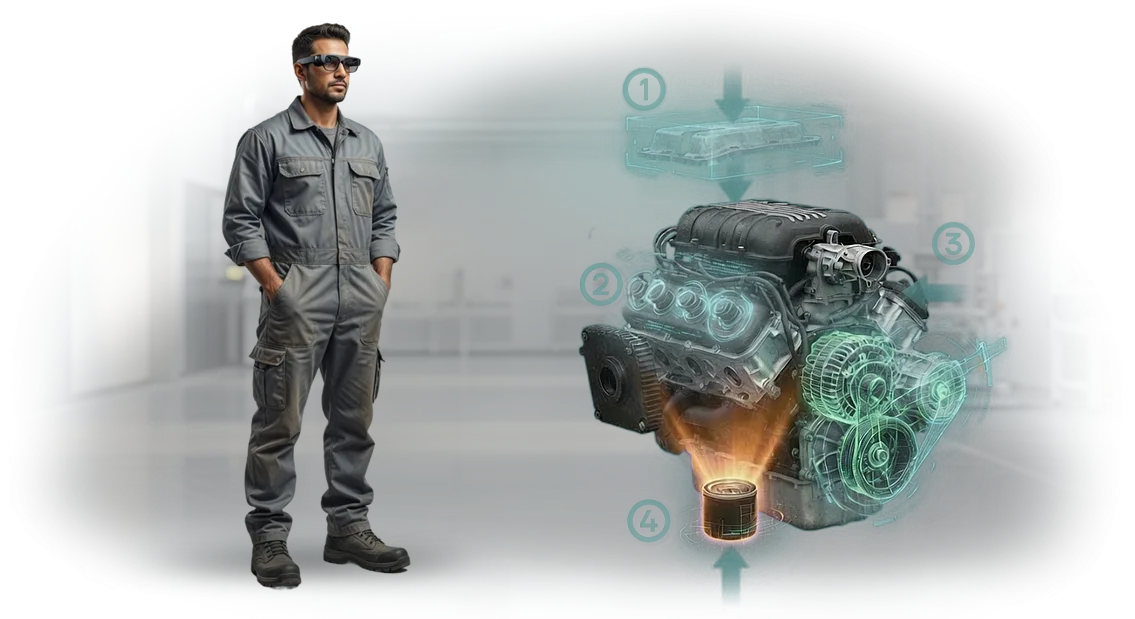
Industrial AR instructions change this picture: the operator receives step-by-step prompts directly over the real equipment.
There is no need to flip through manuals or memorize hundreds of operations — all checkpoints, action sequences, and acceptable tolerances appear right in the field of view.
AR-based worker training turns from a separate course into a natural part of the work shift, and errors are caught at an early stage.
For a manager, this is measurable value: onboarding time for a new employee drops from weeks to a few days, and the number of errors and defects on the line noticeably decreases. Less downtime — more output, less rework — lower cost.
That is why an AR training app for workers is becoming the standard at modern manufacturing sites: such solutions pay for themselves not over years, but within the first months of operation.
We have been implementing such systems at industrial sites for over 10 years. Our engineers adapt AR training to your procedures and equipment, and rollout happens without stopping production.
You get not a “technology for technology’s sake,” but a clear tool that reduces costs and makes the shop floor more predictable.
What will change on the production floor after implementing AR instructions
After AR instructions are implemented, production stops depending on employee memory and mentor experience.
A new worker puts on smart glasses or opens the app on a tablet — and sees right in front of them how to perform the operation: which parts to take, in what order to tighten the fasteners, where the checkpoint is.
Onboarding takes days instead of weeks, and one mentor can supervise several people at once instead of sitting with each newcomer individually.
The number of errors and, as a result, defects drops. The worker receives a prompt directly at the moment of the operation — there is no need to look at a paper map or recall what was said during the briefing.
If the operation is done incorrectly, the system shows it immediately, not when the part has already moved to the next stage. Line staff stop spending time on rework, and quality control focuses only on truly complex cases.
Occupational safety also reaches a new level. Safety requirements are built into the digital instruction: before starting work, the app reminds the worker to check lockouts, put on PPE, and make sure there are no unauthorized people in the work area.
This is not a formal checkbox but a real verification — the system will not let the worker continue until the condition is met. With such prompts, the number of safety violations and minor injuries decreases, and inspectors see that the process is under control.
Production audit stops being a stressful exercise in gathering documents from the last quarter. Every completed training, every skill check, and every checklist pass is recorded automatically and stored in a single log.
For an internal review or external audit, it is enough to show an export: who, when, and which operations they performed, to what scope and with what result. Filling out paper logs takes less time, and the risk of human error in records almost disappears.
The main thing is that the effect is visible within a few weeks, not after a year or a year and a half. While the pilot run is underway on one line, you compare onboarding time, defect rate, and safety findings — and these numbers speak for themselves.
Further rollout to other areas requires nothing more than configuring new scenarios: equipment, operations, and standards are already described in a unified digital instruction format.
AR training app for workers: formats for the shop floor and training
The same AR tool solves different tasks: quick onboarding for newcomers, retraining when a machine model changes, or control of a complex operation. It is important to choose a format that fits the rhythm of the shop floor and does not require stopping production for training.
We have prepared a table so you can immediately see which option suits your team and what it delivers in practice.
| AR training format | For whom | What it gives the client |
|---|---|---|
| Step-by-step AR instruction on a tablet | New operators and setup specialists | Reduces onboarding from weeks to 2-3 shifts, fewer errors during startup |
| AR simulator for practicing emergency situations | Engineers and process technologists | Practice rare scenarios without risk to equipment or people |
| Interactive 3D model of an assembly | Maintenance services | Faster diagnostics: the worker “opens up” the mechanism and sees the disassembly sequence |
| AR prompts “right on the shop floor” | Experienced employees when procedures change | Keeps current instructions in front of their eyes without distracting from work |
Each row is a proven scenario that we adapt to your equipment and procedures. The solution does not require replacing equipment: it uses what is already on the shop floor.
We will help you choose the format for your task, calculate implementation time, and show how quickly it will pay off through reduced downtime and defects.
Developing AR instructions for a plant: 7 project steps
We have been through AR instruction implementation at dozens of production sites and have structured the process so you see results at every step. Below are seven stages we go through together: from brief to post-launch support.
-
Brief and task immersion. We listen to how work is organized, which operations are most frequent, and where mistakes most often occur. This is the basis for instructions that solve your specific problem.
-
Analysis of work processes. We visit the site or study recordings and capture what employees actually do. We understand where the instruction should guide and where it should warn about danger.
-
Plan and prototype. We show what the steps will look like on a tablet or smartphone screen and agree on the logic. You see the future result before the main development starts.
-
Review with your team. We send the materials for review to technologists and occupational safety specialists. We make edits while the instruction is not yet fully assembled.
-
Development of AR scenarios. Our engineers fill the prototype with details: 3D prompts, animation, text steps. You get working instructions that do not require employees to read long documents.
-
Launch on production. We install the app on your devices and train key employees. We measure initial results: how fast a newcomer performs an operation and how many errors are avoided.
-
Support and refinement. We help with updates, add new operations, and adapt instructions when procedures change. You are not left alone with the technology.
What is included in the delivery: a kit for launching AR training
When we say “AR training delivery,” we do not mean a link to an app. You receive a complete kit with everything needed for launch: scenarios, documentation, access rights, and support. All that remains is to assign responsible people and begin employee training.
Here is what is included:
- Ready-made AR scenarios for your real operations — setup, repair, quality control. Not abstract demos, but working instructions an employee opens right at the machine.
- Documentation set — launch procedures, administrator and instructor guides, worker cheat sheets. Everything is designed so any employee can figure it out without developer assistance.
- Access rights configuration — role separation: an administrator manages content, an instructor assigns tasks, a worker sees only their own instructions. This eliminates confusion and protects data.
- Administrator training — we run an online session where your employees learn how to add new scenarios, update instructions, and track completion statistics. After that, your team manages the system independently.
- Deployment of AR instructions on your equipment — we help roll out the solution on tablets, smart glasses, or in the workshop and verify that everything works in real conditions.
- Solution support — for the first few months, we assign an engineer who answers questions, helps with improvements, and monitors stability. You are not left alone with the new system.
- Content updates — on request, we make changes to instructions when processes or equipment change. Scenarios are always current, so training never becomes outdated.
This kit covers the entire cycle: from first launches to regular use. You do not need to assemble the solution piece by piece or hire a separate contractor for each stage — you take the ready delivery and launch AR training within a few days.
Case: AR instructions reduced downtime by 40%
We worked with a machine-building plant: on the assembly line, new operators learned a complex unit from paper manuals, and the first shifts were spent searching for the right page.
We implemented AR instructions on tablets — now the employee sees prompts directly on the equipment rather than in text.
Promstank plant is one of our clients. After the launch, the AR training case showed: downtime after AR dropped by 40%, and average onboarding time was cut in half. Experienced workers also stopped waiting for a mentor — they can find the unit themselves using the highlight.
The implementation results are summarized in the table:
| Metric | Before AR | After AR |
|---|---|---|
| Downtime due to operator errors | 16% of shift | 9% of shift |
| Newcomer onboarding | 3 weeks | 10 working days |
| Share of correctly performed operations | 82% | 97% |
| Repeated references to the instruction | 8-10 times per shift | 2-3 times |
For the plant, these are not just numbers: every minute of conveyor downtime saved is finished product and an order delivered on time. And quickly bringing newcomers to independent work reduces the load on existing employees and lowers staff turnover.
We continue to support this project: we update instructions when procedures change and add new units for specific tasks. The implementation result speaks for itself: properly built AR training pays for itself within the first quarter, and then keeps reducing costs.
How to choose the right AR training format for your equipment?
We often hear this question from production managers: AR training seems useful, but it is unclear where to start and which format will deliver results on your equipment. The honest answer: there is no universal solution — and that is a plus.
The right form is chosen based on your task: quickly onboarding a newcomer is one thing, teaching repair of a rare unit or reducing assembly errors is another.
For example, if you need to reduce the number of errors during assembly, step-by-step AR instructions with highlighting of the required parts directly on the equipment are the best fit.
If the task is to speed up employee adaptation, short interactive modules that workers complete at the machine without interrupting their work are more effective. And for planned maintenance — AR checklists that check each unit and immediately record the result in the system.
In all cases, the employee sees a digital prompt over the real object, so there are fewer errors and faster decision-making.
How do you choose the format for your conditions? We start with an audit: what equipment is in place, who will work with the instructions, whether there is stable system access at the site or whether autonomous solutions are needed.
This matters because it affects implementation timelines and convenience for employees. Often it turns out that pre-prepared materials launched on an ordinary tablet already used at workstations are enough.
In more complex cases, we offer a solution that integrates with your accounting system and automatically suggests the next step.
The key principle is that AR training should fit into your current process, not break it. That is why before launch we define metrics together: reduction in training time, fewer errors, speed of reaching planned productivity.
Based on these indicators, you will see that the format works specifically for your equipment. And if requirements change, the format can be scaled or refined — we keep the materials already developed and add new scenarios.
Frequently asked questions about implementing AR instructions
You are probably wondering how AR instructions will fit into the existing process: will you have to stop the shop floor, change equipment, or wait a long time for results. We have collected answers to the most common questions — briefly and to the point.
What if the equipment does not support AR?
Support is not needed: the instructions work on regular tablets and smartphones that employees already have. We provide protective cases for industrial conditions, and the system itself is configured for a specific machine model without interfering with its construction.
Your machines will continue to work as before — AR only overlays prompts on the device camera feed. No changes to wiring, sensors, or controls.
How do we implement it without stopping production?
We do not block the work shift. First, we collect the brief and build a prototype for one area, then test it on two or three operators while the shop floor continues working. After the result is confirmed, we scale to the rest of the line — the pilot usually takes 2–3 weeks.
The shop continues producing, and employees train between shifts. Gradually you will notice that newcomers get up to speed faster and make fewer mistakes.
What if the procedure changes?
Any production documentation becomes outdated. With AR instructions, edits are made in the system within a few minutes, and all employees see the current sequence of actions — no reprinting paper memos or forwarding new files around the shop.
You control versions and always know that operators are working with the latest scheme. This reduces the risk of defects caused by outdated instructions.
How much does it cost and when will it pay off?
The cost depends on the number of operations and types of equipment. For a pilot area — typically the cost is calculated after audit; for full workshop coverage — up to a figure determined after audit.
Payback comes from fewer errors and faster training of new employees: often the project pays for itself within a few months.
We provide a fixed estimate before the work begins, with no hidden fees. Scope and timelines are fixed in the contract.
Bottom line: implementing AR instructions does not require stopping production, does not break equipment, and quickly adapts to changes. If you have any remaining questions, ask us, and we will prepare a calculation for your operations.Send a request — we will calculate the project and timeline in 2 days
Send a request with a description of your task — for example, “train 40 operators on the line” or “reduce the time needed to bring new machines online.” Our AR training engineer will review the details and get back to you within two working days with an implementation plan, timelines, and an accurate estimate.
The calculation includes the number of instructions, equipment complexity, and worker preparation — the price is tied to your task. We do not sell “AR for AR’s sake”: we show where technology will speed up a shift and where a simple memo is enough.
For the machine-building plant PromTech, we designed five instructions within a month — the repeat error rate fell by half.
What the calculation includes:
- AR consultation: which operations will speed up, where AR is not needed.
- Analysis of equipment and processes — common training scenarios.
- Format recommendation: glasses, tablets, or projections within your budget.
- Estimate: development, testing, and support in two options.
- Implementation plan: stages, timelines, responsible people, and checkpoints.
You receive a document with a fixed price and schedule. If it suits you, we launch the project; if not, you still keep a roadmap and an estimate for budgeting.
Send your AR training request through the form — we will clarify the details within a day and send the calculation in two days. Even a short request without a detailed specification will show the scale of investment.