

AR Step-by-Step Instructions: How to Reduce Downtime and Defects
Every hour of downtime or a batch of defective items is a direct loss that goes into the product cost and impacts contract deadlines.
Most often, the cause isn't even equipment complexity but the human factor: an employee mixed something up, misunderstood an instruction, or simply hasn't had time to gain experience.
Traditional staff training takes weeks: first theory, then working with a mentor, then the first independent steps with the risk of mistakes. Text-based procedures and posters don't provide the answer when it's needed — so the operator decides at random.
This leads to downtime, changeovers, and defects, especially with frequent model changes or when an experienced employee goes on vacation.
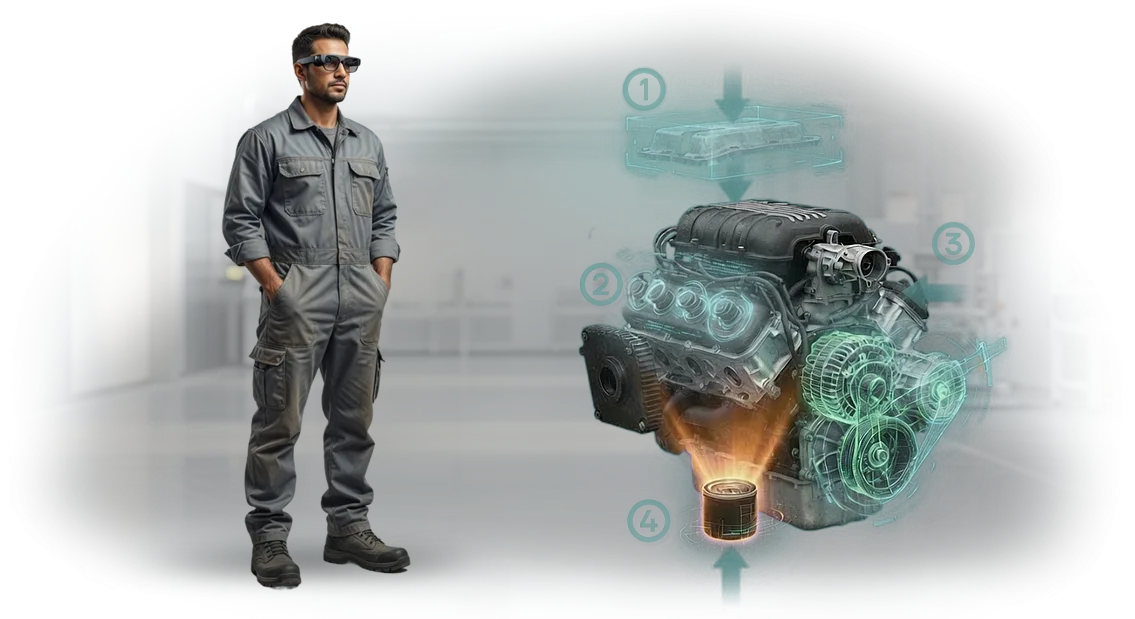
AR step-by-step instructions solve this problem differently: the employee sees hints right on the equipment, within their field of view, and performs each step using visual guidance.
There's no need to recall anything, search a paper manual, or call a mentor — the system guides the operator from the beginning to the end of the operation and doesn't allow important actions to be missed.
Implementing such instructions noticeably reduces downtime: the time for a new employee to get up to speed is cut multiple times, and experienced workers stop being distracted from the machine.
The defect rate also drops because each step is confirmed by visual control, and any deviation from the algorithm is immediately highlighted. Staff training turns from a long and expensive process into a fast and visual one.
At the same time, there's no need to restructure the entire process — the instructions complement the existing training system and technical documentation.
We develop AR step-by-step instructions for your equipment and technological operations: we gather algorithms with your process engineers, make them convenient for workers, and deploy them on tablets or augmented reality glasses.
We take on the entire cycle — from operations audit to implementation and support — so you don't need to understand the technologies. You simply get a working tool that reduces downtime and defects every day.
Step-by-Step Instructions in Augmented Reality: Why They Work
Experienced employees also make mistakes: mixed up the order of operations, missed a check point — that means defects, downtime, and a safety risk.
Paper instructions and videos don't help: they force workers to look away from the equipment, waste time, and provide no instant feedback.
Augmented reality solves this problem. Step-by-step AR instructions are projected directly onto the equipment: the employee sees the required part, tool, and installation point.
The system suggests the next step just as it's performed — there's no need to memorize the procedure in advance. As a result, errors are reduced by 30-50%, and operations are accelerated by 1.5-2 times. This is confirmed by our projects for manufacturing enterprises.
Training newcomers also gets faster: instead of weeks of internship, a few days of working with an AR instruction are enough. The system immediately points out an error, so the skill develops faster and without defects. This is especially important when expanding the workforce or dealing with high staff turnover.
We implement such solutions on the professional platform Microsoft HoloLens — it has proven its reliability in industry. Our engineers adapt AR instructions to the customer's specific equipment, and digital procedures are updated in minutes instead of reprinting paper documents. The economic effect — lower downtime and defect rates — is visible within the first few months.
Content Formats for Augmented Reality
Each production operation requires its own presentation format — a step-by-step AR instruction for repair won't work for assembly or scheduled maintenance.
A universal scenario is ineffective: an operator needs a precise sequence of actions, assembly requires control of correct installation, and maintenance requires procedure verification.
We adapt the format to the specific task and specialist level. Engineers develop scenarios on real equipment, and the employee receives hints directly on components — without paper procedures, searching for the right section, or guesswork.
What Formats We Use
| Format | For Whom | What It Gives the Customer |
|---|---|---|
| Step-by-step repair | Repair teams, service engineers | Less downtime: the employee sees the sequence of operations and required components directly on the equipment, without looking away at diagrams. |
| Assembly and installation | Assemblers, process engineers, new employees | Faster commissioning: animated hints show the order and correct installation, reducing the risk of errors. |
| Scheduled maintenance | Maintenance specialists, service personnel | Procedure control: the AR checklist highlights inspection and lubrication points and records completion — fewer missed operations. |
| Staff training | Mentors, training centers | Faster time-to-proficiency: a newcomer learns the process on real equipment with hints, without waiting for a senior specialist to become available. |
Each format is tested on your equipment and adapted to existing procedures. The result is predictable operations, reduced execution time, and fewer errors affecting the quality of manufactured products.
How We Create Augmented Reality Content: From Brief to Launch
For an AR instruction to truly reduce training time and the number of errors, it's not enough to simply put on glasses or open a phone. You need a well-thought-out scenario that follows the logic of working with the equipment and is clear to any employee. That's why we've structured the process so you see results at every stage and control the content.
- Brief: we meet with your team, collect a list of operations to convert to AR, and identify where errors and time losses most often occur.
- Operations analysis: we review documentation and observe specialists at work, recording the exact sequence of actions and safety requirements.
- Scenario development: we create a step-by-step AR instruction scenario with hints, warnings, and verification of key steps, and align it with your process engineers and experienced employees.
- Prototype: we build a working sample of the instruction on your equipment, show it to you, and make edits before the full launch begins.
- Launch: we install the app or configure the glasses, conduct brief staff training, and provide technical support during the pilot.
- Support and growth: we collect feedback, update instructions when procedures change, and add new scenarios as other operations emerge.
What's Included in the Delivery Package of an Augmented Reality Project
When we talk about an augmented reality project, it's important to understand that you get not just a set of files, but a working tool that solves specific production tasks.
We assemble the delivery package so it can be used both by an engineer with 20 years of experience and by a new employee on their second day after hire.
Here's what's included in the project by default:
- Instruction scenarios for your equipment. We describe each step in the language of your shop floor: referencing actual components, tools, and operations, rather than abstract "part A – part B".
- AR content anchored to physical objects. The instruction "finds" the required component on a real machine or vehicle. The employee sees the hint right where action is needed and doesn't waste time searching paper documentation.
- Voice prompts and visual markers. The operator can work in gloves and look at the equipment rather than at a tablet. The system itself tells them the next step and where the fasteners are.
- Usage analytics. You see which instructions are opened most often, at which steps employees hesitate, and how long an operation takes. This data helps improve procedures and train staff precisely.
- Training for your team. We transfer knowledge to your specialists so they can update content and add new instructions on their own without involving developers.
- Technical documentation and access to source materials. All scenarios, 3D models, and settings stay with you. You're not locked in and can develop the system with your own team at any time.
The main thing you get in the end is a repeatable process for training and operations control that reduces errors and speeds up staff preparation.
We don't abandon the project after launch: we assign support for the first weeks of operation so the system runs steadily at your pace.
Case Study: Machine Repair Became 25% Faster with Augmented Reality
Repairing an industrial machine is not just a breakdown — it's a workshop shutdown, lost hours, and dependence on one or two specialists who know the equipment.
At the machine-building plant PromStanko, such downtime resulted in significant annual losses, and paper instructions gathered dust on shelves: finding the right section took longer than the repair itself.
We developed AR instructions for the plant that overlay step-by-step hints directly onto the equipment. Through a tablet or glasses, the worker sees which components to unscrew, in what order, and with what force — instead of switching between a diagram and the machine. All parts are highlighted in real time, turning a complex operation into a clear scenario.
The result was quick to show. Average repair time dropped by 25% — instead of four hours, workers finished in three. The number of assembly errors fell by a third, and complex operations became manageable for employees with minimal experience.
The customer also appreciated an additional effect: new workers were trained twice as fast because the AR instruction replaced a mentor.
This case is not a one-off solution but a system. The same augmented reality instructions can be applied to any machine, pump, or assembly line, and each time the effect is measured in hours of saved downtime and reduced defect risk.
If you have equipment whose repair takes more than an hour, we can likely cut that time by at least a quarter.
What If We Have Specialized Equipment?
Specialized equipment is not a limitation but a task for a custom solution. We don't force your process into a ready-made template; instead, we develop an AR scenario for the specific components, operations, and conditions of your production. So even a rare machine or a unique line is a typical working situation for us.
The scenario is born from analyzing real work: we study documentation, talk with process engineers and operators, and record benchmark actions. Based on this, we create a step-by-step instruction that shows exactly your parts, your controls, and your sequence of operations. As a result, the employee sees not an abstract diagram but a precise guide for their workstation.
Adaptation also applies to the format: the same process can be shown as a visual animation, text hints, or checkpoints at each step. We choose the option that is easiest for your employees to understand and adjust it if needed after a test launch.
This removes the main fear — that the instruction will turn out useless because it doesn't match reality.
Our engineers have worked with equipment of various complexity levels — from individual machines to complex units with dozens of modes. So you get not just a "pretty picture" but a tool that reduces errors and accelerates staff training.
If you're unsure whether AR will work for you — send us a description of your equipment and a typical operation, and we'll assess the task and offer a solution.
Frequently Asked Questions About Implementing the Technology
Implementing AR instructions is an important decision, and managers naturally have questions. The most common concerns relate to employee training, compatibility with existing equipment, the risk of breakdowns, and data security. Below are honest answers to these concerns.
Can employees handle AR instructions?
Yes. Familiar paper procedures require reading and memorization. AR instructions show the required component right on the equipment: an arrow, a highlight, a step number. The worker acts on the prompts without being distracted by searching for information.
Our project experience shows that training takes hours, not weeks, and even those who haven't worked with tablets pick it up faster.
Will the technology work with our equipment?
We work with most industrial installations: machine tools, packaging lines, CNC equipment, robotic cells. No equipment changes are needed for launch — a tablet, smartphone, or AR headset is enough.
The instructions themselves can be easily linked to your procedures and internal standards to integrate them into existing processes.
Won't AR damage equipment or processes?
No. AR instructions are a visual layer on top of the real object: they do not connect to control systems and do not change settings. They are essentially a smart reference that shows what to do and where. The risk of breakdown is excluded, and factory warranties and maintenance procedures remain intact.
How is our production data protected?
Instructions can be hosted on your server or in an isolated network segment, and access is configured by roles: the operator sees only their steps, the process engineer sees full documentation. Data transmission is protected by encryption, and we do not use public cloud storage. You control who gets access and when.
Implementation is carried out without stopping production: we adapt the instructions, train the first team, and support the launch. We invite you to run a demonstration on your equipment — we'll show everything on real components.How Long Will Augmented Reality Implementation Take?
A typical project to develop an AR step-by-step instruction for one piece of equipment takes 2-4 weeks turnkey.
If you need to cover a whole line of machines or multiple sites, the timeline increases to 1-2 months, but you receive intermediate results in stages and put them into operation immediately.
The timeline depends on the number of procedure steps, equipment complexity, and the readiness of source materials. For 10-15 steps, we allocate 3-5 working days for shooting, processing, and assembly.
The rest of the time is spent on approvals and edits, which we speed up with a clear acceptance procedure.
What's included in the turnkey timeline:
- Equipment audit and step-by-step scenarios — 2-4 days
- Creation or adaptation of 3D models for your machine — 5-7 days
- Assembly of the AR instruction and verification on real equipment — 3-5 days
- Trial operation with employees and feedback — 2-3 days
- Training for engineers and workers, transfer of content rights — 1-2 days
- Post-launch support and refinements — included
You see the first working prototype within 5-7 days from the brief, and a fully completed instruction by the agreed deadline. Production doesn't stop, and employees adopt the AR solution without downtime.
Leave a request — within 1 business day we'll send you a cost calculation for your task and a detailed launch plan with specific dates. You'll know in advance what, when, and what you're paying for — no "surprises" along the way.