

Work instructions software: reduce losses from staff errors
Personnel errors on the production floor cost more than it seems: defects, rework, equipment downtime, missed deadlines, and in the worst case, accidents.
The manager sees only direct costs, but the real cost comes from overtime, forced downtime, customer complaints, and lost contracts.
The reason is usually not employee qualification but the fact that the process is performed from memory or from an outdated paper instruction. A new worker learns by trial and error, an experienced one skips steps due to haste, and every such case increases risk.
Human factors cannot be eliminated by orders and motivation — you need to change the way instructions are delivered.
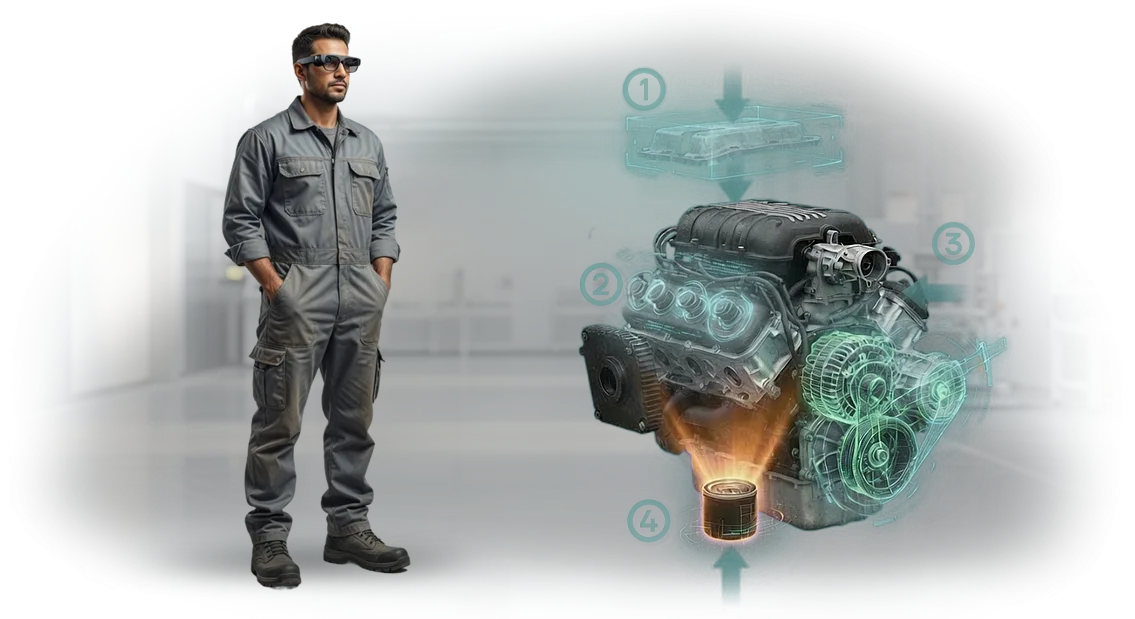
Work instructions software solves exactly this problem: it turns the technical process into a digital format where each step is displayed step by step, with progress control and on-screen prompts or directly on the equipment through AR instructions.
The operator always sees what to do next and cannot silently skip a critical operation. This is not added complexity but simplified work and protection against errors.
The result is lower defect rates and downtime, faster time to target performance, fewer accidents and customer complaints. The manager gets process transparency, and the enterprise gets stable quality that does not depend on the "golden hands" of individual employees. This is practical process digitalization that pays off.
We help implement such solutions for your production needs: we analyze operations, design scenarios, adapt interfaces, and train staff so that the technology is accepted from day one and the effect is visible in numbers — losses, timelines, and quality.
What benefits do AR instructions bring?
New employees start working from day one — without long courses or internships. Instead of a hundred pages of instructions, the operator sees a step-by-step hint right on the equipment: what to take, where to press, in what order to tighten the fasteners.
This shortens the onboarding time by two to three times and relieves mentors who previously spent days repeating the same thing.
Human-factor errors fade into the background. The system highlights the next step and checks in real time that the part is installed correctly.
Operators no longer work from memory or keep checking paper, so the share of defects and rework drops noticeably, and product quality becomes stable.
Savings come from several line items: less scrap, faster changeover, lower costs for printing and updating paper regulations. Senior employees no longer spend time training newcomers, and newcomers make fewer mistakes in their first months.
In total, enterprises recover their investment in AR instructions within the first year and then save on every production cycle.
Finally, there is safety: all prompts are embedded in the logic of a safe action sequence, so operators do not skip critical steps and spend less time working in dangerous zones.
The manager sees a transparent picture: where the process slowed down, where an employee is struggling, which operations should be simplified. We tailor instructions to your standards and equipment, and the client receives a ready-made system that is used from day one.
AR instruction formats: which one to choose for your task
The same AR training can be displayed on a smartphone, a tablet, or an industrial helmet. Each option solves its own task: sometimes price and distribution matter, sometimes freedom of hands and speed of access.
We choose the format based on your specifics: type of operations, workshop conditions, and staff skill level. The table shows the three main scenarios we encounter with our clients.
| Format | Target audience | What it gives the client |
|---|---|---|
| Mobile instructions (smartphones) | For small workshops, mobile teams, maintenance services | Quick launch without purchasing equipment: employees use their own devices, instructions are always at hand — lower entry threshold and faster staff coverage |
| Tablets for the workshop | For fixed workstations, equipment setup and maintenance | Convenient screen, dust- and impact-resistant, step-by-step operation control — fewer errors and defects, easier to teach newcomers |
| Industrial helmets | For complex multi-step operations where hands must be free | Minimal distraction: the operator sees prompts directly in front of their eyes, performance speed increases, training time drops several times |
We will help you choose the format and a pilot area to start. Test it on one operation — you will see the difference in time and number of errors.
How we create work instructions for your equipment
Developing work instructions is not a one-time delivery of files but a structured process in which you understand at every step what is happening and why. We go through the stages in sequence to avoid misunderstandings and surprises on deadlines. Below is the scheme we follow, from the first brief to post-launch support.
Work stages
-
Brief. We briefly record the tasks: which operations need to be described, which equipment, who will use the instructions. We immediately estimate scope and timelines.
-
Engineer visit or video shooting. We study the equipment in operation, film the assemblies, obtain documentation. The instruction is based on the real process, not theory.
-
Prototype on one unit. We create a draft version on the most complex or typical unit. You see the format, navigation, and level of detail, and only after your "yes" do we continue.
-
Approval of the full set. We develop all instructions, you check them for usability and correctness, we make corrections. Every item goes through your confirmation.
-
Verification on equipment. We apply AR markup and test the instructions on actual machines or instruments. Everything works quickly and without failures.
-
Implementation and training. We install the application on employees' tablets or glasses and conduct short training at the workplace. You get a working system, not just "files by email."
-
Post-launch support. Instructions live together with the equipment: we update them, add new operations, help when processes change. Support is included in the project — you are not left on your own.
What is included in the delivery: a complete package for launch
You receive not just digital files but a complete delivery package ready to launch in your production. We have collected everything necessary for employees to start working with AR instructions on day one and for your team to develop the system without additional investment.
-
Ready-made AR equipment models — detailed copies of assemblies and mechanisms that the employee sees "live" through a tablet or glasses. The models accurately replicate the geometry and arrangement of elements, so there is no need to decode anything from drawings.
-
Step-by-step AR instructions for key operations — setup, consumable replacement, scheduled maintenance. Each step is visually shown right on the equipment, and the entire sequence is agreed with your technologists and verified on a real object.
-
Training materials for staff — short videos, cheat sheets, and lesson scenarios for instructors. They help quickly bring new employees up to speed and remove the dependence on our specialists being present.
-
Source files for all projects — models, scenarios, configurations, and settings remain with you. This means you can make changes, create new instructions, or involve any contractors — without lock-ins or licensing restrictions.
-
Technical documentation — instructions for installation, configuration, and maintenance of the system, update procedures, and backup recommendations. Your IT department will have everything needed for independent support.
-
Administration and access management — you set rights for different roles: the operator sees only their operations, the engineer sees an expanded set, and the administrator manages everything. Every action is logged for quality control.
-
Templates for future instructions — standard operation templates that your team can fill with new content without new development investment. This turns the system into an independent tool for your production.
Case study: reduced downtime by 30% with AR instructions
A manufacturer of packaging lines, PackLine, contacted us: complex assembly operations were performed according to paper regulations, newcomers needed up to two shifts to understand the processes, and setters were constantly distracted from the machine by drawings.
Average downtime during changeover reached 45 minutes, and the defect rate on the first series was 3%.
We replaced paper instructions with AR prompts: the employee sees step-by-step actions directly on the equipment via tablet or glasses, without shifting attention to documents.
Implementation took two months: we reworked the technical processes, adapted 3D models of assemblies, and trained 20 setters.
Implementation results
One month after launch, changeover downtime dropped from 45 to 31 minutes — a 30% reduction. The time to bring a new employee up to speed fell from two shifts to four hours: the trainee performs complex operations with prompts without a mentor.
Defects on the first products decreased from 3% to 0.6% — this corresponds to significant annual savings on materials and rework; the exact cost is calculated after audit.
The company was satisfied and has already scaled the solution to three production sites. We support the system, add new operations, and promptly update instructions when regulations change — this takes no more than a week.
Which AR instruction format is right for you?
The AR instruction format cannot be chosen "from a catalog" — it depends on the specifics of your production, the type of equipment, and employee tasks.
A mobile app, a tablet, or smart glasses solve the same task in different ways, and the difference in cost and effect is already noticeable after the first ten operations.
If the equipment is heterogeneous, maintenance requires moving around the workshop, and the project budget is limited, mobile instructions are optimal: the employee uses an ordinary smartphone or tablet that the company already has.
This is a quick start without additional purchases. This format fits when operations are performed from time to time and it is important to quickly open the desired diagram or video.
If the work involves similar assemblies in confined spaces and both hands must be free, AR glasses have the advantage: prompts are projected directly into the field of view, the instruction moves with the employee, and the risk of skipping a step drops many times.
This is a more serious investment, but it pays off quickly on assembly lines and during regular maintenance.
When selecting a solution, we consider the type of equipment, staff skill level, scaling scope, and your budget. Different machines may require different formats — for example, a mobile app for rare operations and a helmet for daily routines.
We help determine where these investments will give the maximum return, and we do not offer anything extra.
To understand which format is right for you, we will conduct a short online review of your situation. Within two working days, we will assess the specifics of production and propose a solution with a cost estimate and expected effect.
Frequently asked questions: safety, compatibility, and support
When implementing work instructions software, managers usually think not about the technology but about risks: will production stop, will the staff cope, what happens after launch. This is the right approach — digital instructions should work for you, not create new problems.
Below are answers to five of the most common questions. If your scenario is not on the list, write to us — we will suggest a solution for your task.
Is it safe for equipment and people?
Yes. Instructions do not connect to machine control and do not change its settings — they are visual prompts in front of the employee. Implementation takes place without stopping production, and the risk of error is reduced through step-by-step checks.
Will it work with our equipment?
We work with both individual machines and automatic lines. For each model, we collect photos, videos, and 3D models based on your documentation. Even for old installations without digital interfaces, we create clear instructions with photos and arrows.
What guarantees do you provide?
We fix deadlines and results in the contract. After launch, we provide warranty support: we fix errors in instructions and update them free of charge if regulations change during the warranty period.
How long does staff training take?
The interface is designed so that the worker does not think but performs steps. Usually staff master the system in one or two shifts. We train mentors and prepare cheat sheets so that new employees can be onboarded without your involvement.
What about post-launch support?
We do not disappear after project delivery. Technical support answers questions, helps with improvements, and scaling to other areas. When processes or equipment change, we update the instructions to the new conditions.
Leave a request — we will develop AR instructions turnkey
We understand: before ordering development, you want to know the timeline, budget, and format of the result. Therefore, the first step is a free consultation and cost calculation without obligation on your part.

Tell us about your equipment and tasks — we will select a solution that reduces employee training time and the number of errors during repair and maintenance. We will give you a realistic project price and launch date within a few days of the brief.

### What you get immediately after ordering

- A format for AR instructions calculated for your task: from simple prompt overlay to full support for repair operations.
- A clear plan of 5-7 stages with fixed deadlines — you always know where the project is and when the result will be ready.
- A single delivery package: the instructions themselves, an application for employee tablets or smartphones, and updates when regulations change.
- A proven implementation scenario: from a pilot zone in one area to rollout across all workshops and sites.
- The ability to integrate with your document management systems — employees work in a familiar interface without additional training.
- A warranty on technical work for one year after launch and support from our engineers at all stages of operation.

Now is the best time to lock in the price: if you order before the end of the month, we include in the base package an engineer visit to the production site and filming of your equipment to create accurate AR markers. This saves you money on a separate digitization stage — the exact cost is calculated after audit.

Leave a request for AR instruction development through the form below — we will call you back within one business day, clarify the details, and prepare an individual proposal. In just a few weeks, your employees will receive simple step-by-step instructions that reduce training time by 2-3 times according to our case studies.