

Wire harness assembly with AR instructions: what manufacturers overlook
Wire harness assembly remains one of the most cost-intensive stages of production. Operators have to keep dozens of connections in mind, check paper diagrams, and constantly shift attention between the drawing and the workbench.
The result is swapped contacts, incorrect routing, and other defects that are only discovered during inspection or at the customer’s site.
Each such case is not just a spoiled part—it is lost hours of work, urgent rework, and the risk of stopping the line. Seemingly minor errors in wire harness assembly translate into a noticeable rise in production costs and lower first-pass yield.
And the more complex the harness, the higher the chance of assembly defects and the more expensive the correction.
Traditional countermeasures—extra inspections, training, and simplified diagrams—only partially solve the problem.
They increase cycle time and burden experienced workers, but they do not remove the root cause: the constant need to match a physical object against a flat instruction.
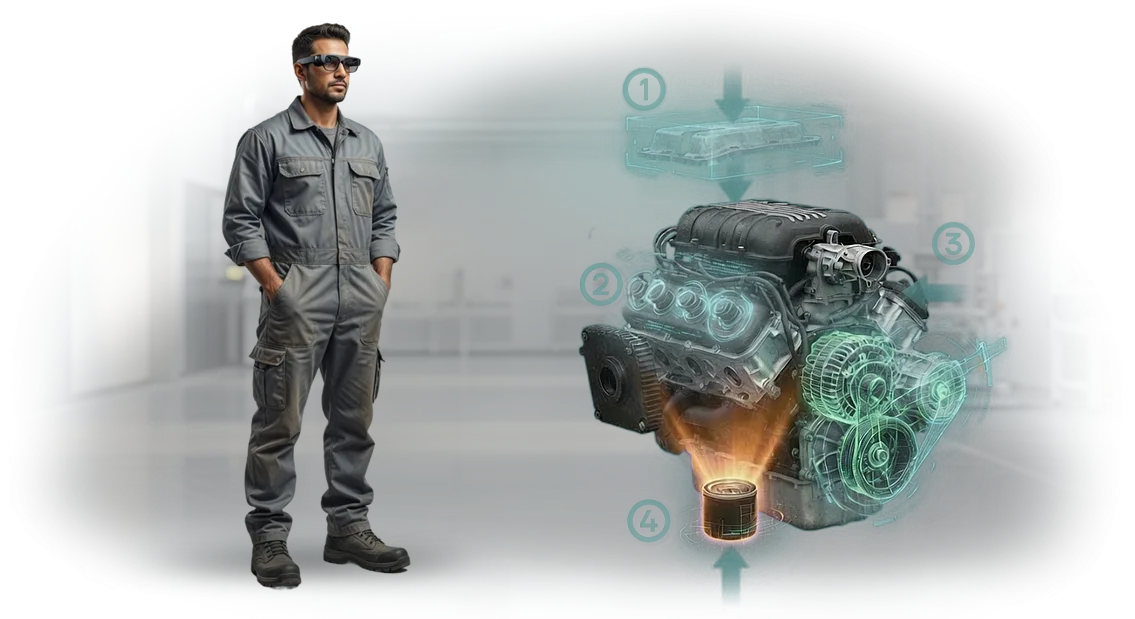
AR instructions change the process itself. The wiring diagram is projected directly onto the work surface, and the operator sees where each wire should go without breaking away from the assembly.
This reduces dependence on employee experience, cuts the number of errors, and speeds up the operation. Manufacturers that adopt such solutions achieve consistently predictable quality even with high staff turnover.
We help industrial companies move harness assembly to AR instructions: we design the process, configure diagram display for specific products, and support the launch. As a result, production loses less to defects, and operators work faster and more confidently.
If you have not yet calculated the losses from manual assembly, that is the first sign that improvement potential already exists.
Benefits of implementing projected assembly instructions
Faster assembly. Projected instructions display the diagram directly on the work surface—the operator does not need to look away at paper, a screen, or memorize the sequence. Hands stay on the task, attention remains on the assembly, and cycle time is cut by up to 40%. Less downtime, more finished products per shift—with the same number of employees.
Fewer defects. Errors most often occur due to incorrect sequence or inattention. The projection highlights the right connector, wire, or mounting point, eliminating guesswork.
As a result, the share of defective products drops, and rework and scrapped materials become a thing of the past—direct savings on procurement and claims.
Fast operator training. A newcomer stops depending on a mentor after just a few hours of working with the projection. The instruction is always in front of their eyes and adapts to the employee’s pace, so reaching target performance takes days, not weeks. This is especially valuable with high turnover or seasonal expansion of staffing.
Transparent quality control. Every assembly step is recorded automatically, and the supervisor sees exactly where a deviation occurred. Instead of random checks by the technical control department, you can get data for every single unit without slowing down the line. This reduces the load on inspectors and increases customer trust in process stability.
Flexibility and scaling. Changing a model or introducing a new configuration does not require reprinting instructions or reconfiguring workstations. Simply update the digital template—and all lines work to the latest version.
Production easily scales to new orders, and knowledge stays inside the company, not in the heads of individual operators.
Formats: projected AR work instructions for your production
On any production floor, there are areas where an employee must check a paper diagram or a PDF on a screen. This slows assembly and opens the door to errors: a missed step, an incorrectly installed part.
Projected AR work instructions solve the problem—the diagram appears directly in the work area and overlays the parts.
Implementation can start at a single workstation or cover an entire workshop. The format is tailored to your specifics and level of automation, and the instructions themselves are personalized to the operator’s skill level and the complexity of the operation.
| Format | Who it suits | What it gives your production |
|---|---|---|
| Stationary table projection | Operators of serial assembly of small units where speed and accuracy matter | Visual prompts without reading drawings, fewer errors, and faster ramp-up to working pace |
| Projection onto the product | Assembly of large housings, pipelines, electrical panels with high responsibility | Accurate positioning of parts directly on the product, eliminating rework and defects |
| Mobile AR devices | Areas with frequent changes of operations, experienced and new employees | Instructions always at hand and up to date, rapid adaptation without stopping production |
How AR instruction implementation works: stages from brief to support
Implementing projected AR instructions for harness assembly is a step-by-step process that we configure for your area. At each stage, you understand what is happening, what results you will get, and how long it will take.
- Brief and audit. We study your production process, harness types, operator skill levels, and current instructions. We identify where AR prompts will deliver the most impact.
- Pilot area. We select one typical operation and create a trial version with a projected instruction. You see how it looks at a real workstation and decide on rollout.
- Approval and plan. We approve the display scenario, prompt texts, control points, and timelines. We lock in metrics: assembly time, number of errors, onboarding speed for new operators.
- Full-package development. We prepare AR instructions for the entire harness range, integrate them with your task tracking system, and configure execution control.
- Training and launch. We train operators and supervisors, install equipment, and support the first shifts. We hand over all materials for your team to work independently.
- Support and development. We stay in touch: update instructions when the design changes, add new harnesses, and help scale the solution to other areas.
In the end, you get a working system with transparent timelines and clear results—without prolonged downtime and with accountability for the outcome firmly in place.
What is included in the AR solution delivery
After launch, you receive a working system and everything needed for day-to-day operations. The delivery package is tailored for a harness assembly area and covers the entire cycle—from installation to operator training.
- Configured projected AR instructions for your harness range: assembly diagrams are projected directly onto the table, and each step is highlighted without needing to glance at paper or a screen.
- Installed and calibrated equipment at your site: our engineers mount components, connect them to the shop floor infrastructure, and verify operation on your products—you receive a ready-made turnkey line.
- Integration with your production tracking system: when an order or batch is scanned, the system automatically loads the correct instruction and records completion. The operator does not need to search for anything manually or switch modes.
- Training for operators and technologists: we conduct training on your equipment with your harnesses, practice typical situations, and make sure employees work confidently without supervision.
- Documentation package for your team: operating instructions, maintenance procedures, and a guide for adding new products to the system on your own.
- Warranty support after launch: our engineer is available, and we help with configuration, updating instructions, and expanding the system to other lines—without long waits.
Case study: how the defect rate in harness assembly was cut 4 times
When a manufacturer of electronics for commercial vehicles approached us, the problem sounded familiar: the defect rate in harness assembly reached 8%, and each operator error meant rework, missed deadlines, and extra costs.
Experienced employees managed, but when hiring newcomers or changing the product model, the number of errors rose sharply—paper instructions distracted from the work, and diagrams on a monitor did not allow looking at the part and the screen at the same time.
We proposed replacing paper and monitors with AR instructions: the operator wearing industrial glasses sees the assembly diagram directly on the workbench, and the projection prompts the order of actions and highlights connection points.
Hands remain free, eyes stay focused on the part, and an error is eliminated before a wire is soldered to the wrong place. Implementation took six weeks, including workstation preparation and staff training.
The result exceeded expectations: two months after launch, the defect rate in harness assembly dropped 4 times—from 8% to 2%. Assembly time was reduced by 30%, and new operators were brought into the process in two days instead of two weeks.
The production manager noted that “employees stopped being afraid of new models”—AR instructions remove the fear of mistakes and accelerate adaptation. The customer was satisfied and has already ordered rollout of the solution to a second workshop.
This case confirms that AR instructions are not just “technology for show” but a practical tool that pays for itself through reduced losses and higher quality.
If you have a similar pain point on your production floor, we will build a pilot in 4 weeks and demonstrate the effect on your product.
How to choose the right AR instruction format for your task?
There is no universal AR instruction format—the right choice depends on the production task you are solving. If assembly is simple and staff have long experience, light prompts at the workstation may be enough.
If the product is complex, with many operations, high turnover, or tight deadlines, you need step-by-step control with projection directly onto the equipment.
First, evaluate three things: assembly complexity, operator skill level, and shop floor conditions (lighting, space, number of shifts). These parameters determine whether you need a static diagram, animation, or an interactive mode with verification of each step.
Equally important is how the instruction will fit into the existing process: where it appears, who launches it, and how data on assembly time and error count is collected.
A good format is one that does not require retraining people and does not slow down work. It should be obvious to the operator, easy to update when the design changes, and pay for itself by reducing defects and speeding up ramp-up to rhythm.
Our engineers choose a format for a specific operation rather than selling a template: we conduct an audit, propose a scenario, test it on your site, and only then implement.
If you are unsure where to start, begin with a consultation: we will analyze your task, show what each format looks like, and help you choose the one that delivers measurable results. You can decide on next steps after that.
Frequently asked questions before ordering AR instructions
Before ordering projected AR instructions, managers typically ask the same questions: guarantees, fault tolerance, training speed, and who is responsible for the result. We address the typical concerns—briefly and in the language of production.
What happens if the equipment fails or the network goes down?
The instructions work autonomously: all information is stored directly in the workshop, so the projection does not disappear when connectivity is lost.
In any abnormal situation, the system clearly tells the operator what to do, and after a restart it continues from the same step. We support the launch and train the staff, and the equipment is covered by a warranty.
How quickly will operators learn the new system?
Usually one shift is enough: the projection shows directly on the workbench which wire to install and where. The employee does not need to read drawings or memorize the sequence—the system guides them step by step.
This lowers the entry barrier for new workers and shortens the error-prone period in the first weeks.
How accurate is the projection and won’t there be errors?
We calibrate the projection for each workbench and verify alignment with the real geometry. The system controls the execution of the operation: it will not let the operator proceed further until the step is done correctly.
This removes the “human factor”—the number of assembly errors drops many times over, according to our data from production sites.
What guarantees and for how long do you provide?
We set timelines and acceptance criteria before the project starts and take responsibility for the stated result. After implementation, we support the system, adjust instructions when the product changes, and respond quickly to questions. Payment is tied to milestones: you pay for the accepted result, not for time worked.
Order AR instructions for assembly and get a measurable result
Order AR instructions for assembly and get a measurable result
We are a development team with 10 years of experience: we design projected AR instructions for wire harness assembly and other industrial equipment.
We work remotely—it does not matter where your production is located; the key requirements are a stable internet connection and the desire to reduce losses.
When you contact us, you get not “technology for its own sake” but a working tool that pays for itself. We start with a cost calculation and a short pilot on one area—you see the effect in real numbers before we scale the solution to all lines.
What you get after contacting us:
- Cost calculation for your task within 2–3 business days—no hidden fees or surprises in the estimate.
- A pilot project on one area or one harness type—minimal risk at the start.
- Ready-to-use AR instructions for 5–10 typical assembly operations—straight into production.
- Integration with your tracking system and technical documentation—without restructuring processes.
- A scaling plan for other lines and products—clear in terms of steps and budget.
- Training for your technologists to work with the system independently—you are not dependent on us after launch.
- Technical support and warranty at all stages—we are there even after the project is completed.
We have already helped manufacturers reduce assembly time and lower defect rates using projected instructions. A pilot lets you see the result on your operations and make a well-informed decision about scaling.
Write to us—we will lock in the task, calculate the budget, and propose a pilot on clear terms. Move from drawings to instructions that accelerate work and reduce the number of errors.