

A Simple Example of Work Instructions: Why Paper Doesn't Work
Paper operating instructions are familiar, but they are often the very thing that causes downtime and operator errors.
When equipment stops, an employee spends minutes searching for the right section in a thick folder or PDF file, and the text found does not always match the actual model and current situation.
As a result, even experienced staff act by guesswork, and a beginner makes mistakes that cost more than the instruction itself.
The problem is not in people, but in the format: linear text is poorly suited for urgent tasks. The operator has to mentally transfer diagrams and descriptions onto real components, and when regulations are updated, paper versions become outdated before they are even distributed.
Simple work instructions should answer the question “what to do now”, not “what is written in the manual”.
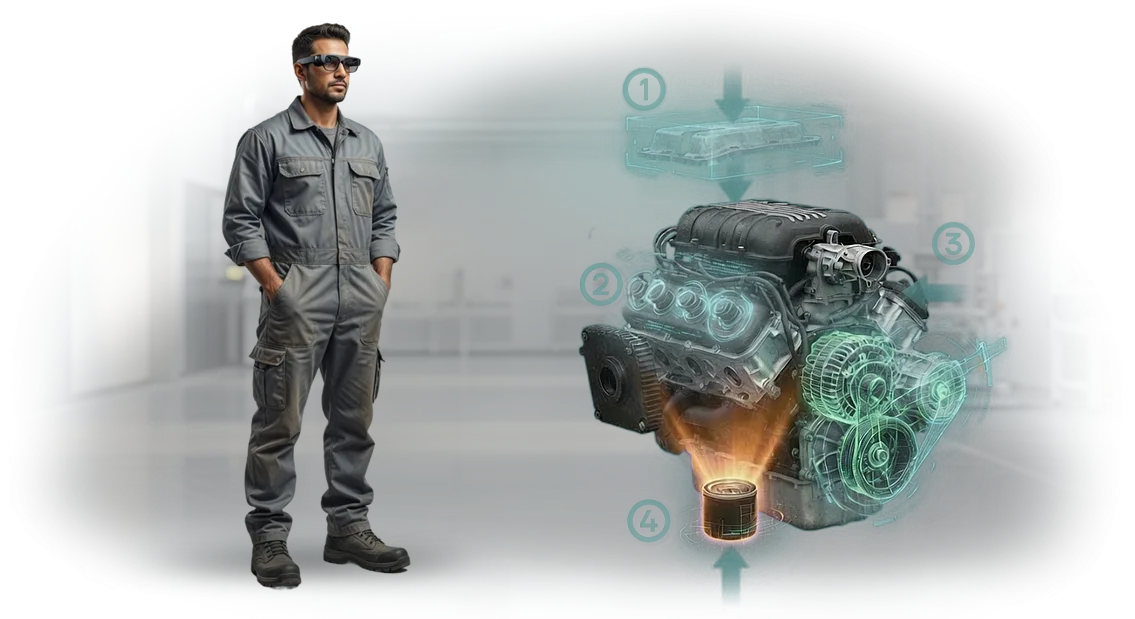
Digital instructions with augmented reality solve this problem. An employee points the camera at the equipment and sees step-by-step hints directly on the parts: which assembly to check, where to press, what order to follow.
This cuts information search time by several times, reduces the number of errors, and accelerates staff training — a new employee performs operations confidently after the first cycle.
For a manager this means less downtime, stable quality, and predictable shift work. We design such instructions based on your regulations and test them with real operators so that the result is clear to every employee.
What an AR Instruction Provides: Fewer Errors, Faster Training
Paper instructions cannot keep up with real practice: while the operator searches for the needed item, equipment idles.
An AR instruction shows step-by-step hints directly on the equipment: the worker sees the required assembly, the sequence of actions, and warnings without being distracted from the task. This turns a complex procedure into a sequence of simple actions that even a beginner can handle.
Fewer errors. The system highlights the work area, indicates the connection point, and monitors compliance with the order. The employee does not skip steps or mix up settings — the defect rate drops by several times, and the costs of rework and re-adjustment approach zero.
Faster training. A newcomer reaches stable performance in 2–3 days instead of weeks. They don’t need to keep all regulations in their head — the instruction is always in front of them.
Experienced employees stop spending time on explanations and return to their main work, and line downtime when onboarding new staff is reduced.
Safety. The AR instruction includes mandatory occupational safety steps: a reminder about protection, control of dangerous movements, and the order of operations. This reduces the risk of injuries and accidents, helps avoid downtime and claims from supervisory authorities. For a manager, this means stable operation of the site without emergencies.
Efficiency and cost reduction. Changeover is accelerated, cycle time is shortened, and equipment idles less.
The savings on a single site are significant — the exact amount is calculated after an audit — driven by lower defect rates, faster onboarding of new staff, and the elimination of emergency stops. Implementation pays off within a few months.
AR Instruction Formats for Different Tasks
The same AR instruction is not suitable for both installation and urgent repair. Each operation has its own rhythm and the employee’s skill level, so we divide instruction formats into specific tasks: installation, repair, and training.
This approach maximizes the benefit from the technology and does not overload staff with unnecessary actions.
In the installation format, the employee sees the installation sequence and warnings about critical assemblies. The repair format allows immediate transition to diagnosis by symptoms, without flipping through paper manuals.
The training scenario provides an opportunity to safely practice actions on a virtual model of the equipment.
| Format | For whom | What it gives the client |
|---|---|---|
| Installation | Commissioning engineers, installation teams | Step-by-step hints directly on the equipment — fewer installation errors, quick line startup. |
| Repair | Service engineers, duty personnel | Component diagram and list of operations before your eyes — accurate diagnostics, reduced downtime. |
| Training | New employees, students | Skill practice on a virtual model — safe for equipment, quick transition to independent work. |
The formats are easy to combine: for example, training for beginners, repair for experienced employees. This way you cover a range of tasks with one system and get a quick effect regardless of the team’s experience.
Analysts at Gartner confirm: AR instructions reduce operation execution time by about a third and noticeably reduce the number of errors.
For a production owner, this is a predictable result — less downtime, stable quality, and confident transfer of experience between generations of employees.
How an AR Instruction Is Developed
Every project with us is a clear route, not a black box. You see in advance what you will get, how quickly, and at what price. The work is built around your task and your equipment, so at every stage we speak the language of your business rather than technical terms.
- Brief and analytics. We examine what equipment employees work with, which operations are the most frequent, and where errors occur. This is the basis for a simple and practical instruction.
- Plan and estimate. We fix the scope, timeline, and cost. You receive a transparent plan where every stage is clear and achievable.
- Concept and prototype. We show what the AR instruction will look like: which steps, what text, how the employee interacts with it. At this step, it is easy to make edits without wasting time.
- Approval. You approve the prototype, we make final adjustments — then we work without surprises.
- Implementation. We create the instruction with professional equipment and proven tools so that the result works stably on your devices.
- Testing and launch. We test on real equipment, make sure everything is clear from the first try, and launch together with brief employee training.
- Support and updates. After launch, we stay in touch: we make edits if equipment or regulations change, and update the instruction without unnecessary bureaucracy.
In the end, you get a tool that workers actually use: simple AR instructions that make it clear what to do, rather than guesswork and thick paper regulations.
What Is Included in the Delivery of an AR Instruction
You get not just a file with an instruction, but a ready-to-use working solution that can be immediately implemented in production.
We assemble the package so that your employees can start using the AR instruction on the very first day, while the technical part remains transparent and manageable.
Here is what is included in the delivery:
- Ready-made AR instructions for the selected operations — tailored to your equipment, with verification at a real workplace. The instructions work on tablets and smartphones that employees already have, without purchasing additional devices.
- Source materials — editable files, 3D models, and assets. You are not tied to us: you can make changes with your own team or transfer them to a contractor in the future.
- Employee training — a short practical session for operators and administrators. We will teach you how to launch the instruction, switch modes, and resolve typical failures without our involvement.
- Clear documentation — user manual, description of roles and usage scenarios, content update guide. Everything is written in human language, without unnecessary technical complexity.
- Technical support for the warranty period — we answer questions, help with setup, and fix errors if they occur. You are not left alone with the new technology.
- Optional: development plan — we recommend which other operations can be converted to AR format to increase training speed and reduce the number of errors.
We also transfer rights to the developed content — it is entirely yours. If in a year you decide to expand the list of instructions, you will already have a ready base and a clear process, and we will help you do it quickly and without unnecessary costs.
In the end, you get not a one-time service, but a working tool that is easy to scale within the company.
Case Study: A Plant Reduced Training Time by 40%
In any production, time is money. When a new line is launched, operators need to be trained while the equipment is idle. The longer the training, the later the factory gets a return on investment.
A telling case is Privolzhsky Machine-Building Plant. The enterprise purchased a new machining center, but the in-house trainers did not have time to prepare shifts. Ordinary training took 20 working days: theory, diagrams, working in pairs with a mentor. Due to staff turnover, some operators left without ever reaching full capacity.
What Changed After Implementation
We digitized the regulations as AR instructions: the operator puts on a tablet or glasses and sees hints directly on the equipment.
Each step is highlighted on the part, the system checks the correctness of the action and does not allow moving forward until the assembly is secured. A mentor is no longer needed for basic operations.
Result: time to full proficiency was reduced by 40% — from 20 working days to 12. The number of assembly errors fell threefold, and the number of emergency line stops dropped by a quarter. Newcomers start their shifts faster, and experienced operators switch to complex tasks.
Why It Worked
The secret is not in the technology but in the simplicity of presentation. Instead of hundreds of pages of instructions — short visual hints in the field of view. This works even for employees without experience: no need to read drawings or memorize the sequence of operations.
After the first stage, the plant ordered two more areas — training for changeover and maintenance. Now AR instructions are used as the standard for staff training at the enterprise.
Answers to Frequently Asked Questions About AR Implementation
Implementing AR instructions raises questions — that is normal, especially when it comes to an operating production facility. We have gathered answers to common concerns so that you understand the budget, timelines, and risks in advance.
What equipment is compatible with AR instructions?
We work with most modern smartphones, tablets, and industrial devices that are already on your site. There is no need to purchase expensive kits — it is enough to run a pilot on your current fleet and evaluate the result.
What happens if the equipment fails?
The instructions work autonomously, so a network outage will not stop the employee. Each scenario includes a backup: text steps and videos allow the operation to be completed even in an unforeseen situation.
How much does implementation cost?
The budget depends on the number of instructions, the complexity of the process, and the content format. We start with a pilot on one or two processes so that you can see the effect on real people and understand scaling. We prepare a transparent estimate before starting work — without hidden surcharges.
What are the development timelines?
We create a simple AR instruction in 2–3 weeks after receiving materials. A project of 5–7 instructions takes 6–8 weeks, including approvals, refinement, and brief staff training.
Will employees use them or refuse?
We make instructions as simple examples of work operations: short steps, large hints, minimal text. Before launch, the scenario is tested on your specialists and adjusted to reduce resistance and speed up the transition to work.
If your question is not covered, write to us — we will prepare a calculation for your task and show an example on your equipment.Order Development of AR Instructions for Your Equipment
We know how difficult it is to understand AR without a technical background.
Therefore, the first request is not the start of a long project but an incoming diagnosis: you describe the task, we explain which operations AR instructions will actually reduce time and errors for, and where their implementation will not deliver the expected effect. No obligations — just an honest assessment of the benefit.
We work at production sites and know how to integrate AR instructions into an existing process: taking into account your regulations, types of equipment, and employee skill levels. Tell us what you want to improve — and we will suggest a simple path.
After your request, you receive:
- Consultation on the task: we determine where AR instructions will have an effect — repair, assembly, training.
- Calculation of cost and timelines for your budget — we fix the figures in the estimate without hidden surcharges.
- Demo version on your equipment or in the workshop — evaluate convenience before payment.
- Implementation plan: pilot, employee training, launch, and result control.
- Support after launch: we refine instructions based on feedback from your supervisors.
- Scaling to other areas — we will advise how to expand coverage.
To order AR instructions, leave a request or write to us. We start with a consultation: we will show examples, clarify the task, and prepare a calculation within a few days.
How to Choose an AR Instruction Format for Your Task?
Choosing an AR instruction format starts not with technology but with the question: where and how will the employee use it? For a repair crew in a workshop, one option is convenient; for a new worker on the line, another; for an engineer during commissioning, a third.
Therefore, we first look at the specific features of your enterprise: type of equipment, staff skill level, and site conditions — noise, lighting, and the ability to hold a device in hand.
These conditions determine what proves more practical: a tablet on a stand next to the machine, a smartphone in a case, or an overlay AR diagram that is displayed directly on the equipment.
Also important is how often regulations change: if instructions are updated regularly, we choose a format that is easy to edit without re-shooting all the material.
And if strict safety requirements apply at the site, we design a scenario in which the employee is not distracted from the equipment and does not perform unnecessary actions.
Another point is specific production requirements: integration with your accounting system, step completion control, and storing error statistics.
All this affects the complexity and development timeline, but the main thing remains a simple principle: an instruction should reduce training time and the number of errors, not turn into another technical task.
We do not sell a single “universal” format. First, we analyze your situation, show 2–3 suitable options, and make a pilot fragment so that you can evaluate the result on real equipment. This way you get a clear solution for your task — without overpaying for unnecessary functionality.
Describe your equipment and process — within a few days we will propose the optimal format and show how it will work for you.