

Visual Work Instructions Examples: Why Your Operators Fail
Every operator wants to do the job right, but the fault lies not with them but with the quality of the instructions. Diagrams on paper or in an electronic file do not convey the real sequence of actions or the specifics of particular equipment. The result — extra errors, defects, line downtime.
Traditional instructions are written for ideal conditions, not for the shop floor, where you have to remember dozens of operations and act fast. While the operator searches for the right item, they lose context.
The more complex the equipment, the more errors occur: ineffective instructions account for up to a third of personnel failures.
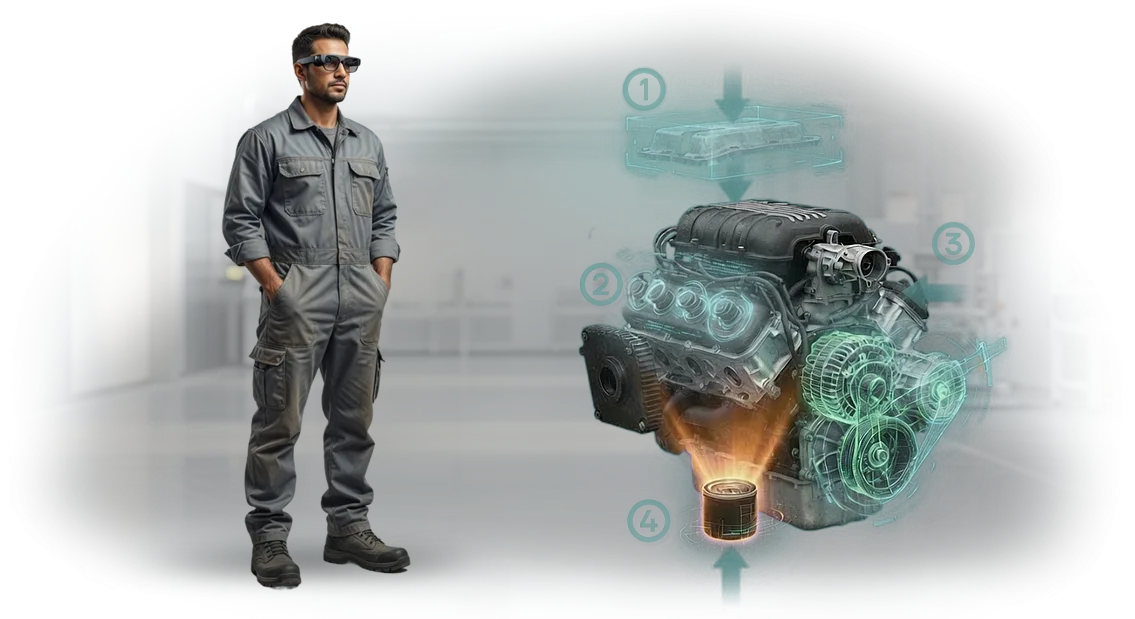
Visual instructions look different. Instead of text, the operator sees step-by-step examples right at the workstation: how to open the panel, in what order to tighten the fasteners, what signal will appear on the screen.
Augmented reality is one of the main advantages of AR instructions: hints are overlaid on real equipment, and the employee does not search for information but acts immediately.
This format accelerates production training. A newcomer starts working independently faster, an experienced operator calls a mentor less often.
Mistakes are trained on a virtual model rather than on real equipment — operator errors decrease, task mastering time shortens, and the line runs more stably.
We build instructions as visual scenarios tailored to your specifics. Request a demo — we will show how a specific operation turns into a clear visual example.
Key Benefits of Augmented Reality for Industrial Safety
The main cause of injuries on the production floor is inattention when working with unfamiliar equipment. Paper instructions cannot be read during the process, and the required sequence has to be recalled on the fly.
AR instructions solve this: step-by-step prompts appear right before the operator's eyes, overlaid on the real object. The employee is not distracted by a tablet or paper — hands are free, eyes stay on the operation.
Training newcomers stops being long and expensive. Instead of a week of theory with a mentor — a few hours of practice with AR prompts.
According to our projects, onboarding time is reduced by a factor of 1.5–2, and the number of errors in assembly and maintenance drops by about a third. That is a direct saving on defects and rework.
Safety is also strengthened by the fact that AR shows hazardous zones in advance, the order of lockouts, and warns about an incorrect sequence. Maintenance speeds up: the specialist immediately sees which unit to remove and which tool to use. Less downtime — more output.
A separate effect is knowledge transfer. Experienced employees leave, but their expertise remains in the form of AR instructions. A new worker receives not dry text but the visual experience of the best specialist. Siemens already uses such solutions at its plants — which confirms the reliability of the approach.
The bottom line: AR for industrial safety pays off through reduced injuries, training costs, and downtime. We design instructions for specific equipment and processes. That is why the result is measurable: fewer errors, faster training, stable operation.
Formats of Instructions: From Tablets to Hands-Free
Work instructions only bring value when the operator actually follows them. A paper manual or a PDF sitting in a folder takes time to find and is often ignored — especially when hands are busy with tools. The right format puts the answer in front of the person at the moment they need it.
We have implemented all the popular instruction formats, from tablets to hands-free devices, so we recommend the one that fits your production and budget. The table below shows the typical scenarios and the business result each format delivers.
| Format | For whom | Business result |
|---|---|---|
| Interactive instructions on tablets | Maintenance and repair teams | Operators find the right step faster and make fewer calls to senior engineers |
| Hands-free instructions on smart glasses | Assembly lines, inspectors | The next step appears in the field of view — no need to stop work, fewer errors |
| Desktop or kiosk AR training | New employees | Standardized training: new staff gains skills at their own pace, fewer mistakes in the first weeks |
| Combined: tablet + smart glasses | Multi-site facilities | One content source: an update reaches every site at once, instructions stay current |
In practice, the strongest effect comes from a combination: a training format plus a working format. Our engineers set up both and help you measure the result within the first month.
How We Build and Deploy the Solution in Six Steps
We structured the process so that at every stage you see results and understand where resources go. We work according to a transparent procedure: we record tasks, deadlines and those responsible, and after launch we stay in touch — fine-tuning instructions and training employees.
- Brief and audit. We meet with your team, study the equipment, procedures and typical operator errors. We identify the operations where visual prompts will give the maximum effect: shorter setup time, less waste, fast onboarding of newcomers.
- Plan and cost estimate. We propose an instruction format for each area, timeline and cost. We agree on priorities so that first results appear on a pilot unit rather than after the entire project is completed.
- AR content development. We create 3D diagrams, animations and text prompts based on your technical documentation. We show intermediate versions — you make edits before the final build, not after it.
- Integration. We package the instructions into tablets, smartphones or industrial helmets that are already in use on the production floor. We configure role-based access and content updates without stopping work.
- Launch and training. Together with your technologists, we run a pilot on a real section, collect operator feedback and make final edits. We train employees to use the instructions from day one.
- Support and development. We stay in touch: we update instructions when procedures change, add new units and help scale the solution to other sites. You get not a one-off delivery but a working tool that evolves together with production.
What’s Included in the Deliverables: Content, Software, Support
Every deliverable is aimed at one thing: putting clear, repeatable visual instructions into the hands of your operators and technicians. You receive a complete package — ready-made scenarios, content, license and support — not a set of raw 3D files.
What is in the handover
- Ready-to-use AR scenarios — step-by-step visual work instructions examples for your equipment: operation, maintenance, troubleshooting.
- 3D models and animations — digital twins that point attention to the right part at the right moment, prepared for your devices and working offline.
- Integration with your documentation — a structured set that embeds into your existing guides, videos and PDFs, with no new system to learn.
- Perpetual software license — for the AR viewer and content management console, so you control updates, translations and usage.
- Training and documentation — practical sessions for your engineers, a quick reference guide and technical docs.
- Support with warranty — a dedicated contact channel and free fixes during the warranty period.
How the package reaches you
The final shipment includes the AR content package, the software license, integration guidelines and editable source materials in open formats. You can extend the content with your internal team or with any developer you choose.
What happens after launch
We stay available: during the warranty period we fix any issues free of charge, after that you can choose a support plan or keep using the solution as is — no hidden costs, no forced subscriptions.
Case Study: How We Cut Maintenance Errors by Half at a Pump Plant
A pump equipment plant was losing money because of the human factor. Even experienced operators maintained complex units from memory, so errors regularly occurred: wrong order of operations, insufficient tightening, missed checks. Each such error meant a stopped conveyor, emergency repairs and lost production hours.
We proposed replacing paper manuals with interactive AR instructions that overlay prompts directly on the equipment. The operator sees on a tablet or smart glasses screen which unit to remove, in what sequence, and which tool to use. This eliminates guesswork, and the process becomes equally repeatable for newcomers and veterans.
“We expected an improvement, but not this much. Maintenance errors dropped by half in the first month, and downtime due to incorrect actions fell sixfold. The project paid back in four months,” says the chief engineer of the PumpTech plant.
After three months of industrial operation, we compiled the operational and financial metrics into a table. The main conclusion: the cost of such a project is many times lower than the losses it prevents.
| Metric | Before implementation | After implementation | Effect |
|---|---|---|---|
| Maintenance errors | 12 per month | 6 per month | −50% error rate |
| Time per operation | 4.5 hours | 2.8 hours | −38% labor costs |
| Downtime due to errors | 18 hours/month | 3 hours/month | −15 hours, cost calculated after audit |
| Output plan fulfillment | 88% | 97% | +9 p.p. productivity |
These are exactly the results we use as a benchmark for every manufacturing case. If your shop floor suffers from maintenance errors — we will show what the solution looks like on your equipment and calculate the potential savings.
What If Your Equipment Is Unique or Extra Complex?
Unique equipment is not a limitation but our core task. Template instructions do not fit when the process depends on a specific machine model, rare tooling or a special sequence of operations. We develop custom AR instructions with your design, procedures and employee skill levels in mind.
We break complex processes into short, clear steps: the operator sees which unit is involved, where to apply force and how to verify the result. This reduces the number of errors and speeds up training even on the most non-standard equipment.
We do not simplify the procedure for the sake of the visuals — we make it understandable without losing technical accuracy.
Scalability is ensured by a modular approach. The instruction is assembled from individual elements: descriptions of units, operations and checkpoints.
Therefore, when equipment is upgraded or a new modification is released, we update not the entire instruction but only the needed blocks — saving time and budget.
We take on documentation analysis, shooting and anchoring animations to real objects. Our engineers work on the production floor, not in a vacuum, so they account for space constraints, lighting and working conditions.
As a result, you get an instruction that can be replicated to other areas and does not require constant developer involvement after implementation.
If your equipment is unlike anything else — even better: you gain a competitive advantage through faster commissioning and reduced dependence on experienced specialists. Tell us about your task — we will propose a format and show how it will work specifically for you.
FAQ: Answers to Common Concerns Before You Start
Before implementing visual instructions, managers ask the same questions: will the system fail at the most critical moment, will it create risks for workers, how much does it cost and when to expect results. Let’s answer the main ones — without technical details, in terms of benefit.
Our team has already implemented such solutions at dozens of production sites. Below are answers to four key concerns.
What if the equipment breaks down or the instruction does not work?
A visual instruction is not fragile software but part of the work process. We design it so that if one element fails (for example, a tablet), the employee can continue with a paper memo or a screen at the control panel.
The instructions themselves undergo reliability testing: they load locally, do not depend on the internet and work in shop floor conditions — dust, vibration, poor lighting.
If something goes wrong, our engineers are available within a business day. Warranty support is included in the price — you are never left alone with a problem.
Is it safe for employees?
The instructions are designed to reduce the risk of errors: step-by-step prompts, action verification before moving to the next step, warnings about hazardous zones. The worker sees exactly what needs to be done right now and is not distracted by unnecessary information. The result is fewer injuries and less scrap — a direct saving.
How much does it cost and when will it pay off?
The cost depends on the number of operations and the complexity of the equipment. On average, a project pays off in 2–4 months due to faster training of new employees and fewer errors. We provide an accurate estimate after a short audit — without obligation.
How fast can we implement it and who will support it?
We build the first instruction in 2–3 weeks — you see the result and the effect before the full launch. Implementation is phased: first a pilot on one section, then scaling. Support stays with us: updates, refinements, consultations — within the contract.
What Happens After Your Request: Timeline and Support
After you submit the request, we don’t disappear into a black box. Within one business day you receive a short confirmation and a consultation slot to discuss your goals, equipment, and the exact problems you want visual instructions to solve.
Here’s the typical timeline you can expect:
- Demo request — we show real examples of visual work instructions for industrial equipment so you can see how they look on the shop floor.
- Initial consultation — a 30-minute call with our team: we map out where AR or visual instructions will bring the fastest ROI in your operations.
- Project proposal — a transparent document with scope, timeline, and fixed pricing. No hidden cost surprises later.
- Pilot on your equipment — we build a small working sample for one or two operations, test it with your operators, and measure feedback.
- Rollout plan — based on the pilot results, we prepare a step-by-step implementation plan for all remaining workstations, including training for your internal team.
- Ongoing support — after launch we stay available for updates, troubleshooting, and adding new instructions when your processes change.
Most clients see the first pilot within 2–3 weeks from the initial call. You don’t need to buy hardware upfront or change your existing infrastructure — we adapt the solution to what you already have.
This approach lowers your risk: you see the result, evaluate the impact on your team’s speed and error rate, and only then decide on scaling. And because we work with professional tools and proven methodology, the quality you see in the demo is the quality you get on your floor.