

Every Mistake During Concrete Mixer Repair Means Downtime
Every mistake during concrete mixer repair halts the site.
The concrete unit is the heart of production, and when it stops, all processes stop: while the mixer is disassembled incorrectly, concrete isn't poured, the crew is idle, and you lose not only time but also money on unplanned spare parts.
One wrong move during maintenance — and instead of a two-hour component replacement, you end up with a full-day repair.
Then the problem grows: deadlines slip, the client files complaints, and you have to negotiate rescheduling. In industry, every minute of downtime is lost output, and with it, lost profit.
Meanwhile, most breakdowns happen not because of part wear, but because of incorrect staff actions during concrete mixer maintenance.
The reasons are simple: mechanics don't have a visual diagram at hand, documentation is outdated, experienced specialists leave, and newcomers act by guesswork.
Paper procedures gather dust in cabinets, video tutorials don't answer what to do with that specific component — and repair turns into a guessing game where every attempt to fix something can add a new problem.
We close this gap by developing AR instructions.
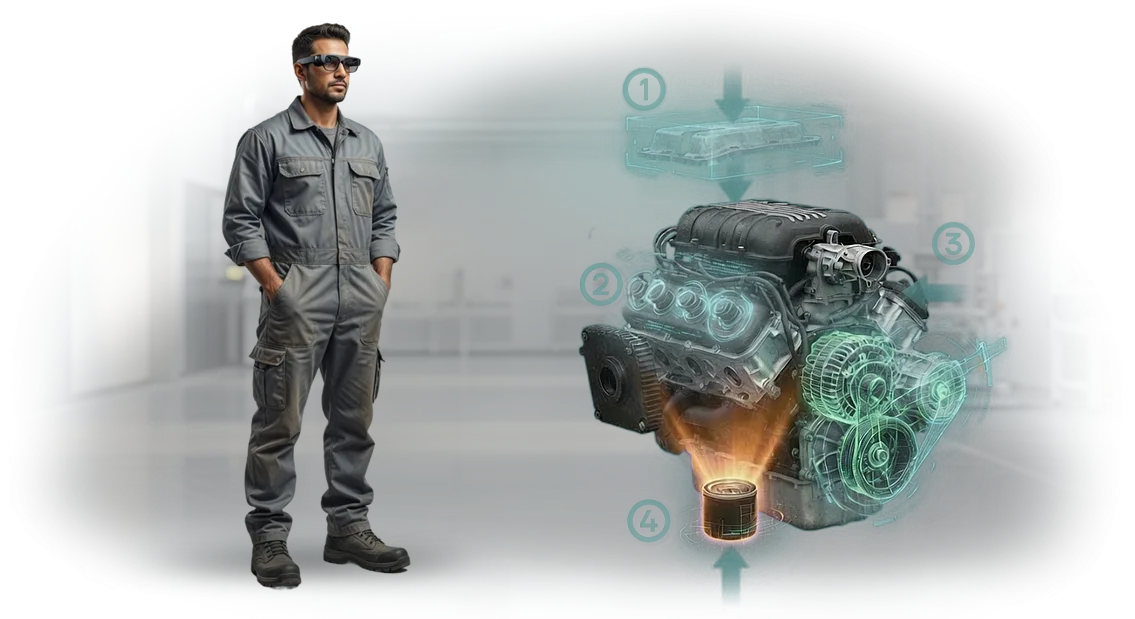
They show the worker step by step what exactly to do and in what order when repairing and maintaining concrete mixers: where the component is located, which tool to use to remove it, which bolts to unscrew, and how to reassemble without errors.
The employee sees digital hints right on the equipment and acts confidently, while you get predictable repairs without downtime or missed schedules.
What You Get from Implementing AR Instructions
Concrete mixer maintenance is a process where a mistake costs a lot: wrong disassembly sequence, a damaged component, extra hours of downtime, and unplanned repairs.
Personnel follow paper instructions, memory, or the experience of senior colleagues, and every step away from the procedure increases equipment recovery time.
AR instructions from our team overlay step-by-step hints directly on the equipment: the employee sees which component to remove, which tool to use, and in what order — without being distracted by searching for information.
This removes the main pain point of maintenance: uncertainty about actions. The mechanic stops guessing, receiving precise visual guidance right in their field of view.
Accuracy of actions improves, and the number of errors during disassembly and assembly drops significantly. Repeat disassembly due to forgotten fasteners or incorrect part positioning is eliminated, meaning every operation is done right the first time.
Repair speed becomes predictable: even a new employee follows the hints at the level of an experienced specialist, without waiting for a mentor. Less time searching for instructions and consulting — equipment returns to operation faster.
The economic effect is the sum of its parts: reduced downtime, lower spare parts costs due to careful handling, and reduced retraining expenses. Every eliminated failure is preserved revenue and a stable delivery schedule.
We digitize your procedures, adapt AR instructions to specific concrete mixer models, and train staff to work with the system.
Implementation takes a few weeks, and the result is measured not by an abstract "innovative status" but by real repair time and maintenance cost indicators.
AR Instruction Formats for Your Production Needs
So, what's the benefit for the client here? They don't want to understand content types — they want to solve a problem: reduce maintenance time, lower accident rates, retain knowledge when experienced employees leave.
This is especially acute for equipment like concrete mixers — complex machinery, different modifications, and staff turnover.
Formats for Your Task
We don't do "AR for AR's sake" — we address a specific pain point. The format depends on scale: whether you need to guide one mechanic or train staff at ten sites simultaneously. The whole system is designed so you can start small and scale up without rework.
| AR Instruction Format | Who It's For | What It Delivers in Practice |
|---|---|---|
| Single interactive guide | A single site with at least one concrete mixer | Speeds up repairs and scheduled maintenance, captures knowledge for a specific model |
| Library for a series or product line | Standard installations at one site | Standardizes training, reduces downtime and errors caused by the "human factor" |
| System for a large equipment fleet | Service departments and distributed staff | Provides a digital procedure for all equipment, quick access to data on each unit |
If you have dozens of concrete mixers from different years and modifications, you need a systematic approach: we create a unified procedure where the instruction opens automatically as soon as the mechanic points the camera at a specific component.
Overlaying hints directly onto the real object recognizes the part and shows the sequence of steps — this reduces errors and eliminates dependence on a book or memory.
Any of the formats can easily be packaged into a tablet, phone, or AR glasses — that's usually where clients start. What matters more is this: you get reduced repair and training time.
And if you haven't decided yet on the scale you need — come for a consultation, we'll review your equipment structure and suggest the optimal entry point.
How We Develop AR Instructions in 5 Steps
To help employees quickly master concrete mixer maintenance, the instruction must account for real operations. We've broken the work down into five clear stages so you can control each step — without technical details or surprises.
From the first briefing to launch takes minimal time, and the result relies on your experience and our ready-made solutions.
- Briefing and audit. You tell us which tasks and procedures matter. We study the equipment, typical errors, and difficult zones to build them into the scenario.
- Instruction scenario. We break maintenance into short steps and determine where hints and warnings are needed. We show you the structure — you immediately see the logic of the future instruction.
- Intermediate version approval. Using a real example, you check how an employee will see and perform the steps. We make corrections before the main work begins.
- Assembly and testing. We build the full instruction, test it on the equipment, and fix any inaccuracies. You receive files for tablets and phones that work even without a network connection.
- Launch and support. We train your specialists, help connect devices, and stay in touch. We update the instruction when procedures or equipment models change.
This approach has already helped dozens of manufacturing companies reduce the time needed to bring new employees up to speed. You get not a one-time service but a tool your staff will use every day.
What's Included in AR Instruction Delivery
The delivery package includes everything needed to launch AR instructions at your facility and work with them daily without involving developers.
This isn't just "animation files" — it's a ready solution: electronic guides, staff training, and post-implementation support.
Package Contents
- Electronic concrete mixer maintenance guides: step-by-step scenarios for each model, animation, and on-screen hints.
- An application for tablets and smartphones — configured within a day, works even without internet at the site.
- Staff training: in-person and online sessions for mechanics, operators, and engineers, accounting for different skill levels.
- Admin panel: add new instructions, change procedures, and assign equipment responsibility.
- Content updates and technical support: we make edits when procedures change and new components are released.
- Knowledge base for engineers: video breakdowns of operations and answers to frequent concrete mixer repair questions.
Why This Is Convenient for Your Facility
Staff master procedures faster — no need to wait for a mentor to become available. The electronic guide is always at hand: in the workshop, at the construction site, or right by the concrete mixer.
Instruction relevance is maintained automatically: edits are made centrally, and all employees see the updated version. This reduces the risk of maintenance errors and cuts equipment downtime.
Guarantees and Support
We are responsible for the package working after delivery. Your operations team stays in touch with us, gets consultations on non-standard situations, and instructions are refined for new production tasks.
Case: How We Speed Up Concrete Mixer Maintenance by 40%
A concrete mix production plant, BetonProm, contacted us — they had 12 concrete mixers whose maintenance was taking too long. Mechanics constantly got distracted by paper procedures, searched for the right section, and double-checked the sequence of operations.
Because of a missed step, the line had to be stopped for unplanned repair twice in a year — the downtime cost more than the instruction itself.
We analyzed the most frequent scenario — blade replacement and drive inspection — and converted it into AR format. The mechanic sees hints through a tablet directly on concrete mixer components: which bolt to loosen, in what order to remove the housing, how to set the gap.
No need to flip through 40 pages of documentation — all steps appear in the field of view, with completion control.
Implementation Results
Over two months of trial operation, assembly time dropped by 40%: an operation that used to take 75 minutes now takes 45. Missed steps are completely eliminated — the system won't let you proceed until the component is properly secured.
The plant reassigned mechanics: two engineers moved from constant presence on the line to other sites.
We also note the reduced dependence on the "human factor." A new employee only needs to be trained once on an AR simulator — and they immediately work to standard, without months of mentoring.
Six months later, the client returned for a second instruction — this time for the hydraulics of the same line.
The metrics speak for themselves: speed increased by 40%, assembly errors — zero, and the repeat order confirms that AR instructions pay for themselves on the first repair.
If your equipment fleet resembles BetonProm's — tell us about your task, and we'll calculate how much time your crew will save.
Answers to Frequent Questions About AR Instruction Implementation
Implementing AR instructions raises three main questions for managers: will it disrupt existing processes, is it safe for employees, and how much time and budget will it require. That's normal — any new solution must pass a reliability check. We address these concerns directly.
Will we have to stop equipment for integration?
No. Integration happens in parallel with the facility's operations. Our specialists work with your technical documentation and create instructions without interfering with production cycles. You keep producing while we prepare AR scenarios. If needed, we adapt the materials to your existing procedures and standards.
Is it safe to use AR instructions on the production floor?
Safety is our top priority. AR instructions are not connected to equipment control systems and do not change its settings.
They simply overlay hints on the real object through a tablet or glasses, so the employee always sees their surroundings and acts strictly according to the procedure. Errors are eliminated because every step is confirmed by a visual marker.
How long does instruction development take?
From one week to several weeks, depending on equipment complexity and the number of operations. We break the project into stages and approve each one with you so you can see intermediate results.
Once the scenario is ready, you receive the instruction for testing on a real object. Usually, one short check is enough to confirm the hints are correct.
What investment is required?
The cost is calculated after audit and depends on the number of instructions, the volume of technical information, and the required level of detail. We prepare a cost estimate after a short briefing and offer options so you can choose the optimal scope. The investment pays off through reduced errors, faster staff training, and less equipment downtime.
Still have questions about implementation? Ask us — we'll tell you more about your specific case.How to Choose the Right AR Instruction Format for Your Equipment?
The choice of AR instruction format directly affects how quickly your employees master the equipment and how much less often errors occur during maintenance.
There is no one-size-fits-all solution for all equipment types: what works for a compact machine will be ineffective for a complex concrete mixer with dozens of components.
The equipment type determines the depth of scenario development. For equipment with frequent scheduled operations, short hints displayed over the real object are enough.
For complex units where the sequence of actions matters, step-by-step guides with visual highlighting of each part work better. We select a format so the instruction solves the task rather than becoming entertainment.
Budget also influences the choice, but this isn't a question of "expensive or cheap" — it's a question of allocating resources wisely.
At the initial stage, you can cover the most frequent operations with a minimal set of scenarios, then scale the solution to all equipment. This lets you launch the project without large upfront investments and get a quick result that pays off through reduced downtime.
We help find the balance between functionality and cost: we analyze your tasks, equipment types, and staff skill levels.
As a result, you get not an "instruction for instruction's sake" but a tool that fits organically into the workflow and genuinely reduces the load on service engineers.
Order AR Instruction Development for Your Production
Submit a request for AR instruction development — and we'll prepare a cost calculation for your task.
We don't need a ready technical brief: we'll study the documentation ourselves, understand the equipment components, and suggest the optimal format for your employees and clients.
What You'll Get After Contacting Us
- An accurate cost estimate for your task — we fix the cost, timeline, and scope of work before starting, so you understand the budget as early as the negotiation stage.
- A demo fragment of the future instruction — we show on a real section of your equipment what a step-by-step hint will look like, rather than explaining abstractly.
- Analysis of typical errors and complex components — we recommend which operations should be covered with AR instructions first to get results faster.
- An implementation plan without stopping production — we explain how to move staff to the new training format without downtime or lost time.
- A clear communication channel — we assign a project manager who answers questions within one business day.
To calculate the cost, we just need three things: the brand or model of the equipment, the number of operations, and where you plan to use the instructions — at the plant or at client sites.
Send a request through the form below or write to us in a messenger — we respond quickly. We'll start with a phone call, during which we'll clarify your task and give you an idea of the budget. You make the decision to collaborate after you see the demo fragment on your own equipment.