

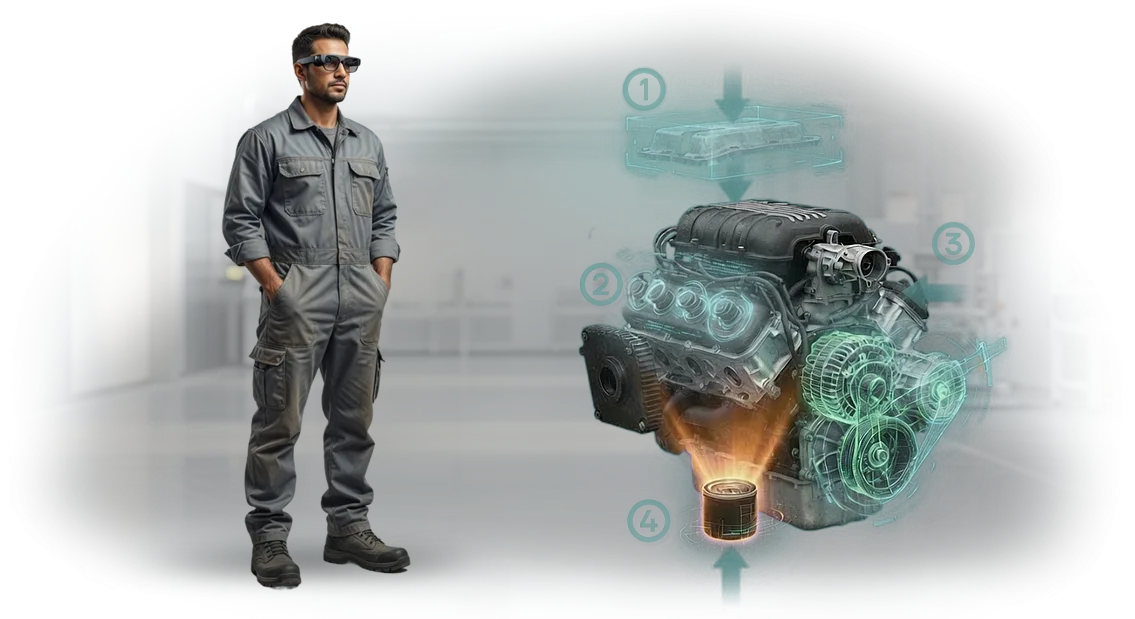
AR instructions for milking equipment: why downtime hits milk yields
A milking line failure almost always happens at the worst possible time: the morning milking is in full swing, operators are waiting, and the technician is flipping through a paper manual looking for the right unit.
Every minute of downtime means not only lost milk yields, but also a shift in the entire schedule, stress for the animals and the people, and the risk that the evening milking will also go wrong. The longer the line is down, the more expensive the recovery becomes.
The problem is not that your team has no instructions — they do, and often thick ones. The problem is that at the moment of a failure, no one reads 40 pages of text. You need an answer here and now: which unit, what to check, in what order to act.
Paper and PDFs don't work that way — they get flipped through, you lose your place, they get interpreted differently. This is exactly the pain that ar instructions for milking equipment solve: a hint appears right on top of the unit the operator sees in front of them.
Operator training for milking is a separate story. A new employee comes on shift and either follows an experienced mentor around or learns by trial and error, and every mistake is a risk to the equipment and to the animal.
With ar instructions, a person goes through the scenario on the actual unit, sees the sequence of steps, and memorizes it with their hands rather than with their eyes from text. The time to reach independent work is reduced, and the load on mentors drops.
The same applies to milking equipment repair. When milking line downtime is measured in minutes, what matters is not the completeness of the manual, but the speed of the correct action.
The instruction guides the specialist step by step, shows where to look for the cause, and doesn't let them skip a check that would cause the failure to return within a shift.
We build such solutions for the specific equipment of a farm — taking into account your units, regulations, and how your shift actually works.
What a farm gains from implementing AR instructions
Implementing AR instructions for milking equipment directly affects three things that a farm owner counts every day: how much time the equipment runs without breakdowns, how quickly a new operator reaches the required level, and how consistently stable the quality of service is.
When an employee sees a prompt right on the equipment, they don't search for a paper regulation and don't wait for a technician — actions are performed step by step and in the correct sequence.
Reducing downtime is the first and most tangible benefit. The less time spent on diagnostics and troubleshooting, the more milking cycles go according to plan and the more evenly herd productivity is maintained.
Service errors that previously led to repeat calls for a specialist disappear along with a clear visual prompt at every step.
Personnel training stops depending on who is available on the shift. A new operator masters working with milking equipment faster, and the farm is no longer tied to a single experienced technician — knowledge stays in the system, not in a specific person's head. This is especially important with seasonal hiring and shift rotation.
Service quality becomes predictable: every employee performs operations the same way, according to the same standard. Milking efficiency grows not through emergency rushes, but because equipment is serviced on time and correctly.
We build AR instructions for your fleet of equipment and the real operating scenarios of your farm — we'll discuss the task and come back with an assessment and a plan.
AR instruction formats for your farm's tasks
AR instruction formats differ not in their "content" but in which farm task they address.
One farm needs to quickly onboard a new operator for a shift, another needs to reduce downtime during breakdowns, and a third needs to establish a single work standard across all farms. Below are typical scenarios for which we select the format.
| Format | Who it suits | What it gives the farm |
|---|---|---|
| Step-by-step instruction for a unit | New operators, seasonal employees | Starting a shift without lengthy mentoring, fewer mistakes at the start |
| Visual maintenance guide | Technicians, foremen | Regulations at hand, less downtime due to incorrect disassembly |
| On-the-job training scenario | Department head, mentors | A single standard for all farms, training without leaving the job |
| Diagnostic tips | Duty shift, night operators | Faster identification of the cause of a failure, fewer calls for an on-site specialist |
| Assembly and setup instruction | Installers, contractors | Equipment is started correctly the first time |
How to choose a format
Start from where time is most often lost: onboarding people, repairs, or differences in approaches between shifts.
We analyze your situation and propose a format for it, not the other way around — the customer receives visual guides that are actually used, not filed away in a folder.
What can be combined
Formats are not mutually exclusive: a step-by-step instruction for an operator and a training scenario for a mentor are often built on the same base.
This way the farm gets both fast onboarding of newcomers and a common work standard — without duplicating materials or unnecessary time spent on approvals.
How the project works: from brief to launch on the farm
We structure the project so that you understand what is happening at every step and how much of your time it will take.
We take on the bulk of the work: what we need from you is access to the equipment, an expert on the maintenance process, and feedback during the approval stages. Below is what the path from the first conversation to working instructions on the farm looks like.
- Brief and task analysis. We discuss which milking equipment components and which operations need to be covered: daily maintenance, washing, replacement of consumables, actions during failures. We establish who will use the instructions — a technician, an operator, or a new employee — and what result we consider a success.
- Plan and structure. We propose a list of scenarios, the order in which they will be developed, and a schedule. You see what you will get and when, even before work starts.
- Approval of instructions. We gather your regulations and the knowledge of service specialists, prepare the scenarios, and approve them with your team. Revisions at this stage are cheaper and faster than after implementation.
- Implementation. Our engineers record and assemble step-by-step prompts overlaid on the actual equipment. We work with professional equipment — you get a stable result, not a trial sample.
- On-site testing. We test the scenarios directly on the farm, together with your technicians: is it clear where to stand, what to press, where to look. We remove everything that gets in the way in real work.
- Launch in production. We train the personnel, hand over the instructions and materials, and help integrate them into daily processes and maintenance regulations.
- Support and development. After launch, we provide ongoing support: we update scenarios when equipment or processes change, and add new components and operations.
This order removes the main risk — ending up with a beautiful development that no one uses. We carry the project through to the point where the instructions are actually used on the farm, not just to the handover of files.
What will be included in the delivery: a kit for your team
You receive not a set of files, but a working tool that the team will start using from day one.
We fix the scope of delivery at the start: you see in advance exactly what will remain with you after the project is handed over, and you can plan staff training and rollout on the farms.
- Ready-made AR instructions for your units and operations: connecting and flushing milking machines, replacing teat liners, servicing the vacuum system, starting up after downtime. Each one is step-by-step, with visual cues overlaid on the real equipment.
- Printed and electronic manuals for each scenario: short reminders for operators and extended regulations for engineers and the service department.
- Staff training: we conduct sessions with operators and adjusters, show how to launch the instructions, and make sure people work with them independently, without your supervision.
- A support guide — how to update scenarios when equipment or regulations change, and who on the team is responsible for this.
- Transfer of materials to your system: we place the content wherever is convenient for you — on tablets, in your internal portal, or in the enterprise accounting system.
- A support period after launch: we answer questions and help with edits and improvements until the tool becomes part of daily work.
- Final project documentation: what was done, which scenarios were covered, and which metrics were measured before and after.
What this gives your team
New employees reach independent work faster, while experienced ones spend less time on prompts and rework. Service engineers arrive at the site prepared and solve the task in one visit instead of two or three.
The department head gets a transparent picture: a clear list of scenarios, trained people, and a point they can return to for support. If new units or operations appear during the project, we expand the kit on the same principle.
Results in numbers: dairy complex case study
What it looked like in practice
A dairy complex with 1,200 head of cattle faced a typical problem: milking equipment would stop, and on-site operators could not find the cause of the failure.
Every call to a service engineer stretched into hours, and during peak calving, every minute of line downtime meant lost milk yields and stressed shifts. Management set the task: reduce response time to failures and lower dependence on on-site specialists.
We deployed AR instructions directly on the operators' work tablets. By pointing the camera at a unit, an employee saw step-by-step guidance: what to check, in what order, and where to look for the fault.
Complex operations — replacing teat liners, setting the vacuum mode, flushing the collector — were no longer "the engineer's job."
What changed for the customer
The average response time to a failure was cut by nearly three times: operators diagnosed and fixed most issues themselves without calling service.
New employees were brought to independent shifts in just a few days instead of weeks of mentoring — the instructions guided them step by step and did not let them miss anything important.
Line downtime during peak periods dropped so much that the customer extended the collaboration to a second complex.
I would separately note the effect for management: the manager gained a transparent picture — which units fail more often, where operators lack skills. This made it possible to plan preventive maintenance in advance rather than putting out fires.
Zarya Dairy Complex — one of the projects where AR instructions paid off in the very first season. If you have a similar task, let's discuss how to apply this to your equipment.
How to choose the right format for your task?
The format of an AR instruction is chosen not by how nice the picture looks, but by the tasks you are solving: training new operators, reducing milking parlor downtime, or lowering errors during maintenance.
That is why we start with questions about the farm — how many pieces of equipment there are, how often employees change, which breakdowns recur most often.
The answers to these questions determine which solution will deliver results and which will remain a beautiful but useless toy.
For small farms with one or two lines, clear step-by-step scenarios for key operations are usually enough: startup, washing, troubleshooting typical failures.
This format is quick to implement and does not require restructuring familiar processes — the operator opens the instruction on a tablet or phone and sees a prompt right on the equipment.
If there are several machines and shifts work at different times, it makes sense to build a library of scenarios with roles: what the operator does and what the maintenance technician does.
Here, AR instructions for milking equipment work as a single standard: a new employee starts a shift with the same quality of actions as an experienced one, and the mentor stops spending hours on repeated explanations.
When the farm is large and distributed, we add analytics: you can see which operations cause the most errors and where training should be improved. These are no longer just prompts, but a tool for managing maintenance quality across all sites.
To determine the format, we analyze your situation and offer two or three options with different depth — from a basic set of scenarios to a full-fledged system with roles and reporting.
You see what you will get as a result and how it will fit into your work before making a decision. Describe your task — we will come back with an estimate and a plan for your farm.
Frequently asked questions before ordering AR instructions
Before starting, clients ask the same questions: what happens if the equipment is updated, will the entire staff need retraining, who is responsible for support a year from now.
These are normal concerns — AR instructions become part of the workflow, and a manager needs to understand that the solution won't turn into yet another project they have to carry on their own. Below are answers to what is most often asked before signing.
What happens if the equipment is updated or a new model appears?
Instructions are assembled so they can be extended and reassembled to accommodate changes — without rewriting from scratch. When a new modification of milking equipment is released, we update the necessary steps and scenes, and the rest remains functional. You won't be left with an outdated instruction six months after launch.
Is special training needed for employees to use this?
No. The interface is designed for an ordinary operator: point the device — see a hint overlaid on the real equipment. We provide brief training for the responsible people on your side and hand over clear materials so you can onboard new employees yourselves. Typically, staff are working independently the same day.
How quickly is this implemented and what do you need from us?
From you — access to the equipment and a person who confirms the correctness of the steps. After that, we work on our own: we shoot, assemble scenarios, and test on real tasks.
A typical project takes from several weeks; we give the exact timeline after discussing the task and the scope of equipment.
What about warranty and support after delivery?
We support the project after launch as well: we answer questions, help with updates, and make sure the instructions remain functional. Support terms are fixed in advance so there are no surprises for you. If something breaks on your side — we sort it out together rather than leaving you on your own.
Describe your task — we'll come back with an estimate, a plan, and timelines for your equipment fleet.
Let's discuss your task and come back with a plan
To order AR instructions for milking equipment, you don't need to prepare a technical specification running dozens of pages.
It's enough to describe the task in your own words: what equipment your technicians service, where they most often make mistakes, how many people need to be trained, and by when.
That's enough for us to come back with a project estimate and a work plan — without vague words and inflated expectations.
After the start, you get not a set of scattered files, but a working tool for the team:
- step-by-step AR instructions for specific units and operations of your milking equipment;
- scenarios for typical and emergency situations that technicians encounter in the field;
- a clear training structure — from a new employee's first day to scheduled maintenance;
- materials that work on a phone or tablet right at the milking parlor, without interrupting the process;
- post-launch support: edits, additions, and updates as your equipment fleet changes.
We take on the entire cycle: we review your regulations, agree on scenarios with your engineers, and build and test the instructions on real tasks. You don't need to assign a person to constantly oversee the project — we stay in touch and show interim results at every stage.
Describe the task in whatever way is convenient — by email, a call, or a short message. We'll ask a few clarifying questions, estimate the scope, and come back with a work plan and timelines. Then you decide whether we start — without pressure or imposed conditions.