

Downtime Due to Crusher and Feed Mixer Repairs: How to Cut It Down?
Downtime on the production line caused by crusher and feed mixer repairs means lost hours, missed deliveries, and extra costs. When a unit stops, maintenance staff waste time searching for the right diagram, digging through paper manuals, or calling in an outside specialist.
Every minute of downtime hits revenue, and recurring maintenance errors only make the situation worse.
Unscheduled repairs add to the problem: production becomes a hostage to the skill level of individual employees, and losing an experienced technician turns into a major issue.
Errors in feed mixer maintenance lead to new breakdowns, and equipment downtime leads to missed deadlines.
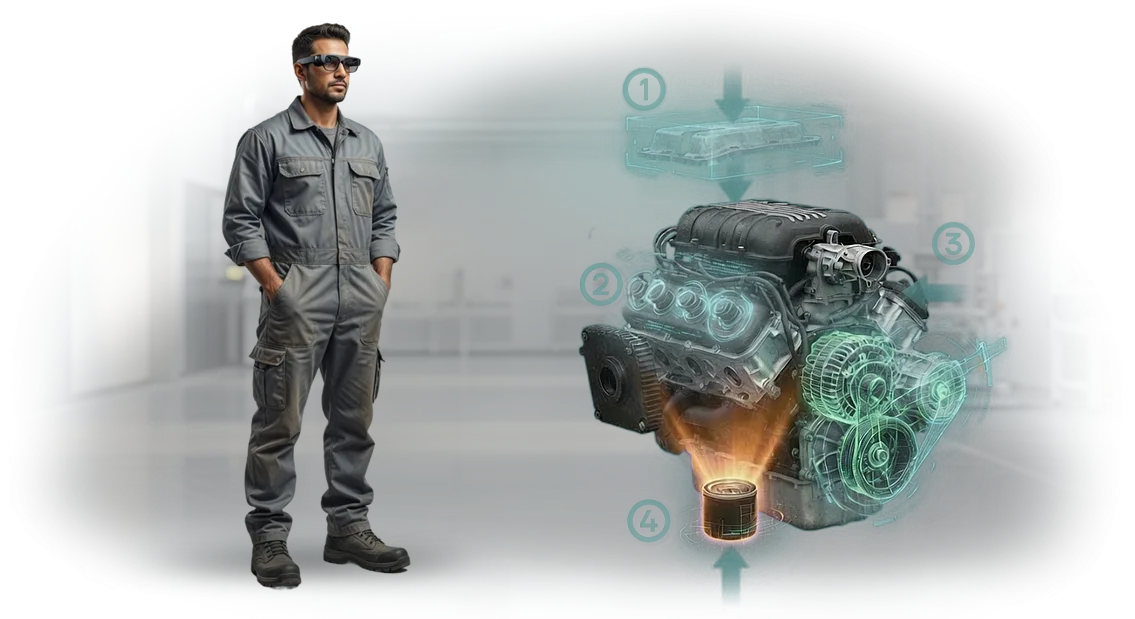
AR instructions for industry solve this problem systematically. The operator points the camera at a crusher or mixer component and sees step-by-step prompts: what to remove, what to unscrew with, how to check.
No need to flip through manuals or keep the sequence in your head — the required data appears right on the equipment at the right moment.
We have been developing such solutions for manufacturing for over 10 years and work remotely across the entire country. We help reduce downtime, lower the number of unscheduled repairs, and make maintenance predictable. If this pain point sounds familiar — let's discuss how to address it in your case.
What You Get from AR Instructions for Industrial Equipment
Faster Onboarding and Operator Training
A new operator or repair technician doesn't need to spend weeks studying paper procedures and memorizing equipment diagrams. The AR instruction right on the job site shows the sequence of actions: from starting the crusher to replacing a component.
The employee learns by performing a real task, not by memorizing abstract instructions — skills grow immediately in practice, without stopping production.
Fewer Errors During Repairs
Even an experienced mechanic can mix up the order of operations on a complex feed mixer. Prompts are projected directly onto the equipment: where the required component is, which tool to pick up, and what to check before startup.
As a result, the number of wrong actions and breakdowns caused by human error decreases — meaning less spending on repeat repairs and part replacement.
Shorter Downtime
When a crusher or mixer goes down, every hour of downtime is lost output and missed delivery deadlines. With AR instructions, the repair crew finds the fault and restores operation faster because they don't waste time searching for documentation and deciphering drawings. Average repair time drops, equipment gets back online sooner, and the production plan is met.
Higher Employee Safety
In production, the cost of a mistake is not just money — it's people's health. An AR instruction warns about danger zones in advance, requires confirmation at every step, and won't let the operator move to the next action until the previous one is completed.
This reduces the risk of injuries and relieves the manager of extra liability for incidents on the floor.
The benefits of AR instructions pay off by the first major repair: faster onboarding, fewer errors, shorter downtime, and higher safety at the plant.
AR Instruction Formats for the Repair Department and Operators
An instruction shouldn't exist just "for the sake of filling a checkbox" — it should help a repair technician find a component in 10 minutes, remove it, and not break the neighboring one.
That's why we make different AR instruction formats — matched to the task, the employee's skill level, and the type of equipment. A crusher is easier to show as a 3D diagram, while a mixer is better as a step-by-step scenario with control over each action.
Below are three working formats that cover 90% of tasks in production. Everything else we assemble individually for your equipment lineup.
| AR Instruction Format | For Whom | What It Gives the Customer |
|---|---|---|
| Step-by-step wizard with component highlighting | Repair department, mechanics | Fewer errors during disassembly/assembly, faster path to part replacement |
| Interactive 3D equipment model | New operators, technical training | Clear view of crusher/mixer construction without opening the housing, shorter onboarding time |
| Voice-controlled checklist | Line operators, daily inspection | Hands-free control of maintenance points — the employee sees the next step and confirms it by voice |
A repair technician doesn't need to page through 40 pages of paper regulations — he puts on a tablet or looks through a phone, and markers right on the equipment show where to unscrew, what to remove, and where to press.
For the line operator, this turns into a quick check: the voice interface walks through the checklist, records the result, and won't let a critical component be skipped.
For each crusher or mixer model, we adapt the scenario to your layout and typical failure modes. If needed, we add a video layer or connect a knowledge base so the instruction always references current regulations. You choose the format, and we fine-tune it into a stable working process within 2–3 weeks.
Stages of Implementing AR Instructions in Production
Implementing augmented reality starts not with technology but with the task: which crusher and mixer maintenance operations need to be simplified, where errors and wasted time occur.
We build a turnkey project and show results at every stage — from the brief to post-launch support. Here's what it looks like in practice.
- Brief and audit. We analyze how maintenance is organized, which equipment models are in place, and which scenarios need to be covered. We agree on timelines and success criteria.
- Plan and checkpoints. We define the scope of work, responsible parties, and approval schedule. You always understand what's happening at each step.
- Scenario mockup. We show how the operator will see steps, checkpoints, and prompts in augmented reality. You make edits before development — this saves time and money.
- AR instruction development. We create step-by-step 3D models, animations, and text prompts overlaid on the real equipment. We use professional tools to ensure a stable result.
- Testing on site. We run the instructions on your crushers and mixers and work with the operators. We adjust details: component highlighting, prompt timing, and wording.
- Launch and support. We hand over the system, train employees, and support the project: we update instructions when regulations change, add new components, and scale to other workshops.
What Is Included in the AR Instruction Package
The package includes a complete set of AR instructions — from source data to post-launch support. You get a working tool that immediately integrates into the service department's processes and helps reduce time spent on crusher and feed mixer maintenance.
- Source data and 3D equipment models. We convert your technical documentation into clear scenarios so mechanics see every component in 3D rather than searching for it in drawings.
- AR repair and maintenance scenarios. Step-by-step operations with highlighting of the required parts and on-screen prompts. The employee performs the work sequentially, without getting distracted by paper procedures.
- Training materials and staff instructions. We provide short reference cards, videos, and checklists — with them, new employees get up to speed faster and make fewer mistakes during their first independent maintenance.
- Documentation package. Includes user manuals, content update procedures, and integration diagrams for existing processes. Everything is structured so the maintenance department can work without depending on the developer.
- Integration with the CMMS (maintenance management system). Inspection results and completed repairs are automatically recorded in your accounting system — you monitor equipment operating hours and plan preventive maintenance without extra reports.
- Technical support and updates. During the agreed period, we adjust scenarios when regulations change or new equipment versions are released, so instructions never become outdated.
- On-site staff training. We run a demonstration for key employees and answer questions until the team confidently uses AR instructions in daily work.
This package covers the entire cycle: you get not just a separate module but a ready solution that the team will adopt and use — with clear documentation and support at the start.
Case Study: An Agricultural Holding Cut Repair Time by 40%
For a large agricultural holding with a fleet of crushers and feed mixers, every line stoppage meant lost product and missed delivery deadlines.
The problem was typical: repairs depended on two or three experienced mechanics, while new employees trained for months and still made mistakes in the sequence of operations.
We proposed moving the maintenance instructions into augmented reality so the specialist could see prompts right on the equipment.
The implementation result exceeded the customer's expectations. AR technology cut repair time by 40%, and the number of errors during scheduled maintenance dropped severalfold.
The key thing — the holding stopped depending on "golden hands": a new mechanic becomes independent in three days instead of two weeks.
| Metric | Before Implementation | After AR Instructions |
|---|---|---|
| Average crusher repair time | 4.5 hours | 2.7 hours |
| Maintenance errors | 3–4 per operation | 0–1 |
| Getting a new employee up to speed | 14 days | 3 days |
| Monthly line downtime | 12 hours | 5 hours |
After the pilot project on crushers, the customer expanded the AR instructions to all feed mixers and spare parts warehouses. Now the holding plans to roll the solution out to other enterprises of the group — for us, this is the best indicator of the value of the result.
How to Choose an AR Instruction Format for Crushers and Feed Mixers?
Choosing an AR instruction format for crushers and feed mixers starts not with technology but with two questions: who will use the instruction and what operation does it cover.
The same equipment requires different formats — scheduled inspection, troubleshooting, or training a newcomer are solved differently. That's why we first analyze your situation and then propose a specific scenario.
The main selection criterion is the complexity and frequency of operations. If a mechanic services a crusher once a month according to regulations, he needs a step-by-step check with visual control of the components.
If a mixer operator changes recipes and dosages daily — a short prompt on parameters and connection diagrams is enough. These are different content types, and imposing a single format means wasting employees' time.
The second criterion is working conditions. A crusher workshop usually has noise, vibration, and dust, so prompts must be readable at arm's length, without searching through paper instructions.
For feed mixers, precise setup of electronics and sensors matters — here AR shows where the required regulator is and what value to set, right in the operator's field of view.
Practice shows: AR for crushers and feed mixers cuts component search time by 30–40%, eliminates skipped steps during maintenance, and makes training safe.
The same format can be easily adapted to a tablet, smart glasses, or a fixed station at the equipment — we decide based on your infrastructure and budget.
We help you choose the format for the task: we conduct a short audit of the workshop and typical operations, identify which scenarios deliver a quick effect, and offer a test area.
You see the result on real equipment and only then decide on scaling across the entire line of crushers and mixers.
What If the Equipment Changes After Launch?
Equipment doesn't stand still: you change crusher screens, modernize a feed mixer, or add dosing components. An AR instruction created once eventually stops matching reality — that's why we build support and content updates into the project.
Each project has a dedicated support engineer. He tracks changes in your equipment and updates AR scenarios in a timely manner. This way you get not a one-time file but a working tool that lives together with the equipment.
How are instructions updated after equipment modernization?
Just send new drawings, photos, or simply describe the changes. We update the 3D model, component labels, and step sequence — it usually takes 1–2 days. Your employees see the current version on the tablet immediately.
What happens when a new crusher or mixer model is added?
The new model goes into the shared AR instruction catalog. Technicians don't need to retrain: access to all instructions opens on one screen. You expand your equipment fleet while the staff uses a familiar interface.
Who is responsible for keeping instructions up to date in the long run?
A support manager is assigned to the project. He knows your specifics, monitors changes in regulations, and proposes updates himself. An extended contract can include regular AR scenario reviews — for example, every six months.
What if an instruction needs to be changed urgently before scheduled maintenance?
A priority channel works: you send a request, and the engineer starts working on it immediately. Critical fixes are delivered within 24 hours. This way you eliminate downtime caused by outdated procedures and keep production running.
Order AR Instruction Development
Ready to speed up the maintenance of crushers and feed mixers? Order turnkey AR instruction development — from equipment audit to ready-made scenarios that your mechanics can use immediately after installation.
We take on the entire process: you get not a report but a working tool that reduces downtime within the first week.
What you get after placing an order:
- A personalized scenario for a specific crusher or mixer model — no rework around "average" equipment.
- Works on your employees' tablets and smartphones — no need to buy expensive glasses or change the familiar process.
- Clear step-by-step instructions overlaid on the real mechanism — fewer repair errors and lower risk of component damage.
- Mechanic training and handover of all materials — your team works independently and doesn't depend on the contractor.
- Post-launch support and a guarantee on the result — we stay close until the instruction starts delivering value.
- Cost calculated within one business day — you immediately understand the budget, timelines, and scope of work.
To get an estimate, send us your task: equipment model, service frequency, and typical failures. We will propose the optimal AR instruction format and give you the exact development cost.
The consultation is non-binding — even if you decline, you'll leave with a clear action plan for your staff.