

Why sports equipment maintenance requires AR instructions
Every hour a piece of gym equipment sits idle means unhappy clients, shifted workouts, and lost revenue. When a treadmill or power rack breaks down, the gym loses traffic, and visitors go to competitors.
Sports equipment breakdowns happen at peak attendance times, when there is no time for repairs, and public clubs are especially vulnerable: visitors do not dig into the reasons — they see a closed machine and draw conclusions.
Fitness center repairs are held back by a shortage of qualified engineers: specialists for specific models are worth their weight in gold, waiting for them to arrive takes days, and club staff have no clear step-by-step instructions.
Manufacturers send generic diagrams that mean nothing to a beginner, so a minor breakdown stretches into a week and becomes the manager's headache.
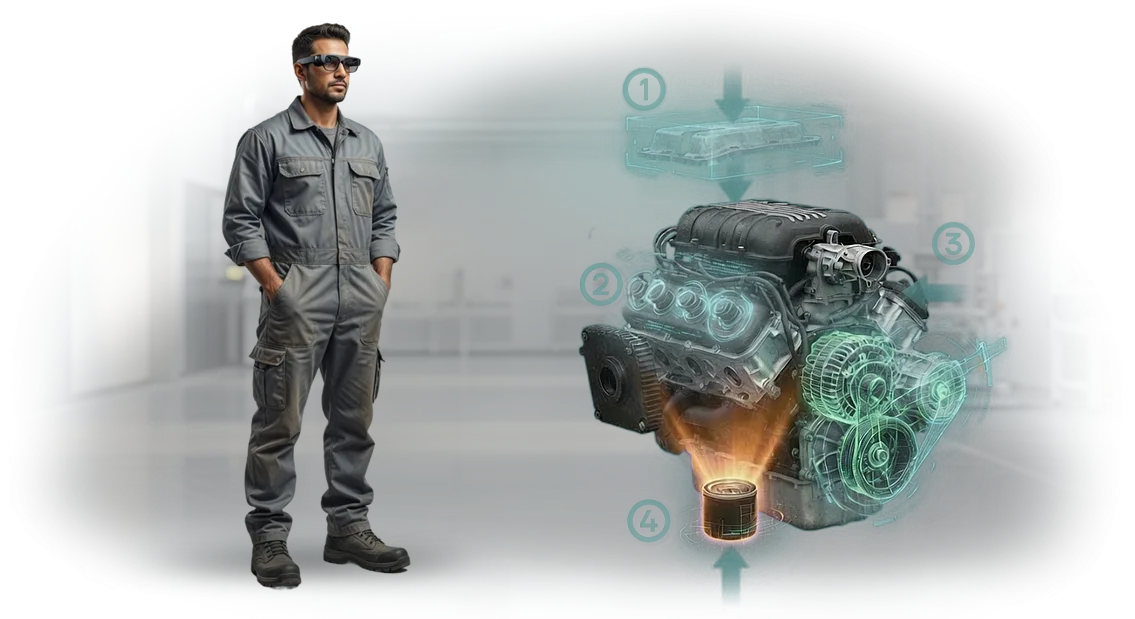
That is exactly why exercise equipment maintenance requires AR instructions. Augmented reality overlays prompts directly onto the equipment: the employee sees what to check, in what order to disassemble the unit, and which part to replace.
This reduces dependence on external services, cuts repair time down to minutes, and returns the machine to service the same day.
Staff trains right on the job, visitor safety stops depending on the qualifications of a particular technician, and the club gains a reputation as a place where everything works.
We develop AR instructions for your equipment fleet — from daily inspections to scheduled maintenance — and solve the main pain point: breakdowns no longer mean downtime.
What you get from implementing AR instructions
Sports equipment maintenance is an endless race: machines break down at the worst possible moment, specialists are scarce, and every hour of downtime hits revenue.
AR instructions solve the problem: a step-by-step scenario is overlaid onto the real equipment through a smartphone screen.
Benefit: faster repairs
The technician does not flip through paper manuals or wait for tech support responses — they immediately see what to do and in what order. Repairs take less time, and the machine is back in service the same shift. The main effect: equipment works instead of sitting idle.
Benefit: reduced costs
Fewer external service visits, fewer errors leading to repeat breakdowns. Each unit maintained with AR instructions requires less money and attention — the savings are visible immediately, not "someday later."
Benefit: improved safety
Sports equipment operates under load and with electricity — a mistake is dangerous for both the technician and visitors. AR instructions follow a proven scenario, show danger zones, and warn about risks.
Benefit: staff training
A newcomer performs tasks previously trusted only to senior specialists. Onboarding takes days instead of months, staff turnover stops being a problem, and work quality no longer depends on the employee's experience.
We prepare such instructions on the professional Unity platform — the client gets a stable result without diving into technical details. All that is left is choosing the unit to start with.
AR instruction formats for your tasks
Each sports equipment maintenance task has its own conditions: somewhere it is noisy, somewhere humid, somewhere the specialist needs to work in gloves or at height.
A universal instruction cannot handle all situations, and the wrong format forces the employee to get distracted, lose time, or skip important steps. That is why we do not offer a rigid solution but select the AR format for the use scenario and staff skill level.
For example, for quick operations on the gym floor, a mobile interface with step-by-step prompts is more convenient; for long work in a noisy workshop — voice guidance; and video prompts help with training when you need to see the entire process at once. Below — what the main formats look like and what benefit each one brings to the business.
| Format | Suitable for | What it gives the client |
|---|---|---|
| Mobile app | Service engineers and technicians maintaining equipment on-site | The employee sees virtual prompts right on the machine's frame — no need to flip through paper manuals. The number of errors decreases, repair time is reduced, and onboarding new specialists is faster. |
| Voice guidance | Technicians whose hands are occupied — during unit replacement, adjustment, disassembly | Commands are delivered by voice into an earpiece: the specialist does not look at a screen and works with the tool. Downtime decreases, and the procedure is followed even by inexperienced employees. |
| Video prompts | Trainers, administrators, and staff during initial setup or training | Short videos in the AR interface show the correct sequence of actions. Training goes faster, and experienced specialists can skip the routine. |
Formats are easily combined: for example, voice guidance for complex operations and video prompts for getting familiar with new equipment. We will help you choose the right set for your specifics and adapt instructions to specific models. As a result, you get a flexible system that saves time and money on maintenance.
How AR instruction implementation works
Implementing AR instructions is not installing an app — it is a structured process that must be clear to the client from day one.
At our team, over 10 years of working with industrial equipment, we have refined a sequence of steps that reduces risks, saves your team's time, and delivers a predictable result. Here is how the work proceeds.
-
Brief and getting to know the task. We discuss which operations need to be described, who will use the instructions, and which formats suit your employees. At this stage we define the goals: reducing errors, speeding up maintenance, or training newcomers.
-
Equipment and workflow audit. We visit the site or review the documentation to understand the real conditions: where the equipment stands, what actions specialists perform, where difficulties most often arise. This makes the instructions useful rather than abstract.
-
Developing the AR instructions. We create step-by-step scenarios and overlay digital prompts onto the real equipment. Professional tools ensure stable operation: the employee sees exactly the part they are working with and is not distracted by anything else.
-
Review and refinement. We show the intermediate result to your experts and technologists. They verify the correctness of the steps and make edits — so the instruction becomes accurate and clear specifically for your team.
-
Staff training. We conduct short training sessions: how to open an instruction, how to use the prompts, what to do if difficulties arise. Training takes minimal time, and the effect is immediately visible — employees work more confidently and faster.
-
Launch and support. We integrate the instructions into daily work, collect feedback, and update content when needed. We stay in touch to keep sports equipment maintenance running without downtime.
As a result, you get not just technology but a working tool that your employees accept and use every day. We handle all implementation stages — from brief to support.
What is included in the client delivery package
You receive not just files with instructions but a working system that integrates into the daily maintenance of sports equipment. We hand over everything needed for launch and independent use — from ready-made augmented reality scenes to training materials for your team.
The delivery package includes:
- Ready-made AR instructions for key operations: inspection, unit replacement, preventive maintenance. The employee points the camera at the equipment — and sees step-by-step actions right on the real object.
- Documentation set — procedures, checklists, reference sheets. Everything is formatted for easy printing or opening from a tablet.
- Staff training — a hands-on session for engineers and technicians: working with the app, reviewing common situations, training colleagues independently.
- Management platform access — you see how employees use the instructions, which operations are performed, and adjust processes when needed.
- Updates and support — when equipment or procedures change, we update the content, and you receive current versions without delays.
- Integration with your maintenance system — export of completed work data, linking to work orders and logs.
This is a ready-made turnkey package: after launch, your team saves time searching for information, makes fewer mistakes, and gets equipment back to work faster. And you gain transparency and control over the maintenance process.
Case study: 40% downtime reduction and budget savings
A fitness club chain with 40+ locations came to us with a typical pain point: exercise equipment maintenance instructions sat in PDFs, staff did not read them, and every breakdown turned into downtime and a visit from an external service.
We proposed replacing paper procedures with AR instructions — the employee points a smartphone camera at the equipment and sees a step-by-step algorithm right in their field of view.
Results the client saw after two months
Equipment downtime decreased by 40% — from 12 to 7 hours per week on average across the clubs. Time for scheduled checks dropped by a third, and calls to third-party specialists halved.
Over the quarter, the chain saved about 80 hours of staff working time and redirected the budget to purchasing new equipment instead of emergency repairs.
An added bonus — the speed of onboarding newcomers. Previously it took two weeks of mentoring; now an employee reaches the required pace in 2-3 days.
This reduced the load on senior trainers and accelerated adaptation, and most importantly — reduced the number of errors caused by the human factor.
Why the client stayed with us
After the first phase, the chain ordered an expansion of AR instructions to the pool and cardio zone — a sign that the service measurably pays off. We consider such metrics the main result: not the number of installed apps, but the client's time and budget savings.
Which AR instruction format suits sports equipment?
The AR instruction format is chosen not "in general" but for the specific tasks of your service and the skill level of your employees.
This is especially important for sports equipment: exercise machines, treadmills, and strength systems of different models require different depths of description, and staff often lack engineering experience.
So first we determine what exactly needs to be addressed — fast onboarding for newcomers, reducing errors during maintenance, or speeding up repairs in the field — and only then propose a format.
For daily maintenance and scheduled procedures, step-by-step holographic instructions overlaid directly onto the equipment are optimal.
The employee sees the sequence of actions on the real machine rather than on a screen with an abstract image — the need to match a drawing to actual parts disappears. This noticeably reduces the time spent finding components and the risk of mixing up the order of operations.
If your task is training new specialists, an educational format with interactive simulation is effective. It allows a person to "walk through" the maintenance cycle on a digital copy of the equipment before working with the real one.
Repeat sessions do not require an instructor to be present, and mistakes carry no production consequences — the employee internalizes the algorithm faster than with classic mentoring.
For complex unscheduled breakdowns, a remote support format with augmented reality is suitable: the technician points the camera at the unit, and an invited specialist sees its condition and suggests steps. This helps when equipment is spread across multiple clubs or sites.
The main requirement for any format is to work on regular tablets and smartphones and to be updated centrally when new models come out or procedures change.
There is no universal recipe, but the right choice covers 80-90% of typical situations. We start with an audit of your equipment fleet and staff skill level — based on that, we propose a format or a combination and test it on a pilot site.
This way you get an AR instruction that is actually used rather than remaining a demonstration prototype.
Answering common client questions
Before ordering AR instructions for sports equipment maintenance, clients ask the same questions. They are most concerned about cost, the complexity of integrating into current processes, and how quickly employees will master the new format.
Below we address the most common concerns — without technical details, only what affects your business.
How much do AR instructions cost and what does the price depend on?
The cost is calculated individually for your site: the number of equipment units, the complexity of operations, and the volume of content. We always fix the estimate before work begins so you understand the budget in advance.
The investment pays off through reduced downtime, fewer repair errors, and faster onboarding of employees to independent work.
Will we have to restructure existing maintenance processes?
No. AR instructions complement your current procedures rather than replace them. The specialist opens the needed diagram on a tablet or smartphone — right where they already work.
Integration with your checklists and documents takes minimal time, and only basic settings are required to launch. You get a clear tool that fits into the familiar workday.
Employees are used to paper instructions. Won't they reject AR?
We make the interface as simple as possible — it is no more complicated than a phone navigation app. Our clients note that even experienced mechanics quickly switch to AR: instead of reading text, a person sees prompts directly on the equipment.
Team training takes a couple of hours, and if needed we conduct additional training for your instructors.
What about technical support after launch?
We do not abandon the project after delivery. A dedicated manager stays in touch to help with launch issues, content updates, and onboarding new employees. When equipment models or procedures change, we promptly adjust the instructions. Your team works without pauses, and we make sure the AR instructions stay current.
If you still have questions — just write to us. We will explain what AR instructions will look like at your specific site and prepare a preliminary estimate for your budget.Order AR instructions today — get results
Submit a request for developing AR instructions for sports equipment maintenance. We will contact you within one business day, clarify the task, and prepare a cost and timeline estimate — without advance payments or hidden conditions.
You will receive not just a set of files but a ready-made tool that works for your business from day one: reduces training time, decreases the number of errors, and makes service maintenance understandable even for a beginner. Below — what you get immediately after the project starts.
- Adaptation to your equipment models: instructions account for the specifics of particular units and typical work scenarios.
- Fast staff training: new employees reach working pace in 2-3 days instead of several weeks.
- Fewer errors during repairs and maintenance — thanks to step-by-step AR prompts directly on the equipment.
- Time savings for service engineers and reduced equipment downtime.
- Round-the-clock access to instructions via tablet or smartphone — no need to hunt for paper manuals.
- Post-launch support: content updates, refinement, and usage consultations.
Even if you are just considering AR — start with a consultation. We will tell you which maintenance processes can be moved to AR with maximum benefit and propose a solution for your tasks. Fill out the form or message us — we will prepare the estimate within a day.