

Why sterilizer maintenance requires AR instructions
Maintenance of sterilizers is not a routine formality but a condition for the uninterrupted operation of a clinic, laboratory, or production facility. When equipment fails, processes halt, operations are disrupted, and the workload on staff grows.
Every hour of downtime translates into losses, and this is exactly where traditional instructions become a bottleneck.
Paper manuals and PDF files take time to search for the right section, and the complex design of sterilizers is not always clear even to an experienced technician. A new employee has to reread dozens of pages, make mistakes, and redo work.
The result is prolonged repairs, repeat callouts for the service team, and the risk of damaging expensive equipment.
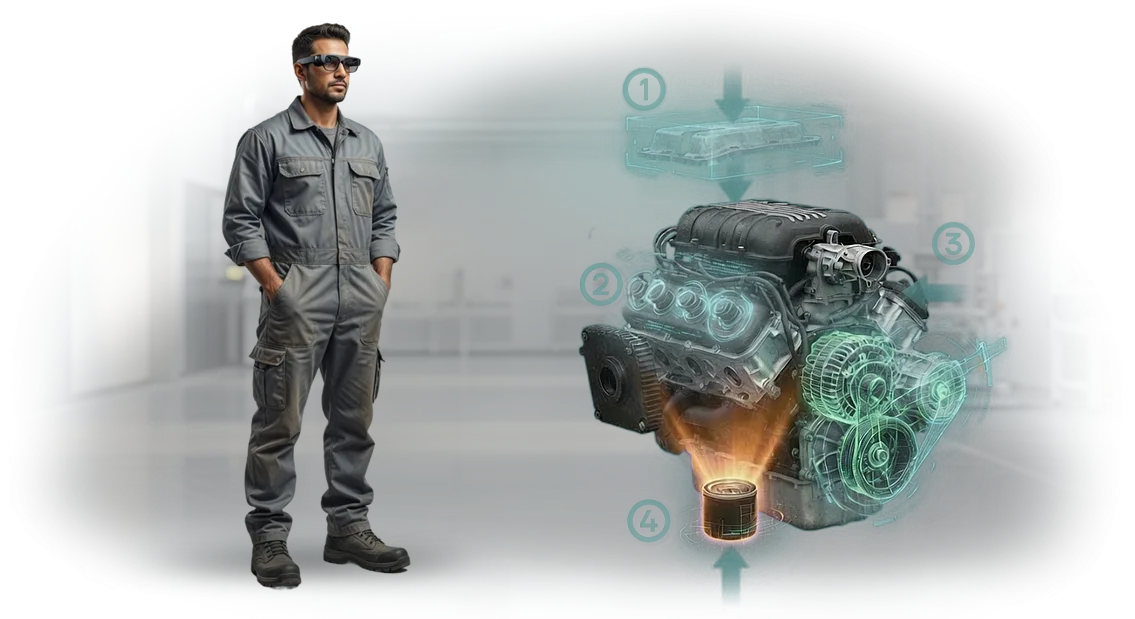
AR instructions eliminate this problem. Instead of matching a drawing to the real device, the specialist sees step-by-step prompts directly on the sterilizer housing: arrows, highlighted components, action animations, and checkpoints.
This makes sterilizer maintenance faster and more precise — the technician completes the repair on the first attempt without being distracted by information search.
From a business perspective, this means reduced downtime, stable equipment operation, and lower costs for correcting errors. AR instructions also simplify training for new employees — they reach independent work faster.
We develop such solutions for your production tasks: we document procedures, turn them into visual scenarios, and support you at every stage of implementation.
What benefits do AR instructions for sterilizers provide
Sterilizers are equipment on which patient safety and the continuity of clinic operations depend. Any downtime means disrupted operations, postponed procedures, and additional strain on staff.
AR instructions turn complex maintenance into a clear step-by-step process: the technician sees prompts directly on the device housing instead of searching for the right section in a paper manual.
We develop such instructions for specific sterilizer models, so implementation takes weeks, not months. Here is what the customer gets.
Benefit: faster repair and maintenance
Instead of consulting diagrams and locating components "by eye," the employee receives a precise visual prompt: which unit to disassemble, which sensor to check, and in what order to remove parts.
Typical diagnostic time is reduced several times over, meaning the equipment returns to service faster.
Benefit: fewer staff errors
The main cause of breakdowns during maintenance is an incorrect sequence of actions or a missed step. AR instructions eliminate guesswork: the system highlights the required element and records the completion of each step. This reduces the risk of damage to expensive components and repeat service callouts.
Benefit: faster training of new employees
Instead of multi-day courses and thick manuals — hands-on work with AR prompts. A new employee immediately performs real tasks under system supervision, and an experienced mentor spends less time on explanations. The clinic gets a qualified specialist within days.
Benefit: stable equipment operation
Regular preventive maintenance using AR instructions extends the service life of sterilizers and reduces the likelihood of sudden failures. Scheduled work takes less time, and maintenance results are recorded automatically — simplifying control and planning.
AR instruction formats for sterilizers: from a label to 3D
For sterilizer maintenance, AR instructions work in four basic formats — from a quick prompt to a visual 3D assembly.
Client tasks are always different: some need to reduce the number of errors during scheduled maintenance, others need to train employees without risking the equipment. Therefore, we choose the format for the scenario rather than imposing one tool on everyone.
Some projects start with a QR code on the housing, others with a 3D model for a training classroom. The table shows how different formats solve different tasks.
Which format works when
| Format | For whom | What it gives the client |
|---|---|---|
| QR + AR marker | Operator at the sterilizer | Instant access to the required step without paper instructions, fewer errors in standard operations |
| Step-by-step AR prompt | Service team during scheduled maintenance | Faster maintenance, sequence control, lower probability of missing a component |
| 3D model with disassembly | Repair service and training center | Visual study of the internal design, safe practice without the risk of breaking equipment |
| Chatbot with AR links | Employee dealing with a rare fault | An answer to a specific question and immediately the needed AR instruction, without searching through procedures |
We do not just hand over a markup file. First, we analyze at which stage employees most often make mistakes, then we choose the format and embed it into existing processes — so the AR instruction becomes part of the work rather than an extra app on a phone.
How we create AR instructions for sterilizers: 7 steps
You get a transparent process: from the first brief to launch and support. No "black boxes" — you always know where the project stands and what you will get as a result.
-
Brief and equipment audit. We study your sterilizer model, procedures, and typical operations. We document the tasks the instruction should solve: training new employees, reducing errors, and controlling procedure compliance.
-
Scenario approval. We specify the action sequences for each component in detail. You and your technologists review the scenario — this eliminates discrepancies and unnecessary edits at later stages.
-
AR content preparation. We create 3D models, animations, and markup for your equipment. We work on professional equipment, so the client gets a stable result that displays correctly on tablets and glasses.
-
App assembly and configuration. We install the solution on the required devices and configure it for your infrastructure. No "experiments on a live production floor" — everything is verified in advance.
-
Testing on the sterilizer. We run the instruction in real conditions: recognition, graphic overlay, and prompt speed. We fix shortcomings before the system reaches your employees.
-
Launch and staff training. We deploy the system on site and conduct a short training session. Your employees quickly master the interface and start using the instruction immediately.
-
Support and updates. If procedures change, new operations are added, or equipment is modernized, we make changes and update the content. You always work with the current version.
This sequence reduces implementation time and ensures that the AR instruction is actually used in production rather than remaining a demonstration prototype.
What's included in the delivery: a complete package for your equipment
When you order the development of AR instructions for sterilizer maintenance, you get not just "files by email" but a complete package ready for use in your service department.
We assemble the solution around your maintenance model — from content to staff training — so you see the effect immediately: faster diagnostics, less downtime, and uniform standards across the entire team.
- Ready-made AR instructions for sterilizers — step-by-step scenarios with visual prompts that are overlaid on real equipment through a tablet or smartphone. The mechanic sees which part to unscrew and in what order.
- Adaptation of your procedures — we convert existing paper instructions into AR format. No need to change familiar processes — just make them more visual.
- Content management panel — you update the instructions yourself when procedures change or a new model is added. The edit is instantly applied for all employees.
- Training and knowledge transfer — we conduct a training session for service engineers and operators: we show how to use AR instructions. Employees start working from day one.
- Technical support during and after implementation — a dedicated specialist helps deploy the system and supports you through the initial period. You are not left alone with the new technology.
- Complete documentation and rights package — user guide, process descriptions, and content license. Everything is legally transparent.
- Integration with your equipment — we configure the solution for specific sterilizer models and also enable replicating it to other machinery.
Case study: how AR instructions cut repair time by 40%
Sterilization equipment manufacturer SterilTech faced a typical problem: after the warranty period, service teams spent up to three hours on a single operation. The cause was bulky paper instructions, complex labeling, and dependence on the engineers' personal experience.
Every hour of sterilizer downtime means schedule disruptions in hospitals and rising costs for the plant itself.
We proposed replacing paper manuals with AR instructions. The technician sees color prompts directly on the equipment housing through a tablet or glasses and performs steps one after another without being distracted by reference books. After the pilot run alone, typical repair time dropped by 40%.
Customer results
Here are the key figures for the first six months:
- Repair of a typical component takes about an hour and a half instead of three.
- Line downtime decreased: the plant produced an additional 12 batches of sterilizers.
- The number of repeat callouts to clients nearly halved — there were fewer errors.
For the business, this is a direct saving of time and money. The same engineers now manage to service one and a half times more equipment, and the plant's clients receive predictable service without long pauses.
Why it worked
AR instructions turn a complex process into clear prompts, so a new employee works almost as confidently as an experienced mentor. Management, meanwhile, sees transparent statistics for each repair: what took the most time and where delays occur.
We adapted the system to specific sterilizer models and integrated it into the regular service cycle. After implementation, the client ordered AR instructions for all their equipment lines — it became the standard of work.
Frequently asked questions about implementing AR instructions
Service department managers often doubt that AR instructions can really be integrated into work without stopping production.
In practice, implementation does not require replacing equipment or reworking procedures: we adapt the instructions to existing sterilizer models, and employees master them in one or two days.
Below are answers to the questions most often asked when making a decision.
Isn't it too difficult to implement AR into service maintenance?
No. We take on the entire technical part: digitizing components, anchoring to real equipment, and interface configuration. Your technician just needs to open the app on a tablet and follow the highlighted prompts — familiar operations become more visual.
How long will it take to prepare instructions for our sterilizers?
On average, two to four weeks for a typical model. First, we document the maintenance procedure, then we mark up the components and review the scenario with your specialists. We split large batches into stages to launch the first units as early as possible.
Will this work with the equipment we already have?
Yes, we work with most common sterilizer models. We use anchoring to reference points on the housing or special markers — as a rule, without interfering with the design and without stopping operations.
What will it cost and when will it pay off?
The final cost depends on the number of components, the level of detail, and the number of languages.
We factor in the savings: AR reduces the time spent searching for information, lowers the risk of errors during maintenance, and speeds up the training of new technicians — it usually pays off within a few months.
Ready to order AR instruction development? Let's discuss your task
Leave a request for a consultation — and we will prepare a cost estimate for the development of AR instructions for your sterilizers.
Tell us what equipment needs maintenance, how many people are on a shift, and which operations most often raise questions: based on this data, we will propose a format that will pay off in a short time.
Our team creates AR instructions that employees use right at the workplace: through a tablet or smartphone, they see a step-by-step sequence of actions with highlighted equipment components. This reduces the number of errors and shortens the training time for new specialists.
After placing an order, you receive:
- a preliminary scenario and storyboard of the future instruction — you see the logic of the steps before development begins;
- an accurate estimate with fixed deadlines — the cost does not change during the process;
- a demonstration of the first AR scenes on your equipment — you evaluate the result before final delivery;
- all source materials and the finished application in your ownership — no vendor lock-in;
- verification of the instructions on real operations — taking into account your production procedures;
- training for your employees in working with the AR tool and technical support after implementation.
We work remotely, so geography does not matter. We coordinate all projects via video calls, and for filming and configuration we travel to the site if necessary.
To calculate the cost and timelines, fill out the form — we will contact you within one business day, ask clarifying questions, and prepare a commercial proposal.
If you have a technical specification or work procedures, attach them to your request — this will speed up the preparation of the plan.
Order AR instructions for sterilizer maintenance today — and reduce downtime as early as next month.
How to choose the AR instruction format for your equipment?
The choice of AR instruction format is determined not by fashion but by the operational task it solves. If you need to speed up sterilizer maintenance, one option works; if you need to reduce errors during repairs, another one does.
A universal solution does not exist: a step-by-step diagram, overlay on real components, control of completed operations, and reference videos give different results in terms of speed and reliability.
The main thing is that the format follows the employee's work logic and does not force them to be distracted from the equipment.
For regular maintenance of sterilizers, step-by-step instructions with highlighting of the required component and confirmation of each action are most often chosen. This reduces the number of errors and speeds up execution even for new specialists.
For complex repairs and diagnostics, AR instructions with video fragments, "normal/deviation" comparisons, and quick access to reference information are used. As a result, the engineer finds the cause of the fault faster and does not go through parts blindly.
The format also depends on the conditions at the site. In a noisy workshop, voice control is inconvenient; when working with gloves, gestures or automatic recognition of parts are more practical.
In bright lighting and confined spaces, stable operation and a clean interface without unnecessary elements are important. We choose the type of interaction and design for your real conditions so that the instruction is not "beautiful" but workable in daily use.
To decide, ask yourself three questions. Where will the instruction be used — stationary at the sterilizer, in the workshop, or during visits to clients? Who are the users — experienced engineers or newly hired employees?
Is it necessary to collect completion statistics and record errors for quality control? The answers to these questions directly point to the appropriate type of AR instruction.
We help you choose the format and design the scenario for your operation without adding unnecessary functions that increase development costs and complicate training.
Over 10+ years, we have implemented projects for industrial equipment, including sterilizers, and we know which solutions give a measurable result: less maintenance time, quick ramp-up of new employees to the required level, and reduced downtime. Tell us about your task — together we will choose the optimal AR instruction format.