

AR instructions for transformers: why repairs drag on
When a transformer goes down, the count is not in days but in hours: every stoppage means unproduced output, shifted deadlines for related departments, and reputational losses in front of the client.
At the same time, repairs rarely drag on because of the complexity of the fault itself. More often the crew wastes time on something else: searching for the right regulation, cross-checking revisions of diagrams, clarifying the sequence of operations with colleagues. While the information is being pieced together, the equipment stands idle.
The second hidden cost item is personnel errors during transformer maintenance.
An experienced engineer keeps the order of actions in his head, but when equipment generations change, when contractors are working, or on the night shift, this "internal manual" stops working.
One missed step — and instead of scheduled maintenance we get a repeat failure, unplanned downtime, and a root-cause review at the management level.
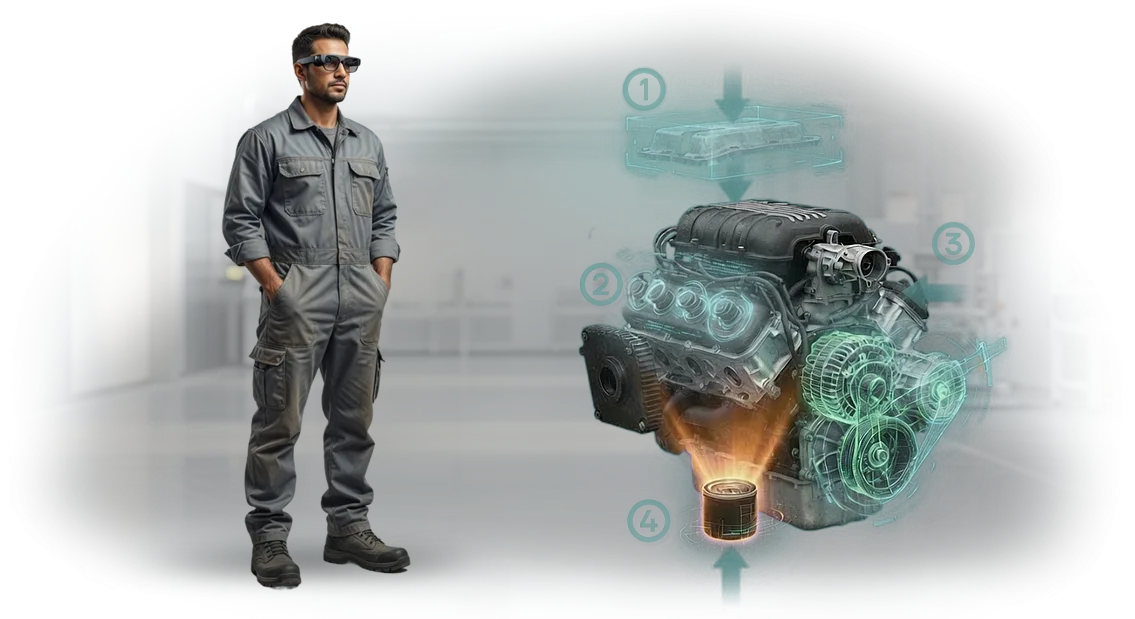
We close this pain point with AR instructions for transformers: a specialist points the camera at a unit and sees right on top of the equipment what to do and in what sequence. No need to flip through folders and call a mentor — the hint appears at the moment it is needed.
This shortens the time spent searching for information, reduces the number of personnel errors, and brings equipment downtime back to reasonable limits.
For a department head, this means predictability: transformer maintenance stops depending on who exactly is on shift today. A new employee gets to the site faster, the contractor works by your rules rather than by their own habits.
We take on the preparation of such instructions for your equipment fleet — from the first scene to a ready scenario that the crew uses.
What a business gains from implementing AR instructions
Reduction of repair time
The engineer does not flip through paper volumes or search for the required diagram in archives — they point a tablet at the transformer and see the sequence of actions right on the unit.
As a result, routine repairs go faster, and equipment downtime is reduced: the crew returns to the same stage less often and spends less time on clarifications over the phone.
Reduction of accident rates
Most incidents at substations are related to the human factor — a missed step, an incorrect sequence, working "from memory." An AR instruction guides the specialist through the procedure and prevents skipping a critical stage, while highlighting disputed points right on the equipment. As a result, the share of errors that lead to equipment damage and unplanned outages is reduced.
Personnel training
A new employee no longer needs to be taken around for months as a "second person" behind an experienced mentor. They go through scenarios on real equipment with prompts and reach independent work faster.
Mentors are freed from routine accompaniment, and knowledge remains in the company instead of leaving with a specialist who has quit.
Process controllability
The department head sees who performed which work and according to which procedure — instead of verbal reports, a transparent picture appears. It is easier to plan workload, train contractors, and replicate best practices at other sites.
We design AR instructions so that they integrate into current maintenance processes rather than disrupt them.
AR instruction formats for your fleet's tasks
The format is chosen not by how good the visuals look, but by the task you are solving: getting a newcomer up to speed faster, reducing downtime, or eliminating costly specialist callouts.
Below are four working scenarios most often requested by customers responsible for a transformer fleet.
| Format | For whom | What it gives the client |
|---|---|---|
| Step-by-step guidance | Field crews, inspectors | An employee performs work step by step right at the equipment: fewer errors, shorter downtime, a newcomer reaches independence within a few shifts |
| Remote assistance | Duty shifts, on-site contractors | An expert sees the same thing as the person at the transformer and guides them remotely — no callout needed, decisions are made within minutes |
| Simulators | New employees, training center | Practicing standard and emergency scenarios without risk to equipment and without stopping work |
| Mixed scenario | Large distributed fleet | Guidance, expert communication, and training in a single loop — a unified work standard across all sites |
How to choose for your fleet
If the priority is the speed and quality of routine operations, start with step-by-step guidance: it delivers results from the very first shift. When the main losses come from downtime waiting for a narrow specialist, address remote assistance first. Simulators pay off where turnover is high and it is important to train people quickly and safely.
The formats do not conflict: guidance and expert communication use the same knowledge base about the equipment, so they can be implemented in stages. We help select a set for your fleet and roles — we will discuss the task and come back with a plan.
How the project unfolds: from brief to support
We structure the project so that you see results at every step, not just at the end.
First, we get to understand the task: which transformer maintenance operations need to be covered, who uses them, what is going wrong now, and by which metrics you will know that things have improved. Based on the results, we formulate a plan and agree on it with you before work begins.
How the stages are structured
- Brief and task definition. We meet with your engineers and department heads, gather the list of operations, on-site conditions, and safety requirements. The output is a clear description of what the ar instruction for transformers should do.
- Plan and prototype. We show what the scenario and prompts for the employee will look like, and agree on scope and timelines. You approve the logic before the main work begins.
- Filming and preparation of materials. We work at your site or on a training mock-up, and use your diagrams and regulations where necessary. We coordinate access and schedules so as not to interfere with ongoing operations.
- Assembling the instruction. Our engineers build the scenario step by step: what the employee sees, what actions they perform, and where they get a prompt when deviating from the norm.
- Testing on real tasks. We run through the instruction together with your specialists, and refine the wording and sequence. We catch errors before launch, not during work under voltage.
- Launch and training. We hand over the finished tool, show how to use it, and help conduct the first shift training.
- Support. After implementation, ar stays in touch: we update scenarios when equipment or regulations change, and answer the crews' questions.
What you get along the way
At every stage you have an agreed document or demonstration — you understand what you are paying for and what you will get. We fix timelines in the plan, and discuss changes separately, with no surprises at the end.
This approach allows the instruction to be put into operation without stopping maintenance and without rework at the final stage.
What is included in the delivery
The customer receives not a "set of files" but a working tool that the crew uses from day one. That is why the delivery includes everything needed for launch and subsequent independent work: scenarios, training, documentation, and integration with your internal systems.
- Ready-made AR instructions for your operations — scenarios for transformer maintenance, coordinated with your regulations and process engineers: inspection, diagnostics, replacement of components, emergency actions.
- Models and anchoring to real equipment — the instruction "lands" on a specific transformer, so the prompts show the required component rather than an abstract diagram.
- Employee training — hands-on sessions for crews and mentors: how to launch an instruction, how to make edits, how to train newcomers without our help.
- Documentation for the internal team — clear guides on updating scenarios, adding new operations, and working with the instruction library.
- Integration with your systems — connection to equipment directories, regulations, and ticketing systems so that the instruction opens where the employee works.
- Validation on real operations — running through the scenarios together with your specialists and refining them based on feedback before handover.
- Warranty support — post-launch support: edits, consultations on further development, assistance when the equipment fleet changes.
Such a package closes the main risk — that the technology remains a pretty demonstration.
Your people get a ready-to-use work scenario, training, and documentation as a foundation, while management gets a predictable result: fewer errors during maintenance, faster onboarding of new employees, and a single standard for performing operations across all sites.
Case study: how AR instructions accelerated maintenance at a substation
One of our projects is the service division of an energy company that maintains distribution substations.
Before the implementation of ar instructions for transformers existed as paper regulations and PDF files: an engineer would search for the needed section manually, verify the sequence of operations from memory, and when deviating from the scenario would call a more experienced colleague for help.
At high-voltage facilities, every extra minute of downtime is a risk both for the equipment and for people.
What changed after implementation
We assembled step-by-step AR instructions for specific operations: inspection, diagnostics, replacement of components, and preparation for repair.
The engineer puts on glasses or picks up a tablet — and sees hints overlaid on the real transformer: which component to check, in what order, what to pay attention to. There is no need to flip through the regulation and keep a sequence of a dozen steps in mind.
Results in numbers
- Downtime for a typical operation was cut almost in half — thanks to the fact that the specialist does not waste time searching for information and double-checking.
- The number of maintenance errors dropped severalfold: the system guides step by step and does not allow a stage to be skipped.
- New employees reach independent work noticeably faster — the instruction provides hints directly on site, not in a training classroom.
- The share of repeat customer requests for new scenarios grew — after the first batch of instructions, the company ordered an expansion to other types of equipment.
Rosseti is an example of how an industrial AR instruction turns from an experiment into a working tool for a shift. The customer received not a demonstration of technology, but a measurable reduction in downtime and a decrease in accident rates.
We discuss the task, study your regulations, and come back with an estimate and a plan — for your facilities and your operations.
How to choose the right format for the task?
The format of an AR instruction is chosen not by how good the visuals look, but by the task it addresses. If you need to quickly train a new employee to service a transformer, a step-by-step instruction with hints overlaid on real equipment will work.
If it is important to reduce downtime at an operating substation, a hint mode is created for experienced specialists: short markers and checkpoints instead of lengthy explanations.
The first criterion is the complexity and type of equipment. For identical transformers, a single universal instruction that is followed sequentially is enough.
For different models and modifications, it is better to build a set of scenarios with selection of the required one at the start — this way the employee does not get confused by unnecessary steps.
The second criterion is operating conditions. In a workshop, outdoors, or in a room with poor lighting, the instruction must work without the internet and reliably recognize equipment under different lighting.
If work is performed with gloves or at height, controls are made voice-activated with large markers so as not to occupy the hands.
The third criterion is who uses it. A beginner needs a detailed scenario with checks at each stage, while an experienced worker needs quick access to the required unit.
A good practice is one scenario with two levels of detail: a basic one for training and a shortened one for daily work.
The fourth criterion is how the instruction integrates into processes. It can be linked to a maintenance regulation, to a ticketing system, or to an inspection log so that the result of the work is recorded automatically. Then management sees who passed the stages and when, instead of collecting reports manually.
We help you make this choice without unnecessary costs: we analyze your equipment and conditions, propose 1-2 suitable formats, and show how they will pay off in training and downtime. Describe the task — we will come back with an estimate and a plan.
Common doubts before ordering
Before starting, customers usually voice the same concerns: "what if the equipment breaks down," "half of our fleet is old models," "what if the instruction doesn't fit real-world conditions." These are normal questions, and we have well-established answers to each.
What happens if the equipment breaks down or gets replaced?
The instruction is not tied to a specific physical unit — it describes the model and its components. If a machine fails, the employee continues working from the same instruction on similar equipment.
When replacing it with a different model, we update the instruction: we add the new component or adjust the sequence of actions.
Our equipment is old — is it even realistic to make an AR instruction for it?
Yes, and often it's the old fleet that benefits the most: there are no recent factory manuals for it, and the expertise rests with two or three experienced employees.
We film the actual machine on site and build the instruction based on reality, not the manufacturer's documentation.
What if an employee does something wrong according to the instruction?
The instruction guides you step by step and highlights the relevant component, so it's hard to skip a stage or mix up the sequence. This reduces the risk of error during maintenance and breakdowns due to human error — and those are exactly the cases that cost the most.
What if we have non-standard conditions on site?
We come to the facility, look at the real conditions — lighting, tight spaces, access to components — and adapt the instruction to them. What works in a workshop doesn't always work in the field, and we take that into account during filming.
Who will maintain the instruction after launch?
We hand over the instruction with a clear structure so your specialists can make edits themselves. If the scope of changes is large or the equipment changes — we step in and update the material.
These doubts are not a reason to postpone. Describe your fleet and tasks, and we'll come back with an estimate and a plan for covering training and maintenance without risks.
Let's discuss your task and come back with a plan
Describe your task — and we will come back with an estimate and a work plan.
Not with generalities, but with specifics: which operations on your transformers make sense to convert into AR instructions, what is needed from your side for this, and in what timeframe the first version can realistically be launched.
Submitting a request takes a few minutes: it is enough to tell us what equipment you service and where time is currently being lost.
What you will get after reaching out
- A review of your scenario: which operations benefit from AR prompts, and which are easier to leave in a paper procedure.
- A phased work plan — from brief to on-site launch, with clear timelines and areas of responsibility.
- A scope estimate: how many instructions we cover in the first phase and what we add later.
- The team composition for your task and the approval sequence, so you understand who is responsible for what.
- Format options: a pilot on a single operation or a full set for standard equipment right away.
- Support terms after launch — updating instructions when procedures and models change.
Why it's worth starting now
Every day of working "from memory" is a risk of error, downtime, and a repeat crew visit. The sooner you convert key operations into a visual format, the faster new employees will start working independently, and experienced ones will spend less time giving prompts.
We usually demonstrate the pilot instruction on your real equipment so that you can evaluate the result before scaling.
Write to us about which transformers and operations are the priority — we will discuss the task, come back with an estimate and a plan, and schedule the start of the project.
If convenient, attach a photo of the site or your current procedure: this will speed up the preparation of the proposal.