

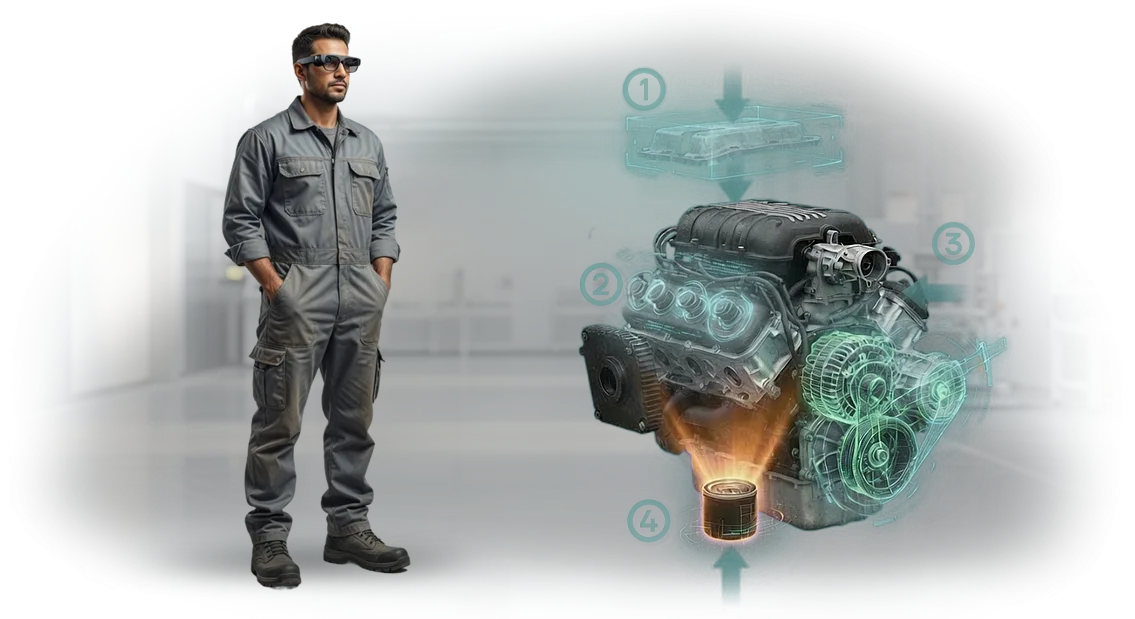
Turbine Maintenance with Paper Instructions: Risk and Losses
When it comes to turbine repair, every minute of downtime translates into real losses: underproduction, schedule shifts, emergency overtime. But personnel often have to work with paper instructions — dozens of pages, small diagrams, notes made back during installation.
Finding the relevant section in such an instruction is already a challenge, and if the equipment has been modified, the paper stops matching reality altogether.
Imagine an emergency shutdown: the crew is standing at the turbine but cannot quickly cross-check the sequence of actions against the drawing because the instruction shows an old modification of the assembly.
Double-checking against the risk of a wrong step eats up another hour or so. For the energy and industrial sectors, this is not just lost time — it is direct financial damage and the risk of dragging the repair into additional shifts.
our team has been solving this pain point for over 10 years: we move turbine maintenance from paper to step-by-step AR instructions that overlay directly onto the equipment.
The technician sees the required assembly, the sequence of actions, and checkpoints — right on the screen of a tablet or smart glasses. Data accuracy no longer depends on which copy of the instruction is lying on the table, and information search time is reduced to seconds.
What an AR Instruction Delivers: Speed, Accuracy, and Control
An AR instruction transforms a complex turbine repair into a clear step-by-step process: the mechanic sees directly on the equipment which assembly to remove, in what order to act, and where to apply force. Instead of reading bulky manuals — transparent hints and visual diagrams.
The main advantages of AR instructions are noticeably faster repair times and higher operational accuracy, regardless of the employee's skill level.
For Mechanics: Repairs without Searching for Information
Employees no longer spend time studying drawings and searching for the right section in documentation — all information appears right in their field of view. For example, assembly disassembly that used to take several hours is now completed noticeably faster with AR hints.
Operational accuracy improves thanks to highlighting of the required parts and step-by-step control.
In addition, an AR instruction solves the personnel training problem: a newcomer performs the work with guidance, just like with an experienced mentor nearby.
There is no need to wait for a senior mechanic to become available — the system guides the employee step by step and reduces the risk of errors.
For Managers: Control without Extra Meetings
You can see which operations have already been completed and which are still ahead, and you can forecast repair timelines more accurately. Fewer downtime events due to errors and rework — every operation is confirmed as correctly executed. Personnel training no longer depends on the personal time of the busiest specialists.
The business benefit is consistent work quality even when the crew composition changes. Employees get up to speed faster, make fewer defects, and you gain process controllability.
The development of such instructions for industrial equipment is handled by our team— we use professional equipment and well-honed tools, so the result is consistent at every site.
AR Instruction Formats for Different Work Areas
Different work areas mean different conditions: at a stationary turbine there is access to the power grid and a table, while a field crew works in tight spaces and at height. That is why we create AR instructions in three formats and match the device to each task.
| Format | Types of Work | Effect |
|---|---|---|
| Phone | Short operations: inspection, measurements, component acceptance | The employee sees hints on the screen without flipping through paper procedures |
| Repair Tablet | Complex repairs, component replacement, scheduled maintenance | Large diagrams, service history, step-by-step control |
| AR Glasses | Work that requires free hands: welding, assembly, work at height | Instructions right in the field of view, hands stay on the job |
For Stationary Turbines
When a turbine is installed in the machine hall, a tablet or phone is most convenient.
The tablet sits on a stand, and the screen shows step-by-step stages and 3D highlighting of the required assembly — the technician sees where to apply the tool and immediately marks the task as complete.
For Field Crews
In field conditions, where there is no table and the environment is noisy and space is limited, AR glasses work best. Hands are free, and a navigation arrow and checklist appear on the lens without voice guidance, which gets drowned out on the shop floor. This speeds up repairs by up to two times and reduces the risk of errors during part replacement.
How Development of AR Instructions for Turbine Maintenance Works
We have structured the implementation process so that your specialists are not distracted from repairs and maintenance.
We take on all stages of developing AR instructions for turbine maintenance — from the initial brief to employee training — and deliver a finished product that works on tablets and smartphones.
- Brief and site audit. We review the procedures, study the specific operations, and identify typical errors that need to be addressed.
- Shooting and data collection. We capture the actual equipment at your site so the instruction matches your specific turbine exactly.
- Creating a 3D model of the turbine. Based on the footage and drawings, we build a digital copy of the equipment with all key assemblies.
- Content review. We show the scenario and model, and you make edits to terminology and the sequence of actions.
- Deployment and access setup. We publish the instruction in a closed application and connect your employees.
- Employee training. We conduct a short training session and provide reference cards — the team starts working with the AR instruction right away.
How the 3D Turbine Model Is Built
We create the model based on measurements, photography, and drawings. In the virtual environment, we reproduce the casing, blades, fasteners, and hard-to-reach assemblies — so the employee sees an exact copy of their turbine and understands where to look and what to remove.
The scenario is broken down into steps: at each stage, the tablet shows the next operation and highlights the required parts. This eliminates questions like "what did they mean here" and reduces the risk of errors during maintenance.
On average, a project takes two to eight weeks — depending on the number of operations. We return to you at any stage to make edits, and after launch we stay in touch.
What Is Included in an AR Instruction Delivery: A Complete Package for Your Department
The delivery of an AR instruction is a ready-made package for your department, not just an application. We provide everything needed for launch and daily work: scenarios, content, platform access, and employee training.
What Is Included in the Package
- Turbine maintenance scenarios — step-by-step algorithms for typical operations: inspection, component replacement, diagnostics. The specialist sees the sequence of actions and reduces the risk of errors.
- Video instructions — videos with real actions on the equipment. They are suitable for training newcomers and quickly reviewing the procedure before a shift.
- Voice prompts — voiced commands that duplicate the visual steps. Convenient when hands are busy with a tool and your eyes need to stay on the turbine.
- Access to the instruction platform — a single window where all AR scenarios and procedure versions are stored. The department manages employee access on its own and can see who uses the materials and how often.
- Department training — a short training session for administrators and engineers: how to launch scenarios, update information, and integrate AR instructions into current processes.
- Content updates — if a procedure changes or a new operation is added, we update the scenarios. The department always works with up-to-date algorithms.
Technical Support
After launch, we stay in touch. The department gets a dedicated manager and a support channel for any questions — from setup to scenario refinements. Average response time is within one business day, and urgent issues are resolved faster.
If an inaccuracy is found in an instruction, we fix it within the support agreement at no additional cost.
Case Study: How a 30% Reduction in Repair Time Was Achieved with an AR Instruction
At the repair division of TurboService, turbine bearing replacement was performed according to a paper procedure. While experienced specialists handled the work, the schedule held.
Once new employees joined, skipped steps and rework started to repeat — each such error added extra minutes, and sometimes hours, to the operation.
We developed an AR instruction for them: the required sequence of actions is projected directly onto the turbine casing, with checkpoints and hints.
Now the operator does not flip through documents or get distracted by a tablet — all steps are visible through the glasses in real time. The very first time study after implementation showed a 30% reduction in operation time. At the same time, the number of assembly errors dropped to zero.
Result for Production
This is not just minutes — it is predictability. The workshop manager knows in advance that the operation will be performed correctly, even if it is performed by a newcomer.
Experienced specialists stopped being distracted by substitutions and mentoring, and newcomers reach the required pace after just a short briefing.
The workshop manager noted the key point: "We stopped going back to paper instructions.
The operator sees all the steps themselves and does not skip anything — this eliminated rework for us and unplanned downtime for our clients." After the pilot, the customer expanded the project to two more types of turbine maintenance.
This case shows how AR is changing repairs at industrial sites: less time, zero critical errors, and more peace of mind for the manager. This is exactly the result every enterprise gets when it trusts us with process optimization.
How to Choose the Right AR Instruction Format for Your Task?
Choosing an AR instruction format does not have to be complicated — you just need to evaluate three key parameters: equipment size, working conditions, and budget.
This determines whether the instruction will be a simple step-by-step assistant on a tablet or a full-scale 3D model that overlays onto the object and shows every detail.
Large equipment — for example, a turbine or generator — requires instructions tied to the real object. When the operator sees a highlighted assembly and arrows pointing to the exact fastener location on the screen, they act faster and do not reread drawings.
For small components, short cards with animation and a checklist are enough — they can be opened from a smartphone.
Working conditions also affect the format. In a noisy workshop, you should not build instructions with voice guidance — visual hints and large pictograms work better. In poor lighting, you need a high-contrast interface and the ability to backlight elements.
If work is done in a confined space, a format that does not require holding the tablet with both hands is more convenient.
Budget determines the depth of detail. A full AR model with all assemblies detailed is justified when the instruction is needed regularly and errors are expensive.
For one-off jobs or training new employees, a modular version is sufficient — it can be put together faster and cheaper, and expanded later if needed.
The key is not to choose a format "by eye" but to start from the specific operations your employees deal with most often. Then the instruction becomes a working tool that reduces repair time and eliminates errors. Tell us about your task — we will recommend the format that will pay off for you.
Frequently Asked Questions about AR Instructions for Repair Crews
Customers usually have the same questions before launch: how much does it cost, is it difficult to implement, will it work for old equipment. We answer them based on our project experience for machine-building and energy enterprises.
The cost of an AR instruction is most often lower than one emergency repair or an extended line shutdown. The investment pays off through reduced maintenance time and fewer personnel errors.
You are not paying for technology — you are paying for a working tool that starts delivering value from the first week.
Implementation does not require stopping production: two or three days of setup on a pilot unit are enough, and then the scenarios are rolled out to other machines. Old machines and turbines are not a problem.
We tie instructions to real parts rather than factory data sheets, so data for any model can be transferred to AR and updated without shutting down the workshop.
The most common concern is how difficult the work will be for the crew:
What if the workers find it inconvenient?
At a site, there is usually no time for lengthy training, so we make the interface as simple as possible: the master sees step-by-step hints, photos, and warnings on the tablet, not screens with technical settings. The crew gets the hang of it within one shift, and each role has its own sequence of actions.
After launch, you stay with support: a dedicated specialist helps with questions in the first weeks, and when a procedure changes, updating the scenario takes a few hours.
The system works on your devices and does not require a constant internet connection, so the instruction is available even in remote workshops.
Leave a Request — Get an AR Instruction Implementation Plan
Every minute of turbine downtime is a direct loss: underproduction, missed deadlines, extra costs for emergency repairs. Regular staff train for months, and experienced setup specialists are worth their weight in gold.
Even well-established maintenance procedures are performed differently in practice — with skipped steps and errors that surface at the worst possible moment.
AR instructions solve this problem: step-by-step graphics directly on the equipment tells the technician what to do next, where to apply the tool, and which tolerance to check. Implementation does not require restructuring production — it all starts with a short request. From there, we conduct the audit ourselves and show how the format works on your specific turbine.
Leave a request for a consultation — within a few days you will receive a concrete implementation plan for your site. You will know the timelines, scope of work, and expected effect even before the project starts.
What you get after your request:
- Audit of current maintenance processes — we identify loss points and the causes of typical errors.
- Demo of an AR instruction on your turbine — you see with your own eyes how a technician will work in augmented reality.
- Individual implementation plan — stages, timelines, and areas of responsibility with no "fluff."
- Benefit calculation after audit — we show how many resources and how much time the format saves in your case.
- Pilot area — a test launch without stopping production.
- Support at all stages — from development to personnel training and monitoring the first shifts.
No abstract presentations — only practice. Leave a request, get an AR instruction implementation plan, and show management a clear path to reducing downtime. Start with a consultation — it is non-binding, but it gives you full clarity on the project.