

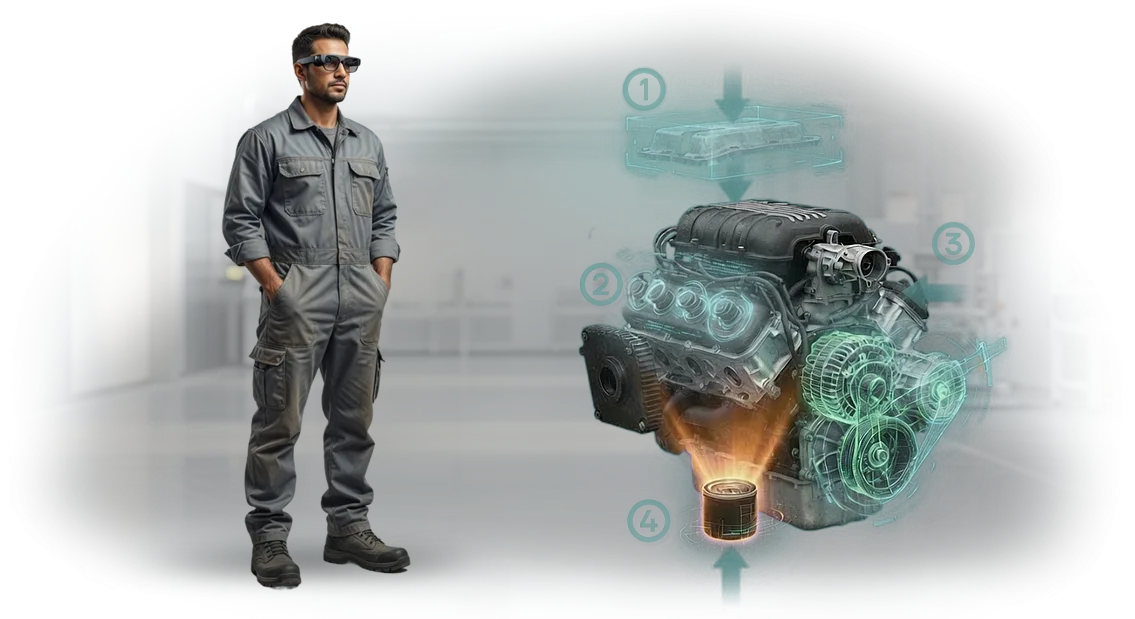
How AR instructions eliminate errors in airport operations
Staff errors in airport operations cost more than just a disrupted schedule. A failure during ground handling, inaccurate diagnostics, or a missed maintenance checklist item means a delayed flight, forced downtime, and a chain of financial losses that follows every such incident.
This is felt especially acutely in emergency situations, when there is no time to think and passenger safety and the operation of the entire hub depend on the employee's actions.
People act at random, relying on memory and experience, while the cost of an error in industry is measured not only in money but also in the reputation of the airline or airport operator.
An extra hour of equipment downtime, damaged equipment, or an incorrect sequence of operations — all of this hits both deadlines and the bottom line.
Direct losses consist of downtime and repairs, while indirect losses come from lost partner trust and increased scrutiny from regulators.
Paper regulations and video instructions don't help: they are read in a calm environment, not during a real task next to a red-hot engine or amid the noise of the apron.
The employee is left alone with a complex device, and any inaccuracies in their actions multiply the risk of an accident.
This is exactly where AR instructions meet the customer's key need: they remove the human factor from mission-critical processes.
Step-by-step visualization directly on the equipment lets the employee act confidently from the very first second, minimizing the likelihood of error and guaranteeing the stability of airport operations.
Benefits for the customer: from safety to budget savings
At an airport, every minute of equipment downtime means flight delays, disruptions in passenger service and rising costs. Traditional paper instructions cannot keep up with today's pace: an employee gets distracted, wastes time searching for the right section, and makes mistakes.
AR instructions solve this problem — step-by-step prompts appear directly on the equipment, speeding up work and reducing risks. Below are the key benefits of AR instructions.
Benefit: improved safety
Personnel see the algorithm of actions without interrupting their work, without leafing through manuals. This reduces the number of errors and helps strictly comply with occupational safety regulations.
This is especially important when servicing critical airport systems — from baggage belts to fueling equipment.
Benefit: speed of repair and maintenance
A technician receives prompts right before their eyes: diagnostics take several times less time, and a remote expert can join the process and see the same thing as the specialist on site. Equipment returns to service faster, and the airport operates without prolonged downtime.
Benefit: reduced staff training costs
New employees master processes 2–3 times faster: AR instructions replace part of mentoring and provide a single standard for performing work. Experienced specialists are less distracted from their tasks, and staff training costs are noticeably reduced.
Benefit: budget savings
Here the results are measurable: less downtime, fewer errors, faster training — these are direct savings on operating expenses.
In addition, digital instructions are easy to update, and you do not need to print and distribute new versions of documents across all sites — changes appear instantly for all employees.
AR instruction formats for your enterprise's tasks
In an airport operational environment, every minute of downtime means a schedule shift, additional approvals, and increased load on ground services.
Generic instructions on paper or in PDF do not help when a task is non-standard: an urgent aircraft inspection, connecting special equipment, actions in an emergency.
Here you need a format that guides the employee step by step right at the moment of work and does not require re-reading regulations.
We adapt AR instructions to different scenarios of your enterprise — from scheduled maintenance to emergency expert call-out. Below are typical formats and benefits for key airport services.
| AR format | For whom | What it gives the client |
|---|---|---|
| Step-by-step visual instructions | Line maintenance personnel, ORM teams | The employee sees the required components directly on the equipment, reducing errors and operation time |
| Remote assistance with an expert | Small airports, remote apron areas | An expert engineer connects to the employee's camera, shows the work location, and monitors actions |
| Interactive checklists | HRS services, ground handling | Monitoring equipment readiness and compliance with regulations, automatic recording of completion |
| Simulator for trainees | Training centers, HR service | New employees learn operations on a synchronized AR model, without risk to real equipment |
Each format addresses a specific operational pain point: where speed and accuracy are needed, step-by-step annotations work; where there is a staff shortage, a simulator and remote connection of an experienced engineer help.
Moreover, the formats can be combined: training on a simulator, then independent work with a checklist, and if necessary, connecting to a remote console.
We select the format for your task, not for the device you already have. We adapt the scenario to tablets, headsets, or mobile terminals that the staff already has — no additional equipment will be needed.
At the start, you get not a “tick-box demo,” but a working process integrated into your regulations and reports.
Stages of AR instruction development: from brief to launch
An AR instruction for airport operations is not just an animation overlaid on the screen. It is a working tool that determines the speed of service and employee safety. That is why we built the development process so that you can see the result at every stage and influence it.
- Brief and immersion in the task. We study regulations, standard equipment operations, and the places where employees most often make mistakes. Based on the results, we set goals: reduce operation time, lower the risk of breakdown, or simplify training for a newcomer.
- Scenario approval. We describe the operator's step-by-step actions — from turning on the unit to monitoring parameters. The technical service approves the scenario before content production begins.
- Interface design. We determine how prompts appear on the tablet or glasses screen: which details to highlight, how much text to show, and when to pause. The interface must not distract from work.
- Creating 3D content and animations. We model equipment units and show the sequence of actions with the required level of detail. The employee sees exactly the part of the mechanism they are working with.
- Testing on real equipment. We check navigation, accuracy of instruction overlay, and readability under airport lighting conditions. We fix anything that hinders fast execution of operations.
- Launch and training. We install the system, configure access, and conduct a short briefing for supervisors and operators. Employees start using the instruction on the launch day.
- Support and refinement. We collect feedback from staff, update content when regulations change, and add new operations without stopping work.
The entire process takes 2–3 weeks for a typical unit. As a result, you receive a ready AR instruction that is understandable to an employee without special training, and a team that continues to support it after launch.
What is included in the delivery: a complete kit for your team
You receive not a fragmented application, but a ready-to-use working system for airport operations.
The package includes AR instructions adapted to your processes and equipment, employee training, a full documentation package, and analytics tools — everything needed to launch without engaging a contractor at every step.
What is included in the delivery package:
- AR instructions for your scenarios. Ready-made step-by-step prompts for typical operations: equipment inspection, loading and unloading operations, scheduled maintenance. The instructions are overlaid on real equipment — the employee sees what to do and in what order, right in their field of view.
- Team training. We conduct training for shift supervisors and key employees: from initial system launch to independent work. Administrators gain content management skills, while regular operators gain confidence in daily use.
- Complete documentation. Operating regulations, short reminders for staff, instructions for updating content. All documentation is in Russian, adapted to employee skill levels — from beginner to technical specialist.
- Analytics and reporting. The system shows which instructions are used most often, which stages cause difficulties, and how long each operation takes. By understanding this data, you can adjust processes and reduce downtime.
- Technical support and updates. We deliver the system with a performance guarantee. If your processes change or new equipment appears, we help update the instructions without lengthy approval.
Such a package allows you to put the AR system into operation within weeks, not months. You are not left alone with the technology — you get a tool, a trained team, and transparent data on operational efficiency.
Case study: how we reduced equipment repair time by 30%
When it comes to airport operations, every minute of ground equipment downtime means delayed flights, disrupted schedules, and dissatisfied passengers.
The technical service often works across different terminals, and waiting for a qualified specialist for complex repairs can take hours.
A large industrial airport approached us with a request: how to speed up troubleshooting without expanding the staff or sending experts on business trips.
We developed an AR remote assistant system. A mechanic puts on a headset, and an experienced engineer sees the picture in real time, highlights the necessary units, and suggests the sequence of actions. The expert connects within minutes — without flights, waiting, or on-site repair visits.
What this gave the customer
- Equipment repair time decreased by 30% — technicians act carefully and get it right the first time, rather than by trial and error.
- Equipment downtime decreased by 35% — the airport reschedules flights less often and returns vehicles to service faster.
- Response speed to non-standard breakdowns increased: complex issues are now resolved remotely, without a lengthy call for an outside specialist.
- Teams accomplish more per shift — the same scope of maintenance takes less time.
The project quickly paid for itself by reducing operational losses. And two months later, the customer returned with a request to extend AR instructions to other types of ground equipment — this confirms the practical value of the system in the airport's daily operations.
What to Consider When Implementing AR for Airport Operations?
When implementing AR for airport operations, the main thing is to start not with the technology, but with a specific task. You cannot experiment here: an employee’s mistake results in a flight delay or equipment downtime.
First determine which operation you want to speed up — staff training, scheduled maintenance, or troubleshooting an abnormal situation — and only then select a solution.
The second criterion is convenience for employees. Airport staff should not have to figure out interfaces: the instruction appears by itself at the right moment and guides the specialist step by step.
Be sure to check offline mode — in the hangar and on the apron there are areas with unstable connectivity, so working without a network becomes a mandatory requirement for the solution.
The third point is support. Airport regulations change regularly, and AR instructions must be updated along with them, without pauses in work or lengthy approvals.
Choose a partner that takes on support, content adaptation, and guarantees stable operation on professional equipment.
And lastly, industry understanding. Implementing AR in airport operations comes down not to beautiful 3D scenes, but to measurable results: shorter training times, fewer errors, and less burden on experienced mentors.
Request industrial case studies and talk to those who already use a similar solution in daily practice.
The right choice saves months on staff training and reduces the share of errors in equipment maintenance. We help you go from task audit to launching AR instructions into the airport’s regular operations.
Common customer doubts and our answers
Anyone responsible for equipment operation at an airport before launching an AR solution asks the same questions: how will this affect regulations, how much will it cost, and won't the new technology become a weak link in data protection.
We understand, because we work with enterprises where the cost of an error is high. We answer the main doubts — without technical details, only the practical side.
How difficult is it to implement AR instructions into an already operating airport operations system?
The integration is designed so as not to stop operations or reshape processes. We start with a pilot area: select one operation, connect the AR assistant, and test it with real employees.
Then we expand to other zones and, if necessary, refine scenarios for your internal regulations. Basic connection usually takes several weeks, and staff master the new instructions in a couple of work shifts.
How much does it cost to develop AR instructions? The cost is based on the number of equipment models, the number of scenarios, and the level of content detail.
Importantly, this is not a one-time expense with no return: such instructions reduce the time to train new employees, lower maintenance errors, and reduce equipment downtime. As a result, the project largely pays for itself in the first year of operation. We prepare the exact cost calculation after a short audit of your processes.
Is data safe when using an AR system? Protection is built into the architecture from day one. All instructions and videos are transmitted over secure channels; access to the system is role-based by employee roles.
If required, we operate entirely within the enterprise perimeter — without accessing external networks. The devices used are checked for compliance with corporate information security standards.
What happens when the equipment is updated or new regulations appear? We provide regular content support. At your request, we update scenarios within a few days, and for major changes we perform additional configuration.
Thanks to the flexible structure, AR instructions do not become outdated along with paper manuals — they always reflect the current state of processes and help maintain a high level of staff training.
Order the development of AR instructions and get results on time
Every minute of ground equipment downtime is a flight delay, a schedule shift, and extra workload on staff.
An AR instruction turns a complex procedure into a step-by-step prompt that appears right before the employee's eyes: maintenance, troubleshooting an abnormal situation, pre-flight preparation.
You get a tool that reduces training time and the number of errors, and therefore improves the regularity of airport operations.
We have been working with industrial AR systems for over 10 years and take on the entire process: from task audit to implementation and staff training. AR instruction development is completed within clear timelines, with stages and deliverables fixed. Therefore, the customer always knows when and what they will receive.
What you get when ordering AR instruction development
- Cost calculation for your task — we provide the cost after a short brief, with no hidden extra charges.
- Consultation on usage scenarios — we will advise where AR will deliver the maximum effect in your airport operations.
- Transparent timelines — we fix the completion date and interim milestones.
- Adaptation to real equipment — the instructions work with the models you already have.
- Staff training and post-launch support — employees quickly get used to the new format, and we stay in touch.
Submit a request for AR instruction development — we will call back within one business day, answer your questions, and prepare an individual proposal on cost and timelines.
We'll start with a consultation so you understand how the technology will work specifically on your equipment.