

AR Instructions for Auto Repair: Why Equipment Sits Idle and Clients Leave
Every hour of equipment downtime in an auto service center means not only missed deadlines, but also clients who leave for competitors. When a car stays in repair longer than promised, the owner loses trust and will choose another service next time.
Equipment downtime becomes a direct loss of revenue: the bay is occupied, work isn't moving, orders pile up.
In most cases, the delay happens not because of the complexity of the breakdown, but because of the long search for the right specialist.
Experienced techs are worth their weight in gold, while an employee with average experience spends hours studying documentation or waits for a senior colleague to free up.
The shortage of specialists makes the situation worse: one expert physically cannot be in several bays at the same time.
The result is lost clients, damaged reputation, and constant stress for the manager. Each such case costs more than it seems: beyond the dissatisfaction of current customers, reviews and recommendations suffer — and these drive the flow of new inquiries. Clients go where their time is valued.
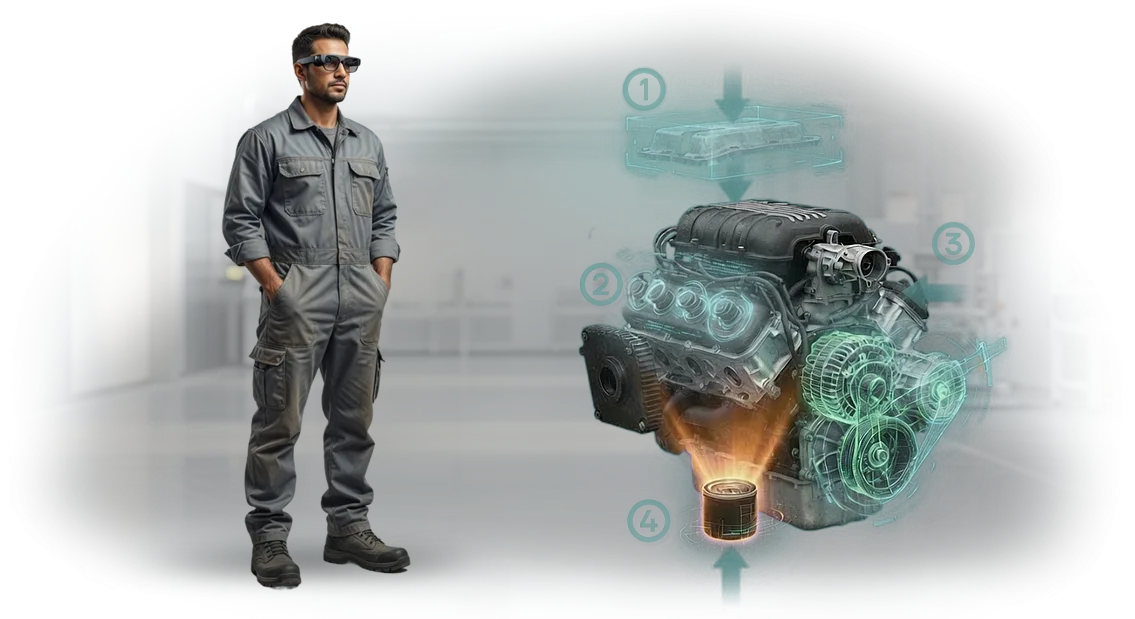
We solved this problem. AR instructions for auto repair let a technician perform work under the supervision of a remote expert who sees the same thing as the employee and guides their actions in real time.
Equipment doesn't sit idle, specialists are evenly loaded, and clients get their cars on time. This is how we solve the pain of downtime and bring back your lost revenue.
What You Get: From Repair Control to Service Profit Growth
AR instructions for auto repair give your service something that directly affects profit: fast repairs, fewer errors, and full control over the process. Each benefit reinforces the others, and as a result you get consistent quality with every visit. The technology pays for itself within the first weeks of implementation.
Fast repair is the first thing the client notices. The technician sees the sequence of actions right on the equipment and doesn't get distracted by paper manuals. Time for typical jobs is reduced by a third, so your mechanics can service more cars per shift. This directly increases the service's daily revenue.
Fewer errors means protection from rework, wasted parts, and unhappy clients. The system highlights mounting points, the order of operations, and places where a part can easily be damaged. The repair is done carefully the first time, and work quality becomes predictable for every client.
Repair control at every stage. The system records completed operations, and the manager sees the status of each car in real time. This allows you to intervene in the process in time, avoid downtime, and give clients clear answers about when their car will be ready.
Profit growth is the natural result of these improvements. More orders, fewer reworks, and higher client trust increase revenue without additional spending on advertising. AR instructions turn your service into a predictable, efficient business that generates steady income.
AR Instruction Formats for Every Auto Enterprise Task
Each task at a service station or in a fleet requires its own approach. Training newcomers needs clear step-by-step instructions, complex repairs need a mentor who controls every action, and rare breakdowns need the ability to quickly bring in an expert. That's why we offer three AR instruction formats that cover all auto repair scenarios.
| Format | For Whom | What It Gives the Client |
|---|---|---|
| Interactive Map | New employees, standard maintenance operations | Highlights components and action sequences step by step — the employee skips no steps and reaches independent work faster |
| Virtual Mentor | Experienced mechanics, complex components, and non-standard breakdowns | An AR outline shows the work area and controls task completion: get the order wrong — the system prompts you, preventing costly mistakes |
| Remote Support | Mobile crews, rare equipment, urgent repairs | The expert sees what the technician sees, right on video with AR annotations — helps in minutes, without a site visit or downtime |
This division lets you avoid overpaying for universal solutions and address your specific pain point. If you have high staff turnover — start with the Interactive Map. If the number of complex repairs is growing — add the Virtual Mentor. And as a guarantee for urgent cases, connect Remote Support.
The formats are easy to combine: one system is built around your enterprise's tasks and scales as you grow. You get not just an AR instruction, but a tool that reduces errors, speeds up repairs, and makes experienced employees less critical to your business.
How AR Instructions Are Implemented in Your Auto Service
We understand that introducing new tools in an auto service raises questions: how will it affect the technicians' work, how long will launch take, and what happens after.
That's why our process is transparent — you see every stage, control the timeline, and get a result that immediately fits into your workflows.
- Brief and process audit. First, we meet with you and the technicians: we review typical repairs, bottlenecks, and the formats of existing instructions. This helps us understand where AR instructions will deliver the greatest effect — in diagnostics, component replacement, or training newcomers.
- Implementation plan and approval. We list the operations, development stages, timelines, and terms. You get a clear plan showing what follows what and when intermediate results will be ready.
- Content development. Based on your procedures, we create AR instructions: step-by-step prompts, diagrams, and warnings about tricky points. We show you intermediate versions — and adjust everything before it goes into production.
- Testing at the service. We run the instructions on real operations together with your technicians. We remove anything that slows things down or confuses, and only move to launch after verification.
- Launch and training. We connect equipment, set up access, and train the team: technicians learn how to open an instruction in seconds, and administrators learn how to track usage.
- Support and development. After launch, we stay in touch: we update instructions when procedures change, respond quickly to questions, and help expand the manual to new operations.
This sequence lets you introduce AR instructions without downtime or chaos: within a couple of weeks you'll see technicians working with prompts and newcomers reaching the required speed faster.
What's Included: A Complete Kit for Launching Your System
To get the system running in your auto service, you don't need to separately look for developers, designers, or methodologists. We deliver a ready-made kit: all elements are assembled, tested, and suited to auto repair tasks. All you have to do is accept the system and start using it.
Here's what's included:
-
Scenarios for your operations. We analyze which repairs you do most often, where technicians make mistakes, and why they don't read paper instructions.
Based on this, we create step-by-step AR scenarios: the worker sees prompts directly on the component and never breaks away from the process.
-
Integration with equipment and your accounting system. We connect diagnostic stands and parts catalogs — parameters are pulled automatically. This removes manual entry and reduces errors during part replacement.
-
A control panel for you. You see which scenarios are used most often and which need refinement. If necessary, you can change texts, step order, and standards yourself, without involving programmers.
-
Training for technicians and service advisors. We run a hands-on workshop at your facility: we work through real cases, show how to use prompts, and embed them into the service's daily rhythm.
-
Launch and support. We help roll the system out across all areas and stay in touch after launch: updating instructions for new car models and changes in procedures.
-
Documentation and quick-reference cards. We provide a system description and short instructions for employees — a new technician can start working without a long onboarding process.
Each item on this list is part of one cohesive system: from operation analysis to post-launch support. You get not a "raw" product, but a working tool that starts delivering value within the first weeks.
Case Study: How a Fleet Cut Downtime with AR Assistance
A logistics company's fleet faced a typical situation: a hydraulic system failure put three vehicles into service, and the wait for a narrow specialist stretched to a week. Every hour of downtime meant unfulfilled orders and missed deadlines.
Experienced mechanics were overloaded, and junior staff lacked the knowledge to work with rare equipment.
We proposed solving the problem with AR assistance: through a tablet, the mechanic sees digital prompts directly on the equipment housing — step sequences, mounting points, safe effort limits.
This allowed a regular crew to perform diagnostics and repair without bringing in an external expert. Instead of a week of downtime, the vehicles were back in service in two days.
The Result the Business Owner Noticed
Repair time dropped by a third, and more importantly, the fleet returned to planned work instead of constantly putting out fires. Downtime became a manageable process: management sees which vehicle will be repaired when and can forecast the schedule.
Experienced mechanics stopped being distracted by typical failures and focused on complex tasks that truly require their expertise.
An additional effect — newcomer training accelerated: fewer mistakes at the start, fewer damaged parts. After the first project, the client ordered AR instructions for all types of equipment in the fleet and expanded usage to other sites.
This is a case where technology pays off not through an abstract "process improvement," but through specific hours of equipment operation.
At the core of the approach is a well-honed system from our team: we don't sell "magic glasses," we build a process that delivers measurable results. We can deploy the same scenario in your fleet: first choose one frequent failure, run a pilot, and see the effect. Scaling is then a matter of weeks.
How to Choose the Right AR Instruction Format for Your Auto Repair Type?
The answer to "which format suits you" starts with three points: the number of employees, the type of equipment, and the need for remote support.
We don't match AR instruction formats from a catalog — we tailor them to your specific situation, because even a good technology won't deliver the needed speed and precision otherwise.
For a small workshop with two or three mechanics, each knowing the specifics of their vehicles, compact overlay prompts are enough. They speed up routine operations and reduce the risk of errors during component replacement.
A large service with new employees and high turnover needs more detailed step-by-step scenarios with built-in verification of each stage — that's how you get newcomers up to speed faster and protect your service's reputation.
The type of equipment also determines the format. A complex stationary stand requires a detailed sequence with safety checks. For a portable diagnostic device, quick visual prompts — "where to find, how to connect, what to check" — are sufficient.
In both cases, AR instructions cut the time spent studying documentation and searching through scattered files.
A separate scenario is remote support. If your technicians work across multiple locations or you need to bring in external specialists, choose the format with video conferencing and real-time prompt overlays.
The technician sees what to do without being distracted by phone consultations and messaging. This solves the "rare breakdown — nobody knows how to fix it" problem without downtime or specialist visits.
We help you decide on the format during a briefing: we analyze the number of technicians, equipment types, and remote support scenarios. After that, we propose a solution that pays off by reducing downtime and speeding up repairs.
Common Concerns: What If AR Instructions Don't Suit My Equipment?
Doubts before ordering are normal. "Will AR work with my equipment? Will launch be complicated? Will deadlines slip?" — behind these lies the old experience of lengthy IT implementations.
We work with equipment of any complexity, from a single machine to an entire line. No sensors, internet, or "digital passport" are needed: the instruction is built from drawings, photos, and comments from your engineers, with anchoring to cabinet elements.
The entire technical side is on us. Your specialist spends two to three hours a week on consultations, and employees use a regular smartphone or tablet. A pilot instruction takes two to four weeks; a standard project takes four to eight. Deadlines are fixed in the contract.
Our equipment has no sensors and no network access — will AR work?
Yes. No access to the machine's "brain" is needed: recognition works through visual markers — the housing, nameplates, fasteners. The employee points the camera, and the system identifies the right component.
How long will launch take, and will the workshop be disrupted?
Production doesn't stop: we shoot during breaks between shifts, and engineer consultations take 15–20 minutes a day. We show the pilot instruction two to four weeks after the brief.
Employees are skeptical about new things — will they cope?
The interface is built as step-by-step prompts with arrows and animations overlaid directly on the equipment. Training takes less than an hour, and the team adapts to the format within one or two shifts.
Leave a Request — We'll Prepare a Plan for Your Production
We understand: before investing in AR instructions, you want to see how the technology will work at your production site or auto repair facility, how long it will take, and what results it will bring.
So we've made the first step as simple and safe as possible for you — you leave a request, and we take on most of the preparatory work.
Within a few days, we conduct an express audit of your processes and send you a concrete plan for your task. No fluffy presentations and generic words — only the solutions that will actually reduce employee training time, lower error rates, and speed up repairs.
After your request, you receive:
- An audit of current instructions — we analyze which operations (from component assembly to complex repairs) most often raise questions and where AR will deliver quick results.
- A selection of AR scenarios — we show at which stages of work the equipment will pay off fastest, whether it's an industrial workshop or an auto service station.
- An implementation plan with stages and deadlines — you see when the first prototype appears, when testing starts, and when AR instructions run at full capacity.
- A preliminary estimate — an honest cost assessment with no hidden extras, calculated after audit: you immediately understand what the project costs for your scope.
- Examples of similar solutions — we show how we've already solved tasks in industry and auto repair, so you can rely on real experience rather than promises.
- A benefit assessment — we calculate how many hours of employee work and how much money you'll save after implementing AR instructions.
The request is non-binding. You'll get ready material for decision-making — with numbers, timelines, and clear steps. Leave your contact info, and we'll prepare a plan for your production facility or auto repair workshop within the coming days.