

Why energy workers lose time on paper equipment manuals
A paper manual is a power engineer's worst enemy. When equipment stops or throws an error, a specialist spends 15–20 minutes searching for the required procedure: opening cabinets full of binders, flipping through dozens of pages, checking outdated diagrams. Every minute of downtime is not just lost output—it is also a risk to the entire supply chain.
At the same time, the human factor never disappears. One employee remembers where the current version is kept, another does not. As a result, the same mistakes repeat, and new specialists spend weeks learning the process instead of doing their job.
In the energy sector, where a failure at one node echoes across hundreds of kilometers, such slowness costs too much.
The situation is made worse by the fact that equipment is getting more complex, and documentation is getting bigger. While staff search for a manual, the fault remains unresolved, the unit's service life is consumed, and the control room sees downtime in reports.
Managers understand the problem, but they are in no hurry to change familiar "paper" processes—until the first major incident.
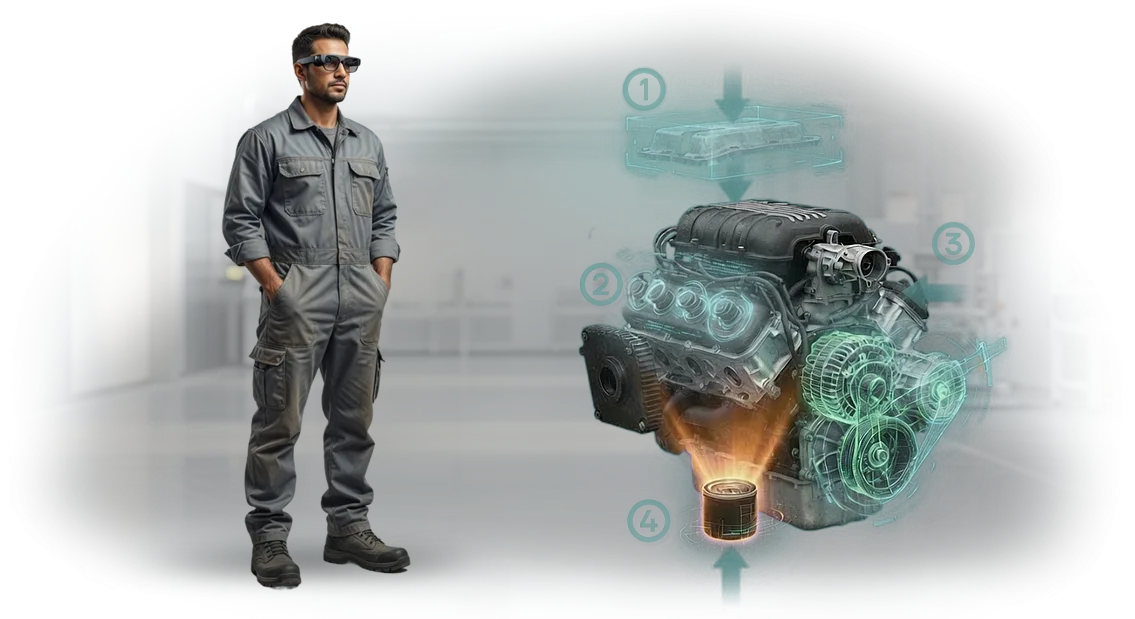
We help energy workers close this gap. Instead of folders and PDFs—step-by-step prompts right on the equipment via tablet or phone. An employee sees the necessary operation without leaving their workstation, and the time to find the procedure drops to seconds.
This reduces downtime, removes dependence on any one person's memory and experience, and makes training new employees far faster.
What AR instructions give your production and repair crew
A newcomer to a repair crew often trains for months: reading manuals, memorizing diagrams, making mistakes. In the energy sector, the cost of an error is especially high—equipment downtime and emergency repairs are expensive.
AR instructions change the approach: an employee sees prompts right on the equipment and completes the operation on the first try.
Here is a checklist of what you get on the production floor:
- Speed of personnel training. An employee does not leaf through paper procedures but looks at step-by-step prompts overlaid on the real object. Time-to-competence is reduced by 2–3 times, and experienced specialists switch to new equipment faster.
- Fewer repair mistakes. The AR instruction fixes the sequence of operations and does not allow an important step to be skipped. Fewer defects, fewer repeat visits, lower costs for spare parts and warranty repairs.
- Process control. A manager sees which operations were completed, how long the repair took, and where difficulties arise. This helps identify weak spots in training and evaluate the crew objectively.
- Work without stopping production. Prompts appear in the field of view, hands remain free. The employee is not distracted by diagrams and tablets, equipment is idle less, and planned repairs stay on schedule.
- Preserving expertise. The experience of the best engineers becomes digital AR instructions and stays with the company even after the specialist leaves. New employees gain knowledge without being tied to the "experience holder."
We have been implementing such systems for industrial customers for more than 10 years. We help digitize procedures, train crews, and set up control—quickly and without stopping production.
AR instruction formats: which one fits which task type
Each task in production or energy requires its own approach to instructions. One thing is a standard procedure performed by dozens of employees; another is a rare repair of a unique unit requiring an engineer's experience.
That is why we divide AR instructions into three formats—standard, adapted, and with a remote assistant.
| Format | For what type of task | What it gives the customer |
|---|---|---|
| Standard step-by-step AR instruction | Recurring operations: inspections, replacement of consumables, daily shift checks | Fast training for new employees, a single standard of performance, fewer errors |
| Adapted to a specific scenario | Non-standard situations: repair of a specific model, commissioning work, abnormal modes | Takes into account the specifics of your equipment, exact procedure without fluff, lower risk of accidents |
| With a remote assistant | Complex or rare breakdowns when you need an external expert | Saves time on sending a specialist, instant consultation, recording of all actions |
Standard formats are simpler and faster to implement, adapted ones cover the specifics of your equipment fleet, and a remote assistant helps where you previously had to wait.
During a consultation, we select the format for your tasks—and offer combined solutions if one format does not cover all scenarios.
How we create an AR instruction for your energy facility
Implementing AR instructions is a process we have refined on dozens of energy facilities.
For you, this means predictability: each stage ends with a result you see and approve, not something "somewhere in development." Below are the implementation stages, from brief to support.
-
Brief and object audit. We capture the goals: reduce repair time, speed up staff onboarding, reduce errors. We visit the site, study the equipment and procedures, and identify operations where AR will deliver quick results.
-
AR instruction development and prototype. Based on your documentation, we build step-by-step scenarios: what an employee sees through a tablet or AR glasses at each stage.
We agree on the logic with technologists and the operations service—so we don't have to redo anything after launch.
-
Approval. You receive an interactive model of the instruction for review before final filming. We make edits, approve the version, and set it as a reference.
-
Filming and AR content preparation. We create marker setup on site, film video guides, and prepare 3D prompts and animations. We work with professional equipment, so the instruction works reliably in the workshop, outdoors, and in difficult lighting.
-
Pilot launch. We test the scenario with a real crew, measuring operation time before and after. We collect feedback, make final edits, and adapt the instruction to your site.
-
Support and scaling. We update content when procedures change and help roll the solution out to other workshops. Staff work without additional training, and you get a single instruction standard.
What is included in the AR instruction delivery
After implementation, you receive not just an app but a working toolkit for operations, repair, and training. Below is what is included in the AR instruction delivery and how it works on your site.
- Step-by-step modes for typical operations — start and stop, scheduled maintenance, handling abnormal situations. An employee sees the required components highlighted on a smartphone or tablet screen and the next step. This reduces time spent searching for information and lowers the risk of error.
- Digital model of your equipment — the model replicates the real components and their location, not an "average" picture. The instruction always matches the specific unit your specialists work on.
- Knowledge base with videos and checklists — a single source of verified data instead of paper folders and scattered files. A new employee quickly finds the required operation; an experienced one verifies against the current procedure.
- Personnel training — we don't hand over "bare code" but run short training sessions for future users and administrators. After launch, your people use the instruction themselves and add new operations.
- Remote assistant — in a difficult situation, an operator calls a specialist via AR, and that specialist sees the same thing as the employee: giving advice by voice or with arrows right in the frame. The expertise of experienced colleagues stops being personal knowledge and becomes available to everyone.
- Updates and support — we regularly update content to reflect procedure changes, new models, or component replacements. You are not left alone with an outdated instruction.
This toolkit covers the main need of the energy sector and industry—fast access to knowledge right at the facility. Implementation is staged: first a pilot on one operation, then we scale the solution to all critical processes.
Case study: How a remote assistant reduced downtime at a substation
Repair at a substation is always a race against time: every hour of downtime means losses for the power sales company and the risk of consumers being left without power.
Sending a specialist, finding the right component, working through a complex diagram—all this takes precious hours while the equipment stands idle.
This is exactly the challenge a distribution grid operator brought to us: they needed to reduce response time to emergencies and reduce human errors in complex repairs.
We deployed a remote AR assistant based on tablets and cameras carried by field staff. An engineer at the substation broadcasts what is happening, while an expert in the office sees the picture and places virtual arrow prompts and callouts right on top of the actual equipment.
The result exceeded expectations: average repair time dropped 2.5 times, and the number of errors during work fell by 40%.
Why this works specifically in energy
The key factor is safety and staff confidence. A young employee working on high-voltage equipment no longer has to guess whether they are performing the steps correctly: the expert sees everything in real time and corrects actions before a mistake leads to an accident or injury.
The second point is the economics of downtime. Cutting repair time by 2.5 times is not just convenience—it is direct money saved from lost revenue and penalties for power supply interruptions. There is also no need to wait for a rare specialist from another region to arrive.
This approach quickly paid off and proved reliable—after a successful test at one substation, the operator scaled the solution to another ten facilities.
Today, the remote assistant has become a standard procedure for them, not an experiment: it saves hours, prevents errors, and gives management confidence that even the most complex failure will not knock the energy supply schedule off track.
FAQ on AR instruction implementation
Every manager asks the same questions before implementing AR instructions: will it disrupt production, will employees accept the technology, and how secure is enterprise data. This is normal—new things always cause caution, especially with complex equipment and secure facilities.
We have implemented AR instructions at more than a hundred industrial sites, so we know in advance where barriers arise and build solutions into the project. Below are answers to the questions we hear most often.
How long does implementation take and will it stop shopfloor operations?
Implementation does not require equipment shutdown. We work in the background: collect data, prepare content, and integrate the system in parallel with current processes.
Training one shift takes two to four hours—this can be done right in the workshop, during breaks, or before a shift starts.
Full deployment at one site takes two to four weeks, depending on the number of instructions. The key point: first results appear within a few days, and employees see the benefit immediately, not a month later.
Staff are used to paper instructions. Won't they refuse tablets and glasses?
Resistance only happens when technology makes work harder. Our AR instructions, on the contrary, reduce the number of steps: an employee sees a step-by-step prompt right on the equipment and does not waste time searching for the right section in a paper manual.
We design the interface together with your own specialists—mechanics, adjusters, operators. They tell us the best way to present information, so the interface ends up intuitive. Experience shows: after the first three or four uses, most employees ask for AR prompts themselves.
How secure is the transfer of data about our equipment?
Security is solved at the solution architecture level. We do not transfer data to third-party servers: AR instructions can run entirely within the enterprise network—locally, on your server infrastructure. The remote assistant uses a secure connection with access rights separation.
If needed, we design instructions so that sensitive parameters and drawings are hidden from outsiders. Only authorized personnel get access, and all actions in the system are logged. This makes it possible to implement AR even at facilities with strict security requirements.
What if the system fails during work?
We design AR systems with fault tolerance in mind. During implementation and for the entire operating period, support is available and responds within a business day. If needed, we provide backup equipment kits so the production process does not stop.
In addition, AR instructions do not replace paper procedures but complement them. In any technical pause, an employee returns to the usual process without losing information.
This scheme has already been proven on hundreds of projects in energy, mechanical engineering, and the oil and gas industry.
Order an AR instruction for your equipment
Leave a request and we will prepare an audit of your equipment: we will analyze which operations most often cause errors and where an AR instruction can deliver quick results. Within 1–2 days, you receive an implementation plan with clear stages and a timeline estimate.
After the consultation, you will know exactly whether the AR format suits your tasks, how long development will take, and which scenarios will pay off first. No abstract promises—only specifics about your equipment and production processes.
Ordering an AR instruction from our team gives you:
- audit of current instructions and procedures—we find bottlenecks that slow your staff;
- format selection for your task: from simple prompts to full remote support;
- clear timeline and cost estimate before work starts—no hidden surcharges;
- phased implementation with regular checkpoints so you see results at every step;
- support after launch: content updates, scenario refinements, and staff training.
We work remotely across the country and have helped industrial companies reduce training time and staff errors for more than 10 years. Your equipment is not a problem but a task we will solve together.
Leave a request for a consultation—we'll show you what your AR instruction will look like and prepare a timeline estimate within a couple of business days.
How to choose an AR instruction if you have specific equipment?
Choosing an AR instruction always starts with the question: how standard is your equipment and what tasks should the instruction solve—staff training, repair procedures, or operations control.
For energy, it is especially important that the instruction accounts for real working conditions: heights, noise, protective gear, and limited access to components.
That is why a "boxed" solution rarely fits—you need a format that can be adapted to your procedures and specific machine models.
The standard format is a ready-made AR instruction for popular types of equipment. If your machines are standard and your maintenance process is typical, this option saves budget and time to launch.
But energy companies often have equipment modifications, older series, or individual operating modes—then a standard instruction does not reflect the real steps and the operator has to rely on memory.
The adapted format takes a ready-made instruction and tailors it to your conditions: changes the sequence of steps, adds checkpoints, takes into account the features of specific components.
This is a good balance of price and result when processes are generally clear but need refinement. A custom AR instruction is developed from scratch for a specific facility: it captures your exact process maps, procedures, and employee competencies.
This option is needed when operator error is critical and documentation exists only in paper form or is scattered across different systems.
| Format | When to choose | What the customer gets |
|---|---|---|
| Standard | Equipment is standard, processes are regulated, launch deadlines are tight | Fast implementation, visible effect from the first days |
| Adapted | Serial equipment with installation or operation specifics | An instruction that accounts for your components and operations without full rework |
| Custom | Unique units, high risk of errors, strict safety standards | Full alignment with your procedures, integration with the personnel training system |
As you can see, there is no universal answer—but there is a proper selection process. We provide consultation on your task: we analyze the equipment, training goals, and safety requirements, then propose an AR instruction format that actually solves the problem. Book a consultation—we'll select a solution for your specifics, not for an abstract template.