

Mining Problems: Losses from Downtime and Errors
Every hour of downtime in mining means lost revenue, a disrupted shipping schedule, and a cascade of problems across adjacent sections.
Emergency stops happen without warning: a drilling rig, excavator, or crusher goes down, and the mining downtime pulls the entire process chain along with it. Eliminating the consequences takes hours, sometimes days, and the financial losses are enormous.
Repair mistakes are the second hidden threat that directly affects the company's budget. Misdiagnosis or the wrong sequence of operations turns planned maintenance into costly repairs: neighboring components get damaged, and the machinery breaks down again.
With each such incident, spending on spare parts and unscheduled work grows, and the downtime stretches longer.
Staff training is another pain point. The equipment is complex, the manuals are long, and experienced specialists retire or move to other sites. New employees take months to master the machinery, and during that period the risk of mistakes is especially high.
Knowledge stays in people's heads rather than in the company's processes, so when the team changes, the company loses competence.
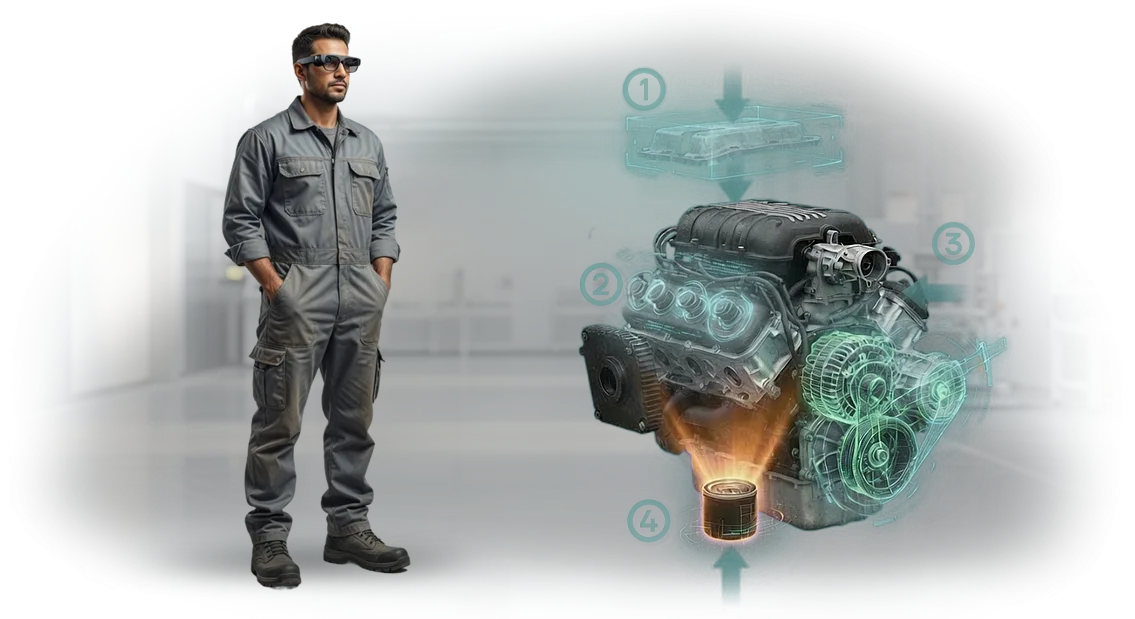
We solve these problems: we turn procedures and manuals into a visual augmented reality format. A specialist sees hints right on the equipment — what to remove, where to press, how to check the result.
This cuts emergency downtime, reduces repair errors, and speeds up staff training several times over.
What an AR Instruction Gives Your Production
An employee at the screen of a machine that stopped for an hour means lost output, missed deadlines, and a frustrated foreman. Traditional manuals and drawings don't help quickly: you have to search for them, decipher them, and match them to the actual component.
An AR instruction puts the right hint right on the equipment — repairs take minutes instead of hours, and the crew doesn't stand idle.
We create such instructions for your machines and processes. Below is what specifically changes on the production floor after implementation.
Repair Speed and Reduced Downtime
Instead of reading a manual, the worker sees step-by-step animation of removing the component and warnings about hidden fasteners right in front of them. Mistakes are eliminated, tools are selected immediately, and return service calls become rare. Machine downtime is cut several times over, which means output grows without additional investment.
Employee Safety
An AR instruction doesn't just show the sequence of actions — it also warns about dangerous zones: high voltage, pressure, moving parts. A new employee doesn't end up in an emergency from lack of knowledge, and an experienced one doesn't forget the procedure. Injuries, insurance risks, and downtime from accidents decrease.
Operation Quality and Control
Every action is recorded and checked against the standard — the instruction won't let anyone skip a torque step or lubrication. The result doesn't depend on the skill of a particular worker, and maintenance quality becomes consistent. The supervisor sees statistics on each operation and can train those who fall behind in time.
Savings on Training and Operation
A newcomer reaches independent work in days, not months — mentors don't get pulled away from their own tasks. Spare parts are used more carefully because there are fewer errors during disassembly and assembly.
The investment in developing an AR instruction pays for itself after the first complex failure is resolved.
What your production gets with an AR instruction:
- reduced repair time and equipment downtime;
- new employees quickly reach full capacity;
- fewer mistakes and accidents, safe work with hazardous components;
- clear quality control and statistics for each operation;
- savings on service engineers and retraining.
We implement the project within a tight timeframe and provide support after launch — the instruction always stays relevant to your equipment and procedures.
AR Instruction Formats for Mining and Repairs
Every hour of downtime in mining is a direct loss, and complex hydraulic or electronic repairs are hard to explain with words and paper diagrams.
Interactive guides solve this problem right at the workplace: beginners learn faster, and experienced repair technicians stop wasting time searching for the right drawing.
We offer several AR instruction formats — the choice depends on the task and working conditions. You don't pay for unnecessary options; you get exactly the tool that covers your need.
| Format | Who it's for (scenario) | What it gives the client |
|---|---|---|
| Stationary | Training new employees in the workshop or training room | Step-by-step visualization without the risk of breaking equipment, cutting the adaptation period for a shift to one week |
| Mobile | Repair crews working in the field or at remote sites | Hints are overlaid right on the component via a tablet, reducing the number of errors and the time to find the fault |
| Combined | Mixed tasks — diagnostics followed by repair | Switching between modes without interrupting the process, saving on logistics for invited experts |
This approach covers both staff turnover and repair complexity without building a separate digital training ground. All formats are built on proven professional tools that deliver a stable image even in dusty conditions and with machine vibration. We'll select an option for your budget and equipment fleet — just set the task.
How We Create AR Instructions: Project Stages
Any project starts with analyzing the task: scattered documents, different versions of instructions, and the machinery that needs to be described.
Developing AR instructions for mining turns this chaos into a clear process with fixed stages and approval checkpoints — you always know what's happening and when you'll get the result.
- Brief and equipment audit — we gather requirements, study the specific machine models, site working conditions, and typical operations. You receive a plan: what will go into the instructions and which tasks AR will cover.
- Scenario approval — we define which steps the operator should see: from start-up to emergency stop. We align the logic with your procedures so the instructions don't contradict current regulations.
- Content creation — we develop step-by-step 3D animations and hint texts. We prepare a draft AR instruction that's easy to read in a headset or tablet — without unnecessary technical complexity for the employee.
- Approval and revisions — you receive a demo version and check it with technologists and operators. We make changes before it goes to the site — this saves time and budget.
- On-site testing — we run a pilot on real equipment. We make sure the instructions work under real lighting, dust, and protective gear.
- Launch and support — we deliver the finished package, train the staff, and support the project. When procedures or equipment change, we update the content without stopping production.
These implementation stages take anywhere from a few weeks to two or three months, depending on the number of equipment units.
The key point: you get not a "prototype for presentation" but a working tool that employees use every day and that trains new specialists faster.
What's Included in the AR Instruction Delivery
When you order AR instructions, you get not a "raw" project but a complete working package — everything needed for launch and day-to-day use is already assembled and tested. Below is the delivery scope.
- Ready-made AR instructions — operation-by-operation scenarios for your equipment, adapted to the real operator workplaces. The employee sees hints right on the equipment and performs steps without referring to paper procedures.
- Operating documentation — clear guides for launching, configuring, and updating the system. These aren't technical abstractions but working procedures for your team that can be built straight into your internal standards.
- Operator training — hands-on training and quick-reference materials so staff start using the instructions from day one. Training takes a few short sessions and doesn't stop the production cycle.
- Integration with your processes — we connect the instructions to your existing work-permit and maintenance procedures. AR becomes part of daily work, not a separate "island" tool.
- Access administration — role and permission distribution for different shifts and sections: who sees the instructions, who updates them, who monitors usage. You keep control over all staff actions.
- Technical support — a dedicated communication channel with our team after launch. We help with questions and quickly update content when equipment or safety requirements change.
- Update plan — regular refinements to the instructions when technology changes, components are replaced, or new procedures appear. Your AR materials always stay current instead of freezing at the moment of implementation.
Thus, the delivery package covers the entire cycle: from installation and training to ongoing support. You get a working tool that speeds up mastering operations and reduces the risk of errors — not just files on a disk.
Case Study: Crusher Repair Without Long Downtime
When a crusher stops, the entire processing complex stops. Every hour of downtime is lost revenue, missed schedules, and frayed nerves for supply managers. Previously, repairs took two days: finding a specialist, preparing documents, disassembling the unit using paper diagrams. We proposed a different scenario.
Vostochny GOK, a large producer of non-metallic materials, faced frequent unscheduled stops of its crushing equipment. Instead of waiting for a rare specialist to arrive, we developed an AR instruction for replacing crusher components.
A fitter puts on glasses or points a tablet at the unit — and sees right on the housing which cover to remove, in what order to loosen the bolts, and where the needed part is.
The result was measured at the very first scheduled repair: the time to replace the moving wear plate dropped from 12 hours to 4. Instead of two shifts — one. And crucially, the neighboring line didn't have to be stopped as before. For the company, this means additional processing volumes and preserved contract deadlines.
"For the first time, crusher repair took one shift instead of two days," says the plant's chief mechanic. "All operations on the screen, mistakes eliminated, nothing to search for in drawings. The AR instructions paid for themselves on first use."
Since then, AR instructions have been applied to other units as well — from the screen to the conveyor belts. Each new scenario is created using a proven method: we go to the site, record the process, and embed the hints. The company gets a system that reduces dependence on the human factor.
Calculating the return on investment is simple: the cost of one hour of your equipment's downtime multiplied by the number of hours saved. An AR instruction works like a digital assistant that always remembers the correct sequence of operations.
Common Doubts About Implementing AR Instructions
At the decision-making stage, mining customers have questions about AR instructions: compatibility with processes, launch timelines, staff workload, and budget.
Most often the doubts relate not to the technology but to the uncertainty — how it will fit into a running production operation.
We answer these questions honestly — over 10+ years of implementations we've seen many different scenarios. Below are answers to four key concerns.
Will AR instructions work with our equipment if it's not new?
Yes. The solutions are built around your machinery, not the other way around. We adapt the interface to the specific models and operating modes, and the employee sees clear hints right in their field of view — without reworking existing processes.
How difficult is it to integrate AR into our current repair and maintenance system?
Integration can be gradual — we start with one section or one operation. AR instructions complement your procedures and electronic logs rather than replace them. This reduces integration complexity and doesn't require stopping production.
How much time does employee training take?
Training takes a few hours instead of days. The instruction shows every step in the context of the equipment, so a beginner reaches independent work faster, and an experienced master no longer needs to keep hundreds of operations in their head.
How do we estimate the implementation cost and when will we see results?
The implementation cost depends on the number of operations and scenario complexity, so we calculate it after a short audit. First results are visible already at the pilot site: less time per operation, fewer errors, and new employees quickly getting up to speed.
Get a Quote for an AR Instruction for Your Equipment
To order an AR instruction for mining equipment, you don't need to understand the technology. Just describe the task — the team at our team will handle the rest. We'll prepare a cost estimate and offer an option that fits your budget and timeline.
Submitting a request takes a couple of minutes. After that, you'll receive:
- A preliminary analysis of the task — which operations can be moved into augmented reality and where it will deliver the greatest effect.
- Format recommendations: a full instruction, a separate module for a complex component, or a series of short hints for workers.
- An estimate of labor and development timelines for your equipment fleet.
- A transparent quote without hidden charges — we fix the price before work starts.
- An implementation plan: how to train employees, integrate the instructions into existing processes, and calculate the savings.
- A consultation on operation and further scaling of the system.
All calculations are tied to your real tasks: equipment composition, staff qualifications, and site safety requirements. You get not abstract numbers but a concrete action plan.
To order an AR instruction and get a quote, leave a request on the website. An engineer will call back at a convenient time, clarify the details, and prepare a proposal — usually within one business day. After approval, we launch the implementation and support the project until it's fully live.
How to Choose an AR Instruction Format for Your Task?
There is no universal AR instruction format — the choice depends on the specific task. In mining, where machinery operates in harsh conditions and at remote sites, an error in choosing the format results in lost repair time and extra training.
So before ordering development, it's worth answering a few questions: who will use the instruction, how complex is the operation, and where exactly it's performed.
The first criterion is the users' skill level. For new employees encountering mining equipment for the first time, step-by-step AR hints overlaid directly on the machine work best: a person sees which button to press or which component to check.
For experienced mechanics, help with rare or emergency situations matters more — they need a remote augmented reality assistant, where an expert gives voice prompts and draws marks directly on the camera image from a distance.
The second criterion is working conditions. Underground, in dusty workings, and with weak connectivity, standard tablets can let you down. For such scenarios, it's right to plan for offline operation and use rugged devices that show the instruction even in a mine.
And if production sites are spread across different regions, consider the remote support format: one expert guides several crews without traveling to the site.
The third criterion is the scale and frequency of tasks.
If an operation repeats daily and the uninterrupted operation of the mining section depends on it, it's better to build the AR instruction into the procedure: the mechanic puts on glasses, walks through checkpoints, marks completed steps, and the system records the result. If the task is rare, a one-off format with hints on a mobile device is enough.
We help with format selection already at the brief stage: we analyze typical operations, the environment, and staff levels, then propose a solution that delivers a measurable effect — reduced downtime and fewer errors.
Our industrial AR development is built on real mining scenarios, so you get a tool that fits your processes rather than a reason to rebuild them around a new technology.