

Why Instructions for Mineral Processing Plants Don't Work
At a mineral processing plant, the cost of a mistake is measured not in minutes of downtime, but in the tonnage of finished product and the safety of an entire shift. Yet most companies still train personnel using paper instructions that are outdated before they are even printed.
Equipment changes, regulations are updated, and an operator facing a complex unit flips through pages looking for the right section — that is lost time, frayed nerves, and a risk to expensive machinery.
Under such conditions, personnel training becomes a formality: a new employee reads text and diagrams but does not see how the mechanism's components actually interact.
A week later, they have already forgotten the details, and a month later they act “from memory,” which often does not match the current regulations. A paper instruction cannot show movement, sequence, or hidden nuances, so mistakes repeat themselves shift after shift.
For a mineral processing plant, this means constant losses: excessive reagent consumption, unscheduled stops, equipment wear, and most importantly — an increased burden on experienced mentors who spend hours explaining things instead of controlling quality.
The more complex the process chain, the more expensive every wrong step becomes. Meanwhile, staff turnover at plants does not decrease, and every new shift means training “from scratch” using the same ineffective materials.
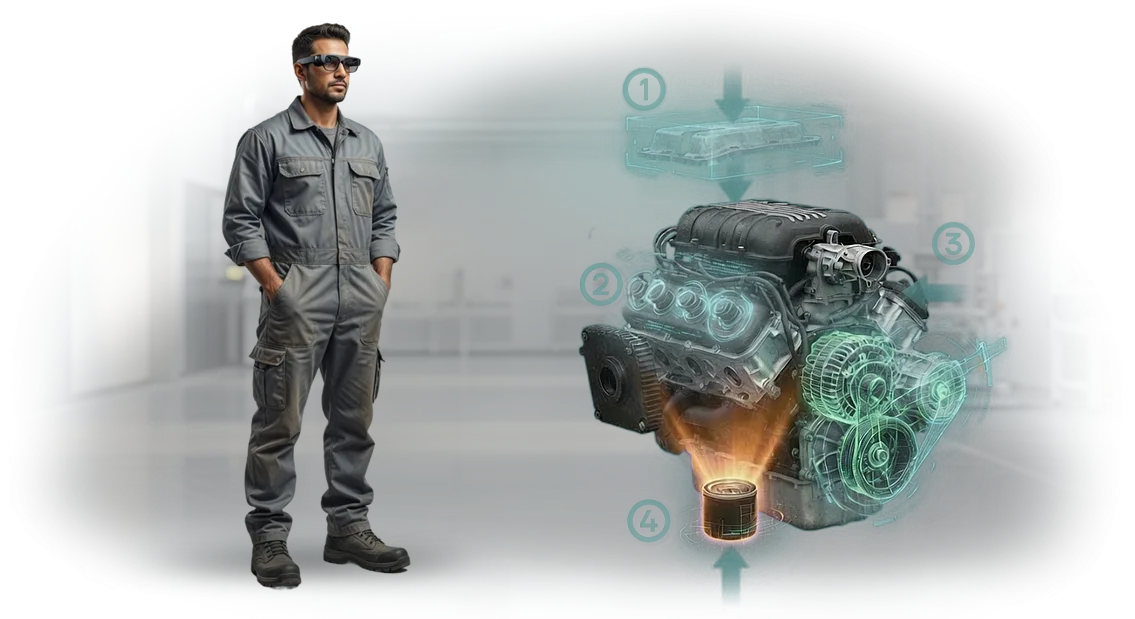
The solution is not to replace paper with PDFs, but to change the format of information delivery. When an instruction becomes visual and tied to real equipment, an employee sees not an abstract diagram but a specific unit and the correct action right at the workstation.
This way, training takes less time, and errors are reduced before they lead to consequences. That is why we develop AR instructions for mineral processing plants — they address the client's core need: quickly bringing personnel up to working speed without losses or accidents.
What Results AR Instructions Will Bring to Your Plant
In mineral processing production, the cost of a mistake is measured not just by downtime — it involves risks to equipment, personnel, and product quality.
A new employee spends weeks studying regulations, while an experienced operator in an emergency acts from memory, which is not always safe.
AR instructions turn work algorithms into visual prompts that appear right in the specialist's field of view — and this changes the plant's key performance indicators.
Benefit: Fewer Errors When Performing Operations
When an operator sees step-by-step instructions overlaid on real equipment, the chance of skipping a step or mixing up the sequence of actions drops sharply.
Instead of paper checklists and searching for the right section in a regulation, a person gets an accurate visual cue at the moment of performing the task. This reduces defects and rework, and also lowers the load on mentors and supervisors.
The system records which operations were performed with prompts and helps identify common errors. Based on this data, you adjust regulations and training materials without waiting for an incident on the production floor.
Benefit: Faster Personnel Training
Bringing a new employee up to speed at a mineral processing plant is a long process that depends heavily on the mentor's experience. With AR instructions, a trainee learns on real equipment but under the guidance of digital prompts.
The time to reach independent work is reduced by an average of 30–40% — the person starts meeting targets and adding value to the plant faster.
Experienced specialists also benefit: rare or emergency operations are always available as a visual algorithm, so there is no need to keep every detail in mind. Training becomes standardized and independent of who exactly conducts the session.
Benefit: Improved Occupational Safety
Most incidents in production are linked to human factors: a person got distracted, forgot the sequence of actions, or misread the situation.
AR instructions remind users of critical steps, warn about high-risk zones, and block the next step if the previous one was performed incorrectly. This reduces the risk of injuries and accidents, directly saving lives and cutting downtime.
In addition, the system allows remote support of an employee in an emergency: an experienced specialist sees the same thing as the operator and can provide guidance in real time. This is especially important for remote areas and complex equipment units.
Benefit: Production Digitalization and Quality Control
Implementing AR instructions is a step toward a digital enterprise where knowledge is stored not in employees' heads but in a secure database. You gain control over how operations are performed: each instruction leaves a digital trace that can be analyzed.
This provides transparency for the quality department and management: you can see at which stage deviations occur and where the process needs to be changed.
AR instruction hardware integrates easily with your existing enterprise infrastructure, and our specialists at our team adapt the system to your regulations and the specifics of mineral processing production.
As a result, you get not just a trendy technology but a working quality and safety management tool that pays for itself within the first few months.
Ready to calculate the economic effect for your site? Contact us — we will show it using your tasks as an example.
AR Instruction Formats for Mineral Processing Production
Mineral processing plants have different working conditions: from noisy workshops to remote sites with unstable connectivity. There cannot be a single AR instruction format — what works well at a stationary control panel is not suitable for a site walk. That is why we select the device based on the equipment type and site conditions.
You do not need to implement all formats at once. It is enough to choose one or two to address the main pain points: faster onboarding, fewer repair errors, or reduced downtime.
Based on your scenarios, we recommend the optimal combination — and you see results almost immediately.
| AR Instruction Format | For whom | What it gives the client |
|---|---|---|
| Stationary stands | Operators of large equipment, employees at fixed workstations | Quick access to step-by-step algorithms without interrupting the process; fewer errors when starting and stopping units |
| Tablets | Repair crews, inspectors, workers covering multiple areas | Mobile instructions with component highlighting; the employee works at their own pace, while management can see that all steps were completed |
| AR glasses | Specialists in complex operations, machine setters, emergency repairs | Instructions right in the field of view, hands free; faster execution and accelerated training for newcomers |
This approach helps avoid overpaying for unnecessary equipment and speeds up the payback of development. If conditions change, the format can be supplemented or replaced — the scenario remains the same.
How Turnkey AR Instruction Development Works
AR instruction development for mineral processing production follows a clear scenario. We have broken the process into six stages so you can track timelines, control approvals, and know exactly what you get at the end. Each step concludes with an intermediate result that can be approved or adjusted.
- Brief and audit. We gather information about your equipment, regulations, and typical operations. We determine which operations most often require explanation and where AR instructions will deliver quick results.
- Scenario approval. Based on real work processes, we create a text scenario: step-by-step actions, checkpoints, warnings. You approve it before content production begins.
- Content preparation. Specialists at our team create 3D models, animations, and text prompts that overlay onto the real equipment. We account for workshop conditions: lighting, viewing angles, and specifics of work positions.
- AR instruction assembly. We combine the finished content into an interactive instruction for a tablet or smartphone. It works offline, without a constant network connection.
- Testing at your production site. We check the instruction on operating equipment together with your employees. We make corrections to prompt timing, wording, and action sequences.
- Launch and support. We hand over the instruction, train personnel, and remain available. When regulations change, we update the content, add new operations, and keep the system current.
As a result, you get a predictable turnkey AR instruction development process: transparent stages, clear approvals, testing at a real production site, and support after launch. Employees master new operations faster, while you save training time and reduce the risk of errors.
What Is Included in the AR Instructions Delivery Package
When you order AR instructions for mineral processing production, it is important to understand that you receive not just files with 3D models, but a complete turnkey solution.
The package includes everything needed to launch the system at your plant, train employees, and keep it running — from content to technical support.
-
Ready-made AR content for your equipment — step-by-step scenarios for repair, maintenance, and diagnostics of crushers, mills, conveyors, pumps, and other components. The employee sees prompts directly on the equipment and performs the work without errors.
-
Software and licenses — a technologist's workstation and a mobile application for tablets and smartphones. All licenses are arranged, and updates are included for the entire support period.
-
Administration system — you can edit instructions yourself, add new steps, change regulations, and manage employee access without involving developers.
-
Personnel training — we conduct sessions for technologists, repair staff, and IT specialists: how to use AR instructions, what to do in case of failures, and how to update content. Training takes place on your equipment and according to your regulations.
-
Technical support — a dedicated communication channel, help during implementation and in the first months of operation. If something goes wrong, we investigate and resolve the issue rather than leaving you alone with the problem.
-
Documentation and regulations — system operating instructions, memos for employees, and templates for adding new components and mechanisms.
The entire package is supplied under a contract with fixed deadlines. You receive a working system, not scattered materials: within the first days after launch, employees are using AR instructions, finding faults faster, and reducing equipment downtime.
Case Study: How AR Instructions Cut Repair Time by 30%
At one of the mining and processing plants, we encountered a typical pain point: the repair crew spent nearly half its working time searching for documentation and calling for an engineer.
Crushers, conveyors, and mills were down longer than planned, and every minute of downtime directly pushed back the production schedule. This is a classic case where AR instructions work not as a decoration but as a cost-saving tool.
We digitized the maintenance regulations and issued AR headsets to the mechanics. Instead of paper diagrams, employees see prompts directly on the equipment component: what to remove, in what order, and what tightening torque to use.
A newcomer no longer depends on the memory of senior colleagues, and the engineer does not run to every call — freeing up time for overseeing complex areas.
After two months, we measured the results. Average repair time dropped by 30%, and assembly errors fell by half. Training a new employee to a normal pace took two or three shifts instead of two weeks.
On one crusher unit alone, we eliminated twelve hours of unscheduled downtime per month — that is thousands of tons of additional product on an annual basis.
The case confirmed that AR instructions pay for themselves through predictable repairs and faster onboarding. The client did not stop at the pilot — six months later, they scaled the solution to three more production sites.
If you have similar equipment and downtime is expensive, this scenario can be repeated at your plant.
Frequently Asked Questions About Implementing AR Instructions
Implementing AR instructions raises three concerns among production managers: cost, integration complexity, and compatibility with older equipment. We answer them based on our experience with projects at mineral processing plants.
How much does AR instruction development cost?
The price depends on the scope and complexity of the tasks. We suggest starting with a pilot at one site: you see a working instruction on your equipment and understand the budget for scaling. We calculate payback through reduced downtime and faster personnel training.
Is it difficult to integrate AR into current processes?
No. The instructions work on tablets and smartphones without replacing your equipment. If necessary, we connect them to your accounting system — production does not stop during this. The rollout is phased: first one unit, then we scale to other workshops.
Will AR instructions work with our equipment?
We work with any machines — from crushers to mills, including older ones without digital documentation. Over 10 years, our team has completed projects for plants of various sizes, so we know the specifics of mineral processing production. If you have doubts, we come to your site and show a prototype within a week.
Describe your task — we will prepare a pilot plan and calculate the cost for your equipment. Send a request, and we will respond within one business day.How to Choose the Right AR Instruction Format for Your Tasks?
There is never a universal AR instruction format — what works perfectly for one site may prove useless at another. The decision depends on the specific equipment your employees work with and their skill level.
Some areas need detailed step-by-step scenarios with highlighting of each component, while others only need a short prompt in the field of view so the operator does not lose focus on the process.
For example, complex mineral processing equipment with frequent scheduled maintenance benefits from comprehensive instructions that guide the employee step by step and automatically verify the correctness of actions.
If the goal is rapid training of new workers, short visual scenarios that can be repeated right at the machine work better.
For remote support of experienced specialists, a format with an expert connection is suitable — the expert sees the same thing as the employee and provides guidance in real time.
We help you decide on the format before development begins — this saves budget and time. First, we analyze your tasks: what should happen on the screen, who will use the instruction, how often, and with what level of preparation.
Then we look at the equipment itself: its complexity, typical operations, and working conditions — lighting, noise, whether hands are free. Based on this, we recommend one or more formats rather than “just doing AR for the sake of technology.”
As a result, you get an instruction that will actually be used rather than gathering dust on a tablet. Employees master new operations faster, make fewer mistakes, and onboarding time is reduced many times over. This is not magic — it is the right format choice, made together with you at the brief stage.
Order Development of AR Instructions for Your Production
To understand how AR instructions will affect your mineral processing operation, you do not need to study technical details. It is enough to discuss your goals: reducing personnel training time, reducing repair errors, and controlling quality.
We consult and prepare a cost estimate for your facility — without long letters or advance payment.
Leave a request on the website — and within one business day, you will receive a preliminary estimate, implementation timelines, and a pilot site plan. This does not obligate you in any way: you will see the numbers and the effect before the project starts.
What you receive together with the estimate:
- An assessment of which operations AR instructions will improve most quickly in terms of time and errors.
- An implementation plan for one or more sites — from repair work to raw material acceptance.
- Examples of how instructions are adapted to your equipment and regulations.
- A calculation of how many specialists can use the system simultaneously.
- Recommendations for integration with your chief mechanic's and technologist's departments.
- Guarantees: after launch, we stay in touch, train personnel, and support the first weeks of operation.
We have been creating AR solutions for industry for over 10 years and know how to turn them into measurable results: reduced downtime, faster commissioning, and lower risk from human factors. During the consultation, we will show how this works on your type of equipment.
Submit your task through the form, and we will get back to you with an estimate within a day.