

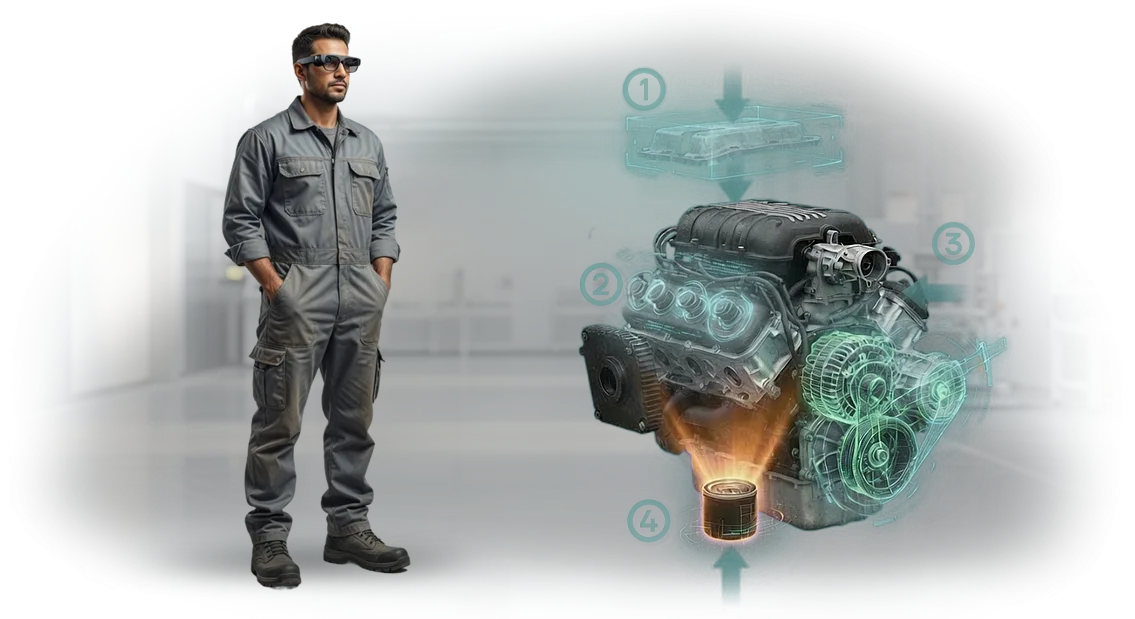
Equipment Sits Idle: Lack of AR Instructions in Mechanical Engineering
Expensive industrial equipment sits idle not because there is no one to service it, but because an employee has to spend half a day with a paper manual to figure out where the required component is and which tool to use on it.
In mechanical engineering, every half hour of such downtime costs the company not just time but also contract margin.
At the same time, the technician staff is limited, and how quickly equipment returns to the production cycle depends directly on the individual worker's skill level.
Digital instructions that work directly on the equipment solve this problem: the technician sees step-by-step prompts on a tablet screen or AR glasses and doesn't switch between the paper manual and the object.
The result — less downtime, fewer errors in repair and maintenance, higher utilization of the machine fleet.
We build such AR solutions for mechanical engineering: we record the process on your equipment, create interactive instructions, and integrate them into your existing employee training and work processes.
Such AR instructions pay for themselves through scalability: instead of waiting for an experienced setup specialist at every new site, you pass on their knowledge in digital form and get consistent work quality even with new personnel.
This is a step from "find an expert" to "hand the employee a tablet with a ready-made solution." Even an employee with minimal experience performs maintenance using clear visual prompts, and you stop depending on the human factor.
What AR Instructions Will Bring to Your Production
Production suffers losses when a new employee takes a long time to learn the equipment and when a machine sits idle due to a repair error. Paper manuals require interpretation, and an experienced mentor is not always nearby.
AR instructions put knowledge right in the worker's field of view — they see what to do and how, directly on the equipment.
The first benefit — faster personnel training. With AR instructions, the operator doesn't need to memorize operations in advance. A newcomer gets prompts right before their eyes and makes significantly fewer mistakes at the start. Ramp-up time shrinks from weeks to days, and mentors are freed up for other tasks.
The second benefit — fast equipment repair. Every minute of downtime is expensive. AR shows the diagnostic sequence, hidden components, and common errors, so the repair technician finds the cause of the fault faster and without unnecessary trips to reference materials.
The third benefit — reduced downtime. Fewer maintenance errors means fewer breakdowns and unplanned stops. Scheduled maintenance follows a clear script, and knowledge stays in the company even if an experienced employee leaves. Production gets a stable output schedule.
AR instructions don't replace the specialist — they enhance them. The investment pays off through faster training, higher repair quality, and predictable workshop operation.
AR Instruction Formats for Mechanical Engineering: From Training to Repair
Industrial equipment becomes more complex with every generation, and paper manuals are already outdated by the time of delivery.
For serial production, the key factors are pace and error-free execution of repetitive operations; for service — diagnostic and repair speed; for field crews — access to expertise on site.
One universal format won't work: what suits an operator at the machine gets in the way of an engineer disassembling a component.
That's why we distinguish three basic AR instruction formats and match them to a specific work area. Below — who each option is for and what business result it delivers.
| AR Instruction Format | For Whom | What It Gives the Client |
|---|---|---|
| Serial production | Operators, process engineers on assembly lines | Reduced training time, fewer errors in repetitive operations, consistent quality for every unit |
| Service and repair | Service engineers, field technicians | Fast diagnostics with step-by-step prompts, reduced equipment downtime and repeat visits |
| Remote assistant | Service managers, technical experts | Real-time connection of a specialist to the site, scaling expertise without travel |
For mechanical engineering, we often combine these formats on a single platform. Personnel work in their usual mode: a newcomer gets the sequence shown via AR prompts, an experienced master gets only checkpoints and deviation warnings.
Management gets transparent statistics in return: where training is faster, which operations take more time, and where failures occur more often.
This approach pays off in the very first cycle: downtime is shortened, dependence on niche specialists is reduced, and the client stops being hostage to the "human factor" on the line. The format is matched to the task, not the other way around.
How AR Instruction Development Works for Your Equipment
We designed the development process so you see the result at every step and can control the timeline. No "black box": you understand what's happening and make decisions based on facts. We work in stages, each of which ends with a clear deliverable for you.
Project Stages
-
Brief and task immersion. We study your equipment, procedures, and typical work scenarios. We pin down the goals: reduce training time, lower error rates, speed up repairs. The output — an agreed technical specification.
-
Plan and prototype. We define the instruction set, number of scenarios, and checkpoints. We create a prototype of the future AR instruction on one of the components — you see what the result will look like and can make edits before full development begins.
-
AR instruction development. We create step-by-step scenarios with 3D models, animation, and text prompts. Each step is anchored to the real equipment via markers or tracking. You receive a draft of the instructions for review.
-
Approval and refinement. You test the instructions on real equipment together with your specialists. We make edits to content, step logic, and presentation. We lock in the final versions.
-
Deployment and launch. We install the application on your devices or set up the remote assistant. We train administrators and operators and hand over documentation. We go live.
-
Support and evolution. We monitor usage, collect employee feedback, and update the instructions when procedures or equipment change. You can always order expansion to new components.
What You Get with AR Instructions
We work as a single contractor: from reviewing your technical documentation to launching finished AR instructions on the production floor. The package includes everything you need to get started — no hidden stages or additional purchases.
- Ready-made AR scenarios for standard operations, components, and maintenance procedures. The employee sees step-by-step prompts directly on the equipment and doesn't get distracted by paper diagrams.
- Access from tablets and smartphones — workers can use the instructions on ordinary mobile devices, without special headsets or desktop computers.
- Adaptation of your technical documentation — we convert existing procedures, drawings, and checklists into an interactive format that's easy for a newcomer to understand.
- Employee training and administrator briefings — your team starts working right away, without a long learning curve for a new system.
- Maintenance and updates — when process sheets change or equipment is replaced, we promptly update the AR scenarios.
- Technical support during operation — we answer employee questions and help expand the instruction library for new tasks.
In short, you get not scattered files but a working tool embedded in the production process.
After launch, you won't need to think about the "implementation" — people simply use the instructions, and you see the result as fewer errors and faster onboarding for new specialists.
Practical Example: Reduced Machine Setup Time by 30%
At a mechanical engineering plant, we encountered a familiar pain point: setup of modern Siemens machines took up to four hours, and every extra half hour of equipment downtime meant losses in production output.
Experienced setup technicians were overloaded, and training new employees required a lot of time. As a result, one machine downtime could delay deadlines across multiple orders at once.
We proposed replacing paper manuals with AR instructions: the specialist puts on a tablet or AR glasses and sees step-by-step prompts directly on the machine — where each component is, what sequence to follow, which parameters to check.
After a successful trial period, we deployed the system for five of the most complex setup operations.
The result exceeded expectations: average setup time dropped by 30%, and parameter entry errors fell by half. The plant was able to switch to new part batches faster and freed up key specialists' time for other tasks.
Six months later, the client came back — expanded the system to ten more workshop areas, and it now runs on all assembly lines.
For us, this is living proof: AR instructions in mechanical engineering are not an experiment but a working tool that pays off quickly. Every extra hour of machine downtime is expensive, so a one-third reduction in setup time becomes a strong argument for adoption.
Experience shows: proper presentation of information shortens the path from newcomer to independent work several times over.
How to Choose the Right AR Instruction Format for Your Task?
The AR instruction format depends directly on the task you're solving on the production floor. Step-by-step overlays that show the sequence of operations directly on the equipment work best for training new employees.
For repair and diagnostics, a remote assistant is more effective — an expert sees the same thing as the operator and guides them in real time.
So the first step isn't choosing the technology but clearly understanding where exactly time and money are lost: in personnel onboarding, downtime due to breakdowns, or assembly errors.
If your main pain point is a long ramp-up period, choose compact instructions for self-check and control: the operator performs operations step by step, and the system highlights errors.
If the issue is rare, complex repairs where a niche specialist's expertise is needed, the optimal choice is a remote format with video and annotations overlaid on the real equipment.
The difference between these scenarios lies in content volume, depth of integration, and budget — and we help you avoid overpaying for unnecessary options.
Our engineers analyze your production processes, talk to the people who will use the instructions, and propose a format that fits your task and budget. We don't push "the latest solution" — we pick the minimal sufficient option that starts paying off right after launch. You also get support at every stage, from content creation to workplace deployment.
As a result, you get not an abstract technology but a working tool that cuts downtime and speeds up training without interrupting production. Leave a request describing your task — we'll show you which AR instruction format fits your case and why.
Frequently Asked Questions When Ordering AR Instructions
Any manufacturing company has questions about implementing AR instructions: will we need to restructure processes, how long will launch take, and is it safe for employees? We answer the main ones below — most concerns are resolved at the brief stage.
Employees aren't ready for AR — how do we train them?
Training takes one short session — usually an hour including practice. The interface is built on prompts that appear right in the field of view, so the operator doesn't need to read manuals or memorize sequences. After the first shift, the team works confidently without supervision.
How quickly can we implement it, and will production stop?
On average, two to three weeks pass from brief to launch, and this timeline doesn't require stopping the workshop. We handle preparation and debugging on test components, and launch happens on schedule. During the pilot period, our specialists stay on call to fine-tune scenarios quickly.
What equipment will we need?
In most cases, the tablets or smartphones already available at the enterprise are sufficient. For high-risk areas and two-hand work, we offer professional AR glasses. We select the option based on your task — there's no need to buy extremely expensive hardware.
What if an employee skips a step or makes a mistake?
The instruction doesn't just show the sequence — it controls it. The system highlights the next step, warns about deviations, and blocks dangerous operations until the action is completed correctly.
Work history is recorded for analysis — you can see where difficulties arise and reduce the risk of defective output.
Every implementation starts with an audit of operations: we identify where AR will deliver maximum impact and support the project until a stable result is achieved. You get not only a system but also a support guarantee — scenario updates and consultations throughout the first year.Order AR Instruction Development and Get a Ready Solution
We know what AR instruction implementation looks like at a mechanical engineering enterprise: from auditing workstations to training personnel. That's why we take on the entire project turnkey — you get a ready solution, not a stack of technical documents.
Leave a request to order AR instructions: we'll hold a consultation, provide a preliminary estimate, and offer a pilot project on one site. Within a few weeks you'll see a working prototype and then decide whether to scale the solution to the workshop or the entire plant.
When you order development from us, you get:
- Preliminary estimate with no obligation — you know the budget and timeline before work even starts.
- Pilot project on one component — assess the effect on a real operation without stopping production.
- Deployment alongside current processes — we don't distract workers or break the schedule.
- Training for your team — engineers and process technologists will be able to extend the instructions themselves.
- Adaptation to your procedures — the instructions integrate into your existing training and control system.
- Post-launch support — we refine the solution based on feedback from operators and shop floor managers.
Write to us about which component or operation you want to convert to AR format. We'll show mechanical engineering examples, propose a demo scenario, and give you implementation timelines.
Start with a consultation — there's no obligation, but it will help you understand where AR will deliver the greatest effect.