

AR instructions for metallurgy: how to avoid downtime
Every hour of downtime for metallurgical equipment means tons of unproduced output and missed contract deadlines.
While the repair crew searches for the right drawing in a paper folder, flips through an instruction manual, or waits for a remote expert to respond, the plant loses revenue.
In metallurgy, where every stoppage of a furnace or rolling mill affects the entire chain of workshops, the speed of repair becomes a matter of survival.
Paper instructions and scattered PDF files also fail because equipment is modernized faster than documentation is updated. As a result, a repair technician spends time searching for the current diagram, rechecks components at random, or makes an assembly error.
The result is repeated disassembly, extra hours of downtime, and the risk of costly breakdowns due to human error.
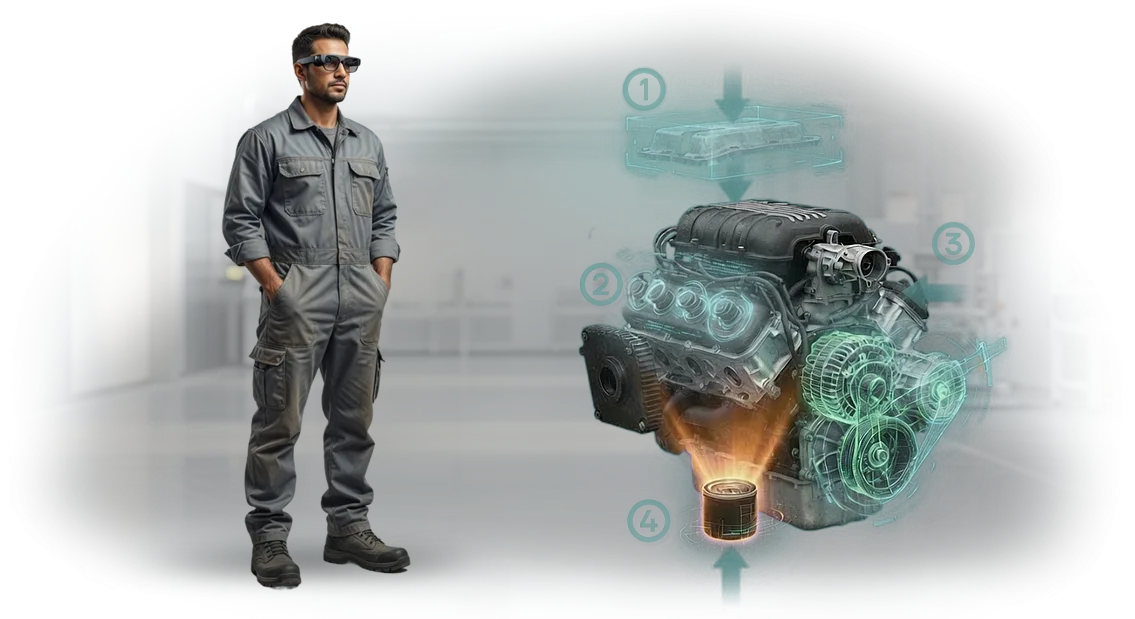
AR instructions solve this problem at the root. Instead of searching through paper catalogs, an employee sees a hologram of the component right on the equipment: prompts with the sequence of operations, highlighted parts, and warnings about dangerous areas.
This turns complex repair into a step-by-step process that is clear to both an experienced mechanic and a newcomer put on a night-shift component replacement.
For a metallurgical plant, this means radically reducing average repair time, fewer maintenance errors, and the ability to quickly bring new employees up to speed.
The dispatcher sees where the crew is, and a remote expert can connect to the headset and guide the on-site specialist—even from another city.
We help close the downtime issue exactly this way: we implement AR instructions tailored to your equipment, integrate them into existing procedures, and make repair stop being a bottleneck in your production.
What you get from implementing AR instructions
Implementing AR instructions in metallurgy delivers measurable results within the first weeks: faster repairs, fewer errors, calmer work with hazardous equipment. Here is what you get in practice.
Speed of repairs and maintenance
Every hour of downtime in metallurgy is lost revenue. AR instructions show prompts directly on the equipment: the worker does not flip through paper procedures but immediately sees the sequence of actions. This cuts diagnosis and repair time significantly.
The system highlights the required components and guides step by step, so even an uncommon breakdown does not stop production for long.
Fewer errors and rework
Much depends on the skill of the technician, and a mistake can disable an expensive unit. AR instructions eliminate omissions: the next step appears only after the previous one is confirmed. Fewer errors mean less scrap and fewer repeated repairs, and therefore lower maintenance costs.
Faster personnel training
A newcomer learns the job in days, not months: the system shows the sequence of operations and monitors their execution. Experienced specialists are not distracted from their tasks, and knowledge stays with the company rather than only in a veteran's head. This solves the labor shortage problem in production.
Occupational safety
AR instructions remind workers about protection and warn about hazardous areas. This reduces injuries and the associated downtime and compensation payments.
Implementation does not require reconfiguring production—instructions work with existing equipment and quickly pay off by reducing downtime and errors.
AR instruction formats for metallurgy and other industries
Metallurgical equipment operates under harsh conditions: temperature fluctuations, vibration, dust. A breakdown stops the workshop, and every minute of downtime turns into losses.
Therefore, the AR instruction format must match the situation: planned maintenance, emergency, or staff training.
We develop solutions for a specific production scenario, not a "one-size-fits-all picture." The customer gets exactly the tool that covers the workshop's task—from scheduled inspection to emergency repair.
| Format | Who it's for | What tasks it solves | What the client gets |
|---|---|---|---|
| Step-by-step maintenance with AR markup | Repair crews, maintenance engineers | Carrying out the planned schedule: visual prompts directly on equipment components | Less time for maintenance, lower error risk, no need for a scarce specialist |
| Emergency repair scenario | Operators, duty personnel | Rapidly resolving an emergency: sequence of actions, control of critical steps | Reduced equipment downtime, employee safety |
| Training mode with 3D diagrams | New employees, master trainers | Visual structure of components and mechanisms without opening the housing | Fast transition to independent work for newcomers, fewer errors "in the field" |
| Remote expert support | Mechanics, service departments, adjacent workshops | The specialist sees what is happening "through the eyes" of the employee, adds comments and arrows in real time | Solving a non-standard breakdown with your own crew, saving on traveling experts |
One production scenario — one convenient format: we tailor the instruction to the employee's level and the urgency of the task.
That is why digital assistants in metallurgy pay off at the very first equipment failure, and personnel work more calmly—there is always an accurate prompt in front of their eyes.
How AR instruction development proceeds, step by step
Developing AR instructions for metallurgy is not a one-off mockup but a sequential project with clear stages and checkpoints. We have structured the process so that you see the result at every stage and can influence the workflow without diving into technical details.
-
Brief and task audit. We record which equipment needs instructions, who will use them, and what result you expect. We study procedures, diagrams, and typical staff errors—this forms the basis of the future scenario.
-
Scenario design. We determine the sequence of steps: what the operator should see and do at each stage. Here we also decide where a simple prompt is enough and where step-by-step animation or action verification is needed.
-
Mockup and logic approval. We show you an interactive prototype of the future instruction, not tied to specific hardware. You see how the interface will look, check the step logic, and make edits before the main development begins.
-
AR instruction development. We build the working product: adding visual prompts, text explanations, video inserts, and a system for verifying correct actions. At this stage, we use professional equipment and proven tools—you get a stable picture across different devices.
-
Testing on real equipment. We test the instruction in the workshop or on a training stand: recognition accuracy, response speed, readability in poor lighting. We fix everything that prevents an employee from quickly and accurately performing the operation.
-
Launch, training, and support. We install the system, train your specialists to work with it, and hand over administrator rights. After launch, we stay in touch: we update content, add new components, and help roll out AR to other areas.
What is included in an AR instruction delivery
You receive not "raw files" but a ready-made package that can be put to work immediately. All materials are packaged so that employees master the equipment faster and you see results in the form of fewer errors and less downtime.
Below is exactly what is included in the delivery package—so you understand what you are paying for and what result you get.
- A complete set of 3D equipment models — interactive copies of components and mechanisms that can be rotated, enlarged, and disassembled without any risk to the machinery.
- Ready-made AR scenarios for typical operations — step-by-step instructions for maintenance, repair, and assembly that are displayed directly on the equipment.
- Technical documentation — a description of all scenarios plus instructions for configuring and adapting them to new tasks.
- User guide for specialists — how to work with the AR instruction, what gestures and commands to use.
- Training materials for personnel — a plan to quickly bring employees up to speed so that the first results appear on day one.
- Ready-to-download files for tablets and smartphones — AR instructions work on devices already available at the plant, with no need to purchase additional equipment.
- Warranty support and updates — during the cooperation period, we adapt content when procedures change or equipment is modernized.
Case study: how AR reduced downtime at a plant
Paper-based instructions have long stopped working when a crew is standing at a hot unit and needs to quickly find the cause of a stoppage.
At one metallurgical plant, downtime losses reached hundreds of hours a year—specialists spent time searching for the necessary documentation, corresponding with related departments, and waiting for an engineer with experience on that specific equipment model to arrive.
The plant's management was looking for a way to transfer knowledge directly "in the field" without pulling people away from their site.
We proposed a solution based on AR instructions: a process engineer points a tablet at a component, sees a step-by-step repair scenario with highlighted parts and prompts. The implementation took place on two rolling mill lines, and the first results appeared within a quarter. Our client received a measurable effect, not just "innovation for innovation's sake."
What changed at the plant
The main metric is response time to equipment stoppage. Average downtime shrank from two hours to fifteen minutes: the crew stopped waiting for a remote specialist and followed familiar steps directly from the instruction overlaid on the equipment.
There were fewer errors during changeover, and repeat calls for repair technicians dropped by a third.
The second result is the speed of onboarding newcomers. Previously, a mentor spent up to two weeks showing all the components and scenarios.
With AR instructions, a trainee works through standard operations independently in a couple of shifts, while an experienced employee monitors remotely.
The plant preserved the know-how of experienced specialists, converting their knowledge into digital scenarios that are not subject to human error.
Based on the pilot results, the plant's management approved rolling out AR instructions to four more production sites. We support the project remotely: we regularly update content, adjust scenarios for equipment changes, and train the internal team of process engineers.
For us, this confirms that AR in industry is a working tool for saving time and reducing costs—not a demo version.
Frequently asked questions about AR instructions
Every AR instruction implementation begins with questions about how it will affect workshop operations. Managers worry about downtime, staff qualifications, and safety. That is normal: new technology must prove its value before it is written into procedures.
We answer the most common concerns—briefly and to the point. If your question is not on the list, ask it directly: we will send a detailed answer and examples from metallurgy.
Won't employees struggle? Is it complicated?
The AR instruction interface is built like regular prompts: large steps, photos, and video overlaid on the equipment. Training takes hours, not weeks. A plant mentor stays on the shift—they show how to open the right instruction and what to do if the connection fails. Most operators begin working independently in the very first shift.
What equipment is needed to get started?
Tablets or smartphones with a camera are enough—we often use the ones already available in the workshop. There is no need to change production lines or stop machines. We select rugged cases and mounts if the environment requires them. Data processing happens on our servers, so you do not invest in purchasing powerful computers.
Doesn't AR distract from safety?
The instructions are designed so that the operator does not constantly look at the screen: prompts are delivered in the field of view and by voice. The worker keeps their hands free and remains aware of the environment.
We account for occupational safety standards and do not connect to equipment control systems—AR only shows information, while decisions remain with the person. This reduces the number of errors caused by misreading paper procedures.
How quickly are instructions updated when equipment changes?
We show how to replace a step or add a new component through a simple panel. Updating takes minutes, and new versions immediately appear for all employees—no need to reprint and distribute documents.
If the process changes, you record the changes once, and then every operator sees the current sequence of actions.
Order AR instruction development for your plant
Metallurgical equipment means the high cost of downtime and strict safety requirements. An AR instruction shows the employee prompts directly on the equipment: no need to flip through paper procedures or look for a mentor.
The employee finds the right component faster, makes fewer mistakes, and acts more confidently in an emergency. Every plant is unique—machines, procedures, staff training. That is why we design the instruction around your production process rather than offering a template.
We have been delivering industrial AR projects for more than 10 years, including metallurgy, and we work remotely—no meetings required. Leave a request: an engineer will contact you, clarify the task, and prepare a cost estimate. What your inquiry includes:
- Consultation: we analyze your scenario and choose the instruction format.
- Cost and timeline estimate: we provide figures before the start, with no hidden costs.
- Pilot project: we test the solution on one site without any risk to production.
- Staff training: we conduct a briefing and hand over materials for independent work.
- Scaling: we roll the solution out to other workshops and equipment types.
A pilot project is a way to see the benefits of AR in practice. You get a working prototype, compare operation times and error counts before and after, and make a decision based on facts, not promises.
Start with a consultation: it is non-binding but gives clarity on timeline and cost. Leave a request on this page—we will get back to you within one business day, provide a consultation, and prepare a cost estimate.
How to choose the right AR instruction format?
Choosing an AR instruction format is not a technical task; it is finding a solution that will pay off in your production.
The same process can be described in different ways: a short prompt on a tablet for a frequent operation, a step-by-step breakdown on the screen for a rare repair, or a two-way session with an expert for a non-standard situation.
Each option requires different investment, so you should start with the question "what do we want to get and how much are we ready to invest."
What should you look at first? Frequency of use: instructions for daily operations must be as simple and fast as possible, while rare complex jobs require deep detail and the ability to pause at any point.
Employee skill level: a newcomer needs a clear algorithm, an experienced worker needs only checkpoints. And, of course, scale: for one workshop a basic version is enough, for several sites—a centralized solution with content updates.
We help the client go from describing the task to choosing the format. At the initial consultation, we record the scenario: where equipment failure occurs, who will use the instruction, what their skill level is, how often the operation takes place.
Based on this, we offer two or three suitable options with a clear difference in cost and effect—so that the decision is made in the language of business, not technical details.
In the end, you get not a "project for the sake of technology" but a working tool that reduces downtime, accelerates time-to-competence, and lowers the number of errors.
The right format is already half the success, because it fits into existing processes and pays off in the very first season of operation.