

Oil and Gas Industry Loses Time and Money on Outdated Instructions
In oil and gas production, every hour of equipment downtime results in direct losses: output drops, schedules slip, and repair costs grow.
At the same time, equipment repairs are often delayed for a simple reason — the crew lacks quick access to current information, and the specialist wastes time searching for the right section in the documentation.
Paper instructions and old PDF procedures can't keep up with real-world operation.
Diagrams don't match the specific equipment modification, process charts are outdated, and the repair technician's experience is passed on "by word of mouth." In a stressful situation, this leads to mistakes that result in emergency shutdowns — and at a hazardous production facility, the price of a mistake is measured not only in money but also in the safety of people.
The problem is systemic: the more complex the equipment, the greater the dependence on individual employee qualification. If an expert leaves, the crew loses speed, and training a newcomer takes months.
We close this gap: we turn paper instructions into clear step-by-step prompts that work right at the facility, help avoid downtime, and protect production from costly errors.
What Implementing AR Instructions Delivers to the Customer
The oil and gas industry involves expensive equipment and high risks. Even experienced personnel make mistakes during repairs, and training newcomers takes weeks and requires a mentor's constant presence.
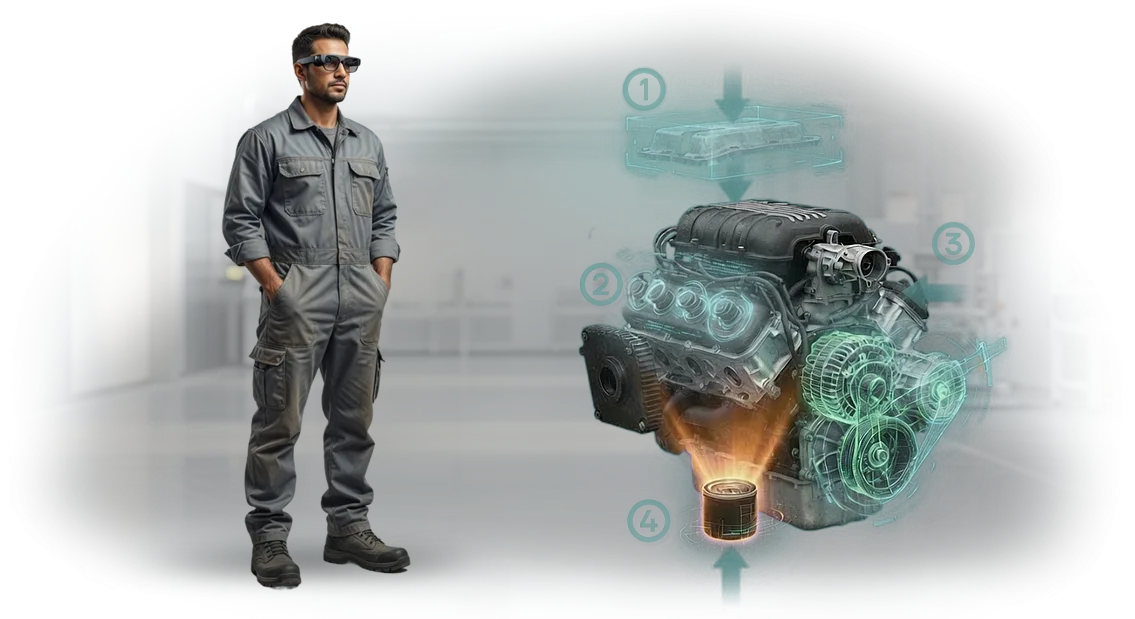
Implementing AR instructions changes the process: the employee sees step-by-step prompts directly on the equipment instead of flipping through paper procedures.
Training speed is reduced several times over: instead of studying hundreds of pages of documentation, a new worker performs the task immediately, receiving visual guidance right in their field of view. This is especially important for oil and gas facilities where every minute of downtime is costly.
At the same time, the number of errors decreases — the system highlights the correct sequence of actions and warns about critical steps, preventing important steps from being skipped.
Repair safety improves through remote support: an expert from the head office sees the same thing as the employee on site and can guide them in real time without being physically present. This format reduces specialist travel, speeds up troubleshooting, and reduces equipment downtime.
Personnel efficiency also grows among experienced employees: they stop wasting time searching for paper instructions, approvals, and clarifications. AR prompts are always up to date, account for specific equipment units, and are updated together with procedures.
For oil and gas enterprises, this means more predictable repair work and fewer disruptions in the production cycle.
We have been developing AR solutions for industry for over 10 years. Our approach is professional equipment and fine-tuned tools that deliver consistent results even in the harsh conditions of oil and gas facilities.
The customer gets not just technology but measurable growth in personnel efficiency and protection from costly errors.
AR Instruction Formats for Oil and Gas
For the oil and gas industry, one universal instruction format doesn't work: tasks, conditions, and staff skill levels differ.
One specialist needs a quick prompt during a repair, another needs visual training for a newcomer, a third needs contact with an expert on the other side of the country.
That's why we build a system of several AR instruction formats that cover each task and combine easily with one another.
| AR Format | For Whom | What It Delivers to the Client |
|---|---|---|
| Interactive 3D models | Engineers, process technologists, designers | Allow disassembling a unit, viewing internal structure and assembly sequence without physical disassembly — reduces diagnosis time and lowers the risk of errors |
| Step-by-step AR instructions | Repair and maintenance personnel | The specialist sees prompts directly on the equipment: what to unscrew, where to press, in what order. Faster return to normal operation, less downtime |
| Video instructions with AR overlay | New employees, operators | Visual training without stopping production — the employee follows the on-screen overlay and starts working independently faster |
| Remote AR assistant | Service crews, contractors at remote sites | An expert sees what the specialist on site sees and guides them remotely. Savings on business travel and faster response time to emergencies |
This set of formats is useful for training, operation, and service maintenance alike. The customer selects the formats that cover their specific tasks, and we assemble them into a single system built around the existing procedures and equipment.
The combined approach delivers a double effect: instructions don't become outdated when equipment is modernized, and employees get access to up-to-date information at the moment they need it.
This reduces dependence on experienced mentors and lowers the number of errors caused by human factors.
How an AR Instruction Implementation Project Proceeds
Implementing AR instructions at oil and gas facilities is not purchasing an application but a managed process: from task audit to on-site support.
We've completed dozens of projects and built a transparent framework — you always understand what's happening, what the deadlines are, and what result you'll get at each step.
-
Brief and audit. We study the equipment fleet, procedures, and points where employees most often stop work for consultations or make mistakes. We identify areas where AR instructions will deliver quick results — reduced downtime, fewer errors during maintenance.
-
Scenario approval. Together with your process technologists and operating personnel, we describe step-by-step actions: what the operator sees, what data appears directly on the unit, in what order operations should be performed.
-
Prototype and demonstration. We build a short demonstration fragment for the selected equipment. You evaluate usability, speed, and regulatory compliance on a real example before full-scale development.
-
Pilot project. We launch AR instructions at one site or with one crew. We measure the impact: time per operation, number of requests for help, number of errors. Based on the results, we refine scenarios and the interface.
-
Fleet-wide rollout. We scale the solution to the remaining equipment units and sites. We configure integration with your document management system and access rights for different roles — from operator to shift supervisor.
-
Personnel training. We conduct on-site or remote training, provide reference cards and internal procedures. Employees start working with AR instructions without stopping the production cycle.
-
Support and updates. We update content when procedures change, add new units and instructions, and advise the technical service. If needed, we extend functionality for new tasks in your operation.
Thanks to this format, you don't buy a "pig in a poke": first you see a pilot on your own equipment, then you make a scaling decision based on numbers — not promises.
What's Included in the AR Instruction Delivery
You receive not "files with 3D models" but a ready-to-use working tool that employees will start using in the first days. The package includes everything you need: from the application to training and technical documentation. Below is the delivery scope as it appears to the customer.
Standard Delivery Package
- AR application for tablets and smartphones — the employee points the camera at the equipment and sees step-by-step prompts directly on top of the unit. Works without internet, so it's suitable for workshops, wells, and remote sites.
- Interactive guides based on your procedures — not abstract instructions but algorithms that mirror your enterprise's process charts. Each step is accompanied by highlighting of the relevant element and a warning about potential errors.
- Content management panel — your engineers make changes to instructions themselves: modify operation sequences, add notes, update standards. No need to order custom development every time.
- Personnel training and instructor preparation — we conduct training for operators and repair crews, and also separately prepare your employees to train new shifts without our involvement.
- Full package of technical documentation — system operation manual, update procedures, access rights description, control log templates. Everything required for quality departments and audits.
- Integration with your maintenance system — we record the fact of instruction completion, time, and results directly in your accounting system. Management sees who completed training or performed scheduled work, and when.
All components are adapted to your equipment fleet and operator skill levels. We don't deliver a "boxed" product — we configure scenarios, dictionaries, and control procedures around your production processes.
After launch, you get a unified work execution standard: at every site, with any shift composition, at any employee qualification level. This reduces the risk of errors and speeds up the onboarding of new people — and those are usually the tasks facing the customer.
Case Study: AR Instructions Reduced Downtime for Oil and Gas
At an oil and gas production facility, every hour of downtime means losses. When a pump breaks down, the repair crew waits for an external expert to arrive: they record video, coordinate actions, double-check. We addressed this pain point differently.
For an oil and gas operator, we developed AR instructions that turn pump repair into a predictable step-by-step process. On a tablet or smart glasses, the units are highlighted directly on the equipment housing: what to unscrew, in what sequence, what to pay attention to.
The dispatcher sees the same image and confirms each step remotely — the crew is never left without supervision.
Results That Show Up in Money
Pump repair time dropped by 40%, and equipment downtime went from 12 hours down to 5, because the need to wait for an expert was eliminated. 90% of operations were completed by the repair crew on the first attempt, without repeated engineer callouts.
The instructions themselves run on standard tablets — the customer didn't have to buy specialized devices.
The customer came back to us again: we're scaling the same AR instructions to other equipment types. That's what demonstrates practical value — the technology proves itself not in a presentation but on the workshop floor.
our team implemented this case for an oil and gas sector operator. If your specialists lose hours waiting and dealing with paper instructions — let's discuss your repair scenario and show how AR can speed up the work.
Frequently Asked Questions About Implementing AR Instructions
AR instructions are a clear technology, but everyone has questions before launch. Most often we're asked about compatibility with existing equipment, personnel training, and data security. Below are answers to what usually concerns customers.
Is the system compatible with our equipment?
Yes, integration doesn't require a full replacement of the fleet. We use professional industrial tablets and a server architecture that connects to your existing systems.
All we need is access to technical documentation and procedures. Launching doesn't require stopping production or involving developers for every unit. Adaptation to your specifics takes from two weeks.
How much time does employee training take?
The basic scenario is mastered in one day. A mechanic sees step-by-step instructions right on the screen and follows the animated prompt. Our goal is to simplify the work, not add another complex tool.
Commissioning and verification at your site usually takes 2-3 days. During this time, operators and process technologists get hands-on experience with the system on real units, and you receive an operating manual for your internal procedures.
How is data security ensured?
All information about your procedures and drawings is stored on your own network perimeter or in a secure cloud under contract. Access is role-based: a supervisor sees one set of data, a director sees another, and an external contractor sees only their assigned area.
We don't share data with third parties and don't use it to train third-party models. For the oil and gas industry, this is standard practice that satisfies internal security requirements.
What happens after project handover? Will you just leave?
No, we support the project after launch. The first month of support is included: you get technical support during business hours and prioritized bug fixes.
After that, it's your choice — we work on a service maintenance model: update instructions when procedures change, add new units, and help with training new employees. On average, customers renew support because it's cheaper than keeping a dedicated AR specialist on staff.
What if the instruction is needed for unique equipment?
This is the most common scenario in oil and gas. You don't have a standard machine off the shelf but a complex unit with its own specifics. We take your drawings, process charts, and procedures and digitize them into step-by-step scenarios.
If documentation doesn't exist, our engineers travel to the site and capture the work process together with an expert. The result is a clear instruction that even a new employee without experience will understand.
Bottom line: implementing AR instructions is not a technology question but one of process organization. We take on adaptation, training, security, and support. All you have to do is define the task.Order AR Instructions for Your Equipment
Leave a request for AR instructions — and we'll prepare a tailored proposal for your equipment within a few days.
We'll start with a short consultation: we'll identify which units and operations cause the most questions for your personnel, where errors happen most often, and which training format suits you best.
After your request, you receive:
- A consultation with a technical specialist on your tasks — no abstract promises, just a practical review.
- A cost calculation for your equipment fleet: accounting for the number of instructions, scene complexity, and the types of devices used by your staff.
- Demo access to a ready-made AR instruction example for your industry — see how it works before paying.
- An implementation plan with clear timelines and stages — from pilot site to scaling across all locations.
- A support guarantee after launch: instruction updates, technical support, and refinements for new procedures.
The implementation is designed so that production doesn't stop and employees aren't pulled away from work for long. We adapt instructions to your procedures, train local administrators, and hand over clear documentation.
The next step is simple — leave a request on this website. We'll contact you within one business day, answer your questions, and prepare a proposal you can immediately discuss with management and include in the budget.
How to Choose an AR Instruction for Your Oil and Gas Tasks?
Choosing an AR instruction format for oil and gas starts not with the technology but with the specific task: where will the employee use the prompt — during scheduled inspections, emergency repairs, or newcomer training?
At remote sites and in hazardous zones, what matters is the speed of access to the right information and the minimum number of actions to get it — not the number of visual effects.
So the first criterion is the employee's work scenario, and only then the device and the prompt's appearance.
The second criterion is on-site conditions: working in protective suits, poor lighting, dirt, or vibration. In oil and gas, an instruction should be designed so it doesn't distract attention from the equipment and doesn't require a touchscreen where hands are busy.
Here, voice prompts, visual 3D diagrams, or a step-by-step mode with action verification win — the choice depends on how exactly the operation is performed.
The third is staff skill level. An experienced mechanic sometimes needs just a brief diagram and checkpoints, while a new employee needs a detailed sequence with explanations and verification.
A good AR format allows flexibly adjusting the depth of prompts for each user without rewriting the entire instruction.
When choosing a format, we start from your specifics: we analyze procedures, typical errors, and the speed at which the employee must perform the operation.
We propose a format that addresses exactly your task — from a simple inspection to complex repair without stopping production. As a result, you get an instruction that reduces the risk of errors and cuts downtime, not just a flashy tech demo.