

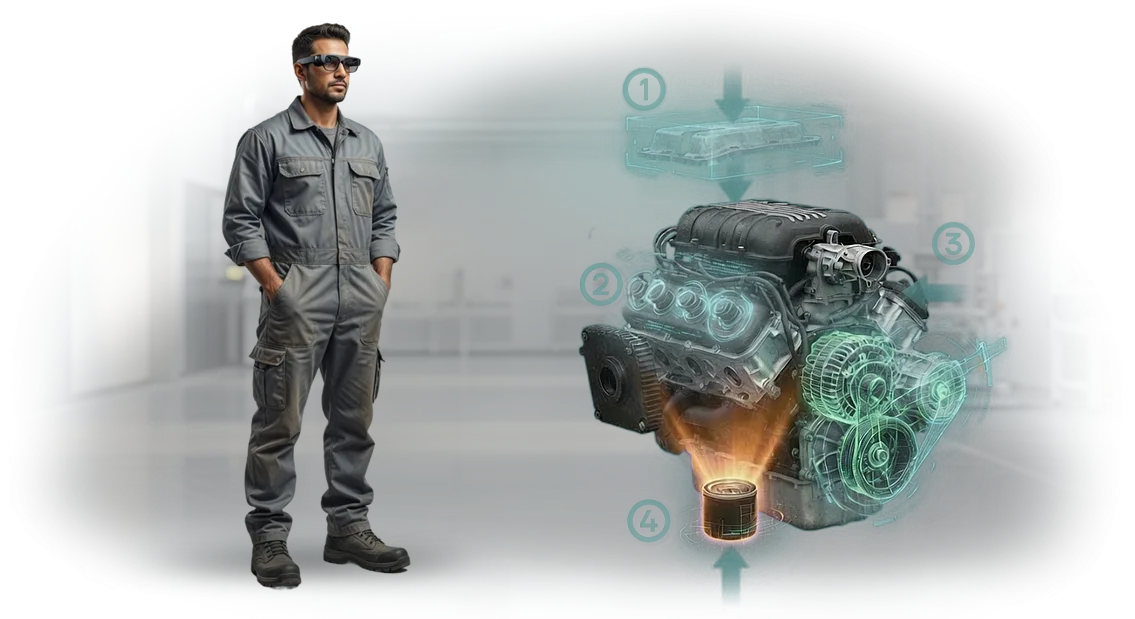
Why losses keep growing in port operations without AR instructions
Port operations have long ceased to be just “loading and unloading.” They are a complex chain of actions where an operator’s mistake at any stage leads to cargo damage, mechanism breakdown, or downtime for the entire terminal.
When equipment stands idle and a ship waits, every minute turns into direct losses, and the port’s reputation suffers from missed deadlines.
The problem becomes especially acute when dealing with rare or non-standard operations. Standard situations are handled automatically, but when a procedure is deviated from, the operator has to search for information in paper instructions, call engineers, or act at random.
That is exactly when those “human” errors occur that result in expensive repairs and prolonged equipment downtime.
Another pain point is staff training. New port employees require a long internship: briefing, mentor, on-the-job practice. These are weeks when a person does not generate profit, while management pays for their salary and the risk of a newcomer’s mistakes.
Staff turnover at terminals is also inevitable, and every departure of an experienced operator is lost expertise that has to be rebuilt from scratch.
Wesolve this problem by developing AR instructions that work right on site. The operator sees hints, step sequences, and control zones in their field of view without being distracted from work.
Training time shrinks, the number of errors drops, and equipment downtime stops being a headache for the technical director. Implementing such systems is not a tech fad but a way to recover the money the port loses every month on disruptions and retraining.
What implementing AR instructions will give your team
Faster training and quick adaptation
New port terminal employees often go through week-long courses before they are allowed to work. With AR instructions, this period shrinks to a few days: the operator puts on glasses or a tablet, sees step-by-step hints, and immediately applies them in practice.
Training takes place right at the workplace, without separating employees from real tasks. This reduces the load on mentors and accelerates reaching full productivity.
Fewer errors
When operating a crane or handling containers, the price of a mistake is high. AR hints highlight the correct components, warn about an incorrect sequence, and record the completion of each step. The system monitors each step and does not let important operations be skipped.
As a result, the number of errors among new employees drops to the level of experienced specialists.
Remote assistant
When a non-standard situation arises on site, it is enough to call an expert through the AR system. The mentor sees the image from the employee’s camera, places markers, and uses voice to suggest what to do.
This speeds up problem-solving many times over and reduces equipment downtime. Such support works from anywhere in the world, which is especially important for distributed port complexes.
Brand recognition growth
Implementing AR instructions is not only about efficiency but also image. A company that uses modern technology is perceived as a reliable partner and attracts qualified specialists.
Investment in such solutions pays off not only through savings but also through a stronger reputation. Clients note increased interest in vacancies after demonstrating AR technologies.
We have been developing AR systems for industry and port logistics for more than 10 years. We know how to integrate them into existing infrastructure and guarantee support after launch.
AR instruction formats for port operations: how to choose for your task
An AR instruction for a port is not just a “picture over the screen” but a working tool that affects the speed of crane repair and the safety of people at the terminal.
Personnel work in shifts, equipment does not stop — so the instruction format must match the specific task: inspection, repair, training, or remote assistance.
We have divided AR solutions for port operations into three basic formats. Each one covers its own class of tasks and fits into the existing logistics without replacing equipment or reworking processes.
| Format | For whom | What it gives the client |
|---|---|---|
| Mobile AR (tablets, smartphones) | Repair and inspection crews moving around the entire port area | The instruction is always at hand: the technician sees hints directly on the equipment, does not look for drawings or call the dispatcher — repair time is reduced |
| AR headsets | Specialists working at height, in the hold, or in a dangerous zone where hands are occupied | Free up hands and allow receiving step-by-step hints without distraction — fewer errors and accidents |
| Stationary AR systems | Checkpoints, inspection zones, regular training at the terminal | Work on a schedule, record the progress of the check, and do not depend on the duty instructor — stable quality of control |
To choose a format, look at the task. If it is repair across the entire area, a mobile tablet is enough. For high-altitude work, take a headset. For regular inspection of the same position, a stationary point is more effective.
We select and combine formats to fit the logistics of a particular port: one position may have a headset, the neighboring one a tablet. This way you get AR instructions that solve a real problem rather than merely demonstrating technology.
Stages of AR instruction development: from brief to launch
Developing AR instructions is not just creating an application but introducing a new system into your work processes. Wehave gone through dozens of projects for industrial enterprises, including port operations, and have built a clear six-stage process.
You always know at what stage the project is, what is ready, and what will happen next — this allows you to plan the budget and resources without surprises.
-
Brief and immersion in the task. We collect information about your equipment, procedures, and typical staff errors. This allows us to accurately determine which operations require AR support and avoid unnecessary work.
-
Approval of the scenario and instruction structure. Based on the brief, we propose a plan: which components and what the step-by-step hint will look like. You approve the scenario before development starts — this eliminates rework and saves time.
-
Prototype development. We create a minimal version with key steps so you can evaluate the logic and usability on real equipment. We make changes quickly and inexpensively — before large resources are invested.
-
Full version implementation. We add graphics, animations, voice prompts, and a recognition system. At this stage, you receive a full-fledged AR instruction ready for testing.
-
Testing on your site. Together with your employees, we check the scenario in real conditions — on cranes, conveyors, or ship equipment. We address all comments before launch to avoid downtime.
-
AR implementation and training. We install the system, configure access, and train staff. We transfer administration rights so you can update instructions on your own, and we supplement them as needed for new procedures.
What is included in the delivery of AR instructions for the customer
Every AR instruction project for port equipment is delivered as a complete package, not just a compiled application. You get everything needed for full operation: from the scenarios themselves to training materials and documentation — and you do not depend on us after launch.
The standard delivery includes:
- Ready-made AR scenarios for key equipment operations. The operator sees step-by-step hints directly on the object, without being distracted by paper instructions and diagrams.
- Personnel training materials — short memos and video reviews that accelerate employee onboarding and reduce the number of errors.
- Project source files — all components that you can modify or supplement with your own team.
- Update instructions — a clear procedure for adding a new scenario or changing equipment parameters without involving developers.
- Technical documentation — a description of the system structure and device requirements so your IT department can independently deploy and maintain AR instructions.
- Integration recommendations — how to embed AR into current maintenance and repair processes, taking into account your organizational structure.
This approach shortens implementation time and makes the project transparent: you immediately see the scope of work and understand how to use the result in daily activities. We stay in touch after handover — we help adapt the package if procedures change or new equipment appears.
Case: how AR instructions reduced staff errors by 30%
An operator of the sea terminal “Northern Port” faced a typical industry problem: personnel errors in servicing cranes and loading equipment led to downtime and emergency stops.
Paper instructions were ignored, and training new mechanics took weeks — during this time the equipment ran at its limit.
We developed AR instructions that overlay step-by-step prompts directly onto the equipment: the employee sees which part to take, in what order to unscrew it, and how to install it correctly. The system itself checks each step and warns about an error before it becomes expensive.
Implementation results
Over six months, the number of errors during repair and maintenance decreased by 30%, and the time to bring a newcomer up to speed dropped from two weeks to three days.
Downtime caused by incorrect actions decreased by about 40% — this allowed the terminal to receive more ships without increasing headcount.
“Previously, training a mechanic took two weeks, but after the implementation of AR instructions, he works confidently by the third day. Errors have practically disappeared,” says the head of the terminal’s technical service.
After the pilot project at three sites, the customer expanded AR instructions to the entire equipment fleet. This is the best indicator that the technology brings measurable benefits: fewer errors, faster training, less downtime, and higher throughput for the whole terminal.
How to choose the right AR instruction format for your task?
The choice of AR instruction format starts not with technology but with the task your personnel solves every day.
Port operations are characterized by a wide range of scenarios: from a quick visual hint during a routine inspection to a complex sequence of actions during an emergency equipment stop.
If an instruction takes more than three seconds to understand, the operator simply will not use it, especially in conditions of noise, vibration, and limited visibility.
The second factor is the specific requirements of your site. Do you need to control the completion of each step in real time? Should the system work autonomously in a weak-signal area?
These questions determine which format is suitable: compact step-by-step cards for regular repairs or a full remote assistant with video communication for non-standard situations.
Our practice shows that 80% of tasks are covered by the first format, but critical emergency cases cannot do without a live expert.
The third point is the speed of adaptation to staff turnover. In ports, turnover of crane operators and mechanics is high, and training time is limited.
The AR format allows a new employee to act confidently on the very first day, following visual markers on the equipment rather than reading a thousand-page manual. This reduces the number of errors in digital operation accounting and improves occupational safety.
We make the final choice together with you after a short audit: we determine the area, equipment type, and criticality of tasks. Then we design one or two formats that cover 90% of personnel needs without overloading with functionality.
The remaining 10% are emergency cases, for which a single call to a remote specialist is enough. This way you get a solution that pays for itself from the first month, not an expensive toy for display at exhibitions.
We answer questions about reliability and implementation of AR instructions
Any responsible manager before implementing AR instructions asks three questions: will the equipment fail, who will help if something goes wrong, and will it work on our equipment.
This is normal — we ourselves have been testing solutions in real production for ten years, so we are ready to honestly answer each of them.
What happens if AR equipment fails?
We use professional industrial devices that undergo stress tests in workshop, port, and open-area conditions. During projects, we provide backup kits and, if necessary, replacement within one or two days. Your production process will not stop because of equipment.
How is support organized after launch?
Each project is assigned a manager who knows your specifics. They are available by phone and messengers, and for difficult situations an engineer visits. We update instruction content when your equipment or procedures change — you do not remain alone with outdated documentation.
Is AR compatible with our equipment?
Before starting, we conduct an audit: we check the types of units, working conditions, noise level, lighting, dust and moisture protection. We select devices and mounts so that they work correctly in your environment.
If you need integration with your systems, we do it through open protocols — without vendor restrictions.
Get a cost estimate and an implementation plan for AR instructions
After your request, you receive not a scattered commercial proposal but a ready implementation plan: cost estimate, timelines, and payback stages for your equipment fleet. We take on the entire path — from audit to launching AR instructions at the site.
Stages after your request
- Request and brief — we call you back within one business day to clarify equipment types and operator tasks.
- Operations audit — we study documentation, procedures, and real scenarios at your site.
- Cost and plan calculation — we prepare a transparent estimate and schedule within 2–3 business days.
- Approval — we fix the scope, timelines, and acceptance criteria; details are adjusted before signing.
- Pilot site — we create a working prototype at one unit so you can see the result before scaling.
- Launch and support — we roll out instructions across all sites, train staff, and stay in touch.
Results of your request
- Exact cost for your equipment fleet — no hidden surcharges.
- Implementation plan with dates, stages, and responsible persons.
- Effect calculation: training time, number of errors, and downtime.
- Equipment recommendations — what to buy and what you already have.
- A pilot site proposal to test in practice.
- A support agreement for the first months of operation.
Leave a request — we will prepare an estimate and implementation plan for your port operations. We will start with an audit and show where AR instructions pay off fastest.