

Errors in electric motor production: AR instructions versus downtime
What stands behind every error in electric motor production? It is not just a damaged part. It is a conveyor stop, missed delivery deadlines, rework of assemblies, and downtime paid for out of profits.
Assembling an electric motor requires a precise sequence of operations: even an experienced worker under pressure can mix up steps, and a newcomer spends weeks training before reaching the required speed.
The result is familiar to every production section: defective samples, disassembly, reassembly. The more complex the motor model, the higher the risk of error. And when several new employees are on the line at the same time, the frequency of downtime grows. The customer pays twice — for rework and for lost time.
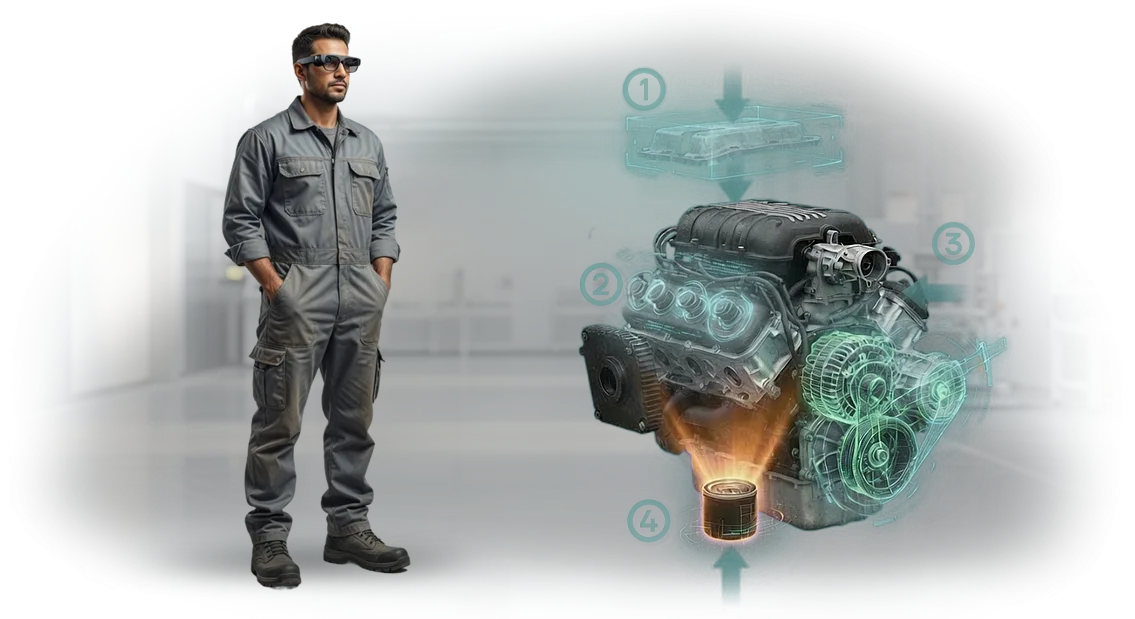
AR instructions work differently. The worker sees not a paper diagram in front of them, but a step-by-step hint right on the equipment: where to place the part, what torque to apply, in what order to connect the assemblies.
Errors are reduced because the sequence is set by the system, not by the master’s memory. Personnel training is cut from weeks to days — a new operator works more confidently and faster from the first practical day.
Our practice at our team confirms: companies that have implemented AR instructions on the assembly line reduce downtime and decrease the share of defects already in the first months.
The system does not require complex infrastructure — professional glasses or tablets already available in production are used. Instructions are easily updated for a new motor model without reprinting regulations.
Personnel training ceases to be a bottleneck, and assembly quality ceases to depend on the fatigue or experience of a particular employee.
AR instructions are not an experiment for tech enthusiasts, but a working tool that pays for itself through reduced downtime and consistent quality of finished motors.
Benefits of AR instructions: training speed and assembly quality
Electric motor assembly is a process where an error in one assembly unit results in expensive defects at the output. At the same time, new employees come often, and the workshop has no time for their full training.
An AR instruction displays hints directly in the worker’s field of view: he sees which part to take, where to install it, and with what force to tighten it. No drawings or paper regulations — only the necessary actions at the right step.
Fast training without stopping production
An employee masters the operation in a few shifts, not weeks. The mentor does not hover over every newcomer — the system itself prompts the next step and shows complex assemblies in 3D.
This is especially important with frequent staff rotation, typical for electric motor manufacturing.
Reduced errors and quality control
Each step is recorded, so skipping an operation or mixing up a part is impossible — AR simply will not let you move forward until the action is performed correctly.
This reduces the percentage of defects and complaints, and quality ceases to depend on the fatigue or experience of a particular assembler.
Process transparency for the manager
The manager sees at which stage delays occur and where employees make mistakes more often. These are not subjective assessments of masters, but objective data — they can be used to adjust the technical process and prevent defects before they become a complaint.
As a result, you get a manageable production process instead of guessing based on the fact of defects.
All these advantages are already working at enterprises where we have implemented AR solutions. We adapt the system to your technical process and specific electric motor model so that you get predictable assembly quality and peace of mind for every produced unit.
AR instruction formats for electric motor production
Every electric motor production facility suffers losses at the same stages: a newcomer takes weeks to learn assembly, an experienced mechanic must wait for a setup specialist to arrive, and technologists explain the same operation ten times.
An AR instruction solves all three problems — but only if the right format is chosen for the specific task, not just a headset is purchased.
Below are four augmented reality formats that we implement at factories and in service departments. They cover typical scenarios: working with newcomers, scheduled maintenance, urgent repairs, and disassembly of a complex assembly unit.
The table shows — who this format is for and what it gives the manager in terms of changes on the line.
| Format | For whom and when | What production gets |
|---|---|---|
| Step-by-step instructions | New employees, operators at machines | The employee sees the next step right on the equipment — fewer errors and faster reaching the planned standard |
| 3D animations | Engineers, technologists during training | The structure of the assembly unit and the assembly order are clearly shown without opening the housing — the group understands faster and remembers for a long time |
| Remote support | Repair crews at remote sites | The expert sees what the mechanic sees and guides them with arrows and annotations — repair is reduced from days to hours |
| Interactive diagrams | Chief mechanic’s department during maintenance | Disassembly, diagnostics, and assembly with step highlighting and part verification — the procedure is fully followed, omissions are excluded |
How AR instruction development works: project stages
Electric motor assembly is a process where an error costs a lot: it is defects, line downtime, and missed deadlines. Experienced mentors are busy, and newcomers learn for months, and it is here that AR instructions provide real savings.
We structured the development so that from day one you understand what you will receive, in what time frame, and what each stage will cost. No “black box” — only transparent steps, approvals, and result control at your site.
- Brief and project goals. We fix areas of responsibility, target operations, and success criteria: reduction of training time, reduction of defects, speed of reaching the line.
- Audit of equipment and scenarios. An engineer visits the production site or works with your documentation, identifies key control points and bottlenecks in current instructions.
- Approval of structure and logic. You see the step-by-step scenario of the future AR instruction and approve it before development starts. Edits at this stage do not affect deadlines.
- Content implementation. We create 3D models, animations, and an interface, and check them on your samples. You receive a demo version for evaluation, and only after that do you launch the final development.
- Test operation. A pilot group of employees works with the instruction — we collect feedback, make adjustments, and make sure the result is understandable to the most inexperienced specialist.
- Launch and personnel training. We deploy the system on your devices and conduct a short orientation for operators and technical specialists.
- Post-launch support. We monitor metrics in the first weeks and help with updates and content refinement if the technological process changes.
The entire cycle takes from three to eight weeks depending on the number of operations. You receive a working tool, not a report on “work done” — simply because each stage is agreed upon and tested in practice.
What is included in the AR instruction delivery: a complete package for the customer
After the project is completed, you receive not just an electronic instruction, but a ready-made working tool integrated into your production processes.
The package includes everything necessary — from the AR scenarios themselves to personnel training and documentation for independent system support.
- Ready-made AR instructions for key operations. Step-by-step scenarios for assembly, adjustment, and maintenance of electric motors. The worker sees hints directly on the equipment, which reduces the number of errors and speeds up task execution.
- 3D models of your equipment. Accurate digital copies of machines and assembly units on which the instructions are built. They also become the basis for presentations, catalogs, and further training programs.
- Training materials for personnel. Ready-made onboarding programs for newcomers and professional development programs for experienced employees. They include training scenarios, tests, and materials for knowledge verification.
- Technical documentation. Maintenance regulations, operating manuals, and content update procedures. All documents are structured and available to employees at the right moment.
- Integration with your systems. We embed AR instructions into your environment: a distance learning system, knowledge base, or request system. This allows assigning tasks, tracking employee progress, and storing training history.
- Administrative panel for your team. A simple interface without developer involvement: add new operations, update 3D models, change scenarios, and view usage statistics.
- Training for your specialists. We transfer knowledge to your team so that they can independently maintain and develop the system. As a result, the project becomes self-sufficient and independent of external contractors.
Thus, you receive a turnkey project: employees work with visual instructions, training materials are already implemented, and your team knows how to manage the system. We remain in touch for planned support, consultations, and refinements for new tasks.
Case study: how AR instructions reduced assembly time at a factory
At one electric motor manufacturing plant, we encountered a classic situation: assembly of a complex assembly unit took more than an hour, and new employees took weeks to build up speed.
Paper instructions were at every workstation, but even experienced operators got lost in them. After implementing the AR remote assistant system, the production process changed within a few weeks.
Results in numbers
On a line of 12 operators, assembly time for the unit was reduced from 55 to 34 minutes — that is 38% less time for each motor. The number of installation errors dropped by a quarter, and training for a newcomer now takes three days instead of three weeks.
The chief technologist of Electromash JSC attributes the effect to the fact that the worker sees the hint directly on the part and does not switch to the instruction.
“Errors have become rare: even yesterday’s trainee assembles as if they have been working at the site for five years. For us, this is not a gadget, but the speed and stability of every shift,” the technologist summarized.
Effect for the customer
After the pilot, the factory scaled the solution to three more assembly sites: the average line output grew, and the number of internal complaints decreased by 30%.
The customer separately noted the fast payback: there is no need to reprint instructions with every design change — data is updated in the system, and workers always see the current process.
For an electric motor manufacturer, this means predictable assembly speed, fewer losses from defects, and easy adaptation of new employees. The same principle can be easily transferred to other workshops — from winding to final assembly.
How to choose an AR instruction format for a specific operation?
The choice of an AR instruction format starts not with technology, but with the operation itself: what exactly the employee does, how often the action is repeated, and what the price of an error is.
For simple steps like “connect the cable,” a short hint is enough — text or an icon right on the equipment. But complex assembly of a unit or fault diagnosis requires step-by-step animation that shows every move and does not allow deviating from the procedure.
Accuracy is the second key factor. When it is critical to hit a tolerance (for example, when installing winding or calibrating a sensor), a format with virtual markers overlaid on the real object is needed.
The employee sees exactly where to place the part rather than guessing from a drawing. For operations where the sequence of actions is important, an interactive checklist with confirmation of each step is better suited — this eliminates omissions and rework.
The third factor is personnel qualification. An experienced master can work with a brief instruction; a newcomer needs a more detailed scenario with explanations.
AR allows adapting the same process to different employees: the system itself determines the level and provides the necessary amount of hints. This reduces training time and the number of errors in the first weeks of work.
In our practice, the choice of format is always fixed in the brief: we discuss with technologists and line personnel where failures occur and select a suitable option.
Sometimes one operation requires a combination of formats — for example, first an animated disassembly of a unit, then a checklist to record the result. We prepare such a scenario and test it on a real site before implementation.
If you are unsure which format suits your task, start with a pilot site: we will select one operation, make an instruction, and measure the execution time and defect rate. These numbers will make it clear what to scale. The rest is our job.
Frequently asked questions about implementing AR instructions
The implementation of AR instructions in electric motor production is usually delayed not because of technology, but because of concerns: “is it difficult to integrate into current processes?” and “how quickly will it pay off?” Let us look at the typical questions we hear before a project launch.
How difficult is it to integrate AR instructions into existing production?
The process takes from two weeks to a month. We do not rebuild your line: employees use tablets or glasses that are already at workstations. The AR system works on top of existing regulations and documentation — our team adapts them into the format of step-by-step hints. All other equipment continues to operate as before.
Is the system compatible with our equipment and accounting systems?
Yes. We work with any types of machines and assembly lines — from individual stations to automated sites. AR instructions do not require replacement of controllers or connection to the factory network.
A basic upload of models and diagrams that your engineers already have is sufficient. If integration with the accounting system is needed to record operations, we will provide a careful bridge through your IT department.
How quickly will employees learn to use AR instructions?
Training takes one working day. The worker sees familiar operations in front of them, just with digital hints: a highlighted assembly unit, the next step, control points. No complex setup — the shift master starts the system in a couple of minutes.
We also prepare short reference cards and short videos for new employees so that adaptation happens without interrupting production.
When will payback appear and how can it be measured?
The effect is visible almost immediately: fewer assembly errors, faster onboarding of new employees, lower defect rate. In one project for an electric motor manufacturer, the number of defective operations decreased by a third in the first month alone.
Payback usually occurs in 3–6 months — due to reduced training time and fewer reworks. We will help you set up simple metrics so that you see results in numbers, not guesses.
We have already helped implement AR instructions at production sites, so we know what questions technologists and directors have. If you still have your own question, ask it in the form below — we will respond within one working day.Order AR instruction development for your equipment
Leave a request for the development of AR instructions for electric motor production equipment — and get a consultation on your site.
We will analyze which operations your employees make mistakes on most often, show where augmented reality reduces time, and calculate the project cost based on your budget and timelines.
Implementation begins with a short brief: you describe the equipment and typical tasks, and we propose a solution that fits into current processes. After launch, you receive a working tool, not a presentation — personnel start using the instructions within the first week.
What you get after ordering:
- Cost estimate within one day — without hidden payments or unnecessary work;
- AR instructions adapted to the specific operations of your workshop, not abstract demos;
- Training for employees and supervisors: how to open instructions, switch steps, return to complex assemblies;
- Support at the launch stage — we help integrate the solution into the work process and answer personnel questions;
- The ability to refine and expand to new machines, lines, and motor models.
Leave a request through the form on the website or call us. A specialist will contact you within one working day, clarify the details, and prepare an individual proposal.
We will start with a consultation that will already give you ideas on how to reduce downtime and reduce the number of assembly errors.